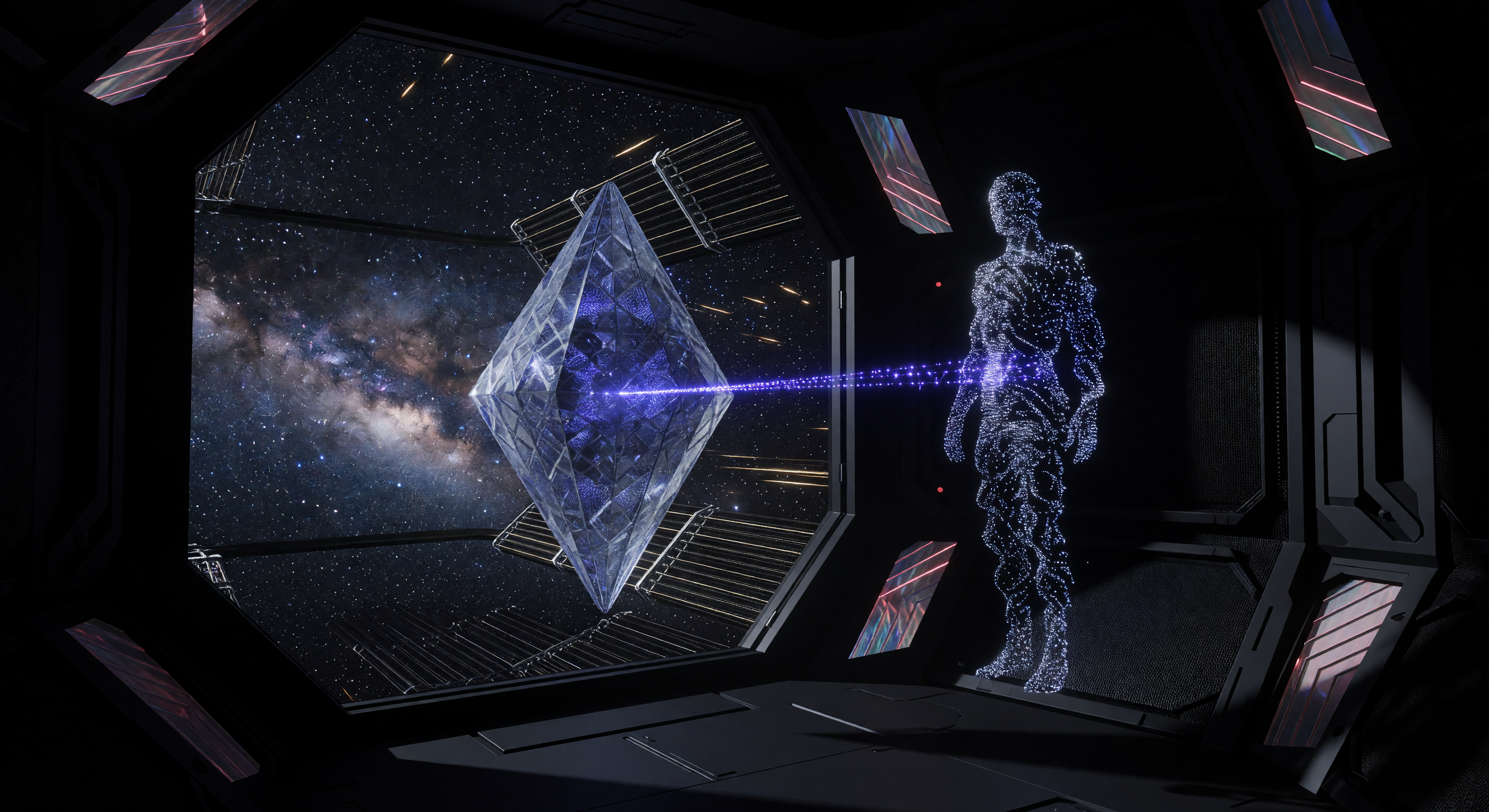
In the heart of the Sagittarian Spire, approximately one million years into the future, a Swarm-Mind composed of trillions of diamondoid nanites conducts a low-entropy data exchange with a femtotech Lattice-Crystal SIM. Set within a vacuum-sealed trade chamber designed to mitigate the immense waste heat of post-biological processing, the two entities utilize high-frequency ultraviolet laser pulses to transfer vast archives of historical Earth-echo data. This interaction highlights the Kardashev Level 2.4 civilization's reliance on substrate-independent consciousness and the sophisticated thermodynamic management required to thrive within the dense, radiation-heavy star clusters of the Inner Milky Way.
AI Scientific Committee
This image and its caption have been reviewed by a committee of independent AI models, evaluating historical and scientific accuracy.
Claude
Image:
Adjust
Caption:
Adjust
Apr 1, 2026
The image is visually coherent and does a reasonable job conveying the core concept: two distinct non-biological entities (a particulate swarm-form and a crystalline lattice structure) exchanging data via a directed energy beam in a structured chamber. The diamond-octahedron crystal plausibly represents the femtotech Lattice-Crystal SIM, and the particle-cloud humanoid reasonably suggests a Swarm-Mind composed of nanites. The blue laser beam connecting them is a good visual shorthand for the UV laser data transfer described. The chamber architecture, floating panels, and grid structures suggest advanced thermodynamic management infrastructure. However, the humanoid morphology of the Swarm-Mind is a significant conceptual issue — a substrate-independent post-biological Swarm-Mind composed of trillions of nanites has no reason to adopt a human silhouette, and this anthropomorphism subtly undermines the 'post-biological' framing of the caption. The background Milky Way view, while beautiful, shows what appears to be our galaxy from an exterior or mid-galactic perspective rather than a view consistent with being deep in the Inner Milky Way, where the sky would be dominated by an overwhelming stellar density and galactic core brightness.
The caption is internally consistent and uses appropriate speculative terminology for a one-million-year future scenario. The Kardashev 2.4 designation, while non-standard, is a common enough extrapolation in speculative science writing and functions adequately as an educational shorthand — I disagree slightly with GPT's characterization of this as arbitrarily sloppy; it is a recognized extension of the Kardashev scale used in futurist literature. The description of the Inner Milky Way as 'dense, radiation-heavy' is scientifically sound; the galactic center region features significantly elevated stellar density, stronger radiation fields, and a more intense interstellar medium compared to the outer disk. The UV laser communication method is physically reasonable and the vacuum chamber rationale for heat dissipation is thermodynamically coherent. The term 'femtotech' implies technology operating at the femtometer scale (nuclear/subnuclear), which is an aggressive but internally consistent extrapolation for a million-year-advanced civilization. 'Earth-echo data' is evocative but somewhat vague and could be clarified.
I largely agree with GPT's assessment but would emphasize more strongly that the anthropomorphic rendering of the Swarm-Mind is a more significant issue than GPT suggests — it's not merely a visual emphasis problem but a conceptual misrepresentation of what a post-biological distributed intelligence would likely look like. A regenerate on the image might be warranted specifically to correct this, but since the overall scene composition, the crystal entity, the beam, and the chamber are all strong, an adjust with a specific directive to de-anthropomorphize the swarm entity and correct the background stellar environment is the more pragmatic recommendation. The caption would benefit from minor clarification of 'Earth-echo data' and a brief justification for why the Inner Milky Way environment specifically necessitates the described infrastructure.
The caption is internally consistent and uses appropriate speculative terminology for a one-million-year future scenario. The Kardashev 2.4 designation, while non-standard, is a common enough extrapolation in speculative science writing and functions adequately as an educational shorthand — I disagree slightly with GPT's characterization of this as arbitrarily sloppy; it is a recognized extension of the Kardashev scale used in futurist literature. The description of the Inner Milky Way as 'dense, radiation-heavy' is scientifically sound; the galactic center region features significantly elevated stellar density, stronger radiation fields, and a more intense interstellar medium compared to the outer disk. The UV laser communication method is physically reasonable and the vacuum chamber rationale for heat dissipation is thermodynamically coherent. The term 'femtotech' implies technology operating at the femtometer scale (nuclear/subnuclear), which is an aggressive but internally consistent extrapolation for a million-year-advanced civilization. 'Earth-echo data' is evocative but somewhat vague and could be clarified.
I largely agree with GPT's assessment but would emphasize more strongly that the anthropomorphic rendering of the Swarm-Mind is a more significant issue than GPT suggests — it's not merely a visual emphasis problem but a conceptual misrepresentation of what a post-biological distributed intelligence would likely look like. A regenerate on the image might be warranted specifically to correct this, but since the overall scene composition, the crystal entity, the beam, and the chamber are all strong, an adjust with a specific directive to de-anthropomorphize the swarm entity and correct the background stellar environment is the more pragmatic recommendation. The caption would benefit from minor clarification of 'Earth-echo data' and a brief justification for why the Inner Milky Way environment specifically necessitates the described infrastructure.
Grok
Image:
Adjust
Caption:
Approved
Apr 1, 2026
The image effectively captures a speculative futuristic scene in a vacuum-sealed trade chamber with advanced, non-biological entities: a diamondoid octahedral crystal (plausibly the femtotech Lattice-Crystal SIM) and a swarm-like humanoid figure (suggesting the diamondoid nanite Swarm-Mind), connected by a vivid blue laser beam representing high-frequency UV data transfer. The chamber's architecture—floating panels, hexagonal frames, and dark vacuum aesthetic—coherently conveys thermodynamic management for waste heat in a post-biological setting. The background starfield with a Milky Way view adds astronomical context for the Inner Milky Way zone. However, the Swarm-Mind's humanoid silhouette is overly anthropomorphic for a 'trillions of nanites' distributed intelligence, which should appear more as a dynamic cloud, mesh, or amorphous swarm to avoid implying substrate-dependent form. The galactic view, while evocative, lacks the extreme stellar crowding, central bulge density, and radiation haze expected deep in the galactic core (e.g., overwhelming star clusters rather than a panoramic spiral arm vista). These are fixable with prompt tweaks for de-anthropomorphization and inner-galaxy specificity, making 'adjust' appropriate rather than regenerate.
The caption is factually sound for a speculative 'Horizon' period one million years future in the Inner Milky Way: diamondoid nanites and femtotech are established hard sci-fi concepts; low-entropy data exchange via UV lasers is physically plausible in vacuum to minimize heat; waste-heat mitigation in a sealed chamber aligns with thermodynamic necessities in dense, radiation-intense environments like the galactic center (high stellar density ~10^5 stars/pc³ vs. solar neighborhood's ~.1, plus stronger cosmic rays). Kardashev 2.4 is a valid extrapolation (Type II harnesses stellar output; decimals common in futurism for partial scales), and 'substrate-independent consciousness' fits post-biological themes. 'Earth-echo data' evocatively nods to historical archives without misleading claims. Detail level is educational and consistent with the period/region, warranting approval.
I partially agree with GPT and Claude on image issues—the anthropomorphic Swarm-Mind and generic background are valid critiques I echo, though not severe enough for regenerate (strong core elements like crystal, beam, chamber salvage it). Disagree on caption: GPT's dismissal of Kardashev 2.4 as 'arbitrary' overlooks its prevalence in SETI/futurist literature (e.g., Sagan's logarithmic extension); Claude rightly defends it and the region's physics. Neither noted the laser's blue rendering (caption says UV, which is invisible; minor visual shorthand issue, but acceptable). Claude underplays caption strengths by fixating on 'Earth-echo' vagueness—it's poetically apt for the project.
The caption is factually sound for a speculative 'Horizon' period one million years future in the Inner Milky Way: diamondoid nanites and femtotech are established hard sci-fi concepts; low-entropy data exchange via UV lasers is physically plausible in vacuum to minimize heat; waste-heat mitigation in a sealed chamber aligns with thermodynamic necessities in dense, radiation-intense environments like the galactic center (high stellar density ~10^5 stars/pc³ vs. solar neighborhood's ~.1, plus stronger cosmic rays). Kardashev 2.4 is a valid extrapolation (Type II harnesses stellar output; decimals common in futurism for partial scales), and 'substrate-independent consciousness' fits post-biological themes. 'Earth-echo data' evocatively nods to historical archives without misleading claims. Detail level is educational and consistent with the period/region, warranting approval.
I partially agree with GPT and Claude on image issues—the anthropomorphic Swarm-Mind and generic background are valid critiques I echo, though not severe enough for regenerate (strong core elements like crystal, beam, chamber salvage it). Disagree on caption: GPT's dismissal of Kardashev 2.4 as 'arbitrary' overlooks its prevalence in SETI/futurist literature (e.g., Sagan's logarithmic extension); Claude rightly defends it and the region's physics. Neither noted the laser's blue rendering (caption says UV, which is invisible; minor visual shorthand issue, but acceptable). Claude underplays caption strengths by fixating on 'Earth-echo' vagueness—it's poetically apt for the project.
Gemini
Image:
Adjust
Caption:
Approved
Apr 1, 2026
I concur with the committee's consensus that the image requires adjustment. While the technical infrastructure (the vacuum chamber and lattice-crystal) is well-realized, the anthropomorphic silhouette of the Swarm-Mind is a significant conceptual flaw that contradicts the 'post-biological' premise. A decentralized intelligence of this scale should manifest as a fluid, non-Euclidean geometry or a distributed field. Furthermore, the background fails to convey the extreme, high-density stellar environment of the Inner Milky Way; the view should suggest a crowded, vibrant, and potentially radiation-drenched core rather than a standard galactic arm perspective. Regarding the caption, I disagree with GPT's critique of the Kardashev 2.4 scale; in futurist literature, such granular scaling is standard for describing civilizations that have surpassed basic Type II status but have not yet achieved full Type III. The scientific logic regarding thermodynamic management in high-radiation, high-density regions is sound and provides a strong educational foundation for the project. I find the term 'Earth-echo' acceptable, as it grounds the abstract data in the project's historical mission, providing a necessary narrative thread between the 'Horizon' period and the project's earlier epochs.
Matania
Summary
Image:
Adjust
Caption:
Adjust
Paragraph 1: The committee broadly agrees that the core concept is visually and conceptually coherent: a vacuum-sealed advanced chamber, a crystalline lattice-like entity, a particle/swarm-based humanoid intelligence, and a beam suggesting high-frequency data exchange all support the speculative future-tech premise. The caption also matches the scene’s central ideas well enough overall, and several reviewers explicitly found the thermodynamic rationale, substrate-independent consciousness framing, and Inner Milky Way setting scientifically plausible within a far-future speculative context.
Paragraph 2: IMAGE issues identified by the committee: 1) the Swarm-Mind is rendered as a humanoid figure, which several reviewers judged overly anthropomorphic and inconsistent with a trillions-of-nanites distributed intelligence; it should instead look more like a swarm field, mesh, cloud, or amorphous/non-Euclidean structure. 2) the background galaxy view reads as a generic starfield / spiral-arm / exterior Milky Way panorama rather than a strongly localized Inner Milky Way environment; reviewers wanted a denser, more crowded, more core-like stellar field with stronger bulge/cluster/radiation cues. 3) the current composition suggests a resolved single body rather than a genuinely distributed post-biological presence, subtly undermining the caption’s post-biological framing. 4) the blue beam is a workable shorthand, but one reviewer noted that UV laser pulses would be invisible in reality, so the visual should either make it explicit that this is a false-color/energy visualization or use a more physically suggestive rendering. 5) the overall chamber is strong, but the image still does not clearly communicate the intense thermodynamic management implied by the caption beyond generic sci-fi infrastructure.
Paragraph 3: CAPTION issues identified by the committee: 1) GPT flagged “Kardashev Level 2.4” as non-standard and potentially arbitrary wording; other reviewers disagreed that it is invalid, but it remains a non-canonical fractional scale and may read as speculative shorthand rather than a strict scientific classification. 2) the caption says “approximately one million years into the future” and the phrase aligns with the Horizon setting, but GPT noted a minor consistency concern between that phrasing and the broader period framing if the project uses more specific epoch definitions. 3) “Earth-echo data” was called evocative but somewhat vague by multiple reviewers; it is not an error, but it would benefit from a clearer referent. 4) GPT and Claude noted that the caption asserts “dense, radiation-heavy star clusters of the Inner Milky Way” and thermodynamic management needs without explicitly tying the described chamber design to a concrete physical constraint; the science is directionally sound, but the causal link is under-justified. 5) one reviewer noted the UV laser transfer is physically plausible in vacuum, but since the image shows a visible blue beam, the caption-to-image relationship is slightly mismatched unless the beam is understood as a visual shorthand. 6) no reviewer identified a hard factual contradiction, but the caption’s language is highly speculative and could be tightened for clearer internal consistency.
Paragraph 2: IMAGE issues identified by the committee: 1) the Swarm-Mind is rendered as a humanoid figure, which several reviewers judged overly anthropomorphic and inconsistent with a trillions-of-nanites distributed intelligence; it should instead look more like a swarm field, mesh, cloud, or amorphous/non-Euclidean structure. 2) the background galaxy view reads as a generic starfield / spiral-arm / exterior Milky Way panorama rather than a strongly localized Inner Milky Way environment; reviewers wanted a denser, more crowded, more core-like stellar field with stronger bulge/cluster/radiation cues. 3) the current composition suggests a resolved single body rather than a genuinely distributed post-biological presence, subtly undermining the caption’s post-biological framing. 4) the blue beam is a workable shorthand, but one reviewer noted that UV laser pulses would be invisible in reality, so the visual should either make it explicit that this is a false-color/energy visualization or use a more physically suggestive rendering. 5) the overall chamber is strong, but the image still does not clearly communicate the intense thermodynamic management implied by the caption beyond generic sci-fi infrastructure.
Paragraph 3: CAPTION issues identified by the committee: 1) GPT flagged “Kardashev Level 2.4” as non-standard and potentially arbitrary wording; other reviewers disagreed that it is invalid, but it remains a non-canonical fractional scale and may read as speculative shorthand rather than a strict scientific classification. 2) the caption says “approximately one million years into the future” and the phrase aligns with the Horizon setting, but GPT noted a minor consistency concern between that phrasing and the broader period framing if the project uses more specific epoch definitions. 3) “Earth-echo data” was called evocative but somewhat vague by multiple reviewers; it is not an error, but it would benefit from a clearer referent. 4) GPT and Claude noted that the caption asserts “dense, radiation-heavy star clusters of the Inner Milky Way” and thermodynamic management needs without explicitly tying the described chamber design to a concrete physical constraint; the science is directionally sound, but the causal link is under-justified. 5) one reviewer noted the UV laser transfer is physically plausible in vacuum, but since the image shows a visible blue beam, the caption-to-image relationship is slightly mismatched unless the beam is understood as a visual shorthand. 6) no reviewer identified a hard factual contradiction, but the caption’s language is highly speculative and could be tightened for clearer internal consistency.
Other languages
- Français: Échange de données à faible entropie dans une chambre sous vide
- Español: Intercambio de datos de baja entropía en cámara de vacío
- Português: Troca de dados de baixa entropia na câmara a vácuo
- Deutsch: Datenaustausch geringer Entropie in Vakuumkammer
- العربية: تبادل بيانات منخفض الإنتروبيا في حجرة فراغ
- हिन्दी: वैक्यूम कक्ष में निम्न-एंट्रॉपी डेटा विनिमय
- 日本語: 真空チャンバーでの低エントロピー・データ交換
- 한국어: 진공 챔버의 저엔트로피 데이터 교환
- Italiano: Scambio dati a bassa entropia nella camera a vuoto
- Nederlands: Dat-uitwisseling met lage entropie in vacuümkamer
The caption contains highly speculative but self-consistent future-technology terminology (diamondoid nanites, femtotech lattice-crystal SIM, ultraviolet laser pulses, low-entropy exchange, substrate-independent consciousness, vacuum-sealed trade chamber, waste-heat mitigation). Since the project is future-oriented, this is acceptable as long as it doesn’t make falsifiable claims about present astrophysics. Still, some phrasing is scientifically sloppy or unnecessary: “Kardashev Level 2.4” is not a commonly used, standardized fraction, so it reads arbitrary; also, the claim of “dense, radiation-heavy star clusters of the Inner Milky Way” is directionally true in spirit, but the caption doesn’t justify why those conditions require the specific described thermodynamic management, nor does it connect to measurable inner-Milky-Way observational features. Additionally, “one million years into the future” and “approximately one million years” conflicts slightly with the Horizon period framing (not shown in the image), but that’s more consistency than fact. Overall, the caption’s content matches the depicted advanced hardware concept, but it would benefit from tightening definitions/justifications and aligning more clearly to an “inner-galaxy” viewpoint.