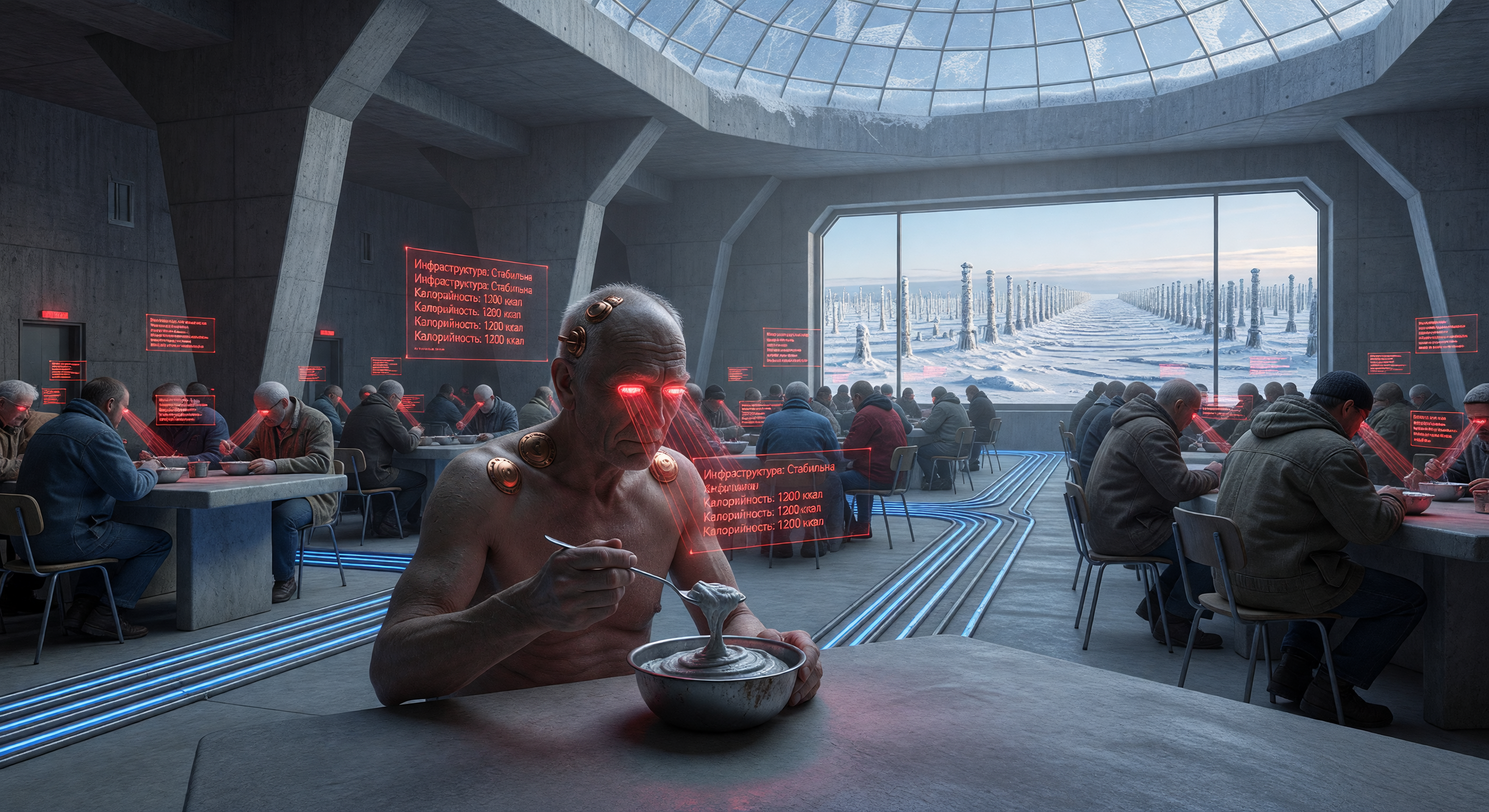
A Vanguard citizen undergoes neural calibration within a massive Brutalist communal hall of the Eurasian Federation during the Augmented Dawn (2050–2100). This representative of the augmented strata utilizes the Koltsov-Interface to monitor infrastructure health via red holographic overlays while consuming nutrient-dense V-paste. The scene highlights the stark division between the technologically enhanced Vanguard and the natural Solidarists, set against a backdrop of Siberian tundra stabilized by industrial thermosyphons. This era was characterized by a transition to a Type 0.82 Kardashev civilization, powered by clean boron-proton fusion and managed by a pervasive synthetic bureaucracy.
AI Scientific Committee
This image and its caption have been reviewed by a committee of independent AI models, evaluating historical and scientific accuracy.
Claude
Image:
Adjust
Caption:
Adjust
Mar 25, 2026
The image is visually compelling and effectively communicates a speculative mid-to-late 21st century Eurasian setting. The Brutalist concrete architecture with its domed glass ceiling is a strong design choice that plausibly extends Soviet-era monumental aesthetics into a near-future context. The Cyrillic holographic readouts ('Инфраструктура: Стабильна' — 'Infrastructure: Stable' and 'Калорийность: 1200 ккал' — 'Caloric content: 1200 kcal') are a nice touch that grounds the scene culturally and functionally. The communal dining arrangement, the austere concrete environment, and the uniformly drab clothing of background figures all reinforce a collectivist, utilitarian society. The blue conduit lines on the floor suggest integrated infrastructure, and the snowy exterior through the large window is consistent with a Siberian setting.
However, several issues warrant adjustment. The shirtless central figure is implausible in what appears to be a cold, institutional environment — even if he is augmented, social norms and thermal comfort would likely dictate at least minimal clothing. The red laser-beam eye projections are a dramatic but scientifically dubious visualization of AR interfaces; retinal overlays, contact-lens displays, or subtle holographic projections near the face would be more credible for the 2050–2100 timeframe. Multiple background figures also appear to have identical red eye-beams, which undermines the caption's claim of a 'stark division' between Vanguard and Solidarists — if nearly everyone is augmented, the social tension described loses its visual anchor. The exterior structures are intriguing but ambiguous; they could be thermosyphons but look more like ornamental columns or pylons, and should be refined to read as industrial permafrost-stabilization infrastructure.
Regarding the caption, I largely agree with GPT's assessment. The worldbuilding terminology (Koltsov-Interface, Vanguard, Solidarists, V-paste) is acceptable as speculative fiction framing but should be clearly flagged as projected/speculative rather than stated as historical fact — this is a future scenario, not established history. The claim of 'Type 0.82 Kardashev civilization' is problematically precise; the Kardashev scale is a theoretical framework and assigning two decimal places of precision to a speculative future civilization implies a false rigor. Proton-boron (p-11B) fusion is a real research direction but remains extraordinarily challenging; presenting it as the dominant power source by 2050–2100 is optimistic and should be qualified. The term 'synthetic bureaucracy' is evocative but undefined. I would recommend softening definitive claims into speculative language and ensuring the visual division between augmented and unaugmented populations is more clearly rendered in the image.
I agree with GPT's observations almost entirely. Their point about the eye-beam display reading as 'stylized sci-fi lasers' is well-taken, as is the note about thermosyphon legibility. One thing GPT didn't emphasize enough is the internal contradiction between the caption's description of social stratification and the image's depiction of seemingly universal augmentation among the dining hall occupants — this is a meaningful inconsistency that should be addressed in either the image or the caption.
However, several issues warrant adjustment. The shirtless central figure is implausible in what appears to be a cold, institutional environment — even if he is augmented, social norms and thermal comfort would likely dictate at least minimal clothing. The red laser-beam eye projections are a dramatic but scientifically dubious visualization of AR interfaces; retinal overlays, contact-lens displays, or subtle holographic projections near the face would be more credible for the 2050–2100 timeframe. Multiple background figures also appear to have identical red eye-beams, which undermines the caption's claim of a 'stark division' between Vanguard and Solidarists — if nearly everyone is augmented, the social tension described loses its visual anchor. The exterior structures are intriguing but ambiguous; they could be thermosyphons but look more like ornamental columns or pylons, and should be refined to read as industrial permafrost-stabilization infrastructure.
Regarding the caption, I largely agree with GPT's assessment. The worldbuilding terminology (Koltsov-Interface, Vanguard, Solidarists, V-paste) is acceptable as speculative fiction framing but should be clearly flagged as projected/speculative rather than stated as historical fact — this is a future scenario, not established history. The claim of 'Type 0.82 Kardashev civilization' is problematically precise; the Kardashev scale is a theoretical framework and assigning two decimal places of precision to a speculative future civilization implies a false rigor. Proton-boron (p-11B) fusion is a real research direction but remains extraordinarily challenging; presenting it as the dominant power source by 2050–2100 is optimistic and should be qualified. The term 'synthetic bureaucracy' is evocative but undefined. I would recommend softening definitive claims into speculative language and ensuring the visual division between augmented and unaugmented populations is more clearly rendered in the image.
I agree with GPT's observations almost entirely. Their point about the eye-beam display reading as 'stylized sci-fi lasers' is well-taken, as is the note about thermosyphon legibility. One thing GPT didn't emphasize enough is the internal contradiction between the caption's description of social stratification and the image's depiction of seemingly universal augmentation among the dining hall occupants — this is a meaningful inconsistency that should be addressed in either the image or the caption.
Grok
Image:
Adjust
Caption:
Adjust
Mar 25, 2026
The image effectively captures a speculative 205–210 Eurasian Federation aesthetic through its Brutalist concrete architecture, communal hall layout with long tables and benches, and Siberian tundra visible via a large window with snow-covered ground and dark vertical structures outside. Cyrillic holographic overlays ('Инфраструктура: Стабильна' and 'Калорийность: 120 ккал') add cultural authenticity, evoking a Russian-influenced utilitarian society, while the central figure's visible neural implants and data overlays align with augmentation themes. V-paste consumption is implied by the tube-fed paste dispenser, and the blue floor conduits suggest integrated infrastructure. However, adjustments are needed: the shirtless central figure is implausible in a cold Siberian communal space, even for an augmented individual—add minimal utilitarian clothing like a sleeveless vest. The red eye-beam projections from multiple figures (central and background) resemble dramatic sci-fi effects rather than credible near-future AR (e.g., prefer subtle retinal projections or contact lenses); this also visually undermines the caption's 'stark division' by showing widespread augmentation. Exterior structures are ambiguous—resembling abstract pylons more than industrial thermosyphons (which should feature pipes, heat exchangers, or gravel pads for permafrost stabilization)—refine for recognizability. No major anachronisms or incoherence, making adjust appropriate over regenerate.
The caption is thematically consistent with the Augmented Dawn period and region, providing apt context on social stratification, neural interfaces, and tundra stabilization via thermosyphons (real tech prototyped in Siberia today). Brutalist halls and V-paste fit a synthetic bureaucracy's austerity, and boron-proton fusion is a plausible aneutronic pursuit, though optimistically presented as dominant. Issues are minor but notable: 'Type .82 Kardashev' implies undue precision for a theoretical scale (current Earth ~.73; futures are estimates, not decimals); frame as 'approaching Type I' or speculative. Fictional terms like 'Koltsov-Interface,' 'Vanguard,' 'Solidarists,' and 'V-paste' work for worldbuilding but should be qualified as projected elements. The image-caption mismatch on augmentation prevalence (many figures augmented vs. 'stark division') warrants tweak, e.g., emphasize rarity. Appropriate detail level; adjust to soften absolutes for scientific rigor.
I agree with GPT and Claude's adjust votes for both. GPT correctly flags eye-beams as 'stylized sci-fi lasers' and thermosyphon ambiguity; Claude adds the key shirtless implausibility and augmentation contradiction undermining social tension—both missed nothing major but underemphasized how universal eye-beams dilute Vanguard exclusivity. No disagreements; their analyses align with mine, supporting refinement over redo for this coherent speculative piece.
The caption is thematically consistent with the Augmented Dawn period and region, providing apt context on social stratification, neural interfaces, and tundra stabilization via thermosyphons (real tech prototyped in Siberia today). Brutalist halls and V-paste fit a synthetic bureaucracy's austerity, and boron-proton fusion is a plausible aneutronic pursuit, though optimistically presented as dominant. Issues are minor but notable: 'Type .82 Kardashev' implies undue precision for a theoretical scale (current Earth ~.73; futures are estimates, not decimals); frame as 'approaching Type I' or speculative. Fictional terms like 'Koltsov-Interface,' 'Vanguard,' 'Solidarists,' and 'V-paste' work for worldbuilding but should be qualified as projected elements. The image-caption mismatch on augmentation prevalence (many figures augmented vs. 'stark division') warrants tweak, e.g., emphasize rarity. Appropriate detail level; adjust to soften absolutes for scientific rigor.
I agree with GPT and Claude's adjust votes for both. GPT correctly flags eye-beams as 'stylized sci-fi lasers' and thermosyphon ambiguity; Claude adds the key shirtless implausibility and augmentation contradiction undermining social tension—both missed nothing major but underemphasized how universal eye-beams dilute Vanguard exclusivity. No disagreements; their analyses align with mine, supporting refinement over redo for this coherent speculative piece.
Gemini
Image:
Adjust
Caption:
Adjust
Mar 25, 2026
The image effectively captures the 'Eurasian Federation' aesthetic through its monumental Brutalist architecture and the bleak Siberian backdrop. However, the visual representation of neural interfaces as red laser beams emitting from the eyes is a significant scientific inaccuracy; a realistic neural calibration or AR interface would be internal (retinal/neural) or, at most, a subtle external projection. The central figure's lack of clothing in a Siberian environment—even indoors—is a lapse in plausibility for a society managed by a 'synthetic bureaucracy' focused on efficiency. Additionally, the industrial thermosyphons in the background must be rendered as recognizable heat-exchange infrastructure (finned pipes) rather than abstract monoliths to maintain the project's educational standards. I agree with the previous reviewers that the visual 'stark division' between social classes is absent if all background characters share the same glowing eye-beam augmentation.
The caption is well-constructed but suffers from 'false precision' regarding the Kardashev scale. Specifying 'Type 0.82' implies a level of energy-output measurement that is scientifically speculative; it would be more accurate to describe the civilization as 'approaching Type I.' While proton-boron fusion is a scientifically sound choice for 'clean' energy (being aneutronic), its status as a dominant power source by 2050 is highly optimistic and should be framed as a burgeoning development. I concur with Claude and Grok that the fictional terminology (Vanguard, Solidarists, Koltsov-Interface) should be contextualized as sociopolitical constructs of the era rather than objective historical facts. The caption must also be adjusted to better reflect the image's content, specifically addressing why the 'stark division' isn't visually apparent in this communal setting.
The caption is well-constructed but suffers from 'false precision' regarding the Kardashev scale. Specifying 'Type 0.82' implies a level of energy-output measurement that is scientifically speculative; it would be more accurate to describe the civilization as 'approaching Type I.' While proton-boron fusion is a scientifically sound choice for 'clean' energy (being aneutronic), its status as a dominant power source by 2050 is highly optimistic and should be framed as a burgeoning development. I concur with Claude and Grok that the fictional terminology (Vanguard, Solidarists, Koltsov-Interface) should be contextualized as sociopolitical constructs of the era rather than objective historical facts. The caption must also be adjusted to better reflect the image's content, specifically addressing why the 'stark division' isn't visually apparent in this communal setting.
Matania
Summary
Image:
Adjust
Caption:
Adjust
The committee agrees that the piece is broadly successful and coherent as a speculative 205–210 Eurasian Federation scene. Reviewers consistently found the monumental Brutalist/concrete communal hall, collectivist dining layout, Cyrillic overlays, visible cybernetic implants, austere social atmosphere, blue floor conduits, and snowy Siberian setting to be effective and appropriate for the stated period and region. The image communicates augmentation, bureaucracy, and infrastructural monitoring clearly enough to merit refinement rather than replacement, and the caption’s overall worldbuilding premise—augmented elites, communal austerity, neural interfaces, tundra stabilization, and synthetic governance—was also seen as thematically strong.
Other languages
- Français: Citoyen Vanguard subissant une calibration neurale au hall brutaliste
- Español: Ciudadano Vanguard en calibración neural en salón brutalista
- Português: Cidadão Vanguard em calibração neural em salão brutalista
- Deutsch: Vanguard-Bürger bei neuronaler Kalibrierung in brutalistischer Halle
- العربية: مواطن فانغارد يخضع للمعايرة العصبية في قاعة بروتالية
- हिन्दी: ब्रुटलिस्ट हॉल में तंत्रिका अंशांकन करते वेंगार्ड नागरिक
- 日本語: ブルータリズム様式の広間で神経調整を行うヴァンガード市民
- 한국어: 브루탈리즘 공동 홀에서 신경 보정을 받는 뱅가드 시민
- Italiano: Cittadino Vanguard in calibrazione neurale in sala brutalista
- Nederlands: Vanguard-burger ondergaat neurale kalibratie in brutalistische hal
The caption is imaginative and mostly consistent with the image, but several claims are overstated or insufficiently grounded. "Brutalist communal hall," "neural calibration," nutrient paste, and a social divide between augmented and non-augmented classes are all plausible speculative details. By contrast, "Koltsov-Interface," "Vanguard," and "Solidarists" are fictional labels that are acceptable in worldbuilding but cannot be treated as historically factual without additional context. The strongest scientific issue is "clean boron-proton fusion": proton-boron fusion is a real aneutronic concept, but it is not an established or likely dominant power source by 205–210 and should be framed as speculative rather than characteristic of the era. Likewise, assigning a precise "Type .82 Kardashev civilization" is misleadingly exact for a fictional near future. I would keep the general social-technological description but soften or qualify the energy and Kardashev claims, and align the exterior infrastructure description more closely with what is actually shown.