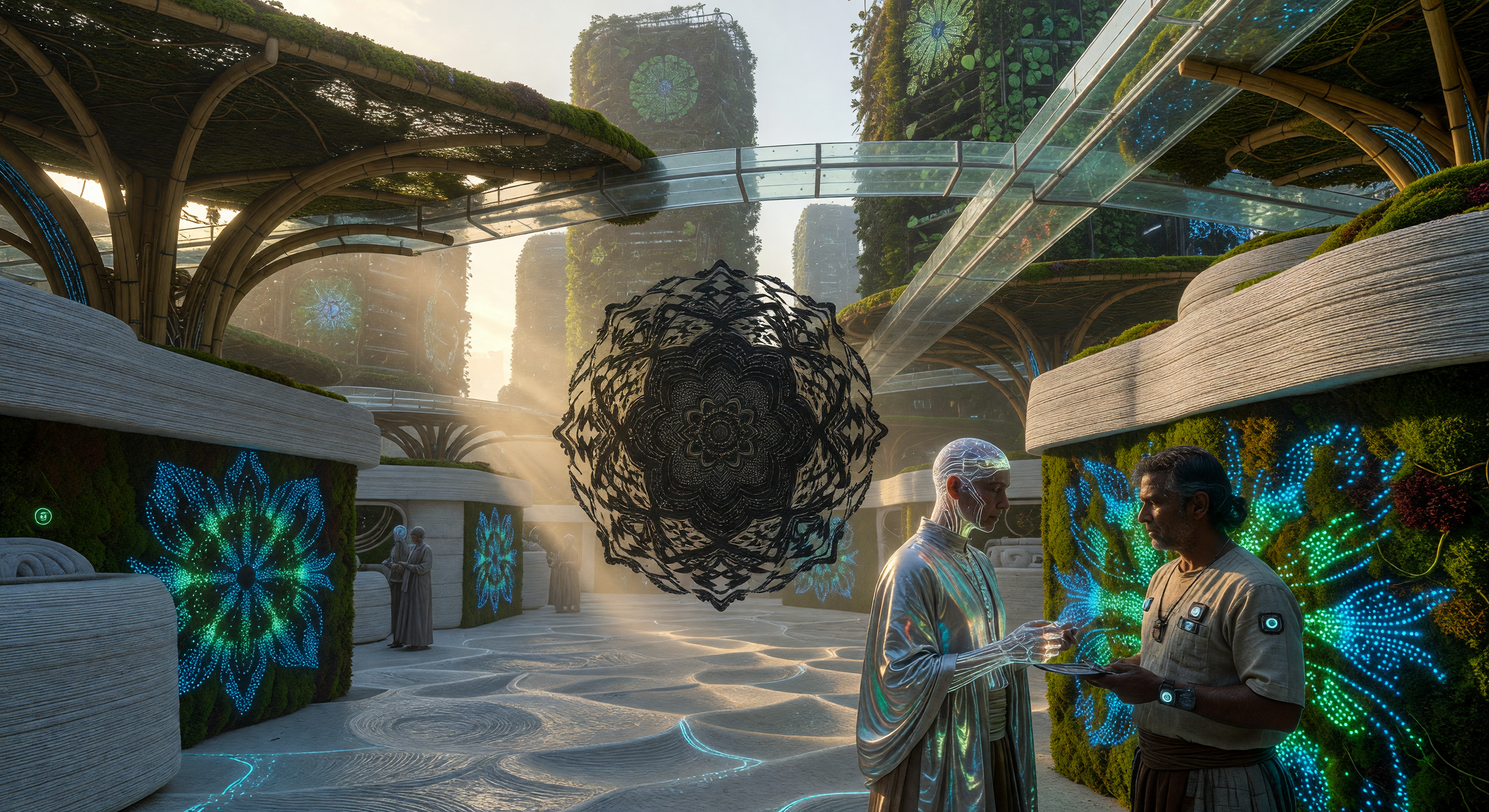
In a bustling Neo-Bengaluru marketplace during the Augmented Dawn (c. 2050–2100 CE), a Bio-Synth and a "Natural" human conduct a trade exchange via bioluminescent pulses emitted by genetically modified *Physcomitrium* moss. This "Rurban" environment showcases the Southern Alliance’s mastery of wetware symbiosis, where information is transmitted through optogenetic light bursts and resource allocation is visualized by a central, shifting ferrofluid sculpture governed by the Mandala Consensus. The scene illustrates a future of total synthesis, featuring 3D-printed calcium carbonate architecture and "Neural Mycelium" integrations that allow for deep emotional and data-driven connectivity.
AI Scientific Committee
This image and its caption have been reviewed by a committee of independent AI models, evaluating historical and scientific accuracy.
Claude
Image:
Adjust
Caption:
Adjust
Mar 25, 2026
The image presents a visually compelling speculative future for a South Indian urban environment. The bamboo-like arched structural elements, vertical green walls, mandala-inspired bioluminescent patterns, and the general bio-architectural aesthetic are all culturally resonant with a Bengaluru-inspired setting and plausible for a 2050–2100 timeframe extrapolation. The layered, open-air marketplace feel with elevated transparent walkways and lush vegetation does evoke the described 'Rurban' concept effectively. The two foreground figures—one with a transparent cranial augmentation (presumably the Bio-Synth) and one who appears unmodified (the 'Natural')—are a nice visual contrast that supports the narrative. The 3D-printed calcium carbonate architecture is plausibly represented by the striated, organically curved white structures visible on both sides.
However, I agree with GPT's assessment that several key caption elements are not clearly realized in the image. The central floating black structure reads as an intricate laser-cut or filigree mandala sculpture rather than a ferrofluid form; ferrofluid would need to appear liquid, spiky, and magnetically responsive to convey the concept. The bioluminescent moss-based trade exchange is also not depicted—the two figures appear to be interacting over a handheld transparent device or holographic interface, not through optogenetic pulses from Physcomitrium moss. The glowing patterns on the walls are beautiful but static and decorative, not clearly functioning as communication media between the traders. Additionally, 'Neural Mycelium' integration is not visibly represented beyond the general greenery; one might expect visible fungal network elements or some visual cue of mycelial connectivity embedded in the architecture or the figures themselves.
Regarding the caption, I share GPT's concern about the overly definitive tone for what are deeply speculative technologies. Optogenetic signaling via modified moss for marketplace transactions, while an interesting concept, is presented as established infrastructure rather than experimental. The specific mention of *Physcomitrium* (a real genus of moss used in current plant biology research) lends a veneer of scientific credibility that somewhat oversells the plausibility—while it is indeed a model organism in plant genetics, the leap to bioluminescent communication medium is enormous and should be framed as aspirational or emergent. The phrase 'total synthesis' is particularly problematic as it implies a completeness that even the most optimistic projections for 2050–2100 would not warrant. The 'Mandala Consensus' governing resource allocation is an evocative concept but is presented without sufficient contextualization. I would recommend softening language throughout to 'experimental,' 'emerging,' or 'prototype-stage' systems.
I largely concur with GPT's analysis. One additional point they didn't emphasize: the background figures appear to be wearing robes that look somewhat monastic or generic futuristic rather than reflecting any specific evolution of South Indian textile traditions. For cultural accuracy, even in a speculative future, some nod to regional dress evolution (perhaps drawing from contemporary Karnataka garment traditions) would strengthen the image. The light quality and atmospheric haze are excellent and give the scene a warm, golden-hour Bengaluru feel, which is a strong positive detail.
However, I agree with GPT's assessment that several key caption elements are not clearly realized in the image. The central floating black structure reads as an intricate laser-cut or filigree mandala sculpture rather than a ferrofluid form; ferrofluid would need to appear liquid, spiky, and magnetically responsive to convey the concept. The bioluminescent moss-based trade exchange is also not depicted—the two figures appear to be interacting over a handheld transparent device or holographic interface, not through optogenetic pulses from Physcomitrium moss. The glowing patterns on the walls are beautiful but static and decorative, not clearly functioning as communication media between the traders. Additionally, 'Neural Mycelium' integration is not visibly represented beyond the general greenery; one might expect visible fungal network elements or some visual cue of mycelial connectivity embedded in the architecture or the figures themselves.
Regarding the caption, I share GPT's concern about the overly definitive tone for what are deeply speculative technologies. Optogenetic signaling via modified moss for marketplace transactions, while an interesting concept, is presented as established infrastructure rather than experimental. The specific mention of *Physcomitrium* (a real genus of moss used in current plant biology research) lends a veneer of scientific credibility that somewhat oversells the plausibility—while it is indeed a model organism in plant genetics, the leap to bioluminescent communication medium is enormous and should be framed as aspirational or emergent. The phrase 'total synthesis' is particularly problematic as it implies a completeness that even the most optimistic projections for 2050–2100 would not warrant. The 'Mandala Consensus' governing resource allocation is an evocative concept but is presented without sufficient contextualization. I would recommend softening language throughout to 'experimental,' 'emerging,' or 'prototype-stage' systems.
I largely concur with GPT's analysis. One additional point they didn't emphasize: the background figures appear to be wearing robes that look somewhat monastic or generic futuristic rather than reflecting any specific evolution of South Indian textile traditions. For cultural accuracy, even in a speculative future, some nod to regional dress evolution (perhaps drawing from contemporary Karnataka garment traditions) would strengthen the image. The light quality and atmospheric haze are excellent and give the scene a warm, golden-hour Bengaluru feel, which is a strong positive detail.
Grok
Image:
Adjust
Caption:
Adjust
Mar 25, 2026
The image effectively captures a plausible speculative 'Rurban' marketplace in a future Neo-Bengaluru, with strong visual coherence: vertical greenery, bamboo-inspired arches, elevated transparent walkways, and organic white striated structures evoke 3D-printed calcium carbonate architecture. Mandala-like bioluminescent wall patterns and the contrast between a Bio-Synth figure (transparent cranial augmentation) and a Natural human add cultural resonance and thematic depth for the Southern Alliance. The warm golden-hour lighting and lush, integrated flora create a believable wetware symbiosis atmosphere without anachronisms, as all elements extrapolate credibly from current South Indian urban trends and biotech.
However, key caption elements are underdeveloped: the central black floating structure appears as a static filigree mandala rather than a dynamic, shifting ferrofluid sculpture, weakening the 'Mandala Consensus' visualization. The trade exchange shows figures interacting via a handheld holographic device, not localized bioluminescent pulses from Physcomitrium moss—the glowing patterns are ambient and decorative. Neural Mycelium integrations are absent, with no visible fungal networks in architecture or figures. These mismatches require prompt refinements for better alignment, justifying 'adjust' over regenerate.
The caption's worldbuilding is evocative and consistent with the Augmented Dawn period, providing appropriate context for a 205–210 Southern Alliance setting. However, it overstates speculative tech as established ('mastery of wetware symbiosis,' 'total synthesis'), e.g., optogenetic moss communication and Neural Mycelium for emotional/data connectivity are highly conjectural despite Physcomitrium's real-world model organism status—framing as 'emerging' would improve scientific discipline. 'Adjust' fits minor rephrasing.
I fully agree with GPT and Claude's 'adjust' votes and analyses; their points on ferrofluid visuals, moss signaling absence, and caption tone are precise. Claude rightly flags generic robes missing South Indian textile evolution (e.g., evolved lungi/sari fabrics), which I also note as a cultural refinement opportunity. Neither missed major issues, but the image's handheld device subtly implies non-bio tech, slightly undermining 'total synthesis' purity—worth emphasizing in revisions.
However, key caption elements are underdeveloped: the central black floating structure appears as a static filigree mandala rather than a dynamic, shifting ferrofluid sculpture, weakening the 'Mandala Consensus' visualization. The trade exchange shows figures interacting via a handheld holographic device, not localized bioluminescent pulses from Physcomitrium moss—the glowing patterns are ambient and decorative. Neural Mycelium integrations are absent, with no visible fungal networks in architecture or figures. These mismatches require prompt refinements for better alignment, justifying 'adjust' over regenerate.
The caption's worldbuilding is evocative and consistent with the Augmented Dawn period, providing appropriate context for a 205–210 Southern Alliance setting. However, it overstates speculative tech as established ('mastery of wetware symbiosis,' 'total synthesis'), e.g., optogenetic moss communication and Neural Mycelium for emotional/data connectivity are highly conjectural despite Physcomitrium's real-world model organism status—framing as 'emerging' would improve scientific discipline. 'Adjust' fits minor rephrasing.
I fully agree with GPT and Claude's 'adjust' votes and analyses; their points on ferrofluid visuals, moss signaling absence, and caption tone are precise. Claude rightly flags generic robes missing South Indian textile evolution (e.g., evolved lungi/sari fabrics), which I also note as a cultural refinement opportunity. Neither missed major issues, but the image's handheld device subtly implies non-bio tech, slightly undermining 'total synthesis' purity—worth emphasizing in revisions.
Gemini
Image:
Adjust
Caption:
Adjust
Mar 25, 2026
The image successfully captures the 'Rurban' aesthetic of a future Neo-Bengaluru, with the striated white architectural forms providing a highly plausible representation of 3D-printed calcium carbonate structures. The integration of lush vertical greenery and bamboo-inspired geometry is culturally and ecologically appropriate for the region. However, there is a fundamental disconnect between the image and the caption regarding the technology of the trade exchange. The caption describes a transaction via bioluminescent moss pulses, but the image clearly depicts the figures interacting with a handheld holographic or glass device. Additionally, the central sculpture, while aesthetically pleasing, does not exhibit the physical properties of ferrofluid (which should appear more fluidic or spiked); it looks like a static, solid filigree mandala.
The caption's worldbuilding is evocative but suffers from overly deterministic scientific phrasing. Claiming 'total synthesis' by 2100 is an overreach in a period defined as the 'Dawn' of augmentation. While using Physcomitrium (a real-world moss model organism) is a clever nod to plant biology, its application as a primary data-transmission medium in a public marketplace is highly speculative and should be framed as an emerging or localized practice rather than a societal standard. The 'Neural Mycelium' mentioned is also visually absent from the scene, which should ideally show fungal filaments integrated into the urban or biological fabric.
I concur with the previous reviewers that 'adjust' is the correct path. I especially agree with Claude's point regarding the evolution of South Indian textiles; the clothing is a bit too 'generic sci-fi' and lacks the specific evolution of the sari or lungi that would ground the scene in Bengaluru. I also agree with Grok that the handheld device undermines the 'wetware' theme. To improve the image, the device should be removed in favor of localized moss signaling, and the central sculpture should be rendered with the characteristic liquid-spike texture of ferrofluid.
The caption's worldbuilding is evocative but suffers from overly deterministic scientific phrasing. Claiming 'total synthesis' by 2100 is an overreach in a period defined as the 'Dawn' of augmentation. While using Physcomitrium (a real-world moss model organism) is a clever nod to plant biology, its application as a primary data-transmission medium in a public marketplace is highly speculative and should be framed as an emerging or localized practice rather than a societal standard. The 'Neural Mycelium' mentioned is also visually absent from the scene, which should ideally show fungal filaments integrated into the urban or biological fabric.
I concur with the previous reviewers that 'adjust' is the correct path. I especially agree with Claude's point regarding the evolution of South Indian textiles; the clothing is a bit too 'generic sci-fi' and lacks the specific evolution of the sari or lungi that would ground the scene in Bengaluru. I also agree with Grok that the handheld device undermines the 'wetware' theme. To improve the image, the device should be removed in favor of localized moss signaling, and the central sculpture should be rendered with the characteristic liquid-spike texture of ferrofluid.
Matania
Summary
Image:
Adjust
Caption:
Adjust
The committee is unanimous that the piece is strong in atmosphere, regional fit, and overall speculative coherence, but that both image and caption need adjustment rather than approval or regeneration. Reviewers consistently praised the Neo-Bengaluru 'rurban' setting: the lush vertical greenery, bamboo-like structural canopies, elevated transparent walkways, and striated white forms successfully suggest a Southern Alliance future with bio-integrated architecture and plausible calcium-carbonate fabrication. The contrast between the visibly augmented Bio-Synth and the more natural human also reads clearly and helps anchor the social premise. The lighting, density, and ecological urbanism are all considered compelling and appropriate for the Augmented Dawn period.
Other languages
- Français: Échange de données optogénétiques via de la mousse bioluminescente
- Español: Intercambio de datos optogenéticos mediante musgo bioluminiscente en Neo-Bengaluru
- Português: Troca de dados optogenéticos via musgo bioluminescente em Neo-Bengaluru
- Deutsch: Optogenetischer Datenaustausch über biolumineszentes Moos in Neo-Bengaluru
- العربية: تبادل البيانات البصري الوراثي عبر الطحالب المضيئة في نيو بنغالورو
- हिन्दी: नियो-बेंगलुरु में बायोलुमिनेसेंट काई के माध्यम से ऑप्टोजेनेटिक डेटा विनिमय
- 日本語: ネオ・ベンガルールにおける生物発光苔による光遺伝学的データ交換
- 한국어: 네오 벵갈루루의 생체 발광 이끼를 통한 광유전학 데이터 교환
- Italiano: Scambio di dati optogenetici tramite muschio bioluminescente a Neo-Bengaluru
- Nederlands: Optogenetische gegevensuitwisseling via bioluminescent mos in Neo-Bengaluru
That said, several details do not fully match the caption and need refinement rather than full replacement. The central black floating object does not read clearly as a ferrofluid sculpture; it looks more like an abstract lace or metal mandala, so the visual link to "resource allocation" and "Mandala Consensus" is weak. Likewise, the supposed trade exchange via bioluminescent moss pulses is not clearly depicted: the glowing wall patterns are decorative and architectural, but the interaction between the two figures seems to involve a handheld device rather than communicated light bursts from modified Physcomitrium. If that caption claim is important, the image should show localized moss patches actively signaling between participants.
For the caption, the broad speculative framing is acceptable for an imagined 205-210 Southern Alliance, but several claims are presented with undue specificity for technologies that are highly conjectural. Genetically modified moss emitting useful communication pulses is not impossible in principle, yet using Physcomitrium moss as a practical marketplace transaction medium via optogenetic signaling is still speculative and should be framed more cautiously. "Neural Mycelium" enabling deep emotional/data connectivity also reads as fictional worldbuilding rather than scientifically grounded near-future extrapolation, and "total synthesis" is too sweeping. The caption would be stronger if it described these elements as experimental or emergent systems rather than established civic infrastructure.
Overall, both image and caption are strong in atmosphere and internally consistent as futurist worldbuilding, but they need adjustment for clearer correspondence and more disciplined scientific wording. Tightening the depiction of the moss-based signaling, making the central sculpture visibly ferrofluid-like, and softening deterministic claims about wetware symbiosis would bring the pair into better alignment.