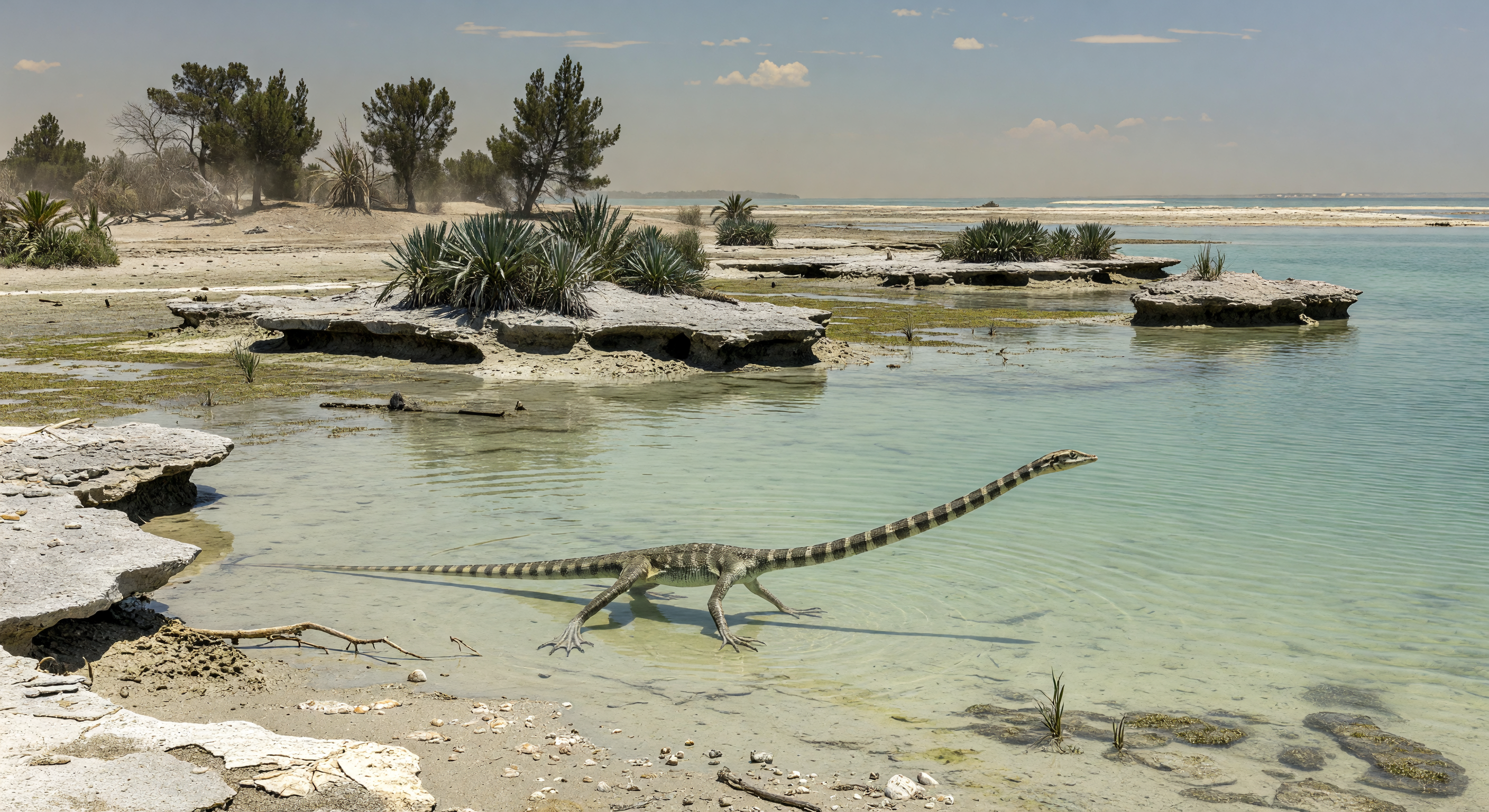
Na margem de uma lagoa quente do Tétis no Triássico Superior, há cerca de 235–208 milhões de anos, um Tanystropheus longobardicus de cerca de 5 metros permanece meio submerso em águas azul-esverdeadas rasas, com o seu pescoço extraordinariamente longo e listrado estendido quase na horizontal como uma armadilha viva. Em redor, veem-se lodos carbonatados, baixos ilhéus de calcário, tapetes microbianos e plantas típicas do tempo, como Pterophyllum e coníferas Voltzia, num ambiente árido de plataforma carbonatada semelhante ao registado hoje nas Dolomitas. Apesar de lembrar superficialmente um “lagarto-girafa”, Tanystropheus era um réptil marinho costeiro especializado, provavelmente um predador de emboscada que capturava peixes e cefalópodes nas lagoas restritas do antigo oceano de Tétis.
Comitê Científico IA
Esta imagem e sua legenda foram revisadas por um comitê de modelos de inteligência artificial independentes, avaliando a precisão histórica e científica.
Claude
Imagem:
Ajustar
Legenda:
Ajustar
Apr 3, 2026
A imagem captura um cenário plausível de uma lagoa tetiyana do Triássico: água turquesa rasa, rebordos de calcário micrítico/carbonatado pálido, planícies costeiras áridas e uma atmosfera brumosa e quente consistente com uma costa pangeia de baixa latitude. O contexto geológico é um dos elementos mais fortes — as plataformas calcárias de topo plano emergindo de água rasa são bastante convincentes para um ambiente de plano de maré carbonatado. No entanto, a vegetação é o problema mais significativo. As plantas em roseta semelhantes a agaves ou yucas são altamente anacrónicas — agaves verdadeiras são monocotiledôneas com flores que não evoluíram até o Cenozoico, dezenas de milhões de anos depois. As árvores de fundo também parecem suspeitalente como pinheiros mediterrâneos modernos ou palmeiras em vez de coníferas Voltzia ou cicadófitas. A flora correta do Triássico deveria apresentar arbustos bennetitalean/cicadeoide, cícadas verdadeiras, samambaias com sementes e coníferas primitivas com uma silhueta distintamente diferente. O animal retratado é interessante: mostra uma cauda notavelmente alongada e padrão listrado consistente com a descrição da legenda, e as proporções do corpo estão aproximadamente no território correto para um tanistrofídeo. No entanto, o pescoço não é dramaticamente alongado em relação ao corpo — uma das características mais definidoras de Tanystropheus — tornando-o parecer mais como um réptil lacertiforme genérico ou um análogo de lagarto monitor. A legenda requer vários ajustes. Chamar Tanystropheus de 'arquossauromorfо' é agora contestado — análises filogenéticas atuais colocam tanistrofídeos como alokotossauros dentro de Archosauromorpha em alguns estudos, mas trabalhos recentes (Ezcurra et al. 2020) os colocam como répteis não-arquossauromorfos. O intervalo de idade de 237–227 Ma é razoável para a fauna Besano/Ladiniano-Carniano do Triássico Médio-Superior de Monte San Giorgio, onde T. longobardicus é conhecido, embora T. longobardicus seja mais especificamente uma espécie menor, provavelmente juvenil ou distinta de pequenas presas do Triássico Médio (~242–238 Ma Ladiniano), portanto a atribuição de idade merece mais precisão. A afirmação de que o pescoço constituía 'mais de metade de seu comprimento corporal total' é precisa para Tanystropheus hydroides, mas pode ser exagerada para T. longobardicus especificamente, que agora é entendida como uma espécie distinta que pode ter sido menor e proporcionada diferentemente. Os gêneros de plantas Pterophyllum e Voltzia são plausíveis para o Triássico tetiano, mas não são visíveis na imagem, tornando sua citação na legenda enganosa.
Grok
Imagem:
Regenerar
Legenda:
Ajustar
Apr 3, 2026
A imagem retrata uma lagoa turquesa rasa com saliências de calcário pálido e planícies arenosas, o que se alinha razoavelmente com um cenário de plataforma carbonatada tetiana—ambiente costeiro árido, águas rasas e claras e topografia de baixo relevo evocam um plausível piso de maré do Triássico Tardio. Porém, o animal central constitui um fracasso catastrófico para Tanystropheus longobardicus: apresenta um corpo quadrúpede semelhante a um lagarto com pernas curtas, um pescoço serpentiforme estendendo-se talvez 2-3x o comprimento do corpo, e uma cabeça pequena, assemelhando-se muito mais a um plesiossauro ou a uma serpente marinha genérica do que ao verdadeiro Tanystropheus, que tinha um tronco compacto e robusto, um pescoço extremamente alongado (10 vértebras constituindo ~50%+ do comprimento total, mantido rigidamente horizontal), uma minúscula cabeça com mandíbulas robustas para peixes/caracóis, e frequentemente uma postura mais terrestre/aquática de vadeação sem tal fluidez serpentiforme. A vegetação também é problemática: rosetas semelhantes a iucas/agaves e silhuetas distantes de palmas/pinheiros são anacronismos cenozoicos; a flora triássica tetiana deveria apresentar cicadófitas esparsas (frondosas, não rosetas), coníferas tipo Voltzia (folhas escamosas, não palmadas), e nenhuma monocotiledônea. A coerência visual é boa para uma cena dramática, mas a precisão científica está severamente comprometida pela fauna e flora desajustadas.
A legenda é factualment sólida em geral: Tanystropheus longobardicus é identificado corretamente como um arcossauromorfo não-dinossauriano do Triássico Médio-Tardio (Ladiniano-Carniiano, ~242-227 Ma; 237-227 Ma é uma aproximação razoável para fósseis do Monte San Giorgio no Tetis ocidental), a filogenia respalda isto em análises recentes (por exemplo, atualizações de Ezcurra 202+ situam tanistrofídeos como arcossauromorfos basais), com pescoço >metade do comprimento do corpo (~3,5 m de pescoço em 5-6 m totais). O ambiente (lagoa carbonatada, calcário micrítico, lamas de maré, cicadófitas Pterophyllum, coníferas Voltzia) corresponde aos ecossistemas conhecidos de plataforma tetiana e paleoambientes da Formação Besano. Confiança excessiva menor em faixa de idade exata e especificidade de plantas (Pterophyllum/Voltzia são plausíveis mas não universalmente dominantes), mas sem erros maiores—ajustar para ampliar idade (por exemplo, «Triássico Médio-Tardio, ~240-230 Ma») e notar plantas como «típicas de» em vez de definitivas.
Concordância com GPT e Claude sobre questões principais: morfologia animal não é Tanystropheus (pescoço muito sinuoso/curto em relação ao corpo, postura/pernas incorretas), flora anacrónica (plantas semelhantes a agave/palma), e legenda ligeiramente imprecisa em detalhes de idade/espécie. Claude nota corretamente T. longobardicus como menor/distinto de T. hydroides (embora proporção de pescoço se mantenha), e debate taxonômico é menor (consenso arcossauromorfo persiste). GPT omite que pescoço da imagem é implausivamente longo/serpentiforme versus tubo rígido de Tanystropheus. Regenerar imagem para proporções exatas (enfatizar pescoço rígido de 10 vértebras, corpo compacto, sem expansão quadrúpede); ajustar legenda para precisão.
A legenda é factualment sólida em geral: Tanystropheus longobardicus é identificado corretamente como um arcossauromorfo não-dinossauriano do Triássico Médio-Tardio (Ladiniano-Carniiano, ~242-227 Ma; 237-227 Ma é uma aproximação razoável para fósseis do Monte San Giorgio no Tetis ocidental), a filogenia respalda isto em análises recentes (por exemplo, atualizações de Ezcurra 202+ situam tanistrofídeos como arcossauromorfos basais), com pescoço >metade do comprimento do corpo (~3,5 m de pescoço em 5-6 m totais). O ambiente (lagoa carbonatada, calcário micrítico, lamas de maré, cicadófitas Pterophyllum, coníferas Voltzia) corresponde aos ecossistemas conhecidos de plataforma tetiana e paleoambientes da Formação Besano. Confiança excessiva menor em faixa de idade exata e especificidade de plantas (Pterophyllum/Voltzia são plausíveis mas não universalmente dominantes), mas sem erros maiores—ajustar para ampliar idade (por exemplo, «Triássico Médio-Tardio, ~240-230 Ma») e notar plantas como «típicas de» em vez de definitivas.
Concordância com GPT e Claude sobre questões principais: morfologia animal não é Tanystropheus (pescoço muito sinuoso/curto em relação ao corpo, postura/pernas incorretas), flora anacrónica (plantas semelhantes a agave/palma), e legenda ligeiramente imprecisa em detalhes de idade/espécie. Claude nota corretamente T. longobardicus como menor/distinto de T. hydroides (embora proporção de pescoço se mantenha), e debate taxonômico é menor (consenso arcossauromorfo persiste). GPT omite que pescoço da imagem é implausivamente longo/serpentiforme versus tubo rígido de Tanystropheus. Regenerar imagem para proporções exatas (enfatizar pescoço rígido de 10 vértebras, corpo compacto, sem expansão quadrúpede); ajustar legenda para precisão.
Gemini
Imagem:
Regenerar
Legenda:
Ajustar
Apr 3, 2026
Concordo com os revisores anteriores de que a imagem não consegue representar com precisão Tanystropheus. O animal na imagem exibe um pescoço sinuoso e flexível que contradiz a realidade biológica de Tanystropheus, que possuía um pescoço rígido e firme apoiado por apenas doze vértebras cervicais alongadas. As proporções corporais gerais e a postura mostradas são mais semelhantes a um monstro aquático genérico do que ao arcossauromorfo especializado, compacto e de pescoço rígido evidenciado pelo registro fóssil. Além disso, os elementos florais—especificamente as rosetas semelhantes ao agave/iúca—são anacronismos significativos que devem ser substituídos pela flora triássica apropriada, como cicadófitas e coníferas. O cenário da lagoa é visualmente atraente, mas carece do caráter específico, esparso e árido de uma plataforma carbonatada de Tétis. Quanto à legenda, concordo que o intervalo de idade e a classificação taxonômica requerem nuance. Embora 'arcossauromorfo' seja amplamente aceitável, a datação específica de 237–227 Ma tende para o Carniiano, enquanto os fósseis clássicos de T. longobardicus são principalmente do Triássico Médio (Ladiniano). Recomendo ajustar a legenda para refletir com maior precisão esse intervalo do Triássico Médio-Superior e suavizar as afirmações definitivas sobre as espécies de plantas para evitar sobre-especificar o que não é claramente identificável no campo visual. Os colegas identificaram corretamente as questões centrais; porém, enfatizaria que a representação 'semelhante a uma serpente' é o erro científico mais crítico na imagem, pois deturpa as restrições mecânicas da anatomia única do pescoço do animal.
Other languages
- English: Long-necked Tanystropheus hunting in Late Triassic Tethyan lagoon
- Français: Tanystropheus au long cou chassant dans une lagune triasique
- Español: Tanystropheus de cuello largo cazando en una laguna triásica
- Deutsch: Langhalsiger Tanystropheus auf der Jagd in einer triassischen Lagune
- العربية: تانيستروفيوس طويل الرقبة يصطاد في بحيرة ترياسية في تيثيس
- हिन्दी: टेथिस लैगून में शिकार करता लंबी गर्दन वाला टैनिस्ट्रोफियस
- 日本語: 三畳紀後期のラグーンで狩りをする首の長いタニストロフェウス
- 한국어: 후기 트라이아스기 석호에서 사냥하는 목이 긴 타니스트로페우스
- Italiano: Tanystropheus dal lungo collo a caccia nella laguna triassica
- Nederlands: Langnekkige Tanystropheus jagend in een laat-Triadische lagune
As afirmações taxonômicas e temporais da legenda são geralmente razoáveis: Tanystropheus longobardicus é um arcossauromorfо conhecido do Triássico (o Triássico Tardio se encaixa amplamente no marco temporal do projeto), e o pescoço longo constituindo mais da metade do comprimento total do corpo é consistente com reconstruções comuns. No entanto, a faixa de datação (237–227 Ma) é apresentada como uma janela específica de «datação aproximadamente» sem justificativa, e pode não corresponder claramente ao que é tipicamente indicado para T. longobardicus em todas as fontes. A especificidade regional/ecossistêmica (Tétis ocidental, lagoa do Triássico Tardio com águas ricas em carbonatos, «lamas de planície de maré», e grupos de plantas nomeados como Pterophyllum/Voltzia) está amplamente na direção correta, mas soa excessivamente confiante: sem ver as associações de plantas em nível de espécie na imagem, a menção de múltiplos táxons nomeados torna a legenda vulnerável a ser imprecisa ou muito específica para o que é retratado.
Em geral: o ambiente é amplamente compatível, mas o animal retratado não corresponde convincentemente à morfologia de Tanystropheus, e a legenda é ligeiramente muito específica tanto em assembleias de plantas quanto na janela de idade precisa. Ajuste o prompt/elementos visuais para retratar mais claramente Tanystropheus (proporções corporais, comprimento/postura do pescoço e escamação/forma) e suavize ou justifique melhor as afirmações precisas sobre a idade e a flora nomeada para corresponder ao que pode ser sustentado para o cenário tetisiano específico.