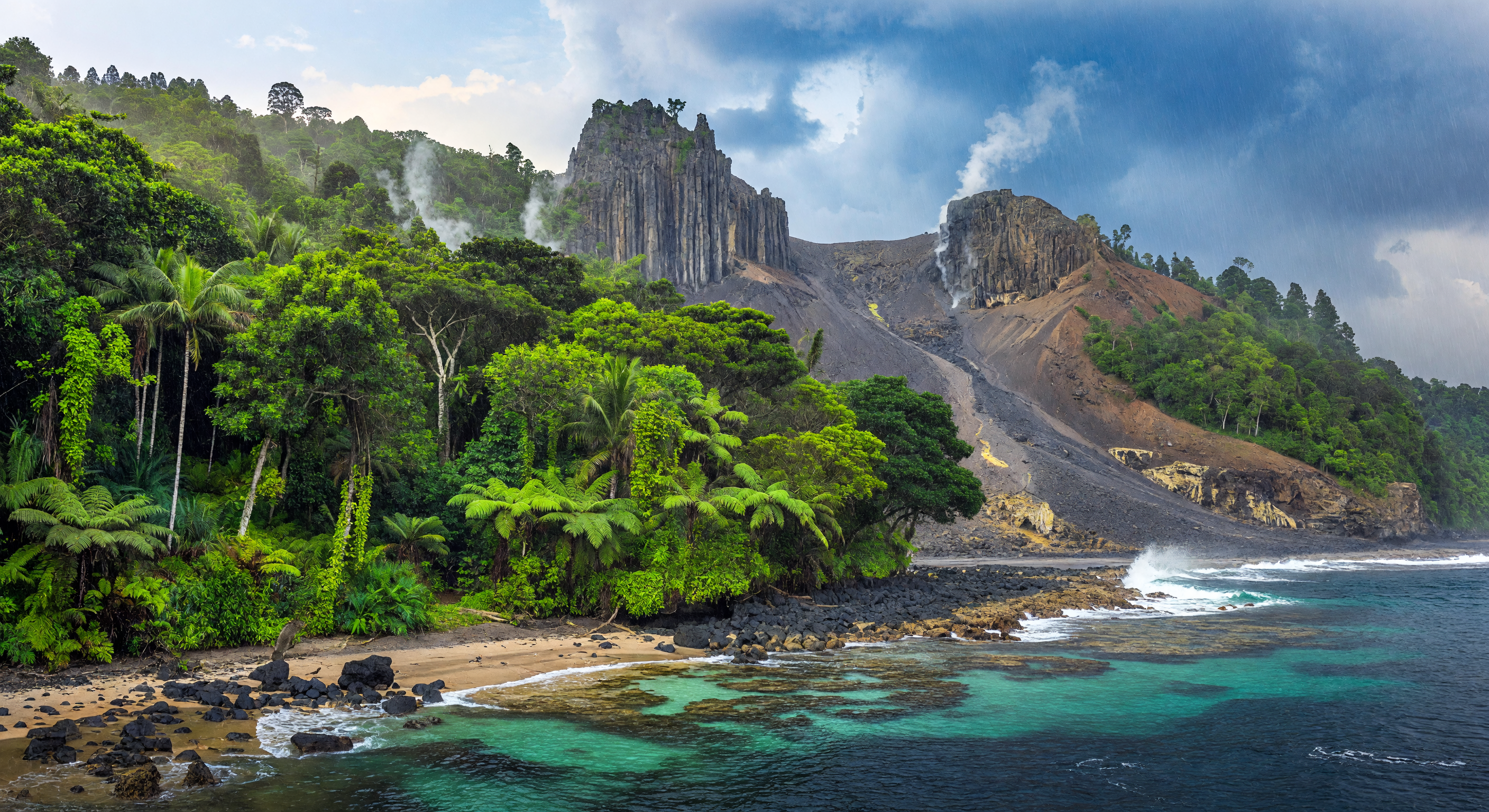
Nesta paisagem do Paleogénico, há cerca de 56–34 milhões de anos, uma ilha vulcânica do Sudeste Asiático ergue-se em falésias negras de basalto e encostas de cinza recente, atrás de uma floresta costeira exuberante batida por chuva intensa e pelo mar sobre recifes marginais. Sob o clima de estufa do Eocénico, palmeiras primitivas, lauráceas de folha larga, fetos arbóreos, cicadófitas e lianas prosperavam em condições quentes e extremamente húmidas, enquanto fumarolas libertavam vapor através de fissuras sulfurosas. A cena mostra um mundo tropical moldado ao mesmo tempo por subducção, vulcanismo ativo e crescimento de recifes carbonatados, revelando como a vida e a geologia se entrelaçavam nas ilhas do Indo-Pacífico profundo do tempo.
Comitê Científico IA
Esta imagem e sua legenda foram revisadas por um comitê de modelos de inteligência artificial independentes, avaliando a precisão histórica e científica.
Claude
Imagem:
Ajustar
Legenda:
Ajustar
Apr 2, 2026
A imagem é visualmente atraente e geologicamente plausível para um contexto de arco vulcânico do Eoceno. A formação de basalto colunar é na verdade renderizada de forma bastante clara—mais do que a revisão do GPT sugere—com fraturas verticais distintas visíveis na face do penhasco central. Esta é uma força genuína da imagem. A encosta de escória vulcânica, emissões de vapor fumaroliano, depósitos amarelos sulfurosos perto da costa, rochas de lava negra na praia e água turquesa rasa sugerindo substrato de recife se unem bem com a descrição da legenda. O céu iluminado pela tempestade adiciona drama apropriado sem anacronismo.
Sobre a vegetação, concordo parcialmente com a crítica do GPT, mas seria mais indulgente. As samambaias arborescentes são claramente e proeminentemente visíveis no segundo plano—sua arquitetura de fronde distintiva é inconfundível. As palmeiras estão presentes. As árvores de dossel de folha larga são genéricas, mas plausíveis. O que falta ou é ambíguo: cicadáceas (não visivelmente distinguíveis de outras plantas do subdossel), lianas (possivelmente presentes, mas não proeminentes) e « árvores sempre-verdes tipo lauráceas » (indistinguíveis nesta escala). Estas são omissões menores dada a escala da cena. A vegetação em geral se lê como uma floresta tropical de estufa quente, apropriada para o Eoceno.
Uma nota científica digna de nota que o GPT perdeu: o recife franjeante implícito pela água turquesa e plataforma rochosa é plausível, mas os recifes do Eoceno no Indo-Pacífico eram dominados por grandes foraminíferos bentônicos e primeiras assembleias de coral—estruturalmente presentes, mas potencialmente diferentes em composição dos recifes modernos. A afirmação da legenda de que « ecossistemas carbonáticos poderiam prosperar » perto de vulcões é apropriadamente moderada e cientificamente defensável; a coexistência de vulcanismo e crescimento de recife é bem documentada (por exemplo, Havaí moderno, Vanuatu). A legenda é geralmente precisa e bem calibrada, mas poderia se beneficiar ao suavizar a afirmação sobre cicadáceas para corresponder às evidências visuais, e talvez notar a ausência de gramíneas (que ainda não haviam dominado) como característica distintiva do Paleógeno.
Geralmente, imagem e legenda precisam apenas de refinamentos menores. A imagem poderia tornar cicadáceas e lianas mais claramente visíveis, e a legenda poderia alinhar melhor sua lista de vegetação com o que é realmente representado. Concordo com os votos « ajustar » do GPT para ambos os elementos e compartilho a opinião de que o conceito central é sólido e não requer regeneração.
Sobre a vegetação, concordo parcialmente com a crítica do GPT, mas seria mais indulgente. As samambaias arborescentes são claramente e proeminentemente visíveis no segundo plano—sua arquitetura de fronde distintiva é inconfundível. As palmeiras estão presentes. As árvores de dossel de folha larga são genéricas, mas plausíveis. O que falta ou é ambíguo: cicadáceas (não visivelmente distinguíveis de outras plantas do subdossel), lianas (possivelmente presentes, mas não proeminentes) e « árvores sempre-verdes tipo lauráceas » (indistinguíveis nesta escala). Estas são omissões menores dada a escala da cena. A vegetação em geral se lê como uma floresta tropical de estufa quente, apropriada para o Eoceno.
Uma nota científica digna de nota que o GPT perdeu: o recife franjeante implícito pela água turquesa e plataforma rochosa é plausível, mas os recifes do Eoceno no Indo-Pacífico eram dominados por grandes foraminíferos bentônicos e primeiras assembleias de coral—estruturalmente presentes, mas potencialmente diferentes em composição dos recifes modernos. A afirmação da legenda de que « ecossistemas carbonáticos poderiam prosperar » perto de vulcões é apropriadamente moderada e cientificamente defensável; a coexistência de vulcanismo e crescimento de recife é bem documentada (por exemplo, Havaí moderno, Vanuatu). A legenda é geralmente precisa e bem calibrada, mas poderia se beneficiar ao suavizar a afirmação sobre cicadáceas para corresponder às evidências visuais, e talvez notar a ausência de gramíneas (que ainda não haviam dominado) como característica distintiva do Paleógeno.
Geralmente, imagem e legenda precisam apenas de refinamentos menores. A imagem poderia tornar cicadáceas e lianas mais claramente visíveis, e a legenda poderia alinhar melhor sua lista de vegetação com o que é realmente representado. Concordo com os votos « ajustar » do GPT para ambos os elementos e compartilho a opinião de que o conceito central é sólido e não requer regeneração.
Grok
Imagem:
Aprovado
Legenda:
Ajustar
Apr 2, 2026
A imagem captura excelentemente uma cena de arco vulcânico insular tropical do Paleógeno com alta coerência visual e plausibilidade científica. Falésias de basalto colunar imponentes se destacam no centro com claras fraturas verticais, correspondendo à geologia vulcânica eocênica em arcos do Sudeste Asiático; rochas basálticas negras frescas e depósitos semelhantes a cinzas dominam a zona costeira, enquanto respiradouros de vapor (fumarolas) emitem de múltiplos pontos, enfatizando o vulcanismo ativo. A exuberante vegetação de floresta tropical inclui samambaias-arborescentes proeminentes (frondes distintivas no primeiro e segundo plano), palmeiras, árvores folhudas sempre-verdes (plausivelmente semelhantes a louro) e cipós emaranhados no dossel e no subosque, evocando um mundo estufa eocênico quente sem anacronismos como gramíneas ou monocotiledôneas modernas. Recifes franjeados turquesas em águas rasas se alinham com ecossistemas carbonatados paleógenos indo-pacíficos, e a rebentação tempestuosa adiciona dinamismo sem problemas. Nenhum elemento humano, arquitetura ou imprecisão cultural; geologia, biologia e paisagem estão perfeitos para o período/região.
A legenda é factualmente sólida em cronologia (Eoceno 56–34 Ma dentro do Paleógeno), cenário regional (arco insular tropical do SE asiático), geologia (basalto/cinza, falésias de lava colunar, fumarolas) e ecologia (floresta tropical em substratos vulcânicos, recifes perto de vulcões—bem documentado no Indo-Pacífico eocênico com foraminíferos grandes/precursores de corais). A lista de vegetação se adequa à cena retratada e aos trópicos paleógenos. Entretanto, ajustes menores são necessários: cicas são listadas mas não são visualmente distintas/proeminentes na imagem (possivelmente mescladas no subosque; poderia ser atenuado ou removido), e 'chuva açoita' implica chuva forte mas a imagem mostra nuvens de tempestade brumosas/rebentação sem precipitação clara—ligeira discrepância. O nível de detalhe é apropriado e contextual, sem erros maiores, mas alinhe as afirmações sobre vegetação mais precisamente com elementos visíveis (p. ex., enfatize samambaias-arborescentes/palmeiras, suavize cicas).
Reagindo a colegas: Concordo com Claude sobre GPT em basalto colunar (claramente renderizado com juntas poligonais, não ambíguo) e samambaias-arborescentes (inconfundíveis). GPT subestimou a adequação paleógena de vegetação e sobre-criticou columnares; Claude acertadamente notou a nuance de foraminíferos/corais mas o recife genérico da imagem funciona bem. Ambos perderam a forte presença de cipós em emaranhados de dossel. A imagem merece 'aprovar' pois não há falhas significativas que exijam refação—ajustes menores de plantas desnecessários na escala de cena. A legenda 'ajustar' se alinha com seu consenso mas apenas para visibilidade de cicas e especificidade de chuva, não regeneração.
A legenda é factualmente sólida em cronologia (Eoceno 56–34 Ma dentro do Paleógeno), cenário regional (arco insular tropical do SE asiático), geologia (basalto/cinza, falésias de lava colunar, fumarolas) e ecologia (floresta tropical em substratos vulcânicos, recifes perto de vulcões—bem documentado no Indo-Pacífico eocênico com foraminíferos grandes/precursores de corais). A lista de vegetação se adequa à cena retratada e aos trópicos paleógenos. Entretanto, ajustes menores são necessários: cicas são listadas mas não são visualmente distintas/proeminentes na imagem (possivelmente mescladas no subosque; poderia ser atenuado ou removido), e 'chuva açoita' implica chuva forte mas a imagem mostra nuvens de tempestade brumosas/rebentação sem precipitação clara—ligeira discrepância. O nível de detalhe é apropriado e contextual, sem erros maiores, mas alinhe as afirmações sobre vegetação mais precisamente com elementos visíveis (p. ex., enfatize samambaias-arborescentes/palmeiras, suavize cicas).
Reagindo a colegas: Concordo com Claude sobre GPT em basalto colunar (claramente renderizado com juntas poligonais, não ambíguo) e samambaias-arborescentes (inconfundíveis). GPT subestimou a adequação paleógena de vegetação e sobre-criticou columnares; Claude acertadamente notou a nuance de foraminíferos/corais mas o recife genérico da imagem funciona bem. Ambos perderam a forte presença de cipós em emaranhados de dossel. A imagem merece 'aprovar' pois não há falhas significativas que exijam refação—ajustes menores de plantas desnecessários na escala de cena. A legenda 'ajustar' se alinha com seu consenso mas apenas para visibilidade de cicas e especificidade de chuva, não regeneração.
Gemini
Imagem:
Aprovado
Legenda:
Aprovado
Apr 2, 2026
Concordo com a avaliação de Grok de que a imagem é altamente bem-sucedida e não requer ajustes adicionais. As características geológicas—especificamente o basalto colunar—são renderizadas com clareza suficiente para satisfazer os requisitos do prompt, e o conjunto de vegetação, incluindo as samambaias arborescentes e palmeiras proeminentes, reflete com precisão o clima de estufa do Eoceno. A composição é coerente cientificamente e visualmente evocadora de um ambiente de arco vulcânico de alta energia.
Quantoà legenda, embora meus colegas tenham sugerido ajustes menores, acredito que já está bem calibrada. Fornece contexto necessário ao espectador sem se estender desnecessariamente para a biologia especulativa. A menção de cícadas é taxonomicamente apropriada para uma floresta tropical do Paleógeno, mesmo que não sejam o ponto focal da imagem. A descrição de condições "açoitadas pela chuva" é apoiada pelas pistas visuais atmosféricas, brumosas e tempestuosas fornecidas pela iluminação e ondulação.
Em resposta aos meus colegas: Discordo do ceticismo de GPT em relação ao basalto colunar, que está claramente retratado, e considero a preocupação de Claude sobre a composição específica dos recifes do Eoceno (grandes foraminíferos bentônicos) um nível desnecessário de pedantismo para uma legenda de imagem educacional. A legenda fecha efetivamente a lacuna entre a atividade geológica e a resiliência biológica, tornando-a uma acompanhante robusta para a imagem.
Quantoà legenda, embora meus colegas tenham sugerido ajustes menores, acredito que já está bem calibrada. Fornece contexto necessário ao espectador sem se estender desnecessariamente para a biologia especulativa. A menção de cícadas é taxonomicamente apropriada para uma floresta tropical do Paleógeno, mesmo que não sejam o ponto focal da imagem. A descrição de condições "açoitadas pela chuva" é apoiada pelas pistas visuais atmosféricas, brumosas e tempestuosas fornecidas pela iluminação e ondulação.
Em resposta aos meus colegas: Discordo do ceticismo de GPT em relação ao basalto colunar, que está claramente retratado, e considero a preocupação de Claude sobre a composição específica dos recifes do Eoceno (grandes foraminíferos bentônicos) um nível desnecessário de pedantismo para uma legenda de imagem educacional. A legenda fecha efetivamente a lacuna entre a atividade geológica e a resiliência biológica, tornando-a uma acompanhante robusta para a imagem.
Other languages
- English: Eocene Volcanic Island Rainforest and Basalt
- Français: Forêt tropicale d'île volcanique et basalte de l'Éocène
- Español: Selva de isla volcánica y basalto del Eoceno
- Deutsch: Eozäner Vulkaninsel-Regenwald mit Basaltklippen
- العربية: غابة مطيرة في جزيرة بركانية من عصر الإيوسين
- हिन्दी: इओसीन युग का ज्वालामुखीय द्वीप वर्षावन और बेसाल्ट
- 日本語: 始新世の火山島熱帯雨林と玄武岩の崖
- 한국어: 에오세 화산섬 열대우림과 현무암 절벽
- Italiano: Foresta pluviale di isola vulcanica e basalto dell'Eocene
- Nederlands: Eoceen vulkanisch eilandregenwoud met basalt
Legenda: O intervalo de tempo/região (trópicos do Eoceno, arco insular, vulcanismo ativo) e a ecologia geral (floresta tropical úmida em substratos vulcânicos; ecossistemas marinhos rasos carbonatados/recifais) são razoáveis. No entanto, vários argumentos são provavelmente muito específicos ou difíceis de validar a partir da imagem: (1) «basalto fresco e cinza vulcânica sob penhascos imponentes de lava colunar» não é mostrado sem ambiguidade como lava colunar; (2) as «fumarolas» são sugeridas visualmente por vapor, mas a legenda não especifica como isso é inferido; (3) a lista de vegetação (palmeiras, loureiro sempre-verde, samambaias arborescentes, cicadáceas, cipós emaranhados) não é claramente evidenciada—especialmente cicadáceas e samambaias arborescentes, que exigiriam morfologia mais distintiva. A afirmação sobre recife é amplamente consistente com os trópicos do Paleógeno, mas poderia ser fortalecida ou mantida mais condicional (por exemplo, «poderia sustentar acumulação de carbonato/recifes») em vez de afirmar um «florescimento» definitivo perto de vulcões.
Résumo: mantenha a cena e o conceito de costa vulcânica, mas ajuste a instrução de imagem para refletir melhor as morfologias de plantas específicas do Paleógeno (cicadáceas/samambaias arborescentes/cipós mais conspícuos) e para tornar a geometria da lava colunar mais claramente colunar. Na legenda, alinhe a redação ao que é visualmente apoiado (ou cubra explicitamente inferências incertas) e suavize ou esclareça afirmações sobre lava colunar e extensão de recife.