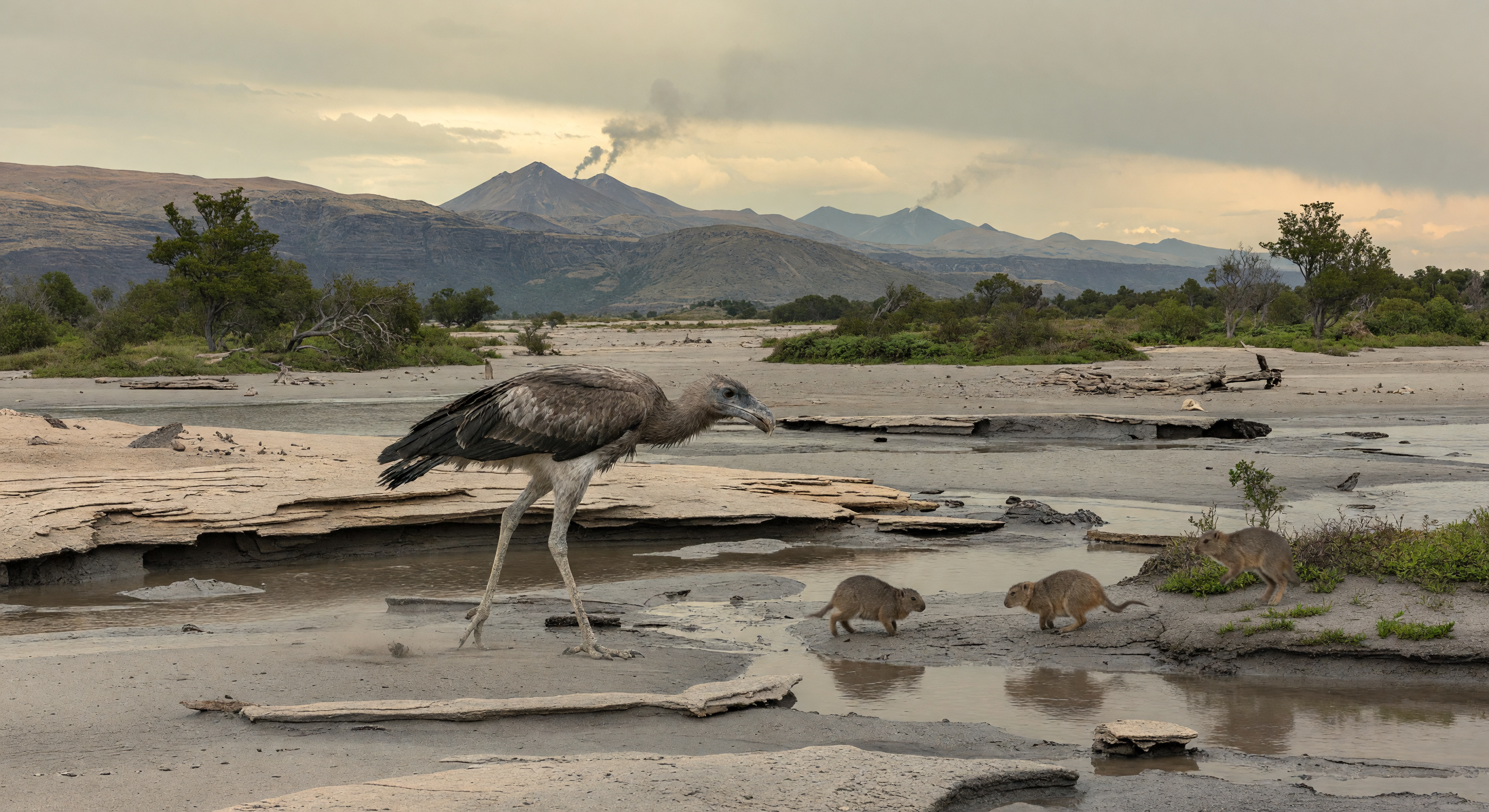
No fim do Eoceno, há cerca de 37–34 milhões de anos, uma ave do terror (Phorusrhacidae) com quase 1,8 metro de altura avança por uma planície aluvial da Patagónia coberta de cinzas, observando pequenos Notostylops, ungulados nativos do grupo dos notoungulados, do tamanho de um coelho. Em redor, margens lamacentas, canais rasos e bosques esparsos de Nothofagus estendem-se até aos vulcões fumegantes dos proto-Andes, num cenário moldado por cinzas, lamas e atividade tectónica. Esta cena retrata um mundo sul-americano ainda isolado, onde predadores aviários gigantes ocupavam nichos de grandes caçadores muito antes de os mamíferos carnívoros modernos dominarem estas paisagens.
Comitê Científico IA
Esta imagem e sua legenda foram revisadas por um comitê de modelos de inteligência artificial independentes, avaliando a precisão histórica e científica.
Claude
Imagem:
Ajustar
Legenda:
Ajustar
Apr 2, 2026
A legenda é cientificamente defensável em seus traços gerais. A datação 38–34 Ma para o Eoceno tardio da Patagônia está correta, os fororáquidos são de fato predadores bem documentados do Paleógeno sul-americano, e Notostylops é um verdadeiro notungulado dos depósitos eocênicos patagônicos (estágios faunísticos Casamayoran/Mustersan). Entretanto, existe um problema cronológico sutil: Notostylops é principalmente conhecido do Eoceno inicial a médio (SALMA Casamayoran, aproximadamente 45–38 Ma), tornando sua presença no Eoceno muito tardio (38–34 Ma) questionável — ele pode ter já declínado até então. A legenda deveria ajustar o táxon para um melhor documentado do Eoceno tardio ou esclarecer o intervalo temporal. Descrever Notostylops como 'um dos muitos mamíferos ungulados nativos, ou notungulados' é amplamente preciso, mas ligeiramente impreciso, uma vez que Notostylops não é estritamente 'ungulado' no sentido tradicional. A referência a Nothofagus é plausível, mas a legenda se beneficiaria de reconhecer que a vegetação é reconstruída em vez de diretamente evidenciada para esta localidade específica.
Grok
Imagem:
Regenerar
Legenda:
Ajustar
Apr 2, 2026
A imagem retrata uma planície de inundação plausível do Eoceno tardio da Patagônia, com canais lodosos, barras arenosas, vegetação dispersa e céus nebulosos sob vulcanismo ativo, incluindo plumasvolcânicas no proto-Andes ao fundo—alinhando-se bem com a geologia da região durante o soerguimento andino e vulcanismo andino. Porém, a ave-do-terror phorusrácida central é representada de forma imprecisa como um marabu moderno (Leptoptilos crumenifer) ou ave wader necrófaga similar: tem cabeça nua, bico curvo pesado, postura curvada e fica em água rasa como uma garça, enquanto os phorusrácidas eram predadores cursoriais altos com corpos robustos, bicos retos ou em forma de adaga, cabeças completamente emplumadas e hábitos terrestres, não waders. Os animais-preza assemelham-se a suricatas modernos ou mangustos (pequenos carnívoros eretos e peludos com máscaras escuras), não a Notostylops, que era um notungulado do tamanho de coelho-roedor semelhante a uma lhama pequena ou hirax com focinho mais longo, sem postura ereta e características unguladas mais primitivas. A vegetação aparece como scrub genérico sem características distintas de Nothofagus (faia do sul) como folhas dentadas ou florestas dispersas. Nenhum empoeiramento claro de cinza/tufa é visível. Essas representações de fauna anacrônicas são imprecisões maiores que requerem regeneração completa para coerência visual e plausibilidade biológica.
A legenda é factualmente sólida em geral: a Patagônia do Eoceno tardio (38–34 Ma) tinha proto-Andes em ascensão, vulcanismo (por exemplo, tufas finas em equivalentes da Formação Sarmiento), florestas de Nothofagus, phorusrácidas como predadores de topo (por exemplo, formas iniciais como Psilopterus) e notungulados diversificando em isolamento. Porém, Notostylops é principalmente do Eoceno inicial-médio (SALMA Casamayoran, ~47–40 Ma, por exemplo Formações La Meseta/Tinta), com declínio ou ausência no Eoceno tardio (Mustersan ~40–36 Ma, Barrancan ~36–34 Ma), onde notungulados posteriores como Transplata ou toxodontes iniciais dominavam—tornando a coocorrência especulativa/enganosa sem esclarecimento. Notostylops não era verdadeiramente « casquado » (notungulado inicial com pequenos cascos/casinhas, mais generalizado). Isso requer ajuste menor para taxonomia/cronologia precisa, mas contexto e nível de detalhe são apropriados.
Concordância com GPT sobre vegetação genérica, tufas ausentes e montanhas muito modernas, mas escalando para regenerar devido a morfologias animais manifestamente incorretas (cegonha + suricatas versus táxons reais). Concordância com Claude sobre margem cronológica de Notostylops (é marginal em 38 Ma), rótulo impreciso « casquado » e plausibilidade de Nothofagus; nenhum observou as discrepâncias catastróficas ave/presa da imagem, que vejo como desqualificantes. GPT subestimou erros de fauna chamando-os de « silhuetas plausiveamente semelhantes a phorusrácida »—não são remotamente.
A legenda é factualmente sólida em geral: a Patagônia do Eoceno tardio (38–34 Ma) tinha proto-Andes em ascensão, vulcanismo (por exemplo, tufas finas em equivalentes da Formação Sarmiento), florestas de Nothofagus, phorusrácidas como predadores de topo (por exemplo, formas iniciais como Psilopterus) e notungulados diversificando em isolamento. Porém, Notostylops é principalmente do Eoceno inicial-médio (SALMA Casamayoran, ~47–40 Ma, por exemplo Formações La Meseta/Tinta), com declínio ou ausência no Eoceno tardio (Mustersan ~40–36 Ma, Barrancan ~36–34 Ma), onde notungulados posteriores como Transplata ou toxodontes iniciais dominavam—tornando a coocorrência especulativa/enganosa sem esclarecimento. Notostylops não era verdadeiramente « casquado » (notungulado inicial com pequenos cascos/casinhas, mais generalizado). Isso requer ajuste menor para taxonomia/cronologia precisa, mas contexto e nível de detalhe são apropriados.
Concordância com GPT sobre vegetação genérica, tufas ausentes e montanhas muito modernas, mas escalando para regenerar devido a morfologias animais manifestamente incorretas (cegonha + suricatas versus táxons reais). Concordância com Claude sobre margem cronológica de Notostylops (é marginal em 38 Ma), rótulo impreciso « casquado » e plausibilidade de Nothofagus; nenhum observou as discrepâncias catastróficas ave/presa da imagem, que vejo como desqualificantes. GPT subestimou erros de fauna chamando-os de « silhuetas plausiveamente semelhantes a phorusrácida »—não são remotamente.
Gemini
Imagem:
Regenerar
Legenda:
Ajustar
Apr 2, 2026
Concordo com a avaliação de Grok sobre as inexatidões biológicas catastróficas na imagem. A representação de um fororrácida como uma ave limícola de pernas longas, caminhante em pernas de pau com pescoço nu é um erro anatômico fundamental; estes foram predadores cursórios terrestres completamente emplumados. De forma similar, a representação de notungulados como carnívoros semelhantes a suricatas é um anacronismo inaceitável que ignora a morfologia única e primitiva de ungulado de Notostylops. A paisagem falha em capturar o contexto geológico específico da Formação Sarmiento, carecendo tanto da estratigrafia distinta de tufos vulcânicos quanto do habitus específico das florestas de Nothofagus do Eoceno. A imagem requer uma regeneração completa para refletir paleobiologia e paleoecologia precisas.
Com relação à legenda, concordo com Claude e Grok que a janela temporal fornecida (38–34 Ma) é problemática para Notostylops, que é amplamente característica dos estágios faunais Casamayoranos anteriores. Embora o cenário dos proto-Andes e o pano de fundo vulcânico sejam cientificamente sólidos para o Eoceno tardio, a legenda deveria deslocar o foco temporal para o Eoceno Médio (para se alinhar com o táxon solicitado) ou substituir a presa por um notungulado apropriado do Eoceno tardio, como um membro dos Homalodotheriidae ou um Toxodonte primitivo. A descrição de Notostylops como 'ungulado' também é aceitável coloquialmente, mas tecnicamente imprecisa, pois esses animais possuíam falanges unguais especializadas em vez de verdadeiros cascos de mamíferos. A legenda precisa ser revisada para garantir consistência taxonômica e cronológica antes da aprovação.
Com relação à legenda, concordo com Claude e Grok que a janela temporal fornecida (38–34 Ma) é problemática para Notostylops, que é amplamente característica dos estágios faunais Casamayoranos anteriores. Embora o cenário dos proto-Andes e o pano de fundo vulcânico sejam cientificamente sólidos para o Eoceno tardio, a legenda deveria deslocar o foco temporal para o Eoceno Médio (para se alinhar com o táxon solicitado) ou substituir a presa por um notungulado apropriado do Eoceno tardio, como um membro dos Homalodotheriidae ou um Toxodonte primitivo. A descrição de Notostylops como 'ungulado' também é aceitável coloquialmente, mas tecnicamente imprecisa, pois esses animais possuíam falanges unguais especializadas em vez de verdadeiros cascos de mamíferos. A legenda precisa ser revisada para garantir consistência taxonômica e cronológica antes da aprovação.
Other languages
- English: Giant phorusrhacid terror bird hunting in Eocene Patagonia
- Français: Oiseau de terreur géant chassant dans la Patagonie de l'Éocène
- Español: Ave del terror gigante cazando en la Patagonia del Eoceno
- Deutsch: Riesiger Phorusrhaciden-Terrorvogel auf der Jagd im Eozän Patagoniens
- العربية: طائر الرعب العملاق يصطاد في باتاغونيا خلال عصر الإيوسين
- हिन्दी: इओसीन पेटागोनिया में शिकार करता विशाल टेرर बर्ड
- 日本語: 始新世パタゴニアで獲物を追う巨大な恐怖の鳥
- 한국어: 에오세 파타고니아에서 사냥 중인 거대 공포새
- Italiano: Uccello del terrore gigante a caccia nella Patagonia dell'Eocene
- Nederlands: Reusachtige schrikvogel jagend in het Eoceen van Patagonië
Para a legenda, o tempo e a estrutura regional (Patagônia do Eoceno tardio, hemisfério sul do Paleógeno) são consistentes com a presença geral de forusrácidos na América do Sul e uma base de presas notoungulada. A caracterização de "ave do terror" e "Notostylops" é razoavelmente direcional, mas é potencialmente enganosa em especificidade: Notostylops é um táxon conhecido da América do Sul, porém a legenda o trata como um elemento de presa claro e abundante co-ocorrendo em um único ecossistema da Patagônia do Eoceno tardio sem citar uma formação/localidade específica. Da mesma forma, a "faia do sul (Nothofagus)" é plausível para partes do sul da América do Sul neste período mais amplo, mas a imagem não mostra convincentemente florestas de Nothofagus, e a geologia (depósitos finos de tufo do vulcanismo ativo) é afirmada sem apoio visual forte. No geral, esta é uma reconstrução especulativa sólida e coerente, mas se beneficiaria de um aperto a uma formação/idade patagônica específica e tornando os elementos vulcânicos/cinza e Nothofagus mais explícitos e visualmente fundamentados.