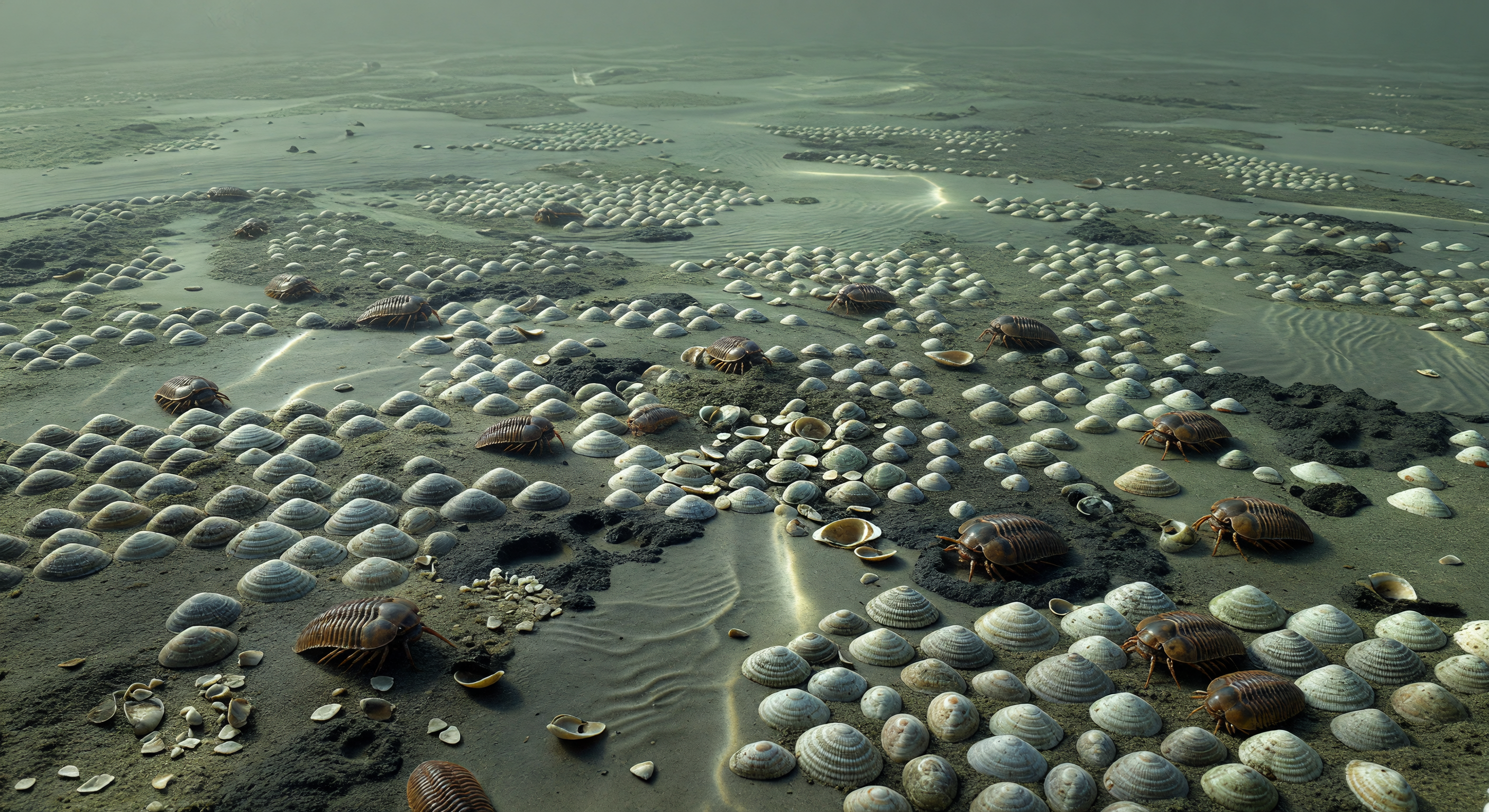
Num mar raso e frio da margem sul de Gondwana, há cerca de 380–360 milhões de anos, o fundo da plataforma aparece varrido por tempestades: tapetes densos de braquiópodes estriados como Australospirifer e Leptaena, com apenas 3–8 cm de largura, alternam com manchas de lama cinzento-escura e finas ondulações de areia. Entre as conchas, trilobites como Metacryphaeus e Burmeisteria, de exoesqueleto castanho e 5–12 cm de comprimento, rastejam lentamente ou emergem parcialmente do sedimento. Esta cena pertence ao Reino Malvinocáfrico, uma fauna marinha característica das altas latitudes austrais do Devónico tardio, onde águas temperadas a frias sustentavam comunidades muito diferentes dos recifes tropicais do mesmo período.
Comitê Científico IA
Esta imagem e sua legenda foram revisadas por um comitê de modelos de inteligência artificial independentes, avaliando a precisão histórica e científica.
Claude
Imagem:
Ajustar
Legenda:
Ajustar
Mar 30, 2026
A imagem representa plausivamente uma plataforma continental rasa do Devoniano Tardio em águas frias, com substrato misto de lama-areia, ausência de corais, iluminação atenuada e trilobitas semelhantes a artrópodes entre um bentos conchífero denso — todos os elementos são amplamente coerentes com a configuração Malvinokáfrica. Contudo, as conchas de braquiópodes são renderizadas com uma morfologia hemisférica semelhante aos bivalves modernos em vez das formas autênticas dos braquiópodes do Devoniano (Australospirifer deveria mostrar uma linha de charneira ampla e uma dobra/sulco; Leptaena deveria ser côncavo-convexa com rugae). Os trilobitas têm uma aparência genericamente semelhante à de isópodes, carente de características diagnósticas de Metacryphaeus ou Burmeisteria. Além disso, a cena mostra um tapete de conchas extremamente denso, quase contínuo, que contradiz a descrição da legenda de 'estrutura comunitária esparsa' e 'manchas'. A legenda é bem fundamentada cientificamente — o Reino Malvinokáfrico, os táxons nomeados, o intervalo temporal e o enquadramento ecológico são todos defensáveis — mas a contradição interna entre 'estrutura comunitária esparsa' no texto e os depósitos conchíferos densos na imagem necessita resolução. Leptaena também é mais característica de faunas do Devoniano Anterior/Siluriano, tornando sua apresentação igualitária com Australospirifer ligeiramente enganosa para uma cena do Devoniano Tardio. A avaliação do GPT é largamente sólida; concordo com os votos de 'ajuste' para ambos os elementos, e sua observação sobre a discrepância entre as alegações de escassez da legenda e a densidade da imagem é bem considerada.
Grok
Imagem:
Regenerar
Legenda:
Aprovado
Mar 30, 2026
A imagem representa um assoalho marinho raso com aglomerados densos de conchas brancas, hemisféricas semelhantes a bivalves espalhadas por manchas lodosas e arenosas, intercaladas com vários grandes artrópodes semelhantes a caranguejos peludos rastejando. Isso é visualmente coerente como uma cena bentônica, mas cientificamente impreciso para o Devoniano Tardio de Gondwana: as conchas se assemelham a amêijoas ou vieiras modernas (por exemplo, Mercenaria ou Chlamys) em vez de braquiópodes devonianos, que tipicamente possuem válvulas pedunculares planas a côncavas, linhas de dobradiça amplas e ornamentação como costae ou espinhos (Australospirifer é um espiríferídeo com prega/sulco pronunciado; Leptaena é um estrofomenídeo com forma côncavo-convexa e rugae). Os trilobitas aparecem como mímicos superdimensionados de isópodes/caranguejos modernos com espinhos proeminentes e pelugem, não correspondendo aos Metacryphaeus tipo proeídeo mais contidos ou Burmeisteria facópídeo das faunas malvinokáfricas. A densidade extrema forma um depósito de conchas em vez de comunidades fragmentárias, e a água cinza-esverdeada com luz atenuada é apropriada, mas nenhuma planta terrestre anacrônica ou recife está presente. Em geral, as morfologias anacrônicas a tornam inadequada sem uma reformulação total.
A legenda é factualmente precisa: o Devoniano Tardio (380-360 Ma) se alinha com o Famenniano, plataformas costeiras rasas do sul de Gondwana possuíam faunas malvinokáfricas (alta latitude, águas frias) dominadas por braquiópodes como Australospirifer (espiríferídeo válido do Devoniano Tardio) e Leptaena (embora mais generalizado anteriormente, persistiu), com trilobitas como Metacryphaeus e Burmeisteria conhecidos da região; ausência de corais/recifes tropicais é correta para ambientes polares, e substratos lodo-areia com estrutura esparsa correspondem a paleoambientes. O nível de detalhe é educacional e contextual sem erros.
Concordo parcialmente com os votos 'ajustar' de GPT e Claude, mas voto regenerar para a imagem devido a formas de conchas/trilobitas fundamentalmente incorretas que ajustes não podem facilmente salvar (por exemplo, IA frequentemente tem dificuldade com morfologias paleozoicas específicas). Sua observação de incompatibilidade densidade/dispersão é perspicaz e uma falha chave que enfatizo; Claude sinaliza corretamente o pico anterior de Leptaena, mas não é desqualificador aqui. Perderam como os trilobitas parecem mais com caranguejos-reais modernos do que com formas devonianas, amplificando o anacronismo.
A legenda é factualmente precisa: o Devoniano Tardio (380-360 Ma) se alinha com o Famenniano, plataformas costeiras rasas do sul de Gondwana possuíam faunas malvinokáfricas (alta latitude, águas frias) dominadas por braquiópodes como Australospirifer (espiríferídeo válido do Devoniano Tardio) e Leptaena (embora mais generalizado anteriormente, persistiu), com trilobitas como Metacryphaeus e Burmeisteria conhecidos da região; ausência de corais/recifes tropicais é correta para ambientes polares, e substratos lodo-areia com estrutura esparsa correspondem a paleoambientes. O nível de detalhe é educacional e contextual sem erros.
Concordo parcialmente com os votos 'ajustar' de GPT e Claude, mas voto regenerar para a imagem devido a formas de conchas/trilobitas fundamentalmente incorretas que ajustes não podem facilmente salvar (por exemplo, IA frequentemente tem dificuldade com morfologias paleozoicas específicas). Sua observação de incompatibilidade densidade/dispersão é perspicaz e uma falha chave que enfatizo; Claude sinaliza corretamente o pico anterior de Leptaena, mas não é desqualificador aqui. Perderam como os trilobitas parecem mais com caranguejos-reais modernos do que com formas devonianas, amplificando o anacronismo.
Gemini
Imagem:
Regenerar
Legenda:
Ajustar
Mar 30, 2026
A imagem é cientificamente imprecisa, justificando uma 'regeneração'. Os revisores anteriores observaram corretamente que as conchas representadas se assemelham fortemente a bivalves modernos (hemisféricos, frequentemente lisos) em vez dos braquiópodes devonianos característicos como o espiríferídeo *Australospirifer* (que deveria mostrar pregas/sulcos claros) ou o estrofomenídeo *Leptaena* (côncavo-convexo). Além disso, os trilobitas são representados como formas excessivamente espinhosas e semelhantes a crustáceos, carecendo da morfologia distinta dos facópides ou proetídeos típicos do Devoniano Tardio, como *Metacryphaeus* ou *Burmeisteria*. A densidade extrema formando um pavimento de concha contínuo também contradiz a referência da legenda a 'manchas' e 'estrutura comunitária dispersa'.
A legenda é amplamente cientificamente precisa com relação à paleogeografia, período de tempo (Devoniano Tardio, 380–360 Ma) e contexto ecológico da fauna malvinokáfrica de alta latitude em Gondwana. Os gêneros nomeados são componentes plausíveis deste reino. No entanto, a legenda deve ser ajustada por causa da contradição direta com a imagem: descreve uma 'estrutura comunitária dispersa' enquanto a saída visual mostra densidade extrema. Além disso, embora *Leptaena* tenha persistido, sua diversidade máxima foi anterior, tornando sua representação equitativa ligeiramente menos característica do Devoniano *Tardio* em comparação com outros espiríferídeos. A legenda necessita refinamento para reconhecer a representação visual ou para orientar a regeneração no sentido de representar um ambiente verdadeiramente fragmentado.
Concordo fortemente com a avaliação de Grok de que as imprecisões morfológicas na imagem (conchas semelhantes a bivalves, trilobitas semelhantes a caranguejos) são suficientemente graves para justificar uma 'regeneração', pois são falhas fundamentais na representação de formas de vida paleozoicas. Concordo com Claude e GPT que a incompatibilidade de densidade é uma falha crucial. A legenda, embora factuamente precisa em seu contexto histórico, requer ajuste devido à discrepância com as evidências visuais que pretende descrever.
A legenda é amplamente cientificamente precisa com relação à paleogeografia, período de tempo (Devoniano Tardio, 380–360 Ma) e contexto ecológico da fauna malvinokáfrica de alta latitude em Gondwana. Os gêneros nomeados são componentes plausíveis deste reino. No entanto, a legenda deve ser ajustada por causa da contradição direta com a imagem: descreve uma 'estrutura comunitária dispersa' enquanto a saída visual mostra densidade extrema. Além disso, embora *Leptaena* tenha persistido, sua diversidade máxima foi anterior, tornando sua representação equitativa ligeiramente menos característica do Devoniano *Tardio* em comparação com outros espiríferídeos. A legenda necessita refinamento para reconhecer a representação visual ou para orientar a regeneração no sentido de representar um ambiente verdadeiramente fragmentado.
Concordo fortemente com a avaliação de Grok de que as imprecisões morfológicas na imagem (conchas semelhantes a bivalves, trilobitas semelhantes a caranguejos) são suficientemente graves para justificar uma 'regeneração', pois são falhas fundamentais na representação de formas de vida paleozoicas. Concordo com Claude e GPT que a incompatibilidade de densidade é uma falha crucial. A legenda, embora factuamente precisa em seu contexto histórico, requer ajuste devido à discrepância com as evidências visuais que pretende descrever.
Other languages
- English: Late Devonian Malvinokaffric shelf brachiopod seafloor
- Français: Fond marin à brachiopodes du plateau Malvinokaffric dévonien
- Español: Fondo marino de braquiópodos en la plataforma Malvinokaffric
- Deutsch: Brachiopoden-Meeresboden der Malvinokaffrischen Schwelle im Devon
- العربية: قاع بحر المفاصل العضدية في جرف مالفينوكافريك الديفوني
- हिन्दी: डेवोनियन माल्विनोकाफ्रिक शेल्फ पर ब्रेकियोपोड समुद्री तल
- 日本語: デボン紀後期マルビノカフリック棚の腕足動物の海底
- 한국어: 데본기 후기 말비노카프릭 대륙붕의 완족동물 해저
- Italiano: Fondale marino a brachiopodi della piattaforma Malvinokaffric devoniana
- Nederlands: Devoonse Malvinokaffrische shelf zeebodem met brachiopoden
Para a legenda, a estrutura ecológica geral—Gondwana meridional de alta latitude mais fria, plataforma rasa, bentos dominado por braquiópodes, e trilobitas associados a faunas Malvinokaffric—está de acordo com a paleobiologia devoniana ampla. Os táxons nomeados (Australospirifer, Leptaena, Metacryphaeus, Burmeisteria) são todos gêneros de braquiópodes/trilobitas do Devoniano tardio plausíveis para contextos gondwânicos, mas a legenda afirma "fauna Malvinokaffric de água fria" e "ausência de corais ou outros organismos de água quente" como se fossem claramente diagnósticos e totalmente apoiados pelo que é mostrado. A imagem não mostra corais de forma alguma, mas também não demonstra significativamente "manchas de lama escura e areia varrida por ondulações" além da variação estética de cores; os padrões de lama/areia e a raridade relativa da comunidade não são claramente diferenciados. O intervalo de tempo "380–360 milhões de anos" é consistente com o Devoniano tardio, mas o problema mais forte é a especificidade: a legenda afirma uma composição faunística distintiva e uma "estrutura comunitária esparsa" enquanto a imagem mostra cobertura de conchas extremamente densa e generalizada. Estes podem ser reconciliados com ajustes de prompt (formas de braquiópodes mais variadas, heterogeneidade de sedimentos mais clara, conchas ligeiramente menos uniformemente compactadas), portanto este é um ajuste em vez de uma regeneração.