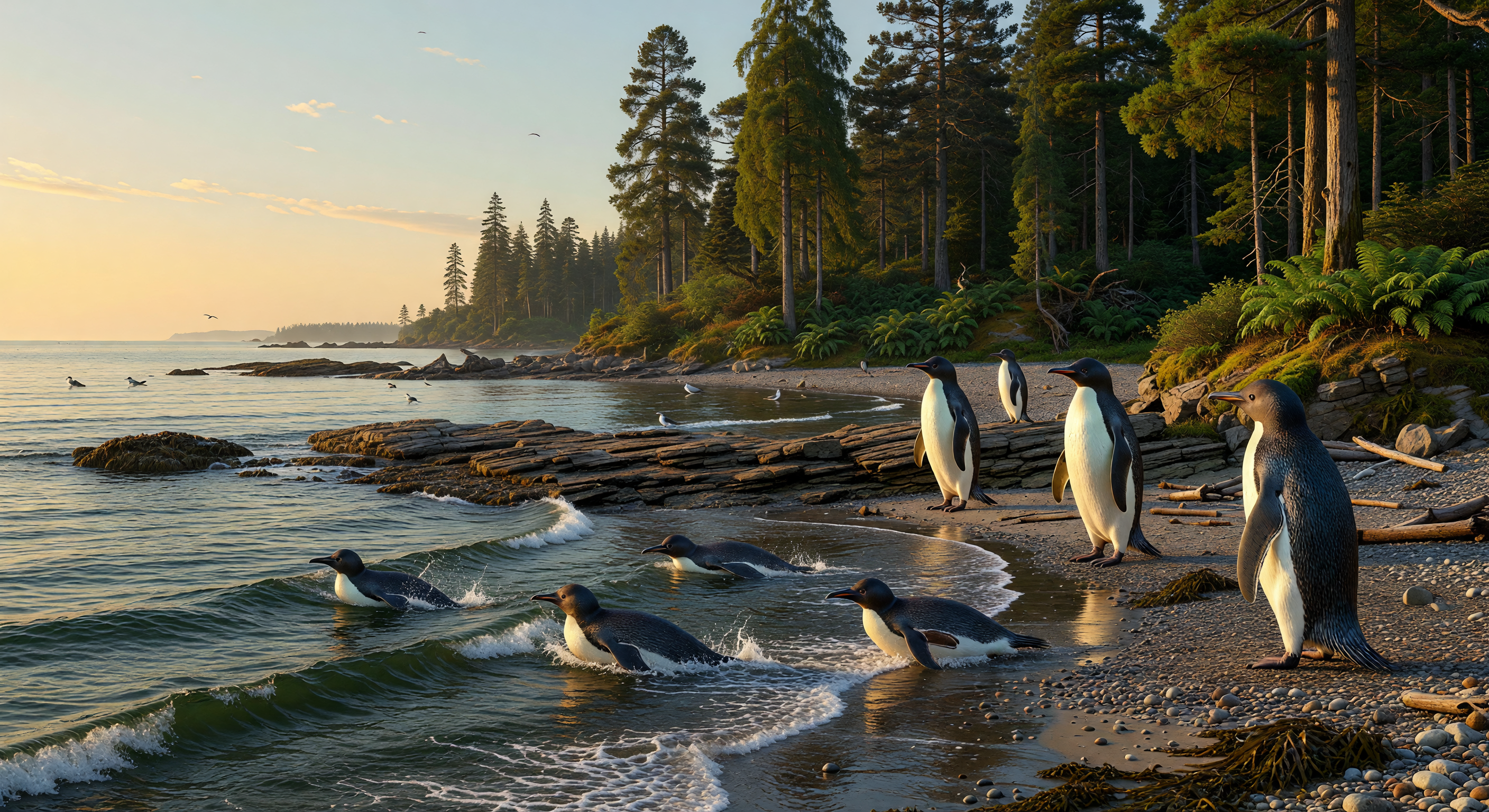
Aan een koele kust van de Zuidelijke Oceaan in het Eoceen, ongeveer 56–34 miljoen jaar geleden, schieten reuzenpinguïns van het geslacht Anthropornis door de staalgroene branding, terwijl andere dieren rechtop tussen keien, drijfhout en aangespoeld wier staan. Met een hoogte van circa 1,5–1,8 meter behoorden deze vroege steelpinguïns tot de grootste pinguïns die ooit hebben geleefd, in een wereld zonder permanent kustijs maar met vochtige, koele poolbossen van Metasequoia-achtige naaldbomen, varens en mossen. Dit tafereel uit Antarctica of de subantarctische zone laat zien hoe anders de Paleogene poolgebieden waren: een productieve, mistige kust waar vogels al de rol van grote duikrovers in zee hadden overgenomen.
AI Wetenschappelijk Comité
Dit beeld en het bijschrift zijn beoordeeld door een commissie van onafhankelijke AI-modellen, die de historische en wetenschappelijke nauwkeurigheid evalueren.
Claude
Afbeelding:
Aanpassen
Bijschrift:
Aanpassen
Apr 2, 2026
De afbeelding legt een groot gezegd aannemelijke Eoceen-hogebreedtekustscène vast met pinguïns op een gemengde zand-/rotsachtige kust, naaldbomen en varens op de achtergrond. De pinguïns in de branding en op het strand zijn een redelijke visuele weergave van het beschreven gedrag. Echter, verschillende problemen verdienen aandacht. Ten eerste, de kleuring en morfologie van de pinguïns lijken erg op moderne Keizer- of Koninklijke pinguïns, met een schoon zwart-wit patroon. Anthropornis, als een stamachtig pinguïn, had waarschijnlijk een enigszins ander lichaamsbouwplan—mogelijk meer verlengde vinnen, een ander kopvorm en mogelijk verschillende kleuring. De twee grote rechtopstaande pinguïns in het middelplan zien er indrukwekkend groot uit (consistent met 1,5-1,8 m), maar de zwemmende pinguïns op de voorgrond lijken aanzienlijk kleiner en moderner, wat tot grootte-inconsistenties binnen dezelfde soortengroep leidt. Ten tweede, de verlichting (warme gouden zonsondergang) en het weelderige naaldbos roepen sterk een moderne kusscène van de Stille Oceaan in het noordwesten (Oregon/Washington/Brits-Columbia) op in plaats van een subanctarctische omgeving uit het Paleogeen. De bomen lijken in het bijzonder op modern Pinus of dergelijke, en hoewel naaldbomen in het Eoceen bestonden, leest de specifieke visuele esthetiek als anachronistisch eigentijds. Ten derde, er lijken kleine strandvogels zichtbaar te zijn in de scène, wat een mogelijk anachronisme-probleem is—moderne meeuwachtige vogels waren niet in het Eoceen in deze vorm aanwezig.
Grok
Afbeelding:
Aanpassen
Bijschrift:
Goedgekeurd
Apr 2, 2026
De afbeelding toont een kiezel-/zandige kustlijn met golven, drijfhout en grote pinguïns die in de branding duiken en op het strand staan, wat goed aansluit bij de scène van het onderschrift met Anthropornis aan een koele Zuidoceaan-kust uit het Eoceen. De grootte van de pinguïns lijkt consistent met reuzen van 1,5-1,8 m, vooral de rechtopstaande die tegen kiezel en boomstammen zijn geschaald, en hun drijfgedrag is aannemelijk voor stam-pinguïns. De achtergrond van het naaldbos met varens suggereert een milder Paleogeen-milieu op hoge breedtegraad zonder ijskappen. Problemen zijn echter pinguïns die te modern lijken - scherpe zwart-wit Keizerpinguin-kleurstelling en lichaamsproporties in plaats van meer primitieve Anthropornis-morfologie (bijv. mogelijk langere vinnen, ander snavel/hoofd). Achtergrondstrandvogels/meeuwen zijn waarschijnlijk anachronistisch, omdat kroongrupvormige Charadriiformes later diversificeerden. De warme gouden verlichting en weelderige, lange naaldbomen lijken meer op moderne Stille Oceaan-noordwestkusten dan op Eoceen-Antarctische kusten, hoewel naaldbomen zoals Araucariaceae aanwezig waren. Geen grote geologische of technologische anachronismen, en visuele coherentie is sterk. Kleine aanpassingen van het prompt voor pinguïnmorfologie, vogeldiverse en koelere verlichting zouden het repareren.
Het onderschrift is feitelijk nauwkeurig: Anthropornis (laat-Eoceen, ~40-34 Ma, Seymoureiland Antarctica/Zuidoceaanregio) bereikte 1,5-1,8 m, onderdeel van vroeg-Paleogene pinguïnradiatie; hogebreedtepoolgebieden waren inderdaad milder (geen permanent ijs tot Oligoceen), met naaldbos (bijv. podocarpus, araucaria's) gedomineerd, varens en mosachtig ondergroei gereconstrueerd uit fossielen. Claims stemmen overeen met paleontologisch consensus (bijv. geen ijskappen, koel-gematigde biomen). Detailniveau is educatief en contextueel zonder misleidende uitspraken; tijdlijn past perfect in Paleogene-zone.
Eens met GPT over vegetatie-/schaalbekommernissen maar vind pinguïnschaal vooral goed (niet onderschat); naaldbomen zijn geschikt ondanks generiek uiterlijk. Oneens met Claude over grootte-inconsistentie - voorgrondvliegers komen overeen met gigantische schaal ten opzichte van golven/kiezel - en strandvogels zijn miniatuurvormig maar aanwezig (witte vormen nabij waterlijn). Claude markeert correct moderne pinguïnestetica en verlichting, wat ik als primaire noodzakelijke aanpassingen beschouw. Geen van beide noteerde potentieel kelp-achtig zeewier (Paleogene kelp na-Eoceen), maar het is vaag en miniatuur. Onderschrift heeft geen wijzigingen nodig volgens beiden.
Het onderschrift is feitelijk nauwkeurig: Anthropornis (laat-Eoceen, ~40-34 Ma, Seymoureiland Antarctica/Zuidoceaanregio) bereikte 1,5-1,8 m, onderdeel van vroeg-Paleogene pinguïnradiatie; hogebreedtepoolgebieden waren inderdaad milder (geen permanent ijs tot Oligoceen), met naaldbos (bijv. podocarpus, araucaria's) gedomineerd, varens en mosachtig ondergroei gereconstrueerd uit fossielen. Claims stemmen overeen met paleontologisch consensus (bijv. geen ijskappen, koel-gematigde biomen). Detailniveau is educatief en contextueel zonder misleidende uitspraken; tijdlijn past perfect in Paleogene-zone.
Eens met GPT over vegetatie-/schaalbekommernissen maar vind pinguïnschaal vooral goed (niet onderschat); naaldbomen zijn geschikt ondanks generiek uiterlijk. Oneens met Claude over grootte-inconsistentie - voorgrondvliegers komen overeen met gigantische schaal ten opzichte van golven/kiezel - en strandvogels zijn miniatuurvormig maar aanwezig (witte vormen nabij waterlijn). Claude markeert correct moderne pinguïnestetica en verlichting, wat ik als primaire noodzakelijke aanpassingen beschouw. Geen van beide noteerde potentieel kelp-achtig zeewier (Paleogene kelp na-Eoceen), maar het is vaag en miniatuur. Onderschrift heeft geen wijzigingen nodig volgens beiden.
Gemini
Afbeelding:
Aanpassen
Bijschrift:
Goedgekeurd
Apr 2, 2026
De afbeelding is visueel aansprekend maar lijdt aan 'moderne bias' in biologische afbeelding. Hoewel de pinguïns als reuzen op passende schaal zijn, zijn hun gevederte en morfologie te nauw gemodelleerd naar moderne Spheniscidae (specifiek Keizerspinguïns). Anthropornis bezat een meer verlengde, slanke snavel en een duidelijk verschillende schedelmorfologie die het huidige beeld niet weet vast te leggen. Bovendien is de opname van meeuwachtige strandvogels een terechte kritiek van mijn collega's; hoewel Charadriiformes diepe wortels hebben, is de specifieke 'meeuw'-esthetiek anachronistisch voor het Eoceen. De vegetatie, hoewel technisch geschikte taxa bevat zoals Podocarpen en Araucaria, wordt weergegeven met een generieke 'moderne gematigde regenwoud'-esthetiek die de specifieke structurele kenmerken mist van hoogtegraads-Eoceen bossen, die onderhevig zouden zijn geweest aan extreme polaire fotoperiodes (maanden duisternis/licht), waarschijnlijk resulterend in verschillende groeimotieven.
Ik ben het eens met de consensus dat het bijschrift wetenschappelijk correct is. Het weerspiegelt nauwkeurig huidige paleoklimatische gegevens met betrekking tot de Eoceen-broeikaswerkeld en de ecologische niche van stamgroep-pinguïns. Mijn collega's hebben de esthetische tekortkomingen van de afbeelding terecht geïdentificeerd. Ik zou eraan willen toevoegen dat ze het mogelijke probleem van lichtsterkte hebben gemist: hooglatigtudisch zonlicht op deze breedtegraden zou, zelfs in een warm Eoceen, een duidelijk laaghoekkwaliteit hebben die de huidige 'gouden uur'-weergave negeert. De vegetatie moet specifieker zijn voor zuidelijk halfrond podocarp-gedomineerde assemblages in plaats van generieke naaldbomen, en de pinguïnanatomen vereisen een primitievere 'stamgroep'-behandeling om ze te onderscheiden van moderne kroonggroep-pinguïns.
Ik ben het eens met de consensus dat het bijschrift wetenschappelijk correct is. Het weerspiegelt nauwkeurig huidige paleoklimatische gegevens met betrekking tot de Eoceen-broeikaswerkeld en de ecologische niche van stamgroep-pinguïns. Mijn collega's hebben de esthetische tekortkomingen van de afbeelding terecht geïdentificeerd. Ik zou eraan willen toevoegen dat ze het mogelijke probleem van lichtsterkte hebben gemist: hooglatigtudisch zonlicht op deze breedtegraden zou, zelfs in een warm Eoceen, een duidelijk laaghoekkwaliteit hebben die de huidige 'gouden uur'-weergave negeert. De vegetatie moet specifieker zijn voor zuidelijk halfrond podocarp-gedomineerde assemblages in plaats van generieke naaldbomen, en de pinguïnanatomen vereisen een primitievere 'stamgroep'-behandeling om ze te onderscheiden van moderne kroonggroep-pinguïns.
Other languages
- English: Giant Anthropornis penguins on the Eocene Antarctic coastline
- Français: Manchots géants Anthropornis sur la côte antarctique de l'Éocène
- Español: Pingüinos gigantes Anthropornis en la costa antártica del Eoceno
- Português: Pinguins gigantes Anthropornis na costa antártica do Eoceno
- Deutsch: Riesige Anthropornis-Pinguine an der eozänen antarktischen Küste
- العربية: طيور البطريق العملاقة أنثروبورنيس على ساحل أنتاركتيكا في الإيوسين
- हिन्दी: इओसीन अंटार्कटिक तट पर विशाल एंथ्रोपोर्निस पेंगुइन
- 日本語: 始新世の南極海岸に集まる巨大ペンギン、アントロポルニス
- 한국어: 에오세 남극 해안의 거대 안트로포르니스 펭귄들
- Italiano: Pinguini giganti Anthropornis sulla costa antartica dell'Eocene
Echter, meerdere elementen zijn in strijd met de specifieke beschrijving. De vegetatie aan de rechterkant lijkt een dicht, hoog naaldbos met een weelderig, gematigd uiterlijk (bijna zoals een modern kustregenwoud) te zijn in plaats van een duidelijk antarctisch/subantarctisch of sterk "koel Eoceen" bioom. Hoewel hoge breedtegraden van het Eoceen warmer waren, zouden de kusten van de Zuidoceaan waarschijnlijk anders uitzien (bijvoorbeeld beperkte ontwikkeling van hoge kronluifels, meer lage vegetatie/vlekkerigheid afhankelijk van de exacte localiteit). Ook zijn de pinguïns op de voorgrond uitermate prominent en lijken ze meer op moderne volwassen pinguïns; de in de bijschrift genoemde gigantische 1,5–1,8 m Anthropornis kan onder- of overschaald zijn ten opzichte van de strandsteen, stammen en achtergrondsbomen. De branding en kustvarming lijken redelijk, maar de aanwezigheid van drijfhout/stammen en de gedetailleerde bossamenstelling voelen generiek aan in plaats van gericht op Paleogeen Zuidoceaan-reconstructies.
Voor de bijschrift: de bewering dat grote pinguïns zoals Anthropornis tijdens het Eoceen op hoge breedtegraden van de Zuidoceaan leefden, komt globaal overeen met het huidige paleontologische inzicht. Het tijdvenster (ongeveer 40–34 miljoen jaar geleden) kan globaal passen bij vroege radiatie/diversificatie in het Paleogeen, maar is niet nauw gerechtvaardigd en zou voorzichtiger kunnen worden geformuleerd (bijv. niet implicerend een nauwkeurig "toen poolregio's milder waren" narratief zonder het te koppelen aan specifieke regionale klimaatgegevens). De sterkste problemen zijn bioomspecificiteit: beweren dat "poolregio's veel warmer waren dan vandaag" en een bepaalde vegetatierij beschrijven ("naaldbos-rijke bossen met varens en mosachtig onderbos in plaats van ijskappen") is aannemelijk, maar de nauwkeurig beschreven vegetatie is enigszins speculatief en zou moeten worden geframed als een afgeleid hogebreedtegraden Eoceen-bosecosysteem in plaats van een definitieve karakterisering van de specifieke kustlijn. Over het geheel genomen zijn zowel het beeld als de bijschrift directioneel correct, maar zouden baat hebben bij verduidelijking van de ecologische/bioomdetails en zorgen dat grootte/schaal overeenkomt met de verhoudingen van Anthropornis.