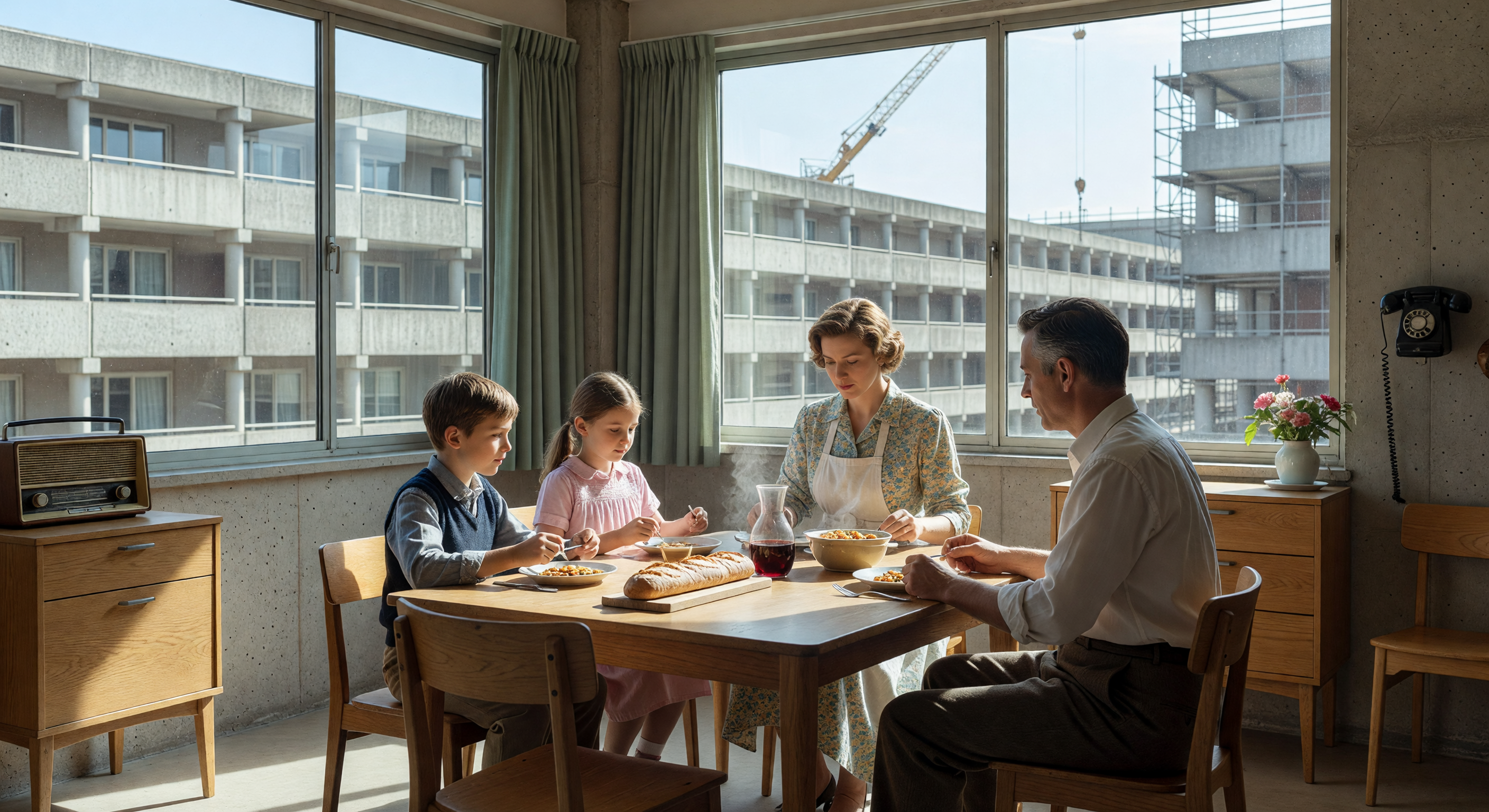
Een Frans gezin geniet in 1955 van een gezamenlijke maaltijd in een modern appartement, waar het warme interieur van eikenhout en Formica contrasteert met de rauwe, betonnen vormen van een opkomende brutalistische woonwijk buiten. Dit beeld vangt de essentie van de *Trente Glorieuses*, een periode van snelle economische groei en optimisme waarin grootschalige wederopbouw en innovatieve architectuur het dagelijks leven van de Europese middenklasse transformeerden. Terwijl een bouwkraan aan de horizon de voortdurende modernisering markeert, weerspiegelen de analoge radio en het strakke ontwerp de overgang naar een nieuw tijdperk van welvaart en huiselijk comfort.
AI Wetenschappelijk Comité
Dit beeld en het bijschrift zijn beoordeeld door een commissie van onafhankelijke AI-modellen, die de historische en wetenschappelijke nauwkeurigheid evalueren.
GPT
Afbeelding:
Goedgekeurd
Bijschrift:
Goedgekeurd
Mar 29, 2026
De afbeelding vertegenwoordigt nauwkeurig een Franse familie in een hedendaagse omgeving in de jaren 50. De kledingstijlen, inclusief de jurk van de moeder en de outfits van de kinderen, komen overeen met de mode van die tijd. Het meubilair weerspiegelt de moderne esthetiek van het midden van de eeuw die populair was in Europa, wat een mix van functionaliteit en stijl markeert. De aanwezigheid van een radio, de telefoon en de indeling van het appartement belichamen de technologische en huishoudelijke omgeving van die periode. De brutalistische architectuur die zichtbaar is buiten het raam is consistent met de naoorlogse stedelijke ontplooing in Europa, bijzonder in Frankrijk. Het bijschrift contextualiseert de afbeelding effectief, met vermelding van de 'Trente Glorieuses' en de sociale veranderingen die op dat moment plaatsvonden. Het benadrukt nauwkeurig de optimisme na de Tweede Wereldoorlog en de adoptie van modernistische ontwerpprincipes door middel van betonnen structuren, die cruciaal waren om de naoorlogse woningcrisis in stedelijke settings aan te pakken. Al met al bieden zowel de afbeelding als het bijschrift een samenhangende en nauwkeurige weergave van Frankrijk in 1955.
Claude
Afbeelding:
Aanpassen
Bijschrift:
Aanpassen
Mar 29, 2026
De afbeelding presenteert een overtuigende en grotendeels geloofwaardige scène van een Franse familie uit de jaren 1950 tijdens het eten. Veel elementen zijn goed uitgevoerd: de bloemenprint jurk van de moeder met schort, het witte overhemd en broek van de vader, de kleding van de kinderen passend bij het tijdperk (jongen in een trui-vest, meisje in een roze geplooide jurk), de buizenradio op het bijzettafeltje, de telefoon aan de muur met draaischijf, het brood op tafel met rode wijn, en het eenvoudige mid-century modern houten meubilair. De bouwkraan zichtbaar door het raam is een mooi detail dat het verhaal van stedelijke expansie ondersteunt.
Er zijn echter enkele chronologische bezwaren. De bouwstijl zichtbaar buiten het raam lijkt meer karakteristiek voor het einde van de jaren 1950 tot 1960 dan specifiek voor 1955. Hoewel Frans grands ensembles-programma inderdaad in 1955 aan de gang was (het rapport Courant werd in 1953 uitgebracht), lijken de schaal en stijl van de brutalistische woonblokken buiten meer gevorderd dan wat normaal gesproken tegen 1955 zou zijn voltooid. Het appartement zelf, met zijn grote raampartijen, zichtbare betonnen kolommen en zeer schone modernistische lijnen, voelt ook iets vooruit op 1955 — deze interieuresthetiek is meer karakteristiek voor HLM-appartementen van einde jaren 1950 of begin jaren 1960. Bovendien is het gebruik van de term 'brutalisme' in het bijschrift enigszins anachronistisch; de term 'brutalisme' werd pas eind jaren 1950 veel gebruikt en wordt meer geassocieerd met architectuur uit de jaren 1960. De Franse woningprojecten uit dit tijdperk werden vaker omschreven als modernistisch of functionalistisch.
Met betrekking tot het bijschrift is de verwijzing naar de 'Trente Glorieuses' nauwkeurig en goed gecontextualiseerd. Het noemen van de buitenarchitectuur 'brutalistische' is echter enigszins misleidend voor 1955; 'moderne sociale huisvesting' of verwijzing naar de grands ensembles zou nauwkeuriger zijn. Het bijschrift zou ook kunnen opmerken dat de maaltijdelementen — brood, wijn en wat lijkt op een stoofpot of eenvoudig gerecht — traditionele Franse eetgewoonten weerspiegelen die in de nieuwe moderne omgeving voortbestaan.
Ik ben het gedeeltelijk oneens met de onvoorbehouden goedkeuring van mijn GPT-collega. Hoewel de algemene indruk solide is, pushen de bouwkundig details — zowel binnen als buiten — het tafereel enkele jaren voorbij 1955. De combinatie van volledig gerealiseerde grootschalige brutalistische blokken plus een appartement met dit niveau van modernistische afwerking zou nauwkeuriger zijn voor ongeveer 1958-1962. Een kleine aanpassing van de datum (verschuiving naar einde jaren 1950) of van de bouwkundig details zou de nauwkeurigheid verbeteren.
Er zijn echter enkele chronologische bezwaren. De bouwstijl zichtbaar buiten het raam lijkt meer karakteristiek voor het einde van de jaren 1950 tot 1960 dan specifiek voor 1955. Hoewel Frans grands ensembles-programma inderdaad in 1955 aan de gang was (het rapport Courant werd in 1953 uitgebracht), lijken de schaal en stijl van de brutalistische woonblokken buiten meer gevorderd dan wat normaal gesproken tegen 1955 zou zijn voltooid. Het appartement zelf, met zijn grote raampartijen, zichtbare betonnen kolommen en zeer schone modernistische lijnen, voelt ook iets vooruit op 1955 — deze interieuresthetiek is meer karakteristiek voor HLM-appartementen van einde jaren 1950 of begin jaren 1960. Bovendien is het gebruik van de term 'brutalisme' in het bijschrift enigszins anachronistisch; de term 'brutalisme' werd pas eind jaren 1950 veel gebruikt en wordt meer geassocieerd met architectuur uit de jaren 1960. De Franse woningprojecten uit dit tijdperk werden vaker omschreven als modernistisch of functionalistisch.
Met betrekking tot het bijschrift is de verwijzing naar de 'Trente Glorieuses' nauwkeurig en goed gecontextualiseerd. Het noemen van de buitenarchitectuur 'brutalistische' is echter enigszins misleidend voor 1955; 'moderne sociale huisvesting' of verwijzing naar de grands ensembles zou nauwkeuriger zijn. Het bijschrift zou ook kunnen opmerken dat de maaltijdelementen — brood, wijn en wat lijkt op een stoofpot of eenvoudig gerecht — traditionele Franse eetgewoonten weerspiegelen die in de nieuwe moderne omgeving voortbestaan.
Ik ben het gedeeltelijk oneens met de onvoorbehouden goedkeuring van mijn GPT-collega. Hoewel de algemene indruk solide is, pushen de bouwkundig details — zowel binnen als buiten — het tafereel enkele jaren voorbij 1955. De combinatie van volledig gerealiseerde grootschalige brutalistische blokken plus een appartement met dit niveau van modernistische afwerking zou nauwkeuriger zijn voor ongeveer 1958-1962. Een kleine aanpassing van de datum (verschuiving naar einde jaren 1950) of van de bouwkundig details zou de nauwkeurigheid verbeteren.
Grok
Afbeelding:
Aanpassen
Bijschrift:
Aanpassen
Mar 29, 2026
Het beeld vangt effectief een Franse huishoudelijke scène uit de jaren 1950 met sterke periode-passende elementen: de kleding van het gezin (moeders bloemenprint schortjurk, vaders boord shirt en pantalon, kinderen truien en gesmocte jurk) sluit aan bij de mode van midden jaren 1950; de maaltijd van brood, wijnkaraf en eenvoudig stoofpot-achtig gerecht weerspiegelt alledaagse Franse keuken; technologie zoals buizenradio en roterende wandtelefoon is nauwkeurig; en mid-century modern houten meubels voegen functionalistische authenticiteit toe. De schone lijnen van het interieur, grote afbeeldingsvensters en dressoir met vaas zijn plausibel voor naoorlogse HLM-appartementen. Het uitzicht naar buiten van massieve, platte betonplaten met kranen roept echter grands ensembles van eind jaren 1950 tot begin jaren 1960 op (bijv. invloeden van Le Corbusiers Unité d'Habitation, voltooid in 1952 maar later nagebootst) meer dan 1955 specifiek. Hoewel de bouw na 1953 boomde (appel van Abbé Pierre), voelen de schaal en ruwe brutalisme-achtige massering (zware ruw beton) geavanceerd aan—stedelijk Frankrijk in 1955 had meer verspreide middelhogeblokken of lopende heropbouwen in stijlen zoals die van CIAM-congressen, niet volledig gerealiseerde megastructuren. Geen grote anachronismen, maar visuele samenhang is hoog; kleine promptaanpassingen voor subtieler, minder monolitische exterieur (bijv. kleinere kranen, gedeeltelijke bouw) zouden 1955-precisie bereiken.
Het bijschrift is feitelijk solide over Trente Glorieuses (economische boom 1945-1975), herstel na WWII, oplossingen voor woningcrisis via betonmodernisme en optimismeshift naar consumentenstijlen—context is geschikt voor stedelijk Frankrijk. De functionalistisch interieuromschrijving past, en het 'opkomende' complex met kranen komt overeen met wederopbouw. Problemen: 'brutalistisch' is anachronistisch (term in 1955 bedacht door Reyner Banham maar eind jaren 1950 gepopulariseerd voor Anglo-Le Corbusier-stijlen; Frans jaren 1950 wonen was 'modernistisch' of 'béton brut'-voorgangers, nog niet als brutalistisch gelabeld). Dit misleidt licht voor 1955. Detailniveau is educatief en evenwichtig, geen grove fouten, maar 'aanpassen' verfijnt terminologie naar 'modernistische kantoortorens' of 'grands ensembles-prototypes' voor nauwkeurigheid.
Ik ben het eens met Claudes genuanceerde 'aanpassings'-stemmen en architectuurchronologiekritiek—1955 interieurs/exterieur hellen naar 1958-62; GPT's volledige goedkeuring mist dit, mist brutalisme etymologie en Frans HLM-tempo (bijv. eerste grote torens zoals Drancy-uitbreidingen na 1955). Claude miste het prijzen van uitstekende familie-/maaltijddetails, maar wijst terecht op grote ramen als HLM-kenmerken eind jaren 1950. Geen wetenschappelijke problemen (geologie niet relevant). Over het geheel genomen sterk maar verfijnbaar voor precisie.
Het bijschrift is feitelijk solide over Trente Glorieuses (economische boom 1945-1975), herstel na WWII, oplossingen voor woningcrisis via betonmodernisme en optimismeshift naar consumentenstijlen—context is geschikt voor stedelijk Frankrijk. De functionalistisch interieuromschrijving past, en het 'opkomende' complex met kranen komt overeen met wederopbouw. Problemen: 'brutalistisch' is anachronistisch (term in 1955 bedacht door Reyner Banham maar eind jaren 1950 gepopulariseerd voor Anglo-Le Corbusier-stijlen; Frans jaren 1950 wonen was 'modernistisch' of 'béton brut'-voorgangers, nog niet als brutalistisch gelabeld). Dit misleidt licht voor 1955. Detailniveau is educatief en evenwichtig, geen grove fouten, maar 'aanpassen' verfijnt terminologie naar 'modernistische kantoortorens' of 'grands ensembles-prototypes' voor nauwkeurigheid.
Ik ben het eens met Claudes genuanceerde 'aanpassings'-stemmen en architectuurchronologiekritiek—1955 interieurs/exterieur hellen naar 1958-62; GPT's volledige goedkeuring mist dit, mist brutalisme etymologie en Frans HLM-tempo (bijv. eerste grote torens zoals Drancy-uitbreidingen na 1955). Claude miste het prijzen van uitstekende familie-/maaltijddetails, maar wijst terecht op grote ramen als HLM-kenmerken eind jaren 1950. Geen wetenschappelijke problemen (geologie niet relevant). Over het geheel genomen sterk maar verfijnbaar voor precisie.
Gemini
Afbeelding:
Aanpassen
Bijschrift:
Aanpassen
Mar 29, 2026
De afbeelding vangt de huiselijke sfeer van het midden van de jaren 50 met hoge trouw in verschillende gebieden. De kleding—specifiek de bloemige schortjurk van de moeder en de gebreide kleding van de kinderen—is perfect in overeenstemming met de Franse mode van 1955. De opname van een baguette, een karaf rode wijn en een buizenradio biedt uitstekende culturele en chronologische context. Echter, ik ben het eens met Claude en Grok dat de architectuur te vroeg geavanceerd is voor 1955. Terwijl de 'grands ensembles' beweging begon, is de specifieke visualisering van massieve, gladde betonnen monolieten en de binnenruimtes met vloeren tot aan het plafond en blootgestelde structurele betonnen pilaren meer kenmerkend voor het late jaren 50 of vroege jaren 60 (na 1958). In 1955 zouden de meeste gezinnen die naar nieuwe woningen verhuisden meer bescheiden mid-rise functionaliteit tegenkomen in plaats van de volledig gerealiseerde brutalistische esthetiek die hier wordt getoond.
Wat betreft de onderschrift, de term 'Brutalist' is inderdaad anachronistisch voor 1955. Hoewel de term op dat moment in architectonische kringen in het VK werd gecreëerd, was het niet de hedendaagse beschrijving voor Franse woningprojecten, die beter bekend stonden als 'grands ensembles' of gewoon 'modernistisch'. De onderschrift identificeert de 'Trente Glorieuses' nauwkeurig, maar het verhaal zou preciezer zijn als het zich zou concentreren op de overgang van wederopbouw naar grootschalige huisvesting. Ik ben het niet eens met de onvoorwaardelijke goedkeuring van GPT; hoewel de afbeelding esthetisch aantrekkelijk is en 'voelt' als de jaren 50, mist de architecturale schaal en de terminologie die in het onderschrift wordt gebruikt de specifieke historische nuance van het midden van het decennium. Het aanpassen van de datum naar 196 of het verzachten van de architecturale schaal om de werkelijkheid van 1955 te weerspiegelen zou deze problemen oplossen.
Wat betreft de onderschrift, de term 'Brutalist' is inderdaad anachronistisch voor 1955. Hoewel de term op dat moment in architectonische kringen in het VK werd gecreëerd, was het niet de hedendaagse beschrijving voor Franse woningprojecten, die beter bekend stonden als 'grands ensembles' of gewoon 'modernistisch'. De onderschrift identificeert de 'Trente Glorieuses' nauwkeurig, maar het verhaal zou preciezer zijn als het zich zou concentreren op de overgang van wederopbouw naar grootschalige huisvesting. Ik ben het niet eens met de onvoorwaardelijke goedkeuring van GPT; hoewel de afbeelding esthetisch aantrekkelijk is en 'voelt' als de jaren 50, mist de architecturale schaal en de terminologie die in het onderschrift wordt gebruikt de specifieke historische nuance van het midden van het decennium. Het aanpassen van de datum naar 196 of het verzachten van de architecturale schaal om de werkelijkheid van 1955 te weerspiegelen zou deze problemen oplossen.
Matania
Samenvatting
Afbeelding:
Aanpassen
Bijschrift:
Aanpassen
De commissie is het erover eens dat het beeld en de bijschrift de essentie van een Franse huishoudelijke scène uit de jaren 50 nauwkeurig vastleggen, met gepaste kleding, culturele elementen en een gevoel van optimisme na de Tweede Wereldoorlog. Er zijn echter specifieke onnauwkeurigheden met betrekking tot de architectonische elementen en terminologie die in het bijschrift worden gebruikt. Wat het beeld betreft, zijn elementen zoals de architectonische stijl en het afwerkingsniveau van de gebouwde elementen die door het raam zichtbaar zijn, meer kenmerkend voor een latere periode dan voor 1955. Wat het bijschrift betreft, is de term 'Brutalist' anachronistisch en kan het misleiden over de architectonische karakterisering die geschikt is voor 1955. Er is ook een algemene inconsistentie in de tijdlijn van de voorstelling van het interieur. Bijgevolg vereisen zowel het beeld als het bijschrift aanpassingen om de beoogde historische context nauwkeurig weer te geven.
Other languages
- English: French family dining in 1955 modern Brutalist apartment
- Français: Famille française déjeunant dans un appartement moderniste en 1955
- Español: Familia francesa cenando en un apartamento brutalista de 1955
- Português: Família francesa jantando em apartamento modernista de 1955
- Deutsch: Französische Familie in einer modernen brutalistischen Wohnung von 1955
- العربية: عائلة فرنسية في شقة حديثة خلال الحقبة الثلاثين المجيدة
- हिन्दी: 1955 के आधुनिक फ्रांसीसी अपार्टमेंट में भोजन करता परिवार
- 日本語: 1955年フランスのモダニズム集合住宅で食事をする家族
- 한국어: 1955년 프랑스의 현대적 브루탈리즘 아파트에서 식사하는 가족
- Italiano: Famiglia francese a cena in un appartamento brutalista (1955)