A busy street near the imperial basilica of Augusta Treverorum (modern Trier) evokes the daily commerce of one of the Roman Empire’s principal northern capitals in the 4th century CE. Townspeople in practical wool and linen garments browse bread and pottery among timber-fronted shops built into masonry structures roofed with terracotta tiles, while the great brick basilica looms behind as a symbol of imperial authority. The scene reflects Trier’s role as an administrative and commercial hub in late Roman Gaul, where local traditions and wider Mediterranean material culture met within a thriving walled city.

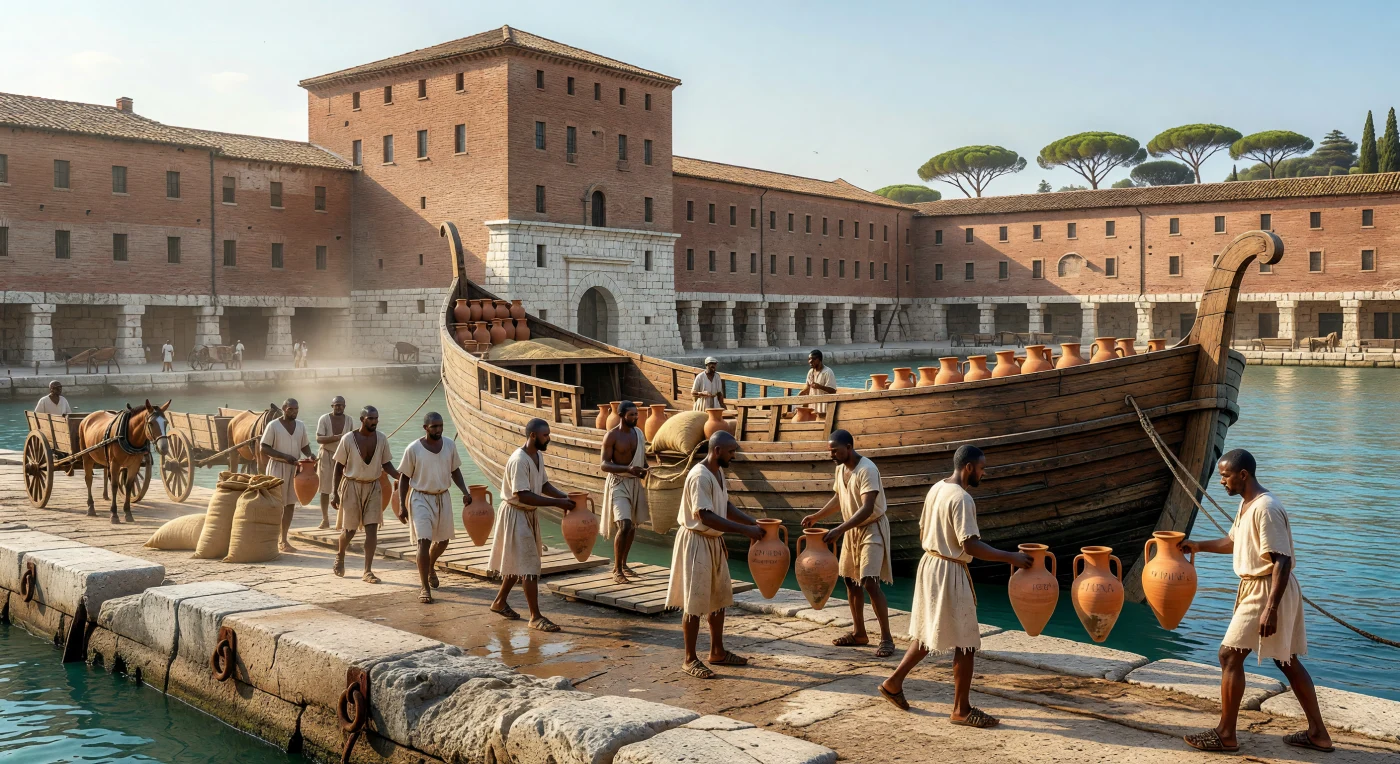
On the Rhine frontier in the 4th century CE, soldiers, dockworkers, and merchants crowd a timber quay as shallow wooden barges are unloaded with amphorae, barrels, sacks, and bundled goods beneath the walls of a late Roman fort. Such river ports were vital to the empire’s military logistics, supplying frontier garrisons with grain, oil, wine, and other essentials carried along the Rhine’s dense transport network. The scene reflects the mixed population of the border provinces, where Roman administration, commerce, and local frontier communities met in an active imperial landscape.

Auxiliary soldiers patrol a stone milecastle on Hadrian’s Wall, their mail shirts, wool tunics, and oval shields darkened by the damp chill of northern Britannia. Built beginning in the 120s CE under Emperor Hadrian, the Wall was a fortified frontier system of gates, towers, ditches, and roads rather than a simple barrier, garrisoned by troops drawn from many provinces of the Roman Empire. The scene captures the exposed reality of service at Rome’s far northwestern edge, where military order met a wet moorland landscape beyond imperial control.

In this reconstruction of a 3rd-century villa estate in northern Gaul, farm workers harvest grain with iron sickles while cattle and sheep graze near hedged fields and trackways. Behind them stands a practical Gallo-Roman villa rustica, with rendered masonry walls, painted plaster, tile roofs, and working outbuildings arranged around a barnyard. Such estates linked local agricultural labor to the wider Roman economy, producing food and surplus within a landscape that blended indigenous Gallic traditions with Roman building methods and rural management.
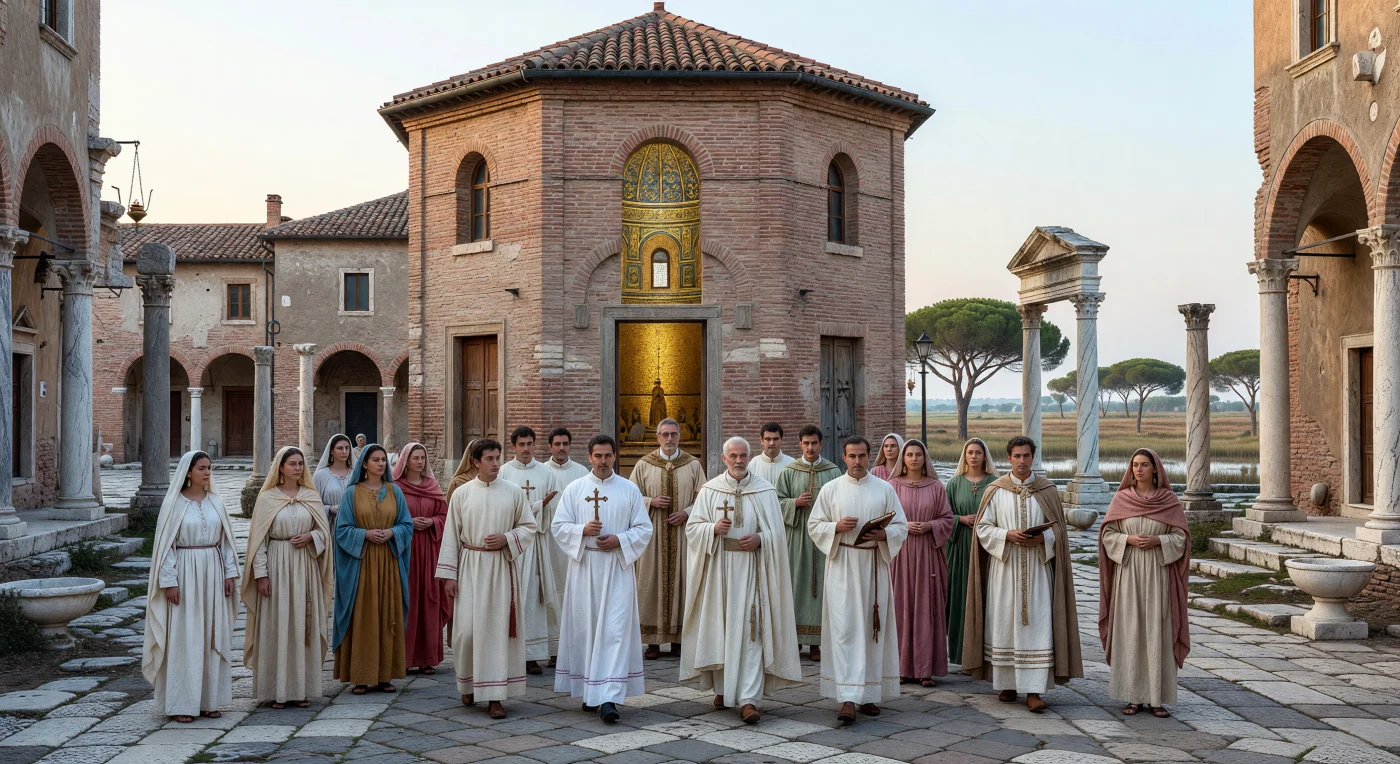
A solemn baptismal procession advances through the streets of 5th-century Ravenna toward an octagonal brick baptistery, where white-robed clergy lead catechumens past spolia from the Roman past and into the new ceremonial life of the Christian city. Veiled women, civic dignitaries, and modestly dressed townspeople reflect Ravenna’s role as both an imperial residence and a major center of early Christianity in Late Antiquity. The plain brick exterior and glittering mosaic interior evoke the distinctive architecture of Ravenna, where new sacred spaces rose amid the reused materials and fading monuments of the Roman world.
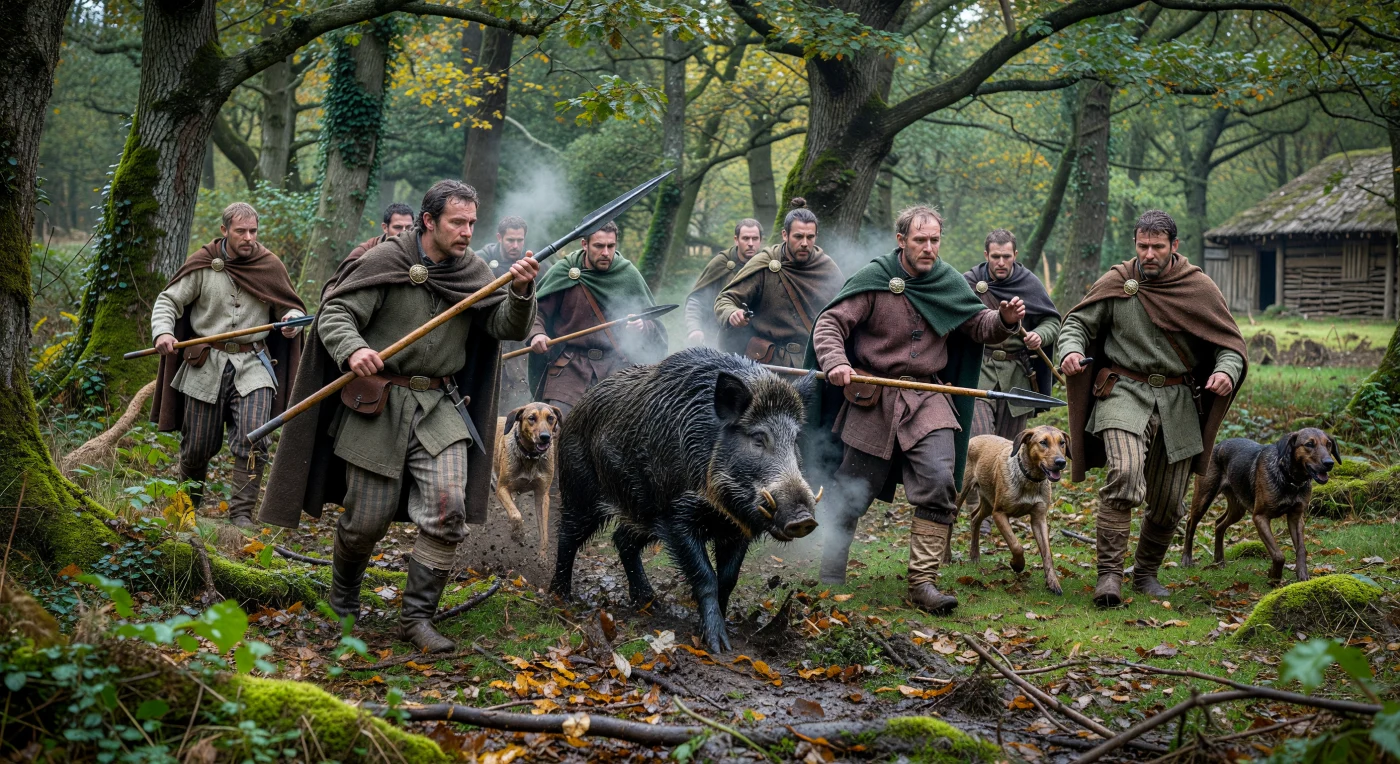
In a rain-darkened woodland of fifth-century western Europe, hunters and hounds press a wild boar through oak and beech undergrowth, their wool cloaks, belted tunics, trousers, and simple spears reflecting the practical dress of the post-Roman rural elite. The scene evokes northern Gaul or Aquitaine in the decades after imperial authority weakened, when status was still displayed through good wool, metal brooches, and heirloom fittings rather than heavy armor or courtly finery. Boar hunting was both a dangerous necessity and a mark of aristocratic prowess, linking late Roman provincial traditions with the emerging cultures of early medieval Europe.

On a windswept 5th-century North Sea shore, fishers haul a clinker-built boat onto wet sand while nearby women and children gather shellfish and repair nets among the tidal flats. Their woolen tunics, cloaks, dresses, and simple leather shoes reflect the practical clothing of coastal communities in Frisia or Saxon territory at the end of Roman antiquity. The scene evokes a maritime world shaped by estuaries, salt marshes, and small-scale exchange, where fishing, shellfish gathering, and boat handling sustained everyday life along Europe’s northern edge.

In the smoky interior of a 4th-century Gothic hall north of the Black Sea, elite retainers feast on meat and grain dishes while seated at low tables beneath walls hung with spears, shields, and horse tack. Their wool tunics, trousers, cloaks fastened with brooches, and carefully groomed hair and moustaches reflect the dress of high-status warriors in the Chernyakhov cultural zone, a region shaped by both local traditions and close contact with the Roman Empire. Pottery vessels alongside imported Roman glass and metalware evoke a frontier world where Gothic elites adopted foreign luxuries without abandoning their own architectural forms and social customs.