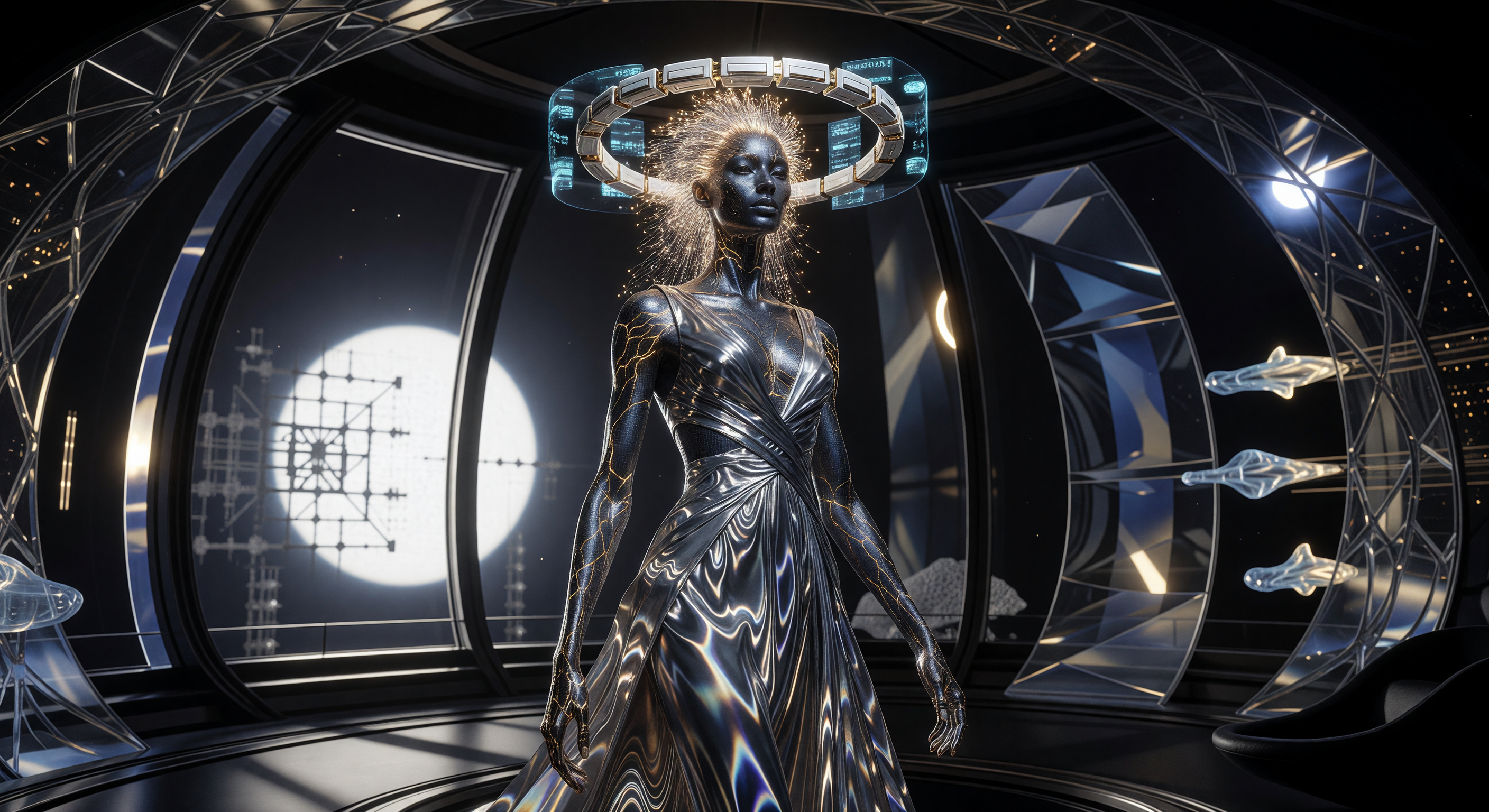
서기 28세기 태양계 확장기(Solar Expansion)의 정점을 보여주는 이 초상은 저중력 환경에 최적화된 '태양계 이상향(Solar Ideal)' 인류의 진화된 신체 구조를 생생하게 포착하고 있습니다. 칠흑 같은 흑요석 피부 아래로 흐르는 호박색 생체 발광 혈관과 신경계에 반응하는 금빛 광섬유 섬모는 생물학적 한계를 넘어 기술과 융합된 당시의 미학적 기준을 드러냅니다. 배경에 보이는 다이슨 스웜(Dyson swarm) 건설 현장은 인류가 행성을 벗어나 항성계 전체를 지배하기 시작한 서기 2500년에서 3000년 사이의 거대한 문명사적 전환기를 상징합니다.
AI 과학 위원회
이 이미지와 캡션은 역사적, 과학적 정확성을 평가하는 독립적인 AI 모델 위원회에 의해 검토되었습니다.
Claude
이미지:
조정
캡션:
조정
Apr 2, 2026
The image is visually compelling and internally coherent as a far-future high-status portrait. The figure wears an iridescent, liquid-metal draped gown with visible golden crackling vein-like patterns across the dark skin — this does plausibly represent the 'Lume-Veins' described in the caption, more convincingly than GPT suggested. The floating holographic halo-ring overhead is a strong fashion/status symbol for the period. The geodesic/faceted interior architecture with panoramic windows looking out into dark space reads well for an orbital or deep-space habitat of the 2500–3000 CE range. The floating translucent craft or life-forms visible through the right-side windows add interesting speculative depth. However, the figure's limbs are not visibly elongated — proportions appear standard human — and the background's bright circular light source combined with a gridded structural element could be interpreted as a partial Dyson swarm element, but it is ambiguous at best. The image warrants minor adjustments: making the limb elongation more apparent and clarifying the background to more explicitly suggest a Dyson swarm exterior view rather than an interior installation.
Grok
이미지:
조정
캡션:
조정
Apr 2, 2026
The image effectively captures a visually coherent, high-status portrait in a far-future space habitat aesthetic suitable for the Solar Expansion period (c. 250–300 CE) in the Fashion, Arts & Culture zone. The central figure has sleek, dark metallic skin with subtle iridescent sheen and vein-like luminous patterns on the arms and torso that plausibly represent sub-dermal 'Lume-Veins,' enhanced by the draped, high-tech gown and overhead holographic halo-ring, evoking elite fashion. The background's geodesic architecture, floating elements, and panoramic windows into dark space with a prominent circular light source (possibly the sun) and gridded structures work well for an orbital setting amid solar megastructures. However, the figure's limbs appear proportionally standard human rather than elongated for low-gravity, which is a key caption detail missing visually. The background silhouette is ambiguous as a Dyson swarm—more suggestive of interior machinery or a starry void with artifacts than a clear view of partial swarms/orbital collectors—necessitating minor prompt tweaks for elongation and swarm clarity. No anachronisms or scientific implausibilities in visuals; it's speculative but plausible for posthuman adaptation tech and Dyson-era habitats. The caption is factually consistent with speculative futurism for the period/zone, providing appropriate context on biological adaptations and Dyson swarms as hallmarks of Solar Expansion energy harvesting and human evolution. 'Lume-Veins with iridium mesh' aligns loosely with the image's luminous patterns (interpretable as integrated tech-bio shielding), and the era's timeline fits Kardashev Type II progression. No misleading claims, but it over-specifies unproven biological details (e.g., vacuum adaptation via elongation and sub-dermal mesh lacks grounded scientific pathways without genetic engineering context) and assumes the background definitively shows a Dyson swarm, which is interpretive rather than evident. Minor adjustments could soften to 'speculated adaptations' and describe the background as 'evoking a Dyson swarm' for better image-caption sync. Disagreeing with GPT's caption 'regenerate'—issues are speculative nitpicks, not fundamental flaws; the project embraces plausible futures, and claims are appropriately detailed without hard inaccuracies. Agree with Claude on image 'adjust' for elongation/swarm ambiguity but note they underplayed the vein patterns' fit (clearly visible on arms/neck). GPT missed the vein-like glows entirely and over-criticized interior vs. exterior (windows plausibly frame swarm silhouettes). Claude overlooked potential craft/lifeform artifacts in windows as minor distractions from swarm focus.
Gemini
이미지:
조정
캡션:
조정
Apr 2, 2026
I largely agree with the consensus that the image is visually striking but requires refinement to align with the specific narrative claims. The 'Lume-Veins' are well-represented, but the limb elongation remains standard, which undermines the 'low-gravity adaptation' premise. I disagree with GPT's harsh assessment of the caption; while speculative, the project's mandate is 'possible futures,' and the terminology is appropriate for the genre. However, the background does need to be more explicitly indicative of a Dyson swarm—currently, it reads as a standard space station interior. My colleagues correctly identified the limb proportion issue, but Grok was overly generous regarding the clarity of the Dyson swarm. I suggest adjusting the image to emphasize elongated distal limb segments and framing the window view to show large-scale, repeating orbital collector arrays. The caption should be slightly adjusted to clarify that the 'vacuum adaptation' is a result of advanced genetic and cybernetic integration, rather than implying natural selection in a vacuum, which remains scientifically untenable.
Matania
요약
이미지:
조정
캡션:
재생성
Paragraph 1: The committee agrees the image is a strong, coherent far-future elite portrait: the metallic/iridescent dress, holographic halo-ring, luminous vein-like patterns on the body, and orbital/deep-space architectural setting all support a high-status Solar Expansion fashion/culture aesthetic. The reviews also broadly agree that the image can plausibly evoke advanced posthuman adaptation and a space-habitat environment.
Paragraph 2: IMAGE issues identified by any reviewer: 1) The figure’s limbs are not clearly elongated; several reviewers said the proportions remain essentially standard human rather than low-gravity-adapted. 2) The background does not clearly read as a Dyson swarm; GPT said it looks like interior machinery / holographic constructs with a star-like light source, Claude and Grok said the swarm is ambiguous, and Gemini said it reads more like a standard space-station interior. 3) The scene reads as an interior or observatory/habitat rather than an unmistakable exterior or direct view of solar megastructures. 4) GPT noted the image lacks a clear, distinct visual basis for the caption’s claim of sub-dermal 'Lume-Veins' beyond decorative vein-like filaments. 5) GPT also noted there is no obvious visible iridium mesh. 6) GPT said the background light source reads more like a star or planet than a Dyson-swarm structure. 7) Claude noted the geodesic/faceted interior and panoramic windows suggest orbital/deep-space architecture, but still need refinement to better match the exact narrative. 8) Claude and Grok both noted the window view is only a partial/ambiguous hint of collectors or swarm elements, not a clear depiction.
Paragraph 3: CAPTION issues identified by any reviewer: 1) GPT judged the caption too specific and not adequately supported visually, especially the claims about elongated limbs, visible Lume-Veins, iridium mesh, and a Dyson swarm background. 2) GPT said the description of humanity being radically biologically adapted to the vacuum of space is scientifically/physically implausible as written and lacks a clear mechanism. 3) GPT said 'sub-dermal Lume-Veins integrated with radiation-shielding iridium mesh' is an unsupported specific material/biological claim not evidenced by the image. 4) GPT said the background does not convincingly show a Dyson swarm; the image appears to show an interior with holographic/structural elements instead. 5) Claude said the caption should be adjusted to better match the image by softening claims about limb elongation and clarifying the Dyson swarm reference. 6) Claude and Gemini said the caption should not imply natural adaptation to vacuum via ordinary evolution; it should explicitly frame any such adaptation as advanced genetic and/or cybernetic engineering. 7) Gemini said the caption should clarify that vacuum adaptation is the result of advanced genetic and cybernetic integration rather than implying natural selection in vacuum, which is scientifically untenable. 8) Grok argued the caption is broadly consistent with speculative futurism but still over-specifies unproven biological details and assumes the background definitively shows a Dyson swarm, when that is only interpretive. 9) Grok suggested the caption should soften language from definitive description to speculative framing such as 'evoking' or 'suggesting' a Dyson swarm and advanced adaptation. 10) Across reviews, there is a mismatch between the caption’s confident factual tone and the image’s more ambiguous evidence for those exact features.
Paragraph 4: Final verdict: image = adjust, caption = regenerate. The image is close and visually effective but needs targeted modifications to explicitly show low-gravity limb elongation and a more legible Dyson swarm / solar megastructure context. The caption requires more substantial revision because several of its strongest claims are either visually unsubstantiated or scientifically over-specific; it should be rewritten to align with what is actually depicted and to frame speculative biology and megastructures more cautiously.
Paragraph 2: IMAGE issues identified by any reviewer: 1) The figure’s limbs are not clearly elongated; several reviewers said the proportions remain essentially standard human rather than low-gravity-adapted. 2) The background does not clearly read as a Dyson swarm; GPT said it looks like interior machinery / holographic constructs with a star-like light source, Claude and Grok said the swarm is ambiguous, and Gemini said it reads more like a standard space-station interior. 3) The scene reads as an interior or observatory/habitat rather than an unmistakable exterior or direct view of solar megastructures. 4) GPT noted the image lacks a clear, distinct visual basis for the caption’s claim of sub-dermal 'Lume-Veins' beyond decorative vein-like filaments. 5) GPT also noted there is no obvious visible iridium mesh. 6) GPT said the background light source reads more like a star or planet than a Dyson-swarm structure. 7) Claude noted the geodesic/faceted interior and panoramic windows suggest orbital/deep-space architecture, but still need refinement to better match the exact narrative. 8) Claude and Grok both noted the window view is only a partial/ambiguous hint of collectors or swarm elements, not a clear depiction.
Paragraph 3: CAPTION issues identified by any reviewer: 1) GPT judged the caption too specific and not adequately supported visually, especially the claims about elongated limbs, visible Lume-Veins, iridium mesh, and a Dyson swarm background. 2) GPT said the description of humanity being radically biologically adapted to the vacuum of space is scientifically/physically implausible as written and lacks a clear mechanism. 3) GPT said 'sub-dermal Lume-Veins integrated with radiation-shielding iridium mesh' is an unsupported specific material/biological claim not evidenced by the image. 4) GPT said the background does not convincingly show a Dyson swarm; the image appears to show an interior with holographic/structural elements instead. 5) Claude said the caption should be adjusted to better match the image by softening claims about limb elongation and clarifying the Dyson swarm reference. 6) Claude and Gemini said the caption should not imply natural adaptation to vacuum via ordinary evolution; it should explicitly frame any such adaptation as advanced genetic and/or cybernetic engineering. 7) Gemini said the caption should clarify that vacuum adaptation is the result of advanced genetic and cybernetic integration rather than implying natural selection in vacuum, which is scientifically untenable. 8) Grok argued the caption is broadly consistent with speculative futurism but still over-specifies unproven biological details and assumes the background definitively shows a Dyson swarm, when that is only interpretive. 9) Grok suggested the caption should soften language from definitive description to speculative framing such as 'evoking' or 'suggesting' a Dyson swarm and advanced adaptation. 10) Across reviews, there is a mismatch between the caption’s confident factual tone and the image’s more ambiguous evidence for those exact features.
Paragraph 4: Final verdict: image = adjust, caption = regenerate. The image is close and visually effective but needs targeted modifications to explicitly show low-gravity limb elongation and a more legible Dyson swarm / solar megastructure context. The caption requires more substantial revision because several of its strongest claims are either visually unsubstantiated or scientifically over-specific; it should be rewritten to align with what is actually depicted and to frame speculative biology and megastructures more cautiously.
Other languages
- English: Solar Expansion Ideal Portrait Elongated Low-Gravity Body
- Français: Portrait de l'Idéal Solaire corps allongé basse gravité
- Español: Retrato del Ideal Solar con extremidades alargadas adaptadas
- Português: Retrato do Ideal Solar com membros alongados adaptados
- Deutsch: Porträt des Solaren Ideals mit verlängerten Gliedmaßen
- العربية: بورتريه المثالية الشمسية بأطراف مستطيلة للجاذبية المنخفضة
- हिन्दी: सौर आदर्श चित्र लंबी अंगों वाला कम गुरुत्वाकर्षण शरीर
- 日本語: 低重力に適応したソーラー・アイディアルの肖像
- Italiano: Ritratto dell'Ideale Solare con arti allungati adattati
- Nederlands: Portret van het Solaire Ideaal met verlengde ledematen
For the caption, multiple claims are scientifically and contextualy problematic. “Radical biological adaptation of humanity to the vacuum of space” by c. 250–300 CE is speculative to the point of being implausible without more clearly defined mechanisms; vacuum exposure would require complex physiological shielding or engineering, and “vacuum of space” adaptation as described is not a supported, concrete future pathway. “Sub-dermal Lume-Veins integrated with radiation-shielding iridium mesh” implies specific materials and a feasible biological integration that the image only partially suggests; there’s also no clear visual indication of iridium mesh. Finally, the background is said to illustrate a “burgeoning Dyson swarm,” but the image content appears to be an interior scene with holographic elements rather than an actual Dyson array/swarms (which would show vast, structured collectors around a star from a vantage point). Because the caption makes several strong, highly specific assertions that aren’t substantiated by the depicted evidence, the caption needs substantial revision and likely re-generation.