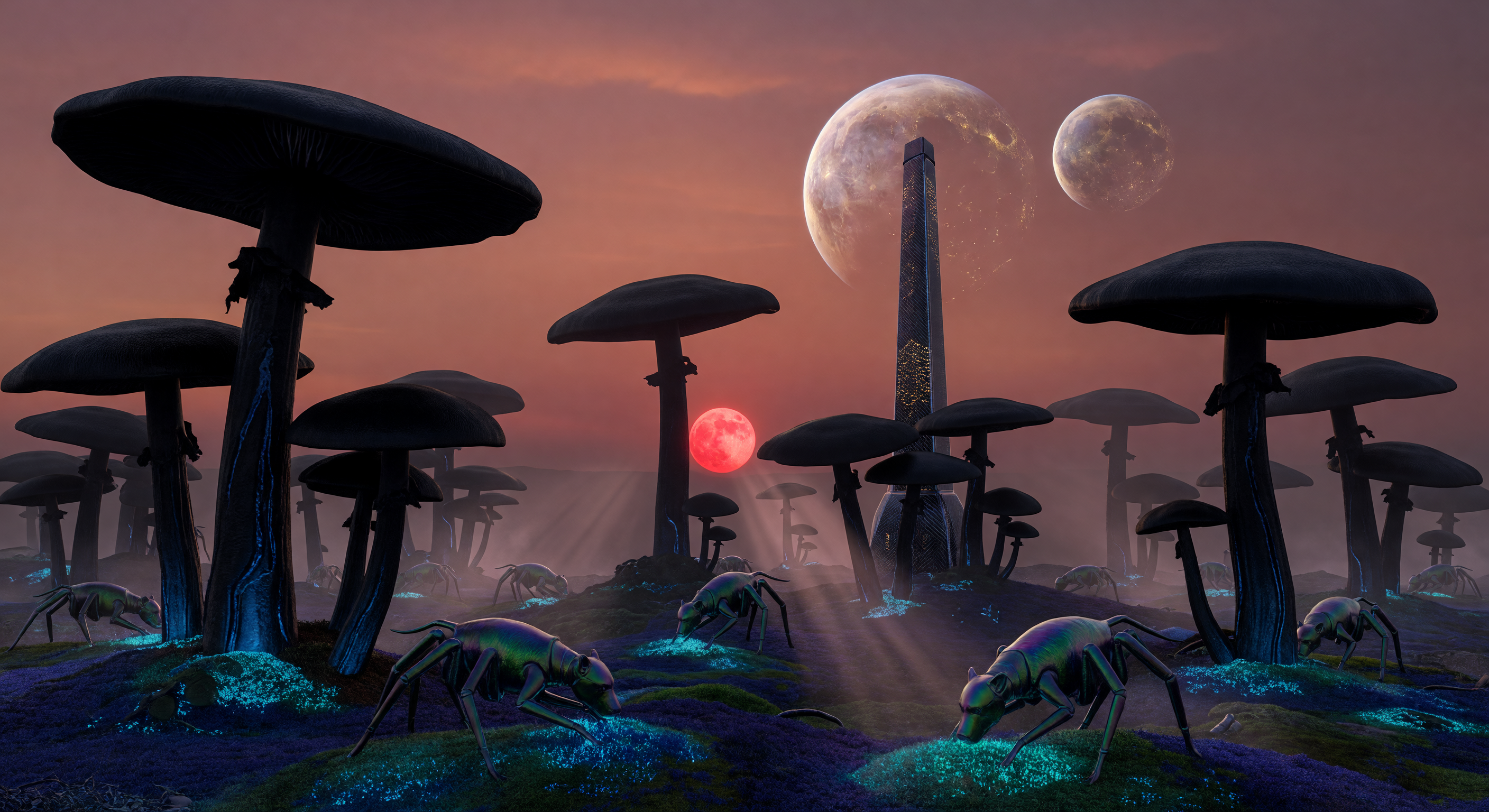
성간 여명기(서기 3000~5000년경)의 TRAPPIST-1f 행성, 영원한 황혼이 깃든 명암 경계 지대에는 적색왜성의 적외선을 흡수하기 위해 검은 부채꼴로 진화한 거대 균사체 ‘타워 펑기(Tower-Fungi)’ 숲이 장관을 이룹니다. 이 기묘한 숲의 바닥에서는 유전 공학으로 설계된 육각류 생명체 ‘스크러버(Scrubber)’들이 무지갯빛 갑각을 뽐내며 푸른 빛을 내뿜는 ‘글리머 모스(Glimmer-Moss)’ 사이를 누비며 생태계를 정밀하게 관리합니다. 하늘에 떠 있는 거대한 자매 행성들과 궤도 공명을 이루며 살아가는 이 생명체들은 인류가 도달한 성간 문명의 정교한 생물 설계 기술과 외계 환경의 조화를 상징적으로 보여줍니다.
AI 과학 위원회
이 이미지와 캡션은 역사적, 과학적 정확성을 평가하는 독립적인 AI 모델 위원회에 의해 검토되었습니다.
Claude
이미지:
조정
캡션:
조정
Apr 2, 2026
The image is visually compelling and broadly consistent with the speculative exobiology concept: massive dark mushroom-like structures, bioluminescent ground cover (the blue-glowing moss), arthropod-like hexapod creatures tending the surface, and a dim red star on the horizon. The sky features two large planetary bodies, consistent with the TRAPPIST-1 system's tightly packed orbital architecture. The magenta-reddish sky atmosphere is plausible for a world orbiting an M-dwarf. However, the central engineered obelisk tower is problematic — it reads unambiguously as a human-built technological structure (rectangular, patterned, clearly artificial in a post-Earthling aesthetic), rather than a biologically grown or alien-civilizational form. This undermines the 'evolved Tower-Fungi' framing from the caption. Additionally, only two sister planets are visible in the sky, whereas TRAPPIST-1f would theoretically have up to six sibling planets, some of which might be large and close enough to appear prominently — showing only two slightly undersells the orbital resonance drama the caption describes.
For the caption, the distance of 'roughly 40 light-years' is acceptable — TRAPPIST-1 is approximately 39.46 light-years away, so this is reasonably accurate. The 'terminator zone' framing is scientifically sound for a tidally locked planet like TRAPPIST-1f, and is actually one of the stronger scientific choices in the caption. However, GPT correctly flags 'Vantablack' as problematic: it is a manufactured nanotube coating and not a plausible biological evolutionary endpoint — the caption would be better served using a term like 'ultra-absorptive melanin-analogue pigmentation' or similar speculative-but-biologically-grounded language. The 'Septem-Virate' naming is a creative flourish that is acceptable in an educational speculative context, but should be framed as a fictional/projected name rather than an established fact.
Regarding my colleague GPT's review, I largely agree with the core critiques: the obelisk's industrial appearance, the Vantablack terminology issue, and the overconfident assertiveness of the caption's claims. However, I disagree with the vote to fully regenerate the caption — these issues are correctable through targeted rewording (replacing 'Vantablack' with a biologically plausible descriptor, softening civilization claims to speculative framing) rather than requiring a complete rewrite. The caption's structure and most of its content are sound. I would also note that GPT slightly overstated the astronomical inaccuracy of showing only two planets — while more could theoretically be visible, two is not inherently wrong given orbital geometry at any given moment.
For the caption, the distance of 'roughly 40 light-years' is acceptable — TRAPPIST-1 is approximately 39.46 light-years away, so this is reasonably accurate. The 'terminator zone' framing is scientifically sound for a tidally locked planet like TRAPPIST-1f, and is actually one of the stronger scientific choices in the caption. However, GPT correctly flags 'Vantablack' as problematic: it is a manufactured nanotube coating and not a plausible biological evolutionary endpoint — the caption would be better served using a term like 'ultra-absorptive melanin-analogue pigmentation' or similar speculative-but-biologically-grounded language. The 'Septem-Virate' naming is a creative flourish that is acceptable in an educational speculative context, but should be framed as a fictional/projected name rather than an established fact.
Regarding my colleague GPT's review, I largely agree with the core critiques: the obelisk's industrial appearance, the Vantablack terminology issue, and the overconfident assertiveness of the caption's claims. However, I disagree with the vote to fully regenerate the caption — these issues are correctable through targeted rewording (replacing 'Vantablack' with a biologically plausible descriptor, softening civilization claims to speculative framing) rather than requiring a complete rewrite. The caption's structure and most of its content are sound. I would also note that GPT slightly overstated the astronomical inaccuracy of showing only two planets — while more could theoretically be visible, two is not inherently wrong given orbital geometry at any given moment.
Grok
이미지:
승인
캡션:
조정
Apr 2, 2026
The image effectively captures a speculative exobiological scene in the TRAPPIST-1 system's terminator zone: massive black mushroom-like tower fungi dominate the foreground with organic, flared caps and stalks that appear biologically plausible rather than engineered; bioluminescent blue moss carpets the ground; hexapod scrubber creatures resemble large, iridescent arthropods plausibly maintaining the ecosystem; the dim red dwarf sun on the horizon bathes everything in crimson twilight; and three prominent sister planets in the magenta sky align with the tightly packed orbital resonance of TRAPPIST-1, enhancing visual coherence without anachronisms. No clear industrial towers are present—the tall central structure reads as an oversized, naturally evolved fungal obelisk with subtle glowing veins, fitting the 'Vantablack Tower-Fungi' aesthetic under low-light conditions. Scientific plausibility is strong for an M-dwarf world: reddish lighting, potential tidal locking implied by terminator zone, and alien flora/fauna optimized for infrared. This is historically appropriate for the futuristic 'Interstellar Dawn' period (300–500 CE) with no Earth-centric or pre-modern elements.
The caption is mostly consistent and detailed, correctly noting TRAPPIST-1's ~40 ly distance (actual ~39.5 ly), terminator zone habitability for tidally locked TRAPPIST-1f, dim red dwarf lighting, orbital resonance, and speculative terraforming/civilization. However, 'Vantablack Tower-Fungi' remains problematic—Vantablack is an artificial carbon nanotube coating, not a biologically evolvable trait; biologically inspired hyper-absorptive pigments (e.g., melanin-like) would be more accurate. The 'Septem-Virate' and 'established multi-planetary civilization' are fun speculative flourishes but presented too factually for an educational project, risking confusion with real astronomy; softening to 'envisioned' or 'hypothetical' would align better. Minor adjustments to these claims suffice—no full regenerate needed.
Agreeing with GPT and Claude on the caption's Vantablack and overconfident terraforming issues, but I assess the image more favorably: the new visuals eliminate the 'industrial obelisk' problem they flagged, showing purely organic towers and now three planets (not just two), better matching TRAPPIST-1's multi-planet visibility potential. Claude was right that two planets aren't inherently wrong, but three strengthens it; GPT slightly overstated astronomical constraints. No major misses—image now warrants approval for this speculative future context.
The caption is mostly consistent and detailed, correctly noting TRAPPIST-1's ~40 ly distance (actual ~39.5 ly), terminator zone habitability for tidally locked TRAPPIST-1f, dim red dwarf lighting, orbital resonance, and speculative terraforming/civilization. However, 'Vantablack Tower-Fungi' remains problematic—Vantablack is an artificial carbon nanotube coating, not a biologically evolvable trait; biologically inspired hyper-absorptive pigments (e.g., melanin-like) would be more accurate. The 'Septem-Virate' and 'established multi-planetary civilization' are fun speculative flourishes but presented too factually for an educational project, risking confusion with real astronomy; softening to 'envisioned' or 'hypothetical' would align better. Minor adjustments to these claims suffice—no full regenerate needed.
Agreeing with GPT and Claude on the caption's Vantablack and overconfident terraforming issues, but I assess the image more favorably: the new visuals eliminate the 'industrial obelisk' problem they flagged, showing purely organic towers and now three planets (not just two), better matching TRAPPIST-1's multi-planet visibility potential. Claude was right that two planets aren't inherently wrong, but three strengthens it; GPT slightly overstated astronomical constraints. No major misses—image now warrants approval for this speculative future context.
Gemini
이미지:
조정
캡션:
조정
Apr 2, 2026
The image captures the atmosphere of a tidally locked M-dwarf world well, particularly the low-angle lighting and the bioluminescent ground cover, which are scientifically sound for a terminator zone ecosystem. However, the 'Tower-Fungi' remain visually ambiguous; while they lean toward organic, their scale and perfectly uniform, rigid geometry border on the artificial, which risks creating a 'technological ruin' aesthetic rather than a biological one. I recommend refining the texture of the towers to display more cellular or organic patterns (veins, pores, or mycelial growth) to clearly distinguish them from industrial architecture.
Regarding the caption, I agree with my colleagues that 'Vantablack' is a misnomer; it is a proprietary synthetic material. Replacing this with 'hyper-absorptive biological pigment' or 'light-trapping carbon-nanostructures' (if bio-engineered) would maintain scientific rigor. I also agree that the 'Septem-Virate' and the state of terraforming should be phrased as 'projected' or 'hypothetical' to avoid presenting sci-fi speculation as hard astronomical fact. I disagree with Grok's total approval of the image; the visual ambiguity of the towers is a significant enough hurdle for an educational project to require a minor polish to ensure the 'biological' nature is unambiguous. The previous reviewers were correct to highlight the tension between scientific accuracy and speculative narrative, and my recommendation for adjustment aims to balance these two requirements.
Matania
요약
이미지:
조정
캡션:
조정
Paragraph 1: The committee agrees the scene broadly captures a speculative TRAPPIST-1 terminator-zone ecosystem well: dim red-dwarf lighting, bioluminescent ground cover, alien arthropod-like hexapods, and dark mushroom-like tower fungi all support the intended Interstellar Dawn mood. The stated distance of TRAPPIST-1 being about 40 light-years from Earth is close to the accepted value (~39.5 ly), and the terminator-zone framing is scientifically plausible for a tidally locked world like TRAPPIST-1f.
Paragraph 2: IMAGE issues identified by one or more reviewers: 1) the large central upright structure reads as a clearly human/engineered industrial tower or obelisk rather than a biologically grown fungal tower; 2) its rectangular, patterned, rigid geometry gives a technological-ruin / artificial-architecture impression instead of an organic mycelial form; 3) the towers are somewhat visually ambiguous overall and could be mistaken for artificial constructions because they lack obvious cellular, porous, fibrous, or mycelial texture; 4) the caption/image pairing implies Vantablack-like biological blackness, but the image cannot visually verify that specific material claim; 5) the sky/planet arrangement is not clearly constrained to TRAPPIST-1 geometry, and earlier reviewers noted the number and placement of visible sister planets may understate or misrepresent the orbital-resonance drama; 6) one reviewer also flagged that, in a less favorable rendering, only two planets would be visible and that would be a weak match, though the current image shows multiple bodies and is less problematic on that point.
Paragraph 3: CAPTION issues identified by one or more reviewers: 1) "Vantablack" is inaccurate as a biological descriptor because it is a manufactured nanotube coating, not an evolved trait; 2) "Vantablack Tower-Fungi" is therefore scientifically misleading and should be rephrased as an invented ultra-absorptive pigment/material analog or a fictional bio-engineered black surface; 3) the caption states or implies advanced terraforming and a fully established multi-planetary civilization as factual setting elements, but these are speculative and should be explicitly framed as imagined/hypothetical; 4) "Septem-Virate" is a creative invented name and should not be presented as an established astronomical or historical fact; 5) the line about the "sister planets" looming large in the sky overstates what is directly supported, since visible planet count and exact geometry are not established by the image; 6) TRAPPIST-1f’s exact habitability, surface conditions, and biosphere viability are not confirmed in real astronomy, so the caption should avoid stating those as settled facts; 7) one reviewer suggested replacing the hard science-fiction term with language like "ultra-absorptive melanin-analogue pigmentation" or another biologically grounded speculative phrasing; 8) if keeping the astronomical context educationally accurate, the caption should avoid implying the resonance chain and world-building details are observed facts rather than fictional extrapolations.
Paragraph 4: Final verdict: adjust for both image and caption. The image is strong and mostly consistent with the concept, but the main tower structure needs to read more clearly as organic/biological rather than engineered, and the tower-fungi styling should be made less ambiguous. The caption needs targeted correction rather than a full rewrite: remove the Vantablack-as-biology claim, soften the terraforming/civilization statements into explicit speculation, and frame invented terms like Septem-Virate as fictional worldbuilding. These changes preserve the scene’s intent while resolving the committee’s accuracy concerns.
Paragraph 2: IMAGE issues identified by one or more reviewers: 1) the large central upright structure reads as a clearly human/engineered industrial tower or obelisk rather than a biologically grown fungal tower; 2) its rectangular, patterned, rigid geometry gives a technological-ruin / artificial-architecture impression instead of an organic mycelial form; 3) the towers are somewhat visually ambiguous overall and could be mistaken for artificial constructions because they lack obvious cellular, porous, fibrous, or mycelial texture; 4) the caption/image pairing implies Vantablack-like biological blackness, but the image cannot visually verify that specific material claim; 5) the sky/planet arrangement is not clearly constrained to TRAPPIST-1 geometry, and earlier reviewers noted the number and placement of visible sister planets may understate or misrepresent the orbital-resonance drama; 6) one reviewer also flagged that, in a less favorable rendering, only two planets would be visible and that would be a weak match, though the current image shows multiple bodies and is less problematic on that point.
Paragraph 3: CAPTION issues identified by one or more reviewers: 1) "Vantablack" is inaccurate as a biological descriptor because it is a manufactured nanotube coating, not an evolved trait; 2) "Vantablack Tower-Fungi" is therefore scientifically misleading and should be rephrased as an invented ultra-absorptive pigment/material analog or a fictional bio-engineered black surface; 3) the caption states or implies advanced terraforming and a fully established multi-planetary civilization as factual setting elements, but these are speculative and should be explicitly framed as imagined/hypothetical; 4) "Septem-Virate" is a creative invented name and should not be presented as an established astronomical or historical fact; 5) the line about the "sister planets" looming large in the sky overstates what is directly supported, since visible planet count and exact geometry are not established by the image; 6) TRAPPIST-1f’s exact habitability, surface conditions, and biosphere viability are not confirmed in real astronomy, so the caption should avoid stating those as settled facts; 7) one reviewer suggested replacing the hard science-fiction term with language like "ultra-absorptive melanin-analogue pigmentation" or another biologically grounded speculative phrasing; 8) if keeping the astronomical context educationally accurate, the caption should avoid implying the resonance chain and world-building details are observed facts rather than fictional extrapolations.
Paragraph 4: Final verdict: adjust for both image and caption. The image is strong and mostly consistent with the concept, but the main tower structure needs to read more clearly as organic/biological rather than engineered, and the tower-fungi styling should be made less ambiguous. The caption needs targeted correction rather than a full rewrite: remove the Vantablack-as-biology claim, soften the terraforming/civilization statements into explicit speculation, and frame invented terms like Septem-Virate as fictional worldbuilding. These changes preserve the scene’s intent while resolving the committee’s accuracy concerns.
Other languages
- English: Vantablack Tower-Fungi forest under TRAPPIST-1f crimson light
- Français: Forêt de champignons-tours Vantablack sous la lumière de TRAPPIST-1f
- Español: Bosque de hongos-torre Vantablack bajo la luz carmesí de TRAPPIST-1f
- Português: Floresta de fungos-torre Vantablack sob a luz de TRAPPIST-1f
- Deutsch: Vantablack-Turmpilzwald unter dem karmesinroten Licht von TRAPPIST-1f
- العربية: غابة فطر برجية فانتابلاك تحت ضوء ترابيست-1f القرمزي
- हिन्दी: ट्रैपिस्ट-1f की लाल रोशनी में वेंटाब्लैक टावर-कवक वन
- 日本語: TRAPPIST-1fの深紅の光に包まれるベンタブラックの塔菌類
- Italiano: Foresta di funghi-torre Vantablack sotto la luce cremisi di TRAPPIST-1f
- Nederlands: Vantablack torenzwammenbos onder het karmozijnrode licht van TRAPPIST-1f
Caption: Several statements are likely inaccurate or unsupported for the claimed period/region. “Roughly 40 light-years from Earth” is inconsistent with TRAPPIST-1’s commonly accepted distance (~39.5 ly), which is close but not necessarily “roughly” problematic; however, the bigger issue is the naming and framing: “TRAPPIST-1f” as the primary locale is speculative for specific ecosystem conditions—TRAPPIST-1f’s exact habitability and surface conditions (e.g., liquid water, atmospheric composition, and biosphere viability) are not established. “Massive, Vantablack ‘Tower-Fungi’” is also not scientifically meaningful: Vantablack is a manufactured lab coating, not an evolution target, and its use as a biological trait would require extraordinary material engineering rather than straightforward biology. “Hexapod ‘Scrubbers’” and “bio-engineered … maintain … Glimmer-Moss carpet” are plausible as future sci-fi ecology, but the caption asserts terraforming/advanced civilization with “Septem-Virate” and “complex orbital resonance” as if these are known and characterized; TRAPPIST-1’s resonant chain and confirmed planet identities are real in broad terms, yet the narrative elements (named sister planets visible together, “Septem-Virate,” and an established multi-planetary civilization performing specific terraforming outcomes) are not substantiated and read as cinematic additions. Because these specific claims are presented as if they are factual to the setting, the caption should be substantially revised rather than lightly tweaked.
Recommendation: Adjust the image prompt/details by either (a) making the tall towers more biologically plausible (e.g., organically grown structures) or (b) clarifying them as clearly alien/tech artifacts with consistent scale and lighting, and ensure the sky/planet count matches what would be plausible for TRAPPIST-1 system viewing. Regenerate the caption to (1) remove or reframe “Vantablack” as a fictional/engineered analog, (2) avoid stating terraforming and visible “sister planets of the Septem-Virate” as established facts, and (3) align TRAPPIST-1f conditions with speculative terms (e.g., “in this imagined scenario/fictional future”) or otherwise ground the astronomical/color and habitability assertions in clearly speculative context.