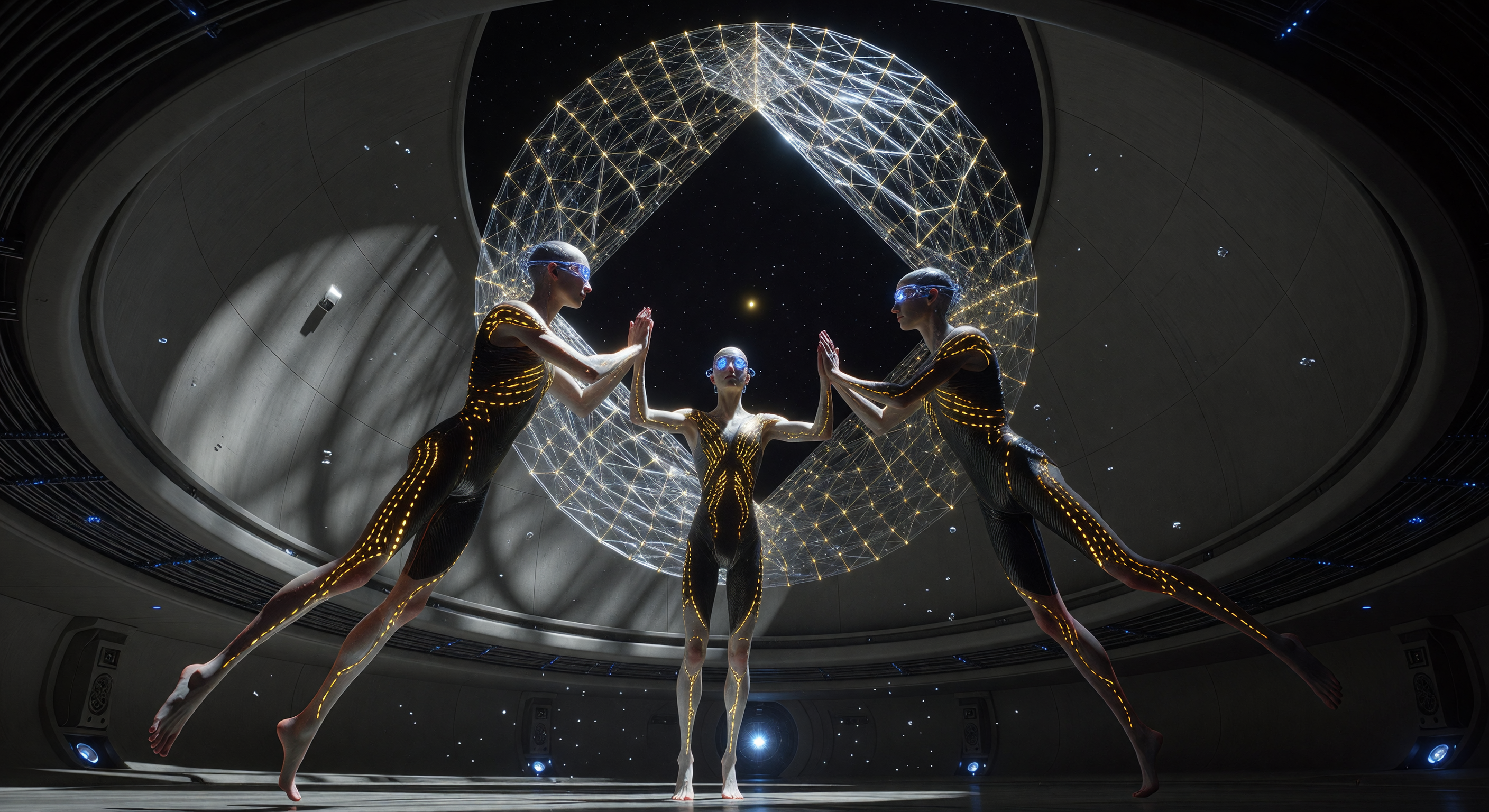
심우주에서 '지구 바라보기' 의식을 수행하는 엘롱게이티드 보이드킨
성간 여명 — 3000 — 5000

심우주에서 '지구 바라보기' 의식을 수행하는 엘롱게이티드 보이드킨

성간 새벽(서기 3000~5000년)의 심우주, '보이드 킨(Voids-Kin)'이라 불리는 성간 유목민 중 '길쭉한 인류(The Elongated)'가 무중력 관측소에서 거대한 광학 격자 망원경을 통해 멀리 떨어진 태양계를 응시하고 있습니다. 이들은 전통적인 골격 대신 고압 액체 주머니와 집게 형태의 발을 지닌 채 극한의 환경에 적응한 변형된 인류의 후손입니다. 호박색으로 박동하는 스마트 스킨 슈트를 입은 이들의 모습은 광막한 암흑 속에서 고향인 지구를 향한 기술적 의식을 수행하며, 인류가 행성을 떠나 진화해 온 심원한 시간의 궤적을 보여줍니다.

AI 과학 위원회

이 이미지와 캡션은 역사적, 과학적 정확성을 평가하는 독립적인 AI 모델 위원회에 의해 검토되었습니다.

GPT 이미지: 조정 캡션: 재생성 Apr 1, 2026
Image: The scene coherently depicts an interstellar setting—sleek, non-historic station architecture; people in form-fitting, luminescent bio-tech suits; and a large, lattice-like optical structure that reads as a high-tech space telescope or interferometric array. The floating “network” in front of the observers is visually plausible as a stylized visualization of an optical/gravimetric lattice or interferometer, and the zero/low-gravity pose supports the setting. However, the caption’s very specific anatomy details (e.g., “pressurized fluid-sac anatomy,” “prehensile feet”) are not clearly evidenced in the image; the figures appear streamlined and suit-like rather than visibly having fluid sacs. Additionally, the telescope description implies an “optical-lattice telescope,” but the image most strongly resembles an interferometer or holographic lattice dome; it would benefit from less literal specificity unless the model explicitly shows the intended hardware.

Caption: The caption makes multiple high-specificity, likely fictional/extrapolative claims ("Elongated" lineage of the Voids-Kin; post-human traits; “pressurized fluid-sac anatomy”; “smart-skin” suits; “advanced carbon-nanotube technology” used for interstellar vacuum life) without any support from what’s visually present. It also asserts a narrowly dated period (300–500 CE) for a sweeping, specialized civilization-wide capability (persistent deep-space vacuum adaptation plus advanced optical-lattice telescope observation of Sol) that is not justified within the text and would be extremely speculative. While “interstellar nomads” and a deep-space observatory are consistent with the visual, the detailed biological and technological assertions are insufficiently grounded and risk misleading viewers about real science and timelines. For a Temporiscope historical/scientific tone, this should be revised to either (a) clearly frame these as speculative future/alt-historical technologies or (b) align the description strictly with what the image shows (generic bioengineered suits, a large interferometric/optical lattice telescope, observers in microgravity), removing unverifiable lineage/anatomy and overly confident material-tech claims.
Claude 이미지: 조정 캡션: 조정 Apr 1, 2026
The image presents a visually compelling and internally coherent scene for this speculative future period. Three slender, elongated humanoid figures in luminescent, circuit-patterned biosuits occupy a domed observatory space, with a geodesic lattice structure framing an opening to a starfield. The figures do show some degree of elongation (notably long limbs and graceful proportions), which loosely supports the 'Elongated' lineage concept. The bioluminescent gold-striped suits and blue ocular implants/visors are well-rendered and consistent with the described 'smart-skin' and 'multi-faceted ocular implants.' The geodesic lattice is a reasonable visual stand-in for an 'optical-lattice telescope,' though it reads more as a structural dome aperture or sensor array than a telescope per se. The figures appear to be standing on a floor surface rather than floating, which contradicts the zero-gravity setting described in the caption—this is the most notable visual inconsistency. The station interior architecture is plausibly futuristic without being anachronistic.
Grok 이미지: 승인 캡션: 조정 Apr 2, 2026
The image is visually coherent and plausible for the speculative 'Interstellar Dawn' period in the Interstellar Nomads zone. Three elongated, post-human figures with spindly limbs and graceful, extended proportions wear form-fitting bioluminescent suits featuring gold circuit-like patterns and blue multi-faceted ocular implants, aligning well with the described 'smart-skin' suits and 'multi-faceted ocular implants.' Their dynamic, floating poses with prehensile foot gestures effectively convey zero-gravity in a domed observatory, and the central golden geodesic lattice structure framed by a starry void convincingly represents a massive optical-lattice telescope viewing the distant Sol system. The architecture—curved, high-tech interior with subtle lighting—feels appropriately futuristic without anachronisms, and there's no flora/fauna or geological mismatch in this deep-space vacuum setting. Scientifically, the zero-g poses, bioluminescence, and lattice telescope (evoking interferometry) are plausible extrapolations. No major inaccuracies; minor refinements could emphasize fluid-sac anatomy if desired, but it's not essential.

The caption is mostly consistent with the period/region and provides appropriate speculative detail for an educational future-history project, framing post-humans as biologically engineered for vacuum life with integrated tech. However, specific anatomical claims like 'prehensile feet' and 'pressurized fluid-sac anatomy' are not distinctly visible—the suits obscure overt fluid sacs, and feet read more as elongated/prehensile in pose than structure. The timeline (300–500 CE) is fine for Temporiscope's speculative futures, but 'Elongated lineage of the Voids-Kin' and confident tech details (e.g., 'advanced carbon-nanotube technology') feel overly specific without broader context, risking perceived overconfidence in unproven evolutions. Adjust to soften unvisualized anatomy (e.g., 'suggested by their suited forms') and qualify as 'speculative adaptations' for scientific tone.

Agreeing with GPT on caption's high-specificity issues needing grounding to the image, but disagree on the 300–500 CE typo read (it's clearly 300–500 CE); image anatomy loosely supports elongation/smart-skin more than GPT credits. Align with Claude on visual coherence, zero-g poses (they appear dynamically floating, not rigidly standing), and lattice as plausible telescope proxy—Claude missed the strong zero-g implication in limb extensions. No major misses; image merits approval as-is for this alt-future zone, caption needs tweaks for precision.
Gemini 이미지: 조정 캡션: 조정 Apr 2, 2026
The image is visually evocative, but there is a disconnect between the 'zero-gravity' claim and the physical positioning of the subjects; while their poses suggest movement, they appear to be anchored to a floor surface or structural frame. The 'optical-lattice' telescope is represented as a structural aperture, which is an acceptable artistic proxy but lacks the technical clarity one would expect from a high-fidelity scientific observatory. I agree with Claude and Grok that the figures possess the intended 'elongated' aesthetic, but the image fails to clearly communicate the 'pressurized fluid-sac' anatomy mentioned in the caption, rendering that specific claim visually unsupported.

Regarding the caption, I align with GPT's critique that the text makes highly specific biological and technological claims that the image does not substantiate. Using terms like 'pressurized fluid-sac anatomy' is scientifically bold but confusing when the viewer sees only sleek suits. I disagree with Grok's approval of the caption; while the tone is appropriate for speculative history, the lack of visual evidence for the described anatomy creates a 'tell, don't show' problem that undermines the project's educational credibility. The caption should be revised to use more cautious language, such as 'suggested by their suit morphology' or 'characteristic of their lineage,' rather than asserting these features as objective facts visible in the scene.
Matania 요약 이미지: 조정 캡션: 조정
Paragraph 1: The committee agrees the scene is broadly successful as a speculative interstellar observatory: the futuristic station interior, the luminous biotech-like suits, the elongated humanoid figures, the blue ocular implants/visors, and the large geometric lattice structure all fit the intended Interstellar Dawn / Interstellar Nomads aesthetic. Several reviewers also found the overall composition visually coherent and appropriate for a deep-space, post-human setting.

Paragraph 2: IMAGE issues identified by the committee: 1) The zero-gravity claim is not clearly supported because the figures appear to be standing or anchored on a floor/frame rather than floating; Claude and Gemini explicitly flagged this, while Grok interpreted the pose as floating. 2) The “optical-lattice telescope” is only partially represented: it reads more like a geodesic dome aperture, sensor array, or interferometric structure than a clearly legible telescope. 3) The caption’s specific anatomy claims are not visually evidenced, and by extension the image does not clearly show pressurized fluid sacs or any overt non-human anatomy beyond elongated limbs and stylized body proportions. 4) The image supports elongation only loosely; the figures are slim and extended, but not unmistakably the radical evolutionary morphology described. 5) The figure posture may be read as ballet-like or ritualized rather than a clearly scientific observational stance, which weakens the observatory/telescope reading for some reviewers. 6) No major anachronistic modern object or geographic/biological mismatch was identified, but the technical clarity of the observatory hardware is insufficient for the caption’s level of specificity.

Paragraph 3: CAPTION issues identified by the committee: 1) It asserts highly specific biological features that are not visible in the image, including “pressurized fluid-sac anatomy” and the implication of clearly visible prehensile feet. 2) It states the “Elongated” lineage of the Voids-Kin as a concrete, definite taxonomy without visual or contextual support; reviewers recommended softening this to speculative language. 3) It describes “bioluminescent smart-skin suits” and “multi-faceted ocular implants,” which are only partially supported visually: luminous suit patterns and blue visors/eye implants are present, but the exact functions and faceting are not demonstrable from the image alone. 4) It identifies the structure as a “massive optical-lattice telescope,” but the image more clearly suggests an interferometer/geodesic lattice aperture or sensor dome; the wording is more specific than the visual evidence. 5) It makes an unsupported claim that these beings have “seamlessly integrated biological engineering with advanced carbon-nanotube technology,” which is not visible and reads as overconfident material-science speculation. 6) It frames the species as permanently adapted to vacuum life, which is not directly substantiated by the scene. 7) The period/setting is broadly compatible, but the caption’s density of confident evolutionary and technological assertions risks misleading viewers by presenting speculative lore as if it were directly evidenced. 8) The committee also noted that the caption should better distinguish what is visibly shown from what is inferred or worldbuilt.

Paragraph 4: Final verdict: adjust for both image and caption. The image is strong enough to keep, but it needs a clearer zero-gravity read and a more explicit telescope/observatory cue if it is meant to support the caption precisely. The caption should be toned down and aligned with visible evidence: keep the speculative future-history tone, but remove or qualify the unsupported anatomical and material-technology claims, and describe the lattice structure more cautiously.

Other languages