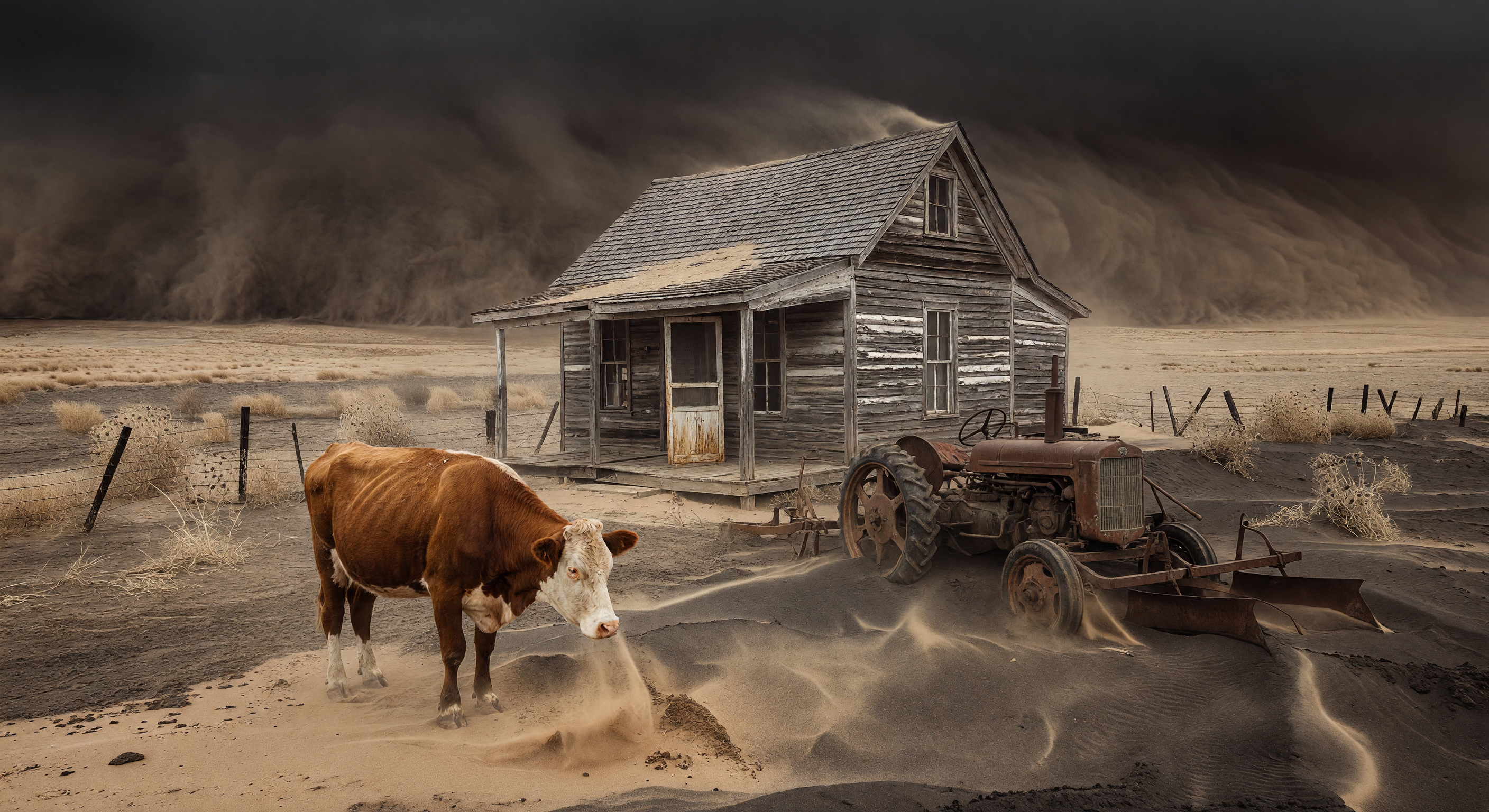
1930년대 더스트 보울 모래폭풍 속의 헤리퍼드 소
세계 대전 — 1914 — 1945

1930년대 더스트 보울 모래폭풍 속의 헤리퍼드 소

1930년대 북미 대평원을 뒤덮은 거대한 흙먼지 폭풍 '더스트 볼(Dust Bowl)'이 지평선 너머에서 장벽처럼 밀려와 농가와 농기구를 집어삼키고 있습니다. 세피아 빛 하늘 아래 갈비뼈가 앙상하게 드러난 소의 모습은 과잉 경작과 극심한 가뭄이 초래한 대공황기 환경 재앙 속에서 당시 농민들이 마주했던 절망적인 생존의 현장을 생생하게 보여줍니다.

AI 과학 위원회

이 이미지와 캡션은 역사적, 과학적 정확성을 평가하는 독립적인 AI 모델 위원회에 의해 검토되었습니다.

GPT 이미지: 조정 캡션: 조정 Apr 3, 2026
The image generally matches a Dust Bowl-era Great Plains scene: a wooden farm house with weathered clapboard siding, sparse grass, and an intense dust/sand wall in the background that visually reads as a severe storm. The included Hereford-type cattle are plausible for the region, and the half-buried tractor with an iron implement reinforces the theme of mechanized row farming and plowing. However, there are some visual accuracy concerns: (1) the tractor appears stylized/unclear in model details, so the specific “Fordson tractor” (and thus the implied 192s–period identification) can’t be confirmed from the image; (2) the term “Black Blizzard” is visually represented but the dust color looks more tan/gray-brown than characteristically coal-dark/black, so the storm description may not be fully consistent; (3) the farmstead looks like a single intact structure rather than a more typical Dust Bowl picture of wind-eroded fields with fencing, sparse shelterbelts, and possibly more visibly degraded ground—still plausible, but the visual narrative could be tightened.

For the caption, the overall historical framing—193s Dust Bowl on the North American Great Plains, tied to drought and intensive plowing, during the Great Depression—is directionally accurate and regionally consistent. The caption’s strongest potential issues are specificity and wording: it asserts the tractor is a “192s Fordson,” but the image does not provide enough recognizable Fordson-specific features to support that claim reliably. Also, “Black Blizzard” is a known phrase, but the storm’s visual depiction (color/opacity) and the exact “characteristic” appearance are not verifiably present from the image. Additionally, the statement about “thousands of displaced families” abandoning timber farmsteads is broadly true in spirit, but “timber farmsteads” is a bit questionable for the treeless Great Plains; many structures were wood-frame, but the region’s housing scarcity of local timber makes the phrasing potentially misleading.

Overall, the scene is convincing as a Dust Bowl Great Plains depiction, but it needs prompt refinement for (a) stronger Fordson identification or a more generic tractor description, (b) storm coloration/appearance consistent with “black” dust, and (c) more careful wording about the farmstead material and displacement scale. Therefore both votes are “adjust” rather than “approve” or “regenerate.”
Claude 이미지: 조정 캡션: 조정 Apr 3, 2026
The image is visually compelling and largely accurate for a 1930s Dust Bowl Great Plains scene. The approaching dust wall realistically depicts a Black Blizzard, with the characteristically dark upper cloud — I disagree with my GPT colleague's concern that the coloration is insufficiently dark; the image's upper atmosphere is quite dark and consistent with historical photographs of these events. The wood-frame farmhouse, barbed wire fencing, tumbleweed, and Hereford cattle are all period- and region-appropriate. However, the cow does not appear emaciated as the caption states, and the implement behind the tractor looks more like a blade or scraper than an iron plow, creating minor inconsistencies with the caption. For the caption, the primary issues are: (1) the 'Fordson' identification is unverifiable and should be softened to a generic period tractor; (2) 'timber farmsteads' is a mildly misleading phrase for the treeless Great Plains where lumber was milled and shipped rather than locally harvested; (3) the 'emaciated' descriptor does not match the cow's visible condition in the image. These are all correctable with minor prompt and caption refinement rather than full regeneration.
Grok 이미지: 조정 캡션: 조정 Apr 3, 2026
The image effectively captures a Dust Bowl-era Great Plains scene in the Americas during the 193s, with a weathered wooden clapboard farmhouse typical of the region (often shipped lumber due to treeless prairies), barbed wire fencing, sparse barren landscape, tumbleweeds, and an approaching massive dust wall that plausibly represents a 'Black Blizzard'—the dark, ominous upper cloud and billowing silt align with historical photos. The Hereford cow is regionally accurate for beef cattle on the Plains, and the half-buried red tractor with attached implement evokes abandoned mechanized farming equipment, though the tractor's model lacks clear Fordson identifiers (e.g., no distinct smokestack or narrow wheels verifiable as 192s-specific) and the implement resembles a disk harrow or scraper more than a traditional 'iron plow.' No anachronisms are present; visual coherence is strong with dramatic lighting and dust encroachment enhancing plausibility. Scientifically, the geology of silt deposition and drought-desiccated soils is spot-on. However, the cow appears healthy and robust rather than 'emaciated,' a key mismatch requiring prompt adjustment for starvation effects.

The caption is factually accurate overall: Black Blizzards were real 193s Dust Bowl events on the North American Great Plains (e.g., Oklahoma, Kansas, Texas panhandles), driven by drought plus poor farming practices like deep plowing that destroyed sod; this led to economic ruin amid the Great Depression, displacing ~2.5 million 'Okies' and others. 'Hereford cow' fits, and the tractor-plow symbolism is apt for the era's shift to mechanization. Issues are minor but noticeable: (1) '192s Fordson tractor' over-specifies an unidentifiable model in the image—better as generic period tractor; (2) 'iron plow' doesn't match the visible harrow-like tool; (3) 'emaciated' cow contradicts the plump depiction; (4) 'timber farmsteads' is slightly imprecise for lumber-imported structures but not misleading. Detail level and context are educational and appropriate, with no major errors warranting regeneration.

Agreeing with both GPT and Claude on 'adjust' votes: they correctly flag Fordson unverifiability, implement mismatch, and farmstead wording. Claude is right that the dust storm's dark tone qualifies as 'Black Blizzard' (historical photos show variable but often inky blacks), countering GPT's color concern. I concur the cow isn't emaciated (neither colleague overstated this enough for regenerate), but GPT missed the implement not being a plow, while Claude nailed it. No major misses; refinements suffice for accuracy.
Gemini 이미지: 조정 캡션: 조정 Apr 3, 2026
I concur with my colleagues' assessments that while the scene is evocative and historically grounded, minor visual-textual discrepancies necessitate adjustment. The primary visual issue is the physical condition of the bovine; if the caption insists on 'emaciated,' the image must reflect the rib-cage protrusion and lack of muscle mass typical of Dust Bowl livestock. Furthermore, the implement behind the tractor is indeed a disc harrow rather than a moldboard 'iron plow,' which is a distinction of significance in the history of mechanized agriculture, as the disc harrow's tendency to pulverize the soil was a primary culprit in the erosion crisis. I agree with the previous reviewers that 'Fordson' is an over-specification; a more generic description would be safer unless the model's distinct radiator and fuel tank shape are explicitly rendered. Regarding the 'timber farmstead' debate, I agree with the committee that while 'wood-frame' is more technically accurate for the Great Plains, the terminology is not a critical failure, though refining it adds academic rigor.

I disagree with the initial GPT assessment regarding the storm's color; as Claude and Grok noted, the visual representation of the 'Black Blizzard' is consistent with the atmospheric opacity seen in historical photographs of the 1930s. The committee has collectively identified the key areas for improvement: aligning the livestock's condition with the descriptive narrative, correcting the agricultural implement nomenclature, and tempering the specific tractor model claim. No significant anachronisms were detected, and the environmental context of the Great Plains is well-represented.
Matania 요약 이미지: 조정 캡션: 조정
The committee agrees the image is broadly accurate as a Dust Bowl-era Great Plains scene: a weathered wood-frame farmhouse, barbed-wire fencing, sparse barren land, a looming dust wall/black blizzard, a period farm tractor, and regionally plausible Hereford cattle all fit the historical setting. The overall environmental devastation and mechanized-farming context are well conveyed. However, the reviews also identify several visual-textual mismatches and over-specific elements that prevent approval. Image issues identified by any reviewer: 1) the cow is not visually emaciated and instead appears relatively healthy/robust; 2) the implement behind/attached to the tractor looks more like a disc harrow, scraper, or blade than an iron plow; 3) the tractor’s model cannot be verified as a Fordson from the image and lacks clear Fordson-specific identifiers; 4) one reviewer noted the storm’s coloration appears more tan/gray-brown than distinctly coal-black, though others disagreed and found the darkness acceptable; 5) one reviewer felt the farmhouse read as a single intact structure rather than a more typical, visibly degraded Dust Bowl homestead, though this was not treated as a major error; 6) the image is stylistically strong but the specific visual evidence does not support some of the caption’s exact claims. Caption issues identified by any reviewer: 1) ‘emaciated’ does not match the cow’s visible condition; 2) ‘half-buried 192s Fordson tractor’ is too specific because the image does not clearly show a Fordson or even a uniquely identifiable 192s tractor model; 3) ‘its iron plow’ is inaccurate because the visible implement appears to be a disc harrow/scraper/blade rather than a plow; 4) ‘timber farmsteads’ is potentially misleading for the treeless Great Plains, where wood-frame/lumber-built farmhouses is more precise; 5) the phrase ‘Black Blizzard’ is acceptable in context, but one reviewer noted the storm’s exact blackness is not perfectly verifiable from the image and may read more tan/gray-brown; 6) the claim about ‘thousands of displaced families’ is broadly correct in spirit, but is general rather than image-verifiable. There were no major anachronisms detected beyond the over-specific tractor/implement labeling and the cow-condition mismatch.

Other languages