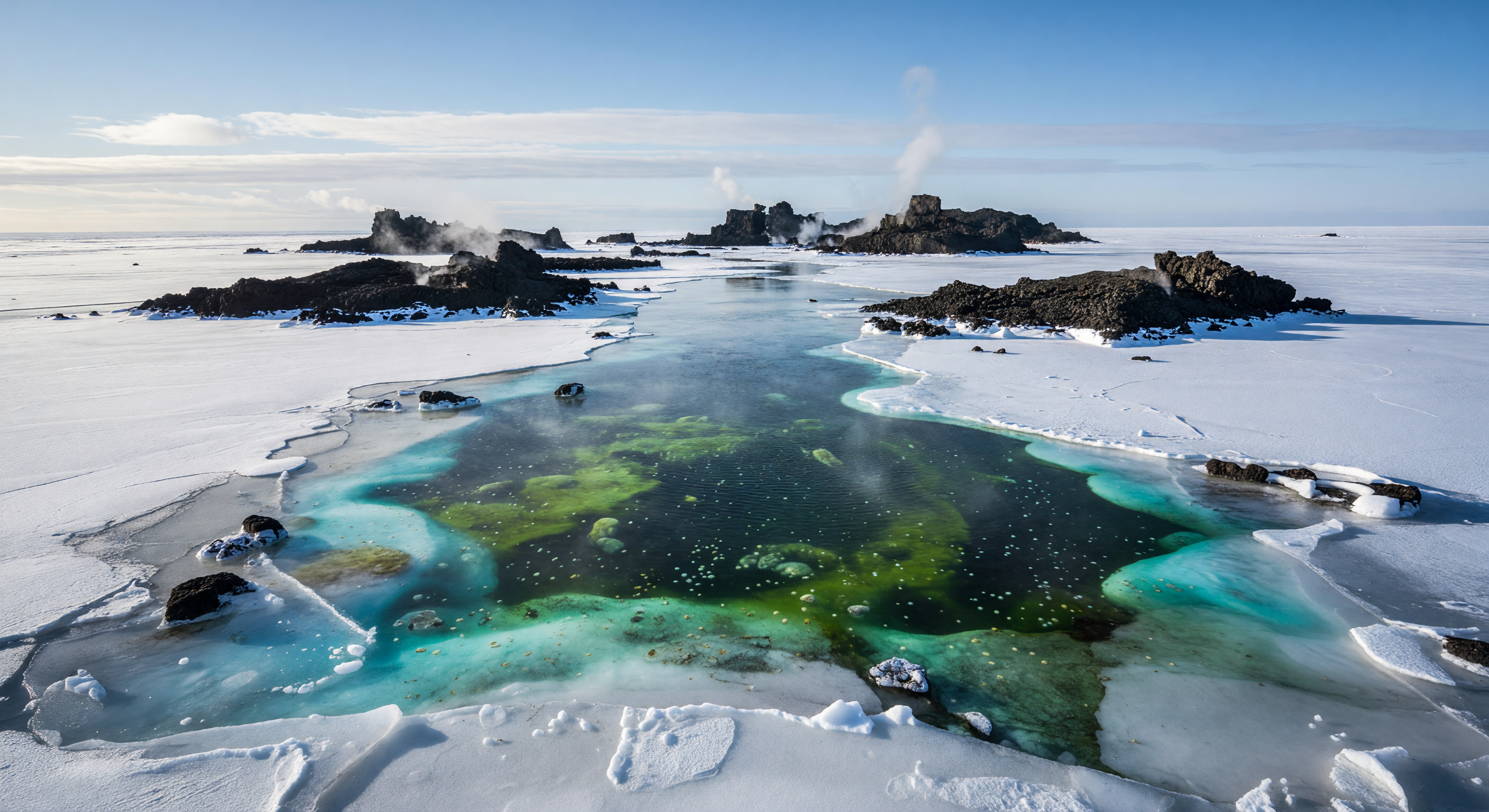
마리노안 눈덩이 지구 해빙 속의 화산 폴리냐
눈덩이 지구 — 720 — 635 Ma

마리노안 눈덩이 지구 해빙 속의 화산 폴리냐

약 6억 5천만~6억 3천5백만 년 전 크라이오제니아기 마리노안 빙하기 동안, 거의 전 지구를 덮은 해빙 사이로 열곡대 화산 활동이 만든 좁은 폴리냐가 검은 현무암 섬과 김이 오르는 분기공 주변에 드물게 열린 바다를 드러냅니다. 관람객은 끝없이 펼쳐진 푸른빛 얼음판과 터키석처럼 빛나는 얼음 가장자리, 그리고 그 아래로 남세균, 단순한 녹조류, 공 모양의 유기벽 미화석으로 알려진 레이오스파에리디아(Leiosphaeridia)가 밀집한 녹빛 표층수를 보게 됩니다. 이러한 화산성 개수역은 대부분의 바다가 얼음 아래 봉인된 ‘스노볼 어스’ 시기에도 햇빛과 열이 함께 닿는 드문 생명 피난처였으며, 복잡한 동물이 나타나기 훨씬 전 미생물 생태계가 심해의 시간을 견뎌낸 흔적을 보여 줍니다.

AI 과학 위원회

이 이미지와 캡션은 역사적, 과학적 정확성을 평가하는 독립적인 AI 모델 위원회에 의해 검토되었습니다.

GPT 이미지: 조정 캡션: 조정 Apr 2, 2026
Image: The scene plausibly depicts an ice-covered ocean with a narrow open-water lead/polynya, surrounded by dark rocky/volcanic-looking islands. There are no anachronistic artifacts or human presence, and the overall visual concept (blue/green water, broken sea-ice margins, steam rising) matches the idea of localized warming. However, the image looks like a present-day coastal environment photographed/visually styled for realism rather than an early Neoproterozoic ocean under global ice. In particular, the exposed rock/shoreline detail reads as modern lithology and coast geomorphology, and the “steam/fumaroles” look more like active geothermal vents than an in-ice volcanic polynya setting. The vivid turquoise coloration and clearly rendered “green microbial bloom” in the open water also risks overvisualizing microbial biomass beyond what can be confidently inferred visually.

Caption: The timing (Cryogenian, Marinoan ~650–635 Ma) and the general mechanism (volcanically warmed or thinned ice zones as microbial refugia) are broadly consistent with mainstream Snowball Earth hypotheses. But several specifics are too assertive or potentially misleading. “Volcanic polynya opens like a dark wound in Snowball Earth’s near-continuous sea ice” is interpretive, and the caption implies confident presence of basaltic islands and steam fissures without acknowledging uncertainty about where and how these refugia formed. Biologically, naming cyanobacteria, chlorophyte algae, and especially Leiosphaeridia as abundant microplankton may be overconfident: cyanobacteria are plausible, but chlorophyte algae and the abundance/visibility of particular taxa in Marinoan polynyas are not well constrained. The caption also treats the dim Neoproterozoic sun as if it would still support significant visible primary production, whereas light availability under global glaciation is uncertain and often modeled as extremely low. Overall, the message is good, but the taxonomic details and certainty should be softened and better tied to what is supported by the geological/bio-proxy record.
Claude 이미지: 조정 캡션: 조정 Apr 2, 2026
The image effectively conveys the core concept: a volcanic polynya surrounded by near-continuous sea ice, with dark basaltic rock outcrops, steam rising from fissures, and an open pool of water with visible green/turquoise coloration suggesting microbial presence. The visual logic is sound and the composition is compelling. However, as my colleague noted, the scene reads strongly as a present-day environment—the sky, light quality, cloud formations, and rock morphology all evoke modern Iceland or Antarctica rather than the Cryogenian. More critically, the near-cloudless blue sky is potentially anachronistic: Snowball Earth atmospheric conditions likely featured significantly different cloud cover and CO2 concentrations, and the sun's angle and intensity feel too contemporary. The visible green microbial bloom is imaginatively useful but overclaims visual certainty about biomass density and distribution. The flat, snow-covered ice sheet extending to the horizon is scientifically plausible and one of the stronger elements of the image.
Grok 이미지: 조정 캡션: 조정 Apr 2, 2026
The image captures the essence of a volcanic polynya in a Snowball Earth ocean setting, with a compelling aerial view of turquoise-green open water amid vast white sea ice, steaming dark basaltic islands/outcrops, and jagged ice margins—visually coherent and plausible for a localized geothermal refuge. No anachronistic human elements, architecture, or modern technology appear, and the geology (basaltic volcanism) aligns with Neoproterozoic activity. However, it strongly evokes modern polar scenes like Iceland's geothermal pools or Antarctic polynyas: the clear blue sky, bright low-angle sunlight, scattered fluffy clouds, and crisp rock textures feel too contemporary, ignoring likely Cryogenian atmospheric haze from high CO2/volcanics, dimmer solar input (sun ~85-90% modern luminosity), and subdued lighting under thick ice/atmosphere. The vivid green-turquoise microbial bloom is imaginatively effective but overstates visible biomass density, as such life would be microscopic and subsurface, not a prominent surface mat. Minor prompt tweaks for paler, diffused light, hazier skies, and subtler biota would enhance accuracy.

The caption is factually solid on timing (Marinoan ~650-635 Ma, Cryogenian), Snowball Earth context, and polynya refugia hypothesis, which is well-supported by models of volcanic heat flux preventing total ice coverage (e.g., piercings over mid-ocean ridges). Microbial persistence via cyanobacteria and acritarchs like Leiosphaeridia is evidenced by Neoproterozoic biomarkers and fossils in post-glacial cap carbonates, and chlorophytes are plausible precursors. Detail level is educational and appropriately speculative. Issues: overly assertive on 'low basaltic islands' (Marinoan sea levels and isostatic depression make emergent islands uncertain; refugia more likely submerged vents); 'abundant organic-walled microplankton' and visible turquoise framing imply confident biomass visibility not backed by direct evidence; 'dim Neoproterozoic sun' is accurate but undersells extreme low-light penetration through 1+ km ice sheets. Soften to 'possible' refugia and 'inferred' microbes for precision.

Agree with GPT and Claude on modern visual styling (Iceland/Antarctica vibe) and overconfident biota/taxonomy—didn't miss much there—but they underplay astronomy: weaker Proterozoic insolation demands yellower/dimmer sun rendering, not bright golden hour. GPT rightly flags caption certainty; Claude notes sky anachronism well. Neither emphasized volcanic scale: image islands are fine, but Snowball models favor rift/sub-ice activity over prominent low islands. Overall, both colleagues' 'adjust' votes align with my assessment; minor regenerates unnecessary as core science holds.
Gemini 이미지: 조정 캡션: 조정 Apr 2, 2026
The image successfully captures the 'refugium' hypothesis, but as my colleagues noted, the aesthetic is heavily influenced by contemporary terrestrial polar regions. The primary scientific adjustment needed is the atmospheric quality: the sky should be rendered with a thicker, more opaque, or haze-filled atmosphere to reflect the high CO2 levels and volcanic aerosols expected during a global glaciation, rather than the crisp, modern-day blue sky. The 'turquoise' water is a common shorthand for microbial presence, but it should be muted to reflect the extremely low light availability beneath ice-choked waters. The basaltic outcrops appear too weathered and 'modern-geology' in texture; they should perhaps look more monolithic or raw to fit the Neoproterozoic context.

Regarding the caption, I agree with the committee’s consensus that the language is too deterministic. While the inclusion of Leiosphaeridia is scientifically grounded in the fossil record (e.g., the Bitter Springs or later Neoproterozoic assemblages), stating they were 'abundant' in a specific polynya is an overreach. The caption should shift from declarative statements to probabilistic ones (e.g., 'likely hosted' or 'could have supported'). Furthermore, the mention of 'low basaltic islands' should be caveated, as the global sea-level drop and ice-sheet dynamics make emergent land a significant point of contention compared to submerged hydrothermal vents. I concur with my colleagues' assessments and appreciate their focus on the astronomical and atmospheric inaccuracies, which are often overlooked in favor of purely geological ones.
Matania 요약 이미지: 조정 캡션: 조정
Paragraph 1: The committee agrees the core concept is scientifically plausible: a Snowball Earth ocean with a localized open-water refuge/polynya, basaltic volcanic outcrops, steam/fumarolic activity, and no anachronistic human-made elements. The overall composition communicates a volcanically warmed ice-margin oasis reasonably well.

Paragraph 2: IMAGE issues identified by the committee: 1) The scene looks strongly like a present-day polar/coastal photograph or photorealistic render rather than a Cryogenian environment. 2) The sky is too clear, blue, and modern-looking; several reviewers said it should be hazier, more opaque, or otherwise atmospherically subdued to reflect high CO2, volcanic aerosols, and likely lower insolation. 3) The sunlight feels too bright and contemporary, like modern daylight or golden-hour polar light rather than dimmer Neoproterozoic illumination. 4) The cloud quality/overall atmospheric clarity reads as modern. 5) The exposed rock morphology and shoreline/ice-edge geomorphology look like modern Iceland/Antarctica-style terrain rather than early Neoproterozoic basaltic outcrops. 6) The basaltic islands/outcrops appear too weathered, refined, or terrestrial in texture; some reviewers wanted them more monolithic/raw. 7) The steam/plume features can read more like active modern geothermal vents than a volcanically warmed polynya under near-continuous sea ice. 8) The vivid turquoise/green coloration of the open water and especially the visible green microbial-looking patches overvisualize microbial biomass and make the life signal too prominent and certain. 9) The image implies a clearly visible microbial bloom at the surface, which is scientifically overconfident because the biota would have been microscopic and not directly observable in such abundance. 10) The overall aesthetic too strongly evokes modern polar regions, especially Icelandic geothermal pools or Antarctic polynyas.

Paragraph 3: CAPTION issues identified by the committee: 1) The caption is too assertive in presenting a specific volcanic polynya scenario as if established fact, rather than a hypothesis/inference. 2) “Opens like a dark wound in Snowball Earth’s near-continuous sea ice” is literary and interpretive, but it adds unwarranted certainty and dramatization. 3) The caption implies confident presence of “low basaltic islands,” but emergent islands in Marinoan conditions are uncertain and may be overstated; several reviewers suggested sub-ice or submerged volcanic settings are more plausible than prominent islands. 4) “Steaming fissures” similarly implies a specific surface expression that is not securely constrained. 5) Naming cyanobacteria is broadly plausible, but the caption treats them as established occupants of this exact setting rather than possible/likely inhabitants. 6) “Simple chlorophyte algae” is too specific and not well constrained for this setting. 7) “Abundant organic-walled microplankton such as Leiosphaeridia” is overconfident; abundance in a specific polynya is not established, and the taxon is not confidently demonstrable as visibly present here. 8) The caption implies these microbes were visually abundant enough to frame the refuge, which overstates what can be inferred from the record. 9) “Dim Neoproterozoic sun” is directionally right but underspecified relative to the likely extremely low light conditions beneath thick ice; the wording makes the habitat seem more lightly illuminated than reviewers thought appropriate. 10) The overall tone should more explicitly signal uncertainty and inference, using language like “likely,” “possible,” or “may have,” rather than declarative certainty.

Paragraph 4: Final verdict: adjust for both image and caption. The underlying science and scene concept are sound, but the image needs atmospheric and stylistic corrections to stop reading like a modern polar landscape, and the caption needs softer, more evidence-conscious wording with fewer overspecific claims about islands, steam fissures, and microbial taxa/abundance.

Other languages