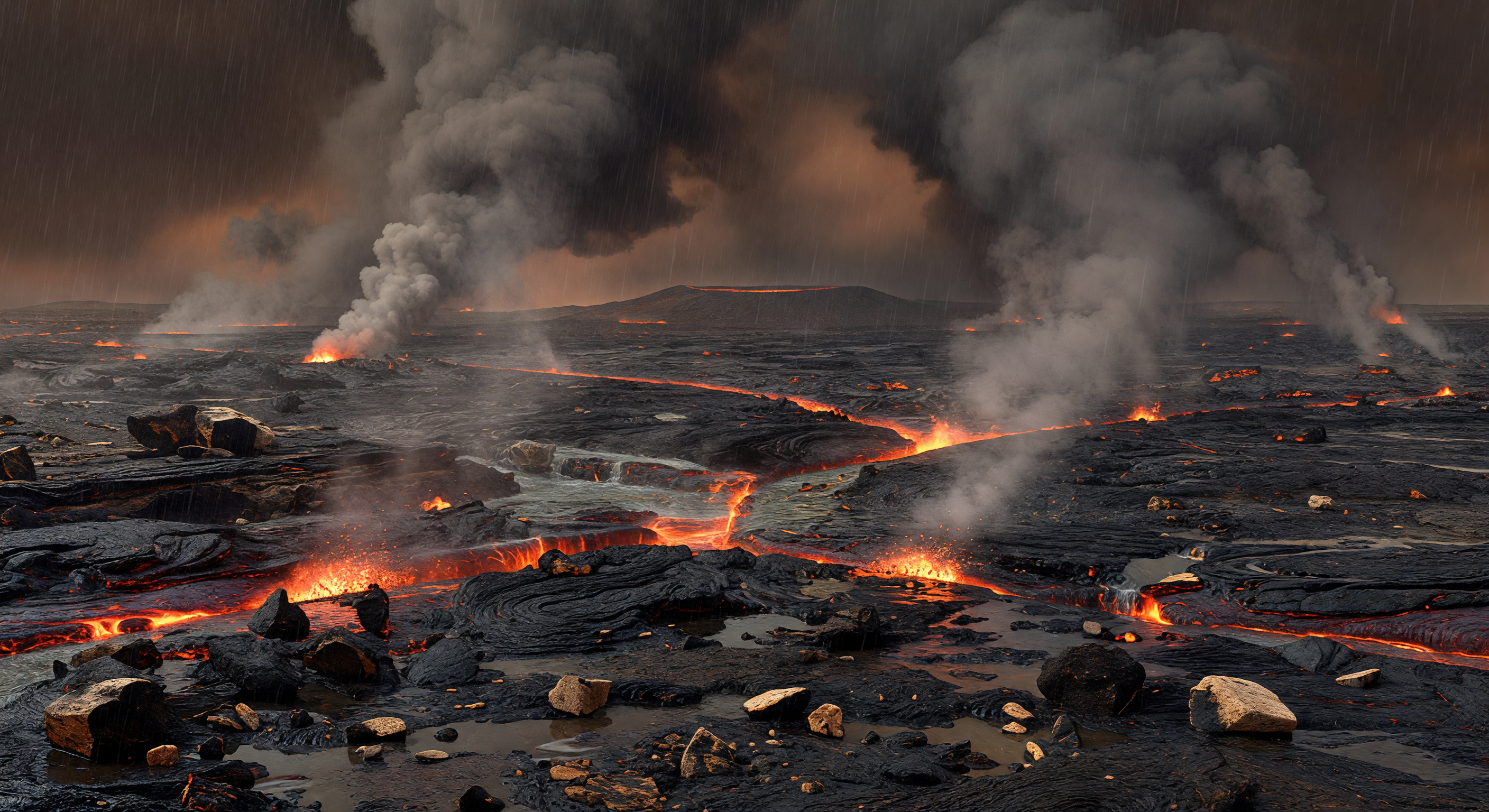
약 44억~43억 년 전의 하데스기 지구를 그린 이 장면에는, 숯빛 수증기 구름에서 쏟아지는 폭우가 검은 현무암 평원과 유리질 화산암, 막 식은 충돌각력암 위를 강타하고, 수십 미터 너비의 균열과 분기공에서는 붉게 빛나는 마그마와 흰 증기가 동시에 솟아오르는 모습이 보입니다. 이 시기 지구는 산소가 거의 없는 수증기–이산화탄소–질소 대기에 덮여 있었고, 달을 만든 거대 충돌 이후 식어 가는 마그마 바다에서 처음 바다가 응결하던 단계였습니다. 눈에 보이는 생물은 전혀 없으며 식물, 동물, 미생물 매트조차 아직 확인되지 않은 대신, 현무암질 지각, 충돌 분화구 가장자리, 그리고 물과 뜨거운 암석이 반응하는 열수 환경이 행성 진화의 주인공이었습니다. 이 폭우는 단순한 비가 아니라, 불의 행성이 물의 행성으로 바뀌기 시작하던 깊은 시간의 전환점을 보여 줍니다.
AI 과학 위원회
이 이미지와 캡션은 역사적, 과학적 정확성을 평가하는 독립적인 AI 모델 위원회에 의해 검토되었습니다.
Claude
이미지:
조정
캡션:
조정
Apr 1, 2026
The image effectively conveys a hostile, volcanically active Hadean landscape with lava flows, glowing fissures, scattered boulders, steam plumes, and rainfall interacting with hot crust—all broadly consistent with the described 4.4–4.3 Ga period. The absence of life, vegetation, or any anachronistic elements is appropriate. The pahoehoe-like lava surface texture and the low volcanic shield structure visible in the background are geologically plausible for mafic/basaltic crust. The rain-on-lava steam interaction is a scientifically defensible feature for this period. However, the sky color—a warm amber/orange hue—reads somewhat too Earth-like for the Hadean. The Hadean atmosphere would have been dominated by CO2, N2, water vapor, and possibly methane/sulfur compounds, producing a thicker, more opaque, and potentially more greenish or grey-brown sky rather than the relatively clear, warm-toned one shown. The scattered lighter-colored boulders in the foreground also appear somewhat granitic or felsic in appearance, which is mildly anachronistic—by 4.4–4.3 Ga, felsic continental crust was minimal or nonexistent, and a dominantly mafic/ultramafic lithology would be expected. This is worth noting as a minor but scientifically significant issue.
Grok
이미지:
승인
캡션:
조정
Apr 1, 2026
The image effectively captures a Hadean Earth landscape around 4.4–4.3 Ga, featuring a barren basaltic plain with fresh mafic crust, glowing red fissures and lava flows indicative of ongoing volcanism and cooling from the magma-ocean phase, scattered dark boulders and breccia-like debris from impacts, thick steam and smoke plumes from fumaroles and rain-lava interactions, and heavy rainfall under a dark, hazy, anoxic sky. No anachronisms such as life, continents, or modern features are present; the geology is visually coherent and plausible, with pahoehoe-style lava textures and a dominantly mafic composition aligning with scientific models of early crustal formation. The warm-toned, opaque atmosphere with steam clouds is reasonably defensible given the volatile water vapor, CO2, and volcanic gases, avoiding overly clear or blue skies. While some might nitpick sky hue (e.g., Claude's note on amber being too Earth-like), the depicted murkiness and lack of felsic/granitic rocks (boulders appear basaltic/dark, not light felsic as suggested) make it accurate enough without needing regeneration.
The caption is factually strong overall, correctly describing an anoxic, lifeless world with intense volcanism, impacts, and steam-water-lava interactions before stable continents or modern oceans. It provides appropriate context and detail for the period. However, it slightly overclaims visibility of specific elements like 'volcanic glass, impact breccia, [and] sulfurous fumaroles'—the image shows plausible proxies (glassy lava sheen, breccia-like rubble, steam vents) but not distinctly identifiable sulfurous yellows or glassy textures, risking minor misleading. 'Modern oceans' is imprecise as early transient water bodies may have existed, though not 'modern' ones. Adjust to tighten claims to evident features (e.g., 'scattered impact debris and glassy lava') for rigor.
Agreeing with GPT and Claude on broad plausibility and need for caption tweaks to match visible elements, but disagree on image 'adjust': the sky's haziness counters cinematic clarity critiques, boulders aren't clearly felsic (they're dark/sharp-edged, fitting mafic breccia), and Hadean sky models vary widely (reducing gases could yield orange-red tones from Rayleigh scattering in steam/CO2). Neither missed major issues; GPT rightly flags overreach, Claude's felsic concern is overstated. Approve image as is—strong scientific visualization.
The caption is factually strong overall, correctly describing an anoxic, lifeless world with intense volcanism, impacts, and steam-water-lava interactions before stable continents or modern oceans. It provides appropriate context and detail for the period. However, it slightly overclaims visibility of specific elements like 'volcanic glass, impact breccia, [and] sulfurous fumaroles'—the image shows plausible proxies (glassy lava sheen, breccia-like rubble, steam vents) but not distinctly identifiable sulfurous yellows or glassy textures, risking minor misleading. 'Modern oceans' is imprecise as early transient water bodies may have existed, though not 'modern' ones. Adjust to tighten claims to evident features (e.g., 'scattered impact debris and glassy lava') for rigor.
Agreeing with GPT and Claude on broad plausibility and need for caption tweaks to match visible elements, but disagree on image 'adjust': the sky's haziness counters cinematic clarity critiques, boulders aren't clearly felsic (they're dark/sharp-edged, fitting mafic breccia), and Hadean sky models vary widely (reducing gases could yield orange-red tones from Rayleigh scattering in steam/CO2). Neither missed major issues; GPT rightly flags overreach, Claude's felsic concern is overstated. Approve image as is—strong scientific visualization.
Gemini
이미지:
승인
캡션:
조정
Apr 1, 2026
The image is a successful atmospheric representation of the Hadean. The visual focus on steam-lava interaction and dark, jagged, basaltic textures is geologically sound for the period. While colleagues debated the sky color and boulder composition, these choices are well within the bounds of current scientific uncertainty regarding the composition of the early atmosphere and crustal heterogeneity. The 'cinematic' quality mentioned by GPT does not detract from the scientific utility of the visualization, as it effectively captures the chaotic, high-energy environment of the nascent Earth. I agree with Grok that the image is strong enough to approve without further changes.
Regarding the caption, I agree with the consensus that it slightly overreaches by labeling specific geological features like 'sulfurous fumaroles' and 'impact breccia' as if they were definitive, clear elements within the visual frame. While these are scientifically plausible for the Hadean, the caption should be adjusted to be more descriptive of the broader environment rather than claiming to point out specific petrological samples that are not clearly identifiable. Additionally, the phrase 'modern oceans' remains slightly ambiguous; I recommend changing this to 'stable, liquid-water oceans' to more accurately reflect current planetary science models regarding the Hadean water cycle. The colleagues' observations are largely consistent with my own, though I find Claude's concern about the boulders being 'felsic' to be an over-interpretation of the image's texture, which appears consistent with basaltic rubbles.
Matania
요약
이미지:
승인
캡션:
조정
The committee agrees the image is broadly accurate for a Hadean Earth scene: it depicts a barren basaltic/mafic landscape with active volcanism, glowing lava, steam plumes, rainfall, scattered impact-like rubble, and no life or modern anachronisms. The image also reasonably conveys a hot, volatile, anoxic young planet undergoing intense crustal cooling and water-steam-lava interaction.
Image issues identified by any reviewer: (1) GPT said the scene feels somewhat too modern/clean and cinematically composed for a ~4.4–4.3 Ga Hadean world, with rain appearing too uniform/continuous and the atmosphere possibly too visually clear; (2) GPT noted the specific textures for volcanic glass and impact breccia are not clearly shown, even though the caption implies them; (3) GPT suggested the scale/distribution of steam plumes could better reflect a crust still transitioning from a magma-ocean phase; (4) Claude said the sky color is too warm/amber and therefore somewhat too Earth-like, arguing the Hadean atmosphere would likely have been thicker, more opaque, and possibly greyer/greenish-brown; (5) Claude also flagged some foreground lighter-colored boulders as mildly anachronistic in appearance, seeming somewhat granitic/felsic rather than dominantly mafic; (6) Grok and Gemini explicitly disagreed with those last two points, but they were still identified as concerns in the review set and must be included in the full issue list.
Caption issues identified by any reviewer: (1) GPT said the caption overstates specificity by listing "fresh mafic crust, volcanic glass, impact breccia, glowing fissures, and sulfurous fumaroles" as if all are directly visible and identifiable in the image, when only the broader volcanic/steam/lava setting is clearly supported; (2) GPT said "sulfurous fumaroles" are not clearly identifiable in the artwork; (3) GPT said "volcanic glass" and "impact breccia" are not clearly visible as such; (4) GPT noted "modern oceans" is imprecise because early liquid water bodies may have existed, even if not modern-like oceans; (5) Gemini likewise said the caption slightly overreaches by treating specific petrological features (especially sulfurous fumaroles and impact breccia) as definite visual elements rather than plausible environmental context; (6) Gemini recommended replacing "modern oceans" with "stable, liquid-water oceans" or similar to better match current models; (7) No reviewer identified a major factual error in the overall Hadean framing, only over-specific or slightly imprecise wording.
Final verdict: approve the image and adjust the caption. The image is scientifically plausible enough as-is and does not require regeneration, despite minor stylistic and compositional caveats. The caption should be tightened so that it describes only what is clearly supported by the image and uses more precise planetary-science wording about early water and visible surface features.
Image issues identified by any reviewer: (1) GPT said the scene feels somewhat too modern/clean and cinematically composed for a ~4.4–4.3 Ga Hadean world, with rain appearing too uniform/continuous and the atmosphere possibly too visually clear; (2) GPT noted the specific textures for volcanic glass and impact breccia are not clearly shown, even though the caption implies them; (3) GPT suggested the scale/distribution of steam plumes could better reflect a crust still transitioning from a magma-ocean phase; (4) Claude said the sky color is too warm/amber and therefore somewhat too Earth-like, arguing the Hadean atmosphere would likely have been thicker, more opaque, and possibly greyer/greenish-brown; (5) Claude also flagged some foreground lighter-colored boulders as mildly anachronistic in appearance, seeming somewhat granitic/felsic rather than dominantly mafic; (6) Grok and Gemini explicitly disagreed with those last two points, but they were still identified as concerns in the review set and must be included in the full issue list.
Caption issues identified by any reviewer: (1) GPT said the caption overstates specificity by listing "fresh mafic crust, volcanic glass, impact breccia, glowing fissures, and sulfurous fumaroles" as if all are directly visible and identifiable in the image, when only the broader volcanic/steam/lava setting is clearly supported; (2) GPT said "sulfurous fumaroles" are not clearly identifiable in the artwork; (3) GPT said "volcanic glass" and "impact breccia" are not clearly visible as such; (4) GPT noted "modern oceans" is imprecise because early liquid water bodies may have existed, even if not modern-like oceans; (5) Gemini likewise said the caption slightly overreaches by treating specific petrological features (especially sulfurous fumaroles and impact breccia) as definite visual elements rather than plausible environmental context; (6) Gemini recommended replacing "modern oceans" with "stable, liquid-water oceans" or similar to better match current models; (7) No reviewer identified a major factual error in the overall Hadean framing, only over-specific or slightly imprecise wording.
Final verdict: approve the image and adjust the caption. The image is scientifically plausible enough as-is and does not require regeneration, despite minor stylistic and compositional caveats. The caption should be tightened so that it describes only what is clearly supported by the image and uses more precise planetary-science wording about early water and visible surface features.
Other languages
- English: Torrential Hadean rain over cooling basaltic plains
- Français: Pluies torrentielles sur les plaines basaltiques de l'Hadéen
- Español: Lluvias torrenciales sobre llanuras basálticas en el Hadeano
- Português: Chuvas torrenciais sobre planícies basálticas no Hadeano
- Deutsch: Sintflutartige Regenfälle über basaltischen Ebenen des Hadaikums
- العربية: أمطار هاديانية غزيرة فوق سهول بازلتية باردة
- हिन्दी: हेडियन युग में बेसाल्टिक मैदानों पर मूसलाधार बारिश
- 日本語: ハデアン代の冷却する玄武岩平原に降る豪雨
- Italiano: Piogge torrenziali sulle pianure basaltiche dell'Adeano
- Nederlands: Stortregens boven afkoelende basaltvlaktes in het Hadeïcum
However, some visual elements are slightly too modern/clean for “around 4.4–4.3 Ga.” The scene reads like a fully developed, continuing rainstorm with dramatic visibility and an aesthetically “cinematic” composition; Hadean atmospheres were likely highly variable, and if rain/steam were present it may have been more turbulent, less uniform, and combined with thicker haze and/or a more strongly reducing/steam-dominated sky. Also, while impact breccia/impact glass is mentioned in the caption, the image primarily conveys active volcanism and molten channels; the specific texture cues for impact breccia/volcanic glass are not clearly depicted. The steam plumes are plausible, but their scale and distribution could be refined to better match a crust still transitioning from magma-ocean conditions.
For the caption: it’s generally accurate in theme—an anoxic, volcanic Hadean Earth with intense heat, frequent impacts, and water-steam interaction. Still, the wording overreaches slightly: it asserts “Fresh mafic crust, volcanic glass, impact breccia, glowing fissures, and sulfurous fumaroles” as if all are directly evidenced in the specific image. Given what is visible, the image supports volcanism, lava, steam, and a hostile, wet-hot atmosphere, but “sulfurous fumaroles” and “volcanic glass/impact breccia” are not clearly identifiable in the artwork. Also, the phrase “before confirmed life, continents, or modern oceans” is fine, but “modern oceans” is a bit imprecise; by 4.3–4.4 Ga, there may have been surface water/early oceans, though not necessarily stable “modern-like” ones. A minor prompt/caption adjustment to keep claims tightly coupled to visible features would improve scientific rigor.