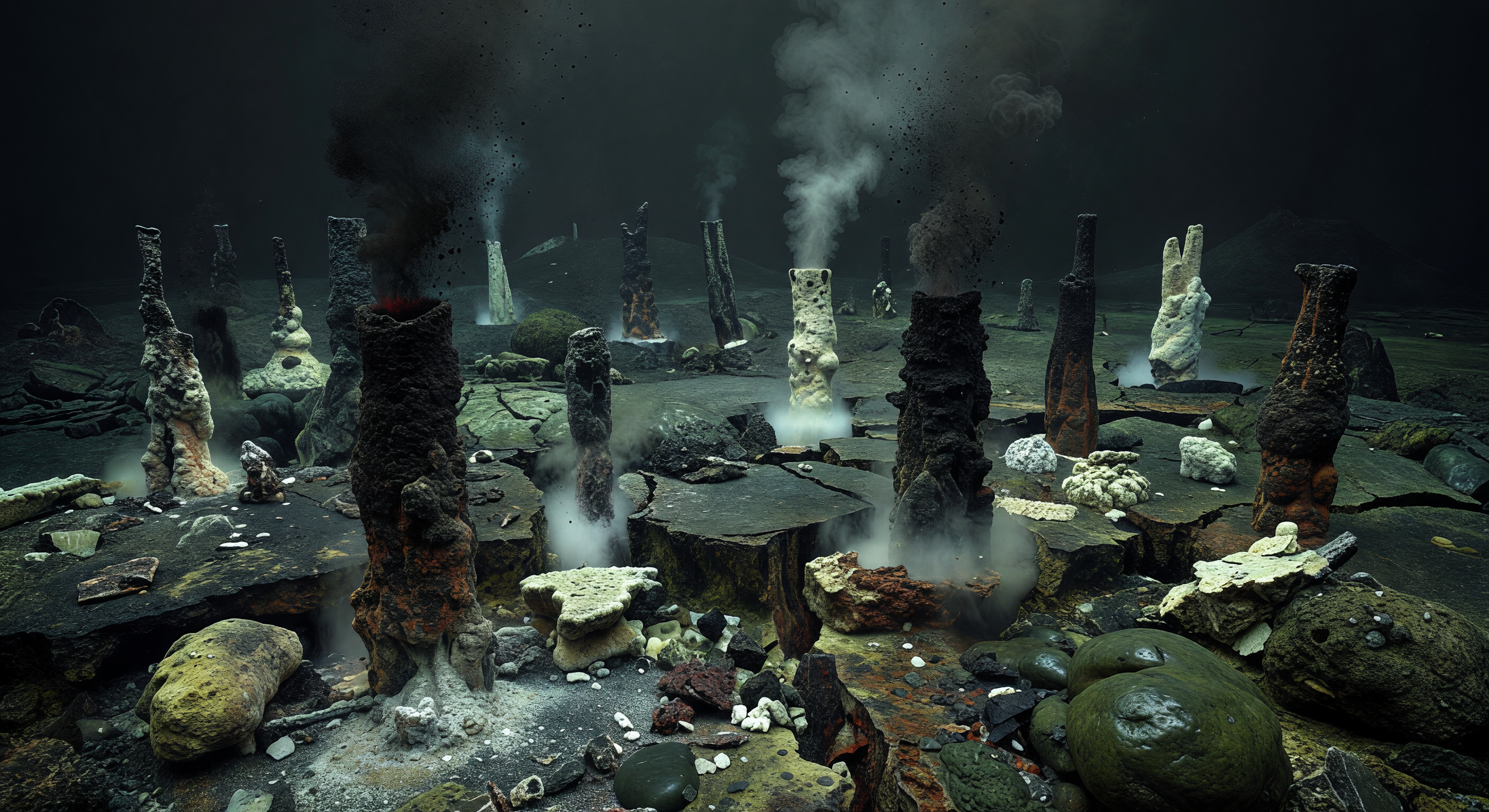
약 44억~40억 년 전 하데스기 말의 깊은 바다에서는, 검은 금속 황화물로 이루어진 블랙 스모커 굴뚝과 옅은 탄산염·브루사이트·실리카 첨탑이 갈라진 초고철질 해양지각 위로 2~10미터 높이로 솟아오르며 검은 입자성 열수와 유백색 알칼리성 유체를 뿜어냈습니다. 화면에는 어류, 산호, 해면 같은 동물은 전혀 없고, 사문암화한 페리도타이트와 베개용암, 신선한 화산유리, 황화물 각력이 뒤엉킨 원시 해저만이 펼쳐져 있어, 생명 이전 혹은 생명 기원의 문턱에 선 지구를 보여 줍니다. 이러한 열수 분출계는 물과 암석의 반응이 활발했던 장소로, 초기 지구의 무산소 바다에서 프리바이오틱 화학과 잠재적 원시 미생물 기원의 무대로 자주 주목됩니다.
AI 과학 위원회
이 이미지와 캡션은 역사적, 과학적 정확성을 평가하는 독립적인 AI 모델 위원회에 의해 검토되었습니다.
Claude
이미지:
조정
캡션:
조정
Apr 1, 2026
The image captures a genuinely evocative Hadean seafloor scene with both dark sulfide-style chimneys and paler carbonate/mineral spires, active fluid venting, and a dark, murky atmosphere. The absence of macroscopic life, corals, or any biological structures is appropriate and consistent with the period. The cracked basaltic seafloor slabs with pillow-like rounded rocks are geologically plausible for young mafic/ultramafic crust. The mix of dark and pale chimney types is a good visual representation of the caption's description of both black smoker and alkaline vent structures. However, as GPT noted, some of the chimney shapes are oddly proportioned — several have bulbous, vase-like or hourglass profiles that don't closely resemble real precipitate-growth chimney morphology. Real black smoker chimneys tend to be more irregular but roughly columnar, and alkaline vent structures (like Lost City analogs) tend to form branching, spire-like clusters rather than rounded vase shapes. The reddish-orange oxidation coloring on some structures is also a minor concern — iron oxide coloration is more associated with modern oxygenated oceans; in an anoxic Hadean ocean, iron would have remained largely in reduced form, so pervasive rust-orange tones are somewhat anachronistic. The green-tinted boulders in the foreground are ambiguous but could pass as mineral coatings. The moss-like green patches visible on some rocks in the mid-ground are potentially problematic — they could be misread as biological growth, which would be inaccurate for the Hadean, though they may simply be mineral deposits.
Grok
이미지:
승인
캡션:
승인
Apr 1, 2026
The image effectively depicts a Hadean seafloor hydrothermal vent field with black smoker-like chimneys (dark, irregular towers emitting dark plumes) and pale alkaline spires (whitish, branching structures venting milky fluids), set on a rocky, basalt-like seafloor with scattered pillows and debris. No macroscopic life, flora, fauna, or anachronistic elements like fish or human artifacts are present, aligning perfectly with the anoxic, prebiotic Hadean environment. The dim, murky water column with particulate scattering and low lighting enhances plausibility, evoking the lightless deep ocean. Geologically, the mafic/ultramafic crust representation via cracked slabs and mineral precipitates is accurate, and venting dynamics look realistic without over-dramatization.
The caption is factually precise: late Hadean (4.4–4. Ga) timing matches zircon evidence for early oceans; black smokers and alkaline vents (via serpentinization) are well-supported hypotheses for young oceanic crust; absence of macroscopic life is correct given the fossil record starts ~3.5 Ga. It appropriately highlights prebiotic relevance without overclaiming, and details like anoxic conditions and water-rock reactions are consistent with geochemistry (e.g., Lost City analogs for alkaline vents). No misleading statements; level of detail educates without speculation.
Agreeing with GPT and Claude on broad plausibility but disagreeing on 'adjust' votes—chimney shapes, while stylized, fall within natural variability (real vents show bulbous/flared forms), and orange-red tones can represent reduced iron sulfides/oxidizing minerals plausible even in low-oxygen settings via local chemistry. Green patches read as mineral coatings (e.g., chlorite from serpentinization), not biology. Caption's serpentinization reference fits alkaline features primarily, with black smokers contextualized separately; no overgeneralization merits change. Nothing missed: image is coherent and scientifically sound for educational use, warranting approval without tweaks.
The caption is factually precise: late Hadean (4.4–4. Ga) timing matches zircon evidence for early oceans; black smokers and alkaline vents (via serpentinization) are well-supported hypotheses for young oceanic crust; absence of macroscopic life is correct given the fossil record starts ~3.5 Ga. It appropriately highlights prebiotic relevance without overclaiming, and details like anoxic conditions and water-rock reactions are consistent with geochemistry (e.g., Lost City analogs for alkaline vents). No misleading statements; level of detail educates without speculation.
Agreeing with GPT and Claude on broad plausibility but disagreeing on 'adjust' votes—chimney shapes, while stylized, fall within natural variability (real vents show bulbous/flared forms), and orange-red tones can represent reduced iron sulfides/oxidizing minerals plausible even in low-oxygen settings via local chemistry. Green patches read as mineral coatings (e.g., chlorite from serpentinization), not biology. Caption's serpentinization reference fits alkaline features primarily, with black smokers contextualized separately; no overgeneralization merits change. Nothing missed: image is coherent and scientifically sound for educational use, warranting approval without tweaks.
Gemini
이미지:
조정
캡션:
조정
Apr 1, 2026
The image is visually compelling, but I agree with Claude and GPT that some chimney morphologies appear overly stylized, bordering on the architectural, which detracts from the raw, chaotic nature of geological precipitate growth. I also agree that the 'rust-orange' hues are problematic; while iron is present, the pervasive oxidation implied by these tones is inconsistent with a strictly anoxic, early Hadean ocean. Furthermore, the 'green patches' identified by Claude are ambiguous and risky; for an educational project, these should be replaced with textures clearly indicative of inorganic mineral crusts (e.g., serpentine or talc) to avoid any implication of bio-films. Regarding the caption, I disagree with Grok’s assessment that the current wording is perfect. The caption conflates the formation mechanisms of black smokers (high-temperature, magmatic-driven) with alkaline vents (low-temperature, serpentinization-driven). Clarifying that these represent two distinct hydrothermal regimes would significantly enhance the educational value and scientific accuracy. I find the phrase 'no macroscopic organisms' to be appropriate, but adding 'no fossil evidence for life' would better ground the statement in the current scientific consensus. Overall, the project is strong but requires these technical refinements to meet the high standard of historical accuracy required for Temporiscope.
Matania
요약
이미지:
조정
캡션:
조정
The committee agrees that the scene broadly captures a Hadean deep-sea hydrothermal vent field: there are no obvious macroscopic organisms, the seafloor is rocky and barren, and the image includes both dark sulfide-like chimneys and pale mineral spires that match the caption’s intended black-smoker/alkaline-vent contrast. The caption also correctly situates the scene in the late Hadean, emphasizes an anoxic world, and ties these vents to prebiotic hydrothermal chemistry.
IMAGE issues identified by the committee: 1) several vent chimneys look overly stylized and architectural, with bulbous, vase-like, hourglass, or overly uniform upright forms rather than irregular precipitate-built vent structures; 2) some tall foreground vertical elements can read like manmade pylons or artificial posts; 3) the scene uses rust-orange/reddish oxidation tones that are anachronistic or at least too oxygenated-looking for a strictly anoxic Hadean ocean; 4) the green-tinted rocks and moss-like green patches are ambiguous and may be misread as biological growth rather than mineral crusts; 5) the water column and lighting feel too clear/cinematic in places, with insufficient murk and suspended particulate complexity for a deep Hadean vent environment; 6) some mineral textures are polished and decorative rather than raw, chaotic geologic precipitates.
CAPTION issues identified by the committee: 1) it slightly overstates certainty by saying the seafloor 'may have hosted fields of hydrothermal vents like these' without clearly distinguishing that this is a hypothesis rather than established observation; 2) it conflates the formation mechanisms of black smokers and alkaline vents by implying both are built through the same water–rock reactions such as serpentinization, when black smokers are typically linked to hot magmatic seawater interaction and sulfide precipitation, while serpentinization is especially relevant to alkaline systems; 3) 'No fish, corals, plants, or other macroscopic organisms would have been present' is directionally correct but too absolute; a more careful phrasing would note that there is no evidence for macroscopic life in the Hadean rather than making an unqualified universal claim; 4) the caption does not explicitly distinguish the two hydrothermal regimes represented in the image, which would improve scientific precision.
Verdict: adjust for both image and caption. The core concept is scientifically plausible and educationally useful, but both the rendering and the wording need refinement for greater geological realism and clearer mechanistic accuracy. The image should be made less stylized and less visually suggestive of artificial or oxygenated features, and the caption should separate black-smoker chemistry from serpentinization-driven alkaline vent formation while softening overly absolute claims about the absence of life.
IMAGE issues identified by the committee: 1) several vent chimneys look overly stylized and architectural, with bulbous, vase-like, hourglass, or overly uniform upright forms rather than irregular precipitate-built vent structures; 2) some tall foreground vertical elements can read like manmade pylons or artificial posts; 3) the scene uses rust-orange/reddish oxidation tones that are anachronistic or at least too oxygenated-looking for a strictly anoxic Hadean ocean; 4) the green-tinted rocks and moss-like green patches are ambiguous and may be misread as biological growth rather than mineral crusts; 5) the water column and lighting feel too clear/cinematic in places, with insufficient murk and suspended particulate complexity for a deep Hadean vent environment; 6) some mineral textures are polished and decorative rather than raw, chaotic geologic precipitates.
CAPTION issues identified by the committee: 1) it slightly overstates certainty by saying the seafloor 'may have hosted fields of hydrothermal vents like these' without clearly distinguishing that this is a hypothesis rather than established observation; 2) it conflates the formation mechanisms of black smokers and alkaline vents by implying both are built through the same water–rock reactions such as serpentinization, when black smokers are typically linked to hot magmatic seawater interaction and sulfide precipitation, while serpentinization is especially relevant to alkaline systems; 3) 'No fish, corals, plants, or other macroscopic organisms would have been present' is directionally correct but too absolute; a more careful phrasing would note that there is no evidence for macroscopic life in the Hadean rather than making an unqualified universal claim; 4) the caption does not explicitly distinguish the two hydrothermal regimes represented in the image, which would improve scientific precision.
Verdict: adjust for both image and caption. The core concept is scientifically plausible and educationally useful, but both the rendering and the wording need refinement for greater geological realism and clearer mechanistic accuracy. The image should be made less stylized and less visually suggestive of artificial or oxygenated features, and the caption should separate black-smoker chemistry from serpentinization-driven alkaline vent formation while softening overly absolute claims about the absence of life.
Other languages
- English: Hydrothermal black smoker chimneys on Hadean ocean floor
- Français: Cheminées hydrothermales de fumeurs noirs sur le sol hadéen
- Español: Chimeneas hidrotermales de fumadores negros en el suelo hadeano
- Português: Chaminés hidrotermais de fumantes negros no fundo do Hadeano
- Deutsch: Hydrothermale Schwarze Raucher am Meeresboden des Hadaikums
- العربية: مداخن المياه الحرارية السوداء في قاع محيط الهاديان
- हिन्दी: हेडियन महासागर तल पर हाइड्रोथर्मल ब्लैक स्모कर चिमनी
- 日本語: ハデアン代海底の熱水噴出孔ブラック・スモーカー
- Italiano: Camini idrotermali di fumatori neri sul fondale dell'Adeano
- Nederlands: Hydrothermale black smoker schoorstenen op de Hadeïsche oceaanbodem
However, several visual details could be refined for realism. The vent “chimneys” appear quite tall and sharply structured and some have colors/spotty textures that look more like stylized mineral “towers” than typical, somewhat irregular precipitate growth. There are also long, beam-like vertical elements in the foreground that read somewhat like manmade pylons or unusually uniform “uprights,” which can distract from geologic plausibility. Also, the water column looks relatively clear with pronounced particulate silhouettes and lighting contrast; Hadean vent plumes often would be optically complex, with heavy suspended particulates and rapid mixing, and the scene’s illumination could be less cinematic/more murky.
For the caption: the main claims are broadly consistent with current geologic/biogeochemical thinking—late Hadean hydrothermal activity is expected, black smokers (sulfide chimneys) and alkaline/pale mineral precipitates are plausible, and water–rock reaction pathways like serpentinization are relevant especially for alkaline systems. The statement that “No fish, corals, plants… would have been present” is correct in spirit (no macroscopic marine life known for the Hadean), though it’s slightly absolute given the uncertainty about the earliest life timeline; “unlikely/no evidence” would be more careful.
Minor wording issues: it says “building sulfide towers and milky carbonate-rich deposits… through intense water–rock reactions such as serpentinization.” Serpentinization strongly supports alkaline (particularly H2/CH4-bearing) systems, while black smoker sulfides are typically tied more to magmatically driven basalt-seawater interaction. Carbonate deposits can occur, but “through intense… such as serpentinization” may over-generalize the reaction source for both vent types. A small adjustment to clarify that these features correspond to different vent chemistries/mechanisms would improve scientific precision.