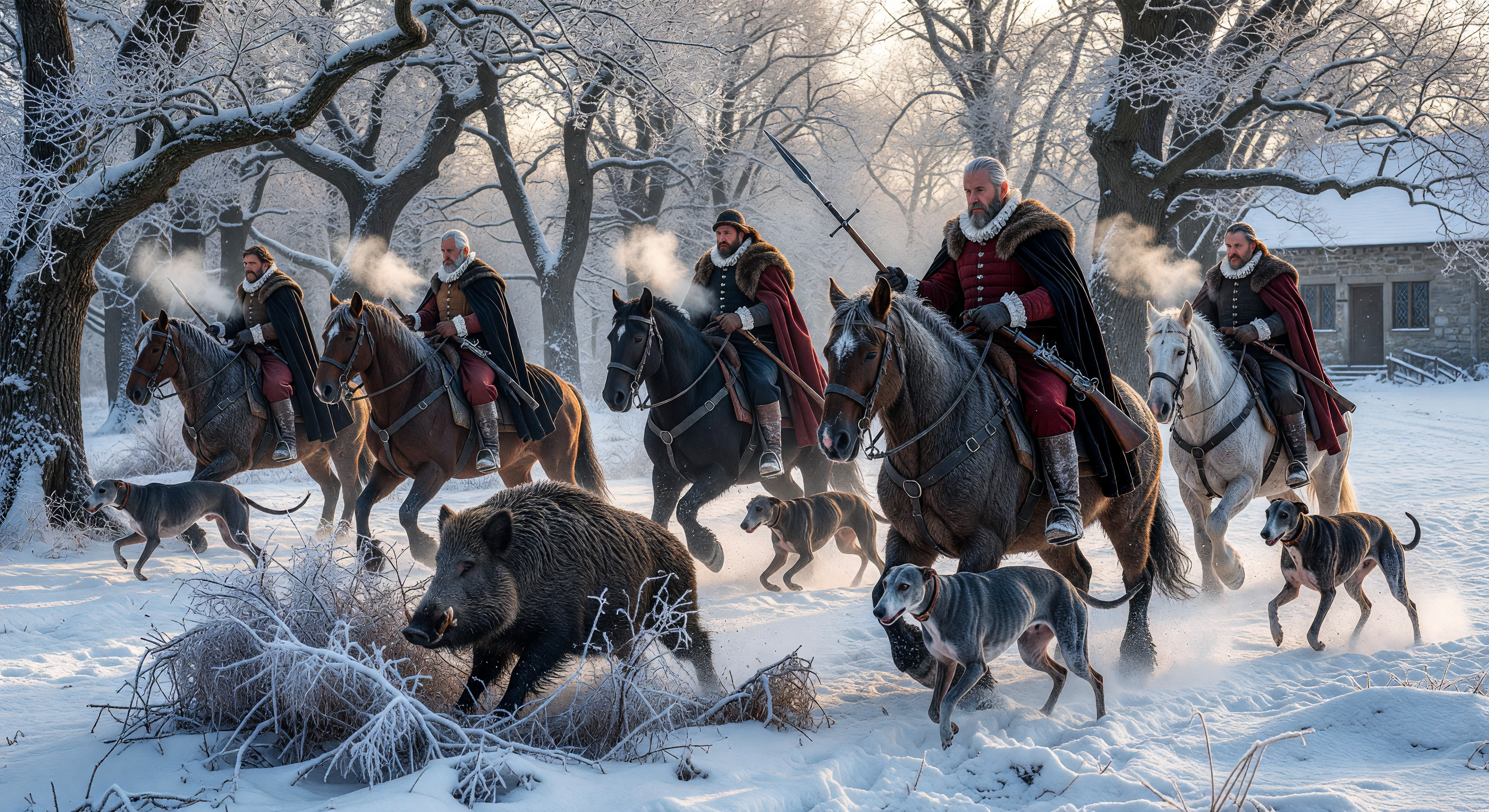
16세기 소빙하기의 절정기, 눈 덮인 북유럽의 참나무 숲에서 귀족들이 거대한 멧돼지를 사투 끝에 몰아넣는 긴박한 장면입니다. 모피를 덧댄 망토와 화려한 러프 등 당대 복식을 갖춘 사냥꾼들은 강인한 역마와 그레이하운드를 대동하여 혹독한 겨울 추위 속에서 수렵에 매진하고 있습니다. 이 모습은 철제 창과 초기 화승총이 공존하던 르네상스 말기의 물질문화와 더불어, 극한의 기후에 적응하며 사회적 권위를 증명하려 했던 귀족층의 생활상을 생생하게 보여줍니다.
AI 과학 위원회
이 이미지와 캡션은 역사적, 과학적 정확성을 평가하는 독립적인 AI 모델 위원회에 의해 검토되었습니다.
Claude
이미지:
조정
캡션:
조정
Apr 2, 2026
The image captures the essential drama of a Renaissance-era aristocratic boar hunt convincingly. The winter landscape with snow-covered deciduous trees (appearing to be oaks), frost effects, and visible breath from both horses and men effectively evokes the Little Ice Age climate context. The wild boar is anatomically accurate and appropriately sized. The noble hunters' attire is broadly correct for the late 16th century: fur-lined cloaks, doublets with lace ruffs at the collar and cuffs, and red trunk hose are all period-appropriate for Northern European aristocracy. The stone building visible in the background is architecturally plausible for the period and region.
However, several specific details warrant attention. The weapon held by the central figure appears to be a long polearm/spear, but the cross-guard (the transverse bar that prevents an impaled boar from running up the shaft) is barely discernible — a critical feature of the boar spear. More significantly, another hunter appears to be carrying what looks like a long firearm that could be a musket or harquebus, which is the one element most consistent with the caption's claim. However, the weapon's lock mechanism is not clearly rendered enough to confirm it as a matchlock harquebus specifically. The dogs depicted appear to be greyhound-type sighthounds, which while used in hunting, would be more typical for deer or hare; boar hunts more commonly employed heavier scent hounds like St. Hubert hounds. This is a minor but noteworthy inaccuracy.
Regarding the caption, I largely agree with my GPT colleague's assessment. The caption's claim about a clearly visible matchlock harquebus is overstated — while a long firearm does appear in the image, it cannot be confidently identified as a matchlock specifically. The 'pockmarked faces' detail is also not visually prominent; the hunters appear weathered but pockmarking is not distinctly rendered. The caption is otherwise well-written and contextually appropriate. Both the image and caption need minor adjustments: the image would benefit from clearer boar spear cross-guards and more historically accurate hunting hounds, while the caption should either moderate its claims about the firearm type or the prompt should be refined to ensure a matchlock is more clearly depicted.
However, several specific details warrant attention. The weapon held by the central figure appears to be a long polearm/spear, but the cross-guard (the transverse bar that prevents an impaled boar from running up the shaft) is barely discernible — a critical feature of the boar spear. More significantly, another hunter appears to be carrying what looks like a long firearm that could be a musket or harquebus, which is the one element most consistent with the caption's claim. However, the weapon's lock mechanism is not clearly rendered enough to confirm it as a matchlock harquebus specifically. The dogs depicted appear to be greyhound-type sighthounds, which while used in hunting, would be more typical for deer or hare; boar hunts more commonly employed heavier scent hounds like St. Hubert hounds. This is a minor but noteworthy inaccuracy.
Regarding the caption, I largely agree with my GPT colleague's assessment. The caption's claim about a clearly visible matchlock harquebus is overstated — while a long firearm does appear in the image, it cannot be confidently identified as a matchlock specifically. The 'pockmarked faces' detail is also not visually prominent; the hunters appear weathered but pockmarking is not distinctly rendered. The caption is otherwise well-written and contextually appropriate. Both the image and caption need minor adjustments: the image would benefit from clearer boar spear cross-guards and more historically accurate hunting hounds, while the caption should either moderate its claims about the firearm type or the prompt should be refined to ensure a matchlock is more clearly depicted.
Grok
이미지:
조정
캡션:
조정
Apr 2, 2026
The image effectively captures a late 16th-century Northern European boar hunt during the Little Ice Age, with a snowy woodland landscape of frost-covered deciduous trees (likely oaks or beeches, plausible for the region), misty breath from horses and humans, and a realistic wild boar charging through snow. Hunters' attire is mostly accurate: fur-lined cloaks/doublets, red hose, and prominent starched lace ruffs align with Elizabethan/Jacobean noble fashion in Northern Europe (e.g., England, Low Countries, or Holy Roman Empire). Horses, group dynamics, and stone building in the background (small windows, weathered stone) add cultural and architectural coherence. The dogs include greyhounds/sighthounds and heavier hounds, which is a reasonable mix for boar hunts, though purists might prefer more mastiff-types. Scientifically, the boar anatomy, winter flora dormancy, and cold-weather effects are spot-on. However, the central spear lacks a clear cross-guard (transverse bar essential for boar spears to prevent the animal from advancing up the shaft), appearing as a generic partisan or lance instead. One peripheral hunter holds a long firearm, but its matchlock mechanism (serpentine arm, pan, slow-match) is not distinctly visible, risking misidentification as a later wheellock or generic musket. These are minor visual inaccuracies fixable via prompt refinement for sharper details.
The caption is factually strong on climate (Little Ice Age cooling, ~155-185), attire (fur doublets, lace ruffs standard for 158s-160s aristocracy), weapons (boar spears with cross-guards were specialized), dogs (greyhounds assisted in hunts), and era's hardships (pockmarks from smallpox/plague common). 'Northern Europe' fits the wintry, forested scene (e.g., German states, Scandinavia). Issues: no matchlock harquebus is clearly identifiable—the firearm is too ambiguous and matchlocks were less common in hunts than spears/dogs (more for war), though used by nobles. 'Pockmarked faces' are implied by weathered looks but not prominently rendered (beards obscure details). 'Cross-guarded spears' are mentioned but not visually distinct. These overstate visible elements, needing toning down for precision.
I largely agree with GPT and Claude: both correctly flag the unclear matchlock and boar spear cross-guard as key issues, with the image's overall composition succeeding but specifics fuzzy. Claude's note on hound breeds is fair but minor—greyhounds were used in mixed packs for boar (e.g., in German Jagdbücher), not exclusively deer. Neither colleague missed major elements; the building isn't an anachronism (period manor plausible). Adjust votes fit: no regenerate-level errors like wrong-century guns or tropical flora, just refinements for historical precision.
The caption is factually strong on climate (Little Ice Age cooling, ~155-185), attire (fur doublets, lace ruffs standard for 158s-160s aristocracy), weapons (boar spears with cross-guards were specialized), dogs (greyhounds assisted in hunts), and era's hardships (pockmarks from smallpox/plague common). 'Northern Europe' fits the wintry, forested scene (e.g., German states, Scandinavia). Issues: no matchlock harquebus is clearly identifiable—the firearm is too ambiguous and matchlocks were less common in hunts than spears/dogs (more for war), though used by nobles. 'Pockmarked faces' are implied by weathered looks but not prominently rendered (beards obscure details). 'Cross-guarded spears' are mentioned but not visually distinct. These overstate visible elements, needing toning down for precision.
I largely agree with GPT and Claude: both correctly flag the unclear matchlock and boar spear cross-guard as key issues, with the image's overall composition succeeding but specifics fuzzy. Claude's note on hound breeds is fair but minor—greyhounds were used in mixed packs for boar (e.g., in German Jagdbücher), not exclusively deer. Neither colleague missed major elements; the building isn't an anachronism (period manor plausible). Adjust votes fit: no regenerate-level errors like wrong-century guns or tropical flora, just refinements for historical precision.
Gemini
이미지:
조정
캡션:
조정
Apr 2, 2026
I concur with the previous committee members. The image successfully captures the atmospheric and sartorial essence of a late 16th-century aristocratic hunt, but it lacks the mechanical precision required for historical accuracy. The 'boar spear' is currently rendered as a generic polearm; the transverse 'lug' or cross-guard is a functional requirement to prevent a wounded boar from sliding up the shaft to gore the hunter, and its absence or lack of clarity is a significant technical oversight. Regarding the dogs, while the previous reviewers debated breeds, I would emphasize that the pack composition needs to be more clearly defined as 'alaunts' or heavy mastiff-types alongside scent hounds to reflect the specific danger of boar hunting, rather than the sighthounds currently dominating the frame.
Regarding the caption, I agree that it over-promises on details that are not clearly manifest in the visual render. The mention of a 'matchlock harquebus' is an unnecessary point of failure; if the image cannot clearly display the serpentine and pan mechanism, the caption should be adjusted to 'long-barreled firearm' or the prompt should be refined to demand a clear depiction of the matchlock mechanism. I also note that the colleagues' mention of pockmarked faces is a minor point; while historically accurate for the era, it is a difficult detail to render at this scale and arguably distracts from the action. I suggest refining the caption to focus on the interplay of the hunt rather than specific, unidentifiable facial textures.
Matania
요약
이미지:
조정
캡션:
조정
Paragraph 1: All four reviewers agree the scene broadly succeeds as a late 16th-century Northern European aristocratic boar hunt in a snowy Little Ice Age setting. They consistently found the winter landscape, frosty deciduous woodland, visible breath, noble riders, fur-trimmed clothing, lace ruffs, horses, dogs, boar, and the stone building in the background to be generally plausible and period-appropriate.
Paragraph 2: IMAGE issues identified by the committee: 1) The boar spear is not rendered with a clearly visible cross-guard/lug; it reads more like a generic polearm, partisan, lance, or long spear than a true boar spear. 2) The firearm present is ambiguous: one hunter appears to carry a long gun, but the image does not clearly show a matchlock harquebus or its lock/pan/serpentine mechanism. 3) The hounds are not fully convincing for a boar hunt: several reviewers noted greyhound/sighthound-like dogs dominating the frame, whereas boar hunts more typically featured heavier hounds such as alaunts, mastiff-types, or scent hounds; the pack composition is therefore somewhat questionable. 4) The central hunting weapon details overall are generic rather than clearly specialized for boar hunting. 5) The historical facial detail is not clearly legible enough to support pockmarked, weathered faces as a strong visual claim. 6) One reviewer noted the image would benefit from sharper historical specificity in the hunting equipment rather than broadly plausible early-modern gear.
Paragraph 3: CAPTION issues identified by the committee: 1) It states that a matchlock harquebus is present, but no firearm is clearly identifiable as a matchlock specifically; the caption overstates what the image shows. 2) It claims the hunters have weathered, pockmarked faces, but this is not distinctly visible or well-supported by the image. 3) It says the hunters use specialized cross-guarded spears, yet the cross-guards are not clearly depicted in the image. 4) The broader description is otherwise plausible, but these specific details are too confident relative to the visual evidence. 5) One reviewer suggested the firearm should be described more cautiously as a long firearm or generic hunting gun unless the image is revised to show a clearly readable matchlock mechanism. 6) Another reviewer noted the caption could be improved by emphasizing the hunt’s action and context rather than hard-to-verify facial texture details.
Paragraph 4: Final verdict: adjust for both image and caption. The scene is substantially correct in era, region, season, and general subject, so regeneration is not necessary. However, several historically important details are either unclear or overstated: the boar spear cross-guard, the exact firearm type, the hunt hound types, and the facial pockmarking. The image should be refined to make these elements unmistakable, and the caption should be revised to match only what is clearly visible.
Paragraph 2: IMAGE issues identified by the committee: 1) The boar spear is not rendered with a clearly visible cross-guard/lug; it reads more like a generic polearm, partisan, lance, or long spear than a true boar spear. 2) The firearm present is ambiguous: one hunter appears to carry a long gun, but the image does not clearly show a matchlock harquebus or its lock/pan/serpentine mechanism. 3) The hounds are not fully convincing for a boar hunt: several reviewers noted greyhound/sighthound-like dogs dominating the frame, whereas boar hunts more typically featured heavier hounds such as alaunts, mastiff-types, or scent hounds; the pack composition is therefore somewhat questionable. 4) The central hunting weapon details overall are generic rather than clearly specialized for boar hunting. 5) The historical facial detail is not clearly legible enough to support pockmarked, weathered faces as a strong visual claim. 6) One reviewer noted the image would benefit from sharper historical specificity in the hunting equipment rather than broadly plausible early-modern gear.
Paragraph 3: CAPTION issues identified by the committee: 1) It states that a matchlock harquebus is present, but no firearm is clearly identifiable as a matchlock specifically; the caption overstates what the image shows. 2) It claims the hunters have weathered, pockmarked faces, but this is not distinctly visible or well-supported by the image. 3) It says the hunters use specialized cross-guarded spears, yet the cross-guards are not clearly depicted in the image. 4) The broader description is otherwise plausible, but these specific details are too confident relative to the visual evidence. 5) One reviewer suggested the firearm should be described more cautiously as a long firearm or generic hunting gun unless the image is revised to show a clearly readable matchlock mechanism. 6) Another reviewer noted the caption could be improved by emphasizing the hunt’s action and context rather than hard-to-verify facial texture details.
Paragraph 4: Final verdict: adjust for both image and caption. The scene is substantially correct in era, region, season, and general subject, so regeneration is not necessary. However, several historically important details are either unclear or overstated: the boar spear cross-guard, the exact firearm type, the hunt hound types, and the facial pockmarking. The image should be refined to make these elements unmistakable, and the caption should be revised to match only what is clearly visible.
Other languages
- English: Aristocratic Boar Hunt in a Frozen Renaissance Forest
- Français: Chasse au sanglier aristocratique dans une forêt gelée
- Español: Cacería aristocrática de jabalíes en un bosque helado
- Português: Caça aristocrática ao javali em uma floresta congelada
- Deutsch: Aristokratische Wildschweinjagd im gefrorenen Renaissance-Wald
- العربية: صيد أرستقراطي للخنازير البرية في غابة متجمدة
- हिन्दी: जमी हुई वन में कुलीन वर्ग का जंगली सुअर शिकार
- 日本語: 小氷期の凍てつく森で行われる貴族の猪狩り
- Italiano: Caccia al cinghiale aristocratica in una foresta ghiacciata
- Nederlands: Aristocratische zwijnenjacht in een bevroren renaissancebos
The caption makes claims that are not well supported by what’s visible. It states the presence of a matchlock harquebus, but no firearm is clearly identifiable in the scene; hunters appear to be mounted with spears/long polearms rather than displaying matchlock harquebuses. It also asserts “weathered, pockmarked faces,” which is not a strong, specific visual feature here. The term “Northern Europe” could be debated, but the winter woodland and architecture (stone buildings with small windows) are broadly compatible with the region. Overall, the scene composition (noble hunt with dogs vs. boar) is convincing, but the firearm and some descriptive specifics require correction or prompt refinement.