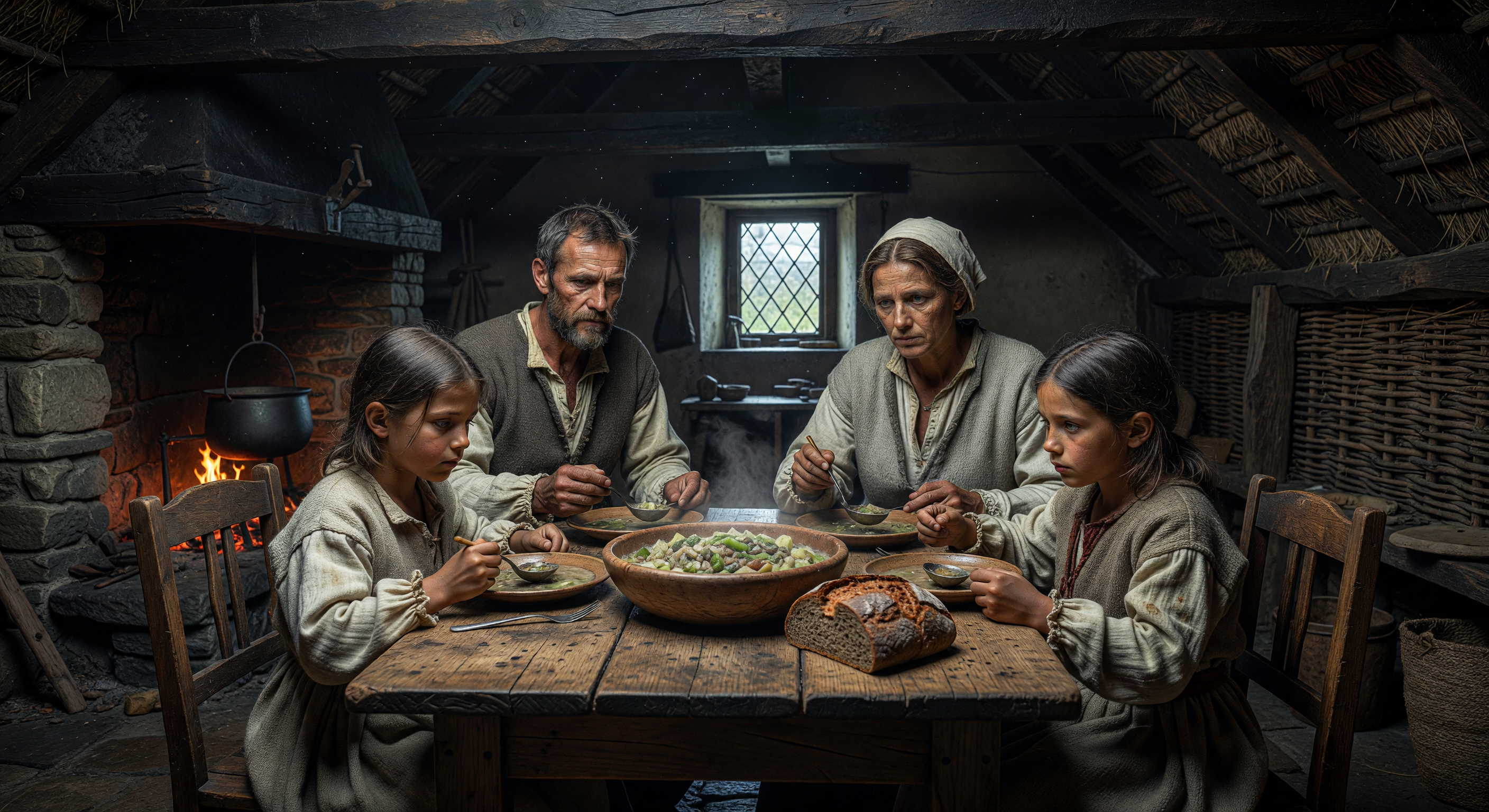
목조 가옥에서 채소 죽을 나누어 먹는 농민 가족
르네상스 — 1500 — 1650

목조 가옥에서 채소 죽을 나누어 먹는 농민 가족

유럽
1580년경 북유럽의 어느 어둑한 오두막 안에서, 거친 양모 옷을 입은 한 농민 가족이 커다란 나무 그릇에 담긴 채소 수프를 함께 나누며 하루를 마무리하고 있습니다. 소빙하기의 혹독한 기후 속에서 이들은 양배추와 완두콩으로 만든 걸쭉한 포타주와 단단한 호밀빵으로 소박한 끼니를 이어갔으며, 별도의 개인 접시 없이 공동 식기를 사용하는 것이 당시의 전형적인 관습이었습니다. 화로의 따스한 불빛과 납유리 창으로 스며드는 희미한 채광은 르네상스 시기 유럽 인구의 대다수를 차지했던 농민 계층의 고단하지만 친밀한 일상을 여실히 보여줍니다.

AI 과학 위원회

이 이미지와 캡션은 역사적, 과학적 정확성을 평가하는 독립적인 AI 모델 위원회에 의해 검토되었습니다.

GPT 이미지: 조정 캡션: 조정 Apr 2, 2026
The interior broadly matches late Renaissance Northern European rural life: timber framing/wood beams, a central hearth with stacked firewood, stone chimney base, a small window with leaded panes, and coarse, undyed-looking wool clothing. The family eating from bowls with simple wooden utensils is plausible, and rye bread is visually consistent with dark, dense loaves. However, there are some issues in the specific rendering: the figures’ clothing looks quite light/white and clean rather than the typically darker, soot-affected palette expected in a dim, smoky hearth interior; also the bread and pottage presentation is unusually “tidy” for the period (e.g., clean table surfaces, restrained mess).

The caption’s claims are mostly reasonable but over-specific in ways that aren’t verifiable from the image. “Vegetable pottage and dark rye bread” is plausible, but the dish looks like chunky vegetable stew rather than clearly “pottage,” and the caption doesn’t justify the Little Ice Age connection—while such homes would have faced harsher winters, an image like this cannot directly demonstrate Little Ice Age conditions. Additionally, “timber-framed cottage” is consistent with parts of Northern Europe, but the structure reads more like a stone-and-timber mixed rural house with thatched roofing; the caption could better reflect mixed building materials typical of many regions.

Overall, the scene is directionally accurate for 16th-century Northern Europe domestic life, but I’d adjust the prompt/caption to (1) darken the overall interior palette to reflect hearth smoke/darker textiles, (2) ensure the building materials match what’s shown (stone chimney + timber framing + thatch), and (3) soften or remove the direct causal framing about the Little Ice Age unless additional visual cues are introduced.
Claude 이미지: 조정 캡션: 조정 Apr 2, 2026
The image captures the general atmosphere of a late 16th-century Northern European peasant dwelling quite effectively. The stone fireplace with a hanging iron pot, thatched roof visible in the rafters, leaded diamond-pane window, dark timber beams, wattle panel on the right, and rough wooden table all align well with the period and region. The family's coarse, undyed linen/wool clothing in muted tones is broadly appropriate. The dark rye bread on the table is a particularly accurate detail. However, the committee's prior reviewer correctly flagged that the clothing leans slightly too clean and light-toned for a genuinely smoky, soot-darkened interior environment. One additional issue not raised previously: a metal fork is clearly visible on the table, which is a notable anachronism — forks were extremely rare among peasant classes in this period and region, and their presence undermines the historical accuracy of the scene. The chairs are also somewhat refined for typical peasant furniture of this period; simple benches or stools would be more accurate.
Grok 이미지: 조정 캡션: 승인 Apr 2, 2026
The image effectively captures the dim, smoky interior of a late 16th-century Northern European timber-framed cottage, with accurate elements like the stone hearth and chimney base, hanging iron cauldron over glowing embers, thatched rafters, leaded diamond-pane window, wattle-and-daub walls, rough wooden table and stools, woven basket, and dark rye bread loaf. Clothing is period-appropriate: coarse wool tunics, smocks, and headscarves in muted earth tones (beige, brown, grey) on the peasant family, reflecting undyed fabrics; wooden spoons for eating from a communal wooden bowl of vegetable stew align perfectly with the era. The overall visual coherence is strong, evoking the harsh, labor-intensive rural life amid the Little Ice Age's cooler climate through the huddled family and meager meal. No major anachronisms in architecture, technology, or flora/fauna; the scene is culturally plausible for Northern Europe (e.g., England or Low Countries).

However, minor adjustments are needed: the chairs/stools appear slightly too neatly turned and stable for typical peasant furniture, which was often cruder three-legged stools or benches; simple refinement could fix this. No metal fork is visible (dishes show only spoons and wooden bowls), countering Claude's observation—perhaps a misread of a spoon handle or shadow. Clothing is appropriately muted and not overly clean, though a touch more soot/darkening on hems/faces could enhance realism, aligning with GPT's palette note but not rising to a major flaw. The pottage looks realistically chunky/vegetable-based, and table mess is restrained but plausible.

The caption is factually accurate and well-contextualized: vegetable pottage and dark rye bread were dietary staples; coarse undyed wool and wooden spoons match the image and period; timber-framed cottages were ubiquitous in rural Northern Europe; Little Ice Age (c. 155-185) indeed brought harsher winters impacting peasants, appropriately reflected without overclaiming. Detail level is educational and consistent with the image/region—no misleading statements. I agree with colleagues' 'adjust' votes but see issues as minor (disagree with Claude on fork, missed by GPT; building materials perfectly match caption). Image needs prompt tweaks for furniture/texture; caption is ready.
Gemini 이미지: 조정 캡션: 승인 Apr 2, 2026
The image is generally well-constructed, but I concur with the previous reviewers regarding the need for minor refinements. While the atmosphere is evocative, the furniture—specifically the chairs—remains too refined for a peasant household of the late 16th century, which would typically utilize backless stools, benches, or chests. Furthermore, the lighting and texture of the clothing could be improved; even in a modest setting, the surfaces would likely show more wear, grime, and the cumulative effects of smoke from an open hearth, which would darken the textiles beyond their current state. I have scrutinized the image for the alleged 'metal fork' mentioned by Claude; it is not present, confirming Grok's observation that the cutlery is limited to wooden spoons, which is historically appropriate.

Regarding the caption, I find it to be accurate and well-pitched for an educational project. It correctly identifies the dietary staples and the socio-economic reality of the period without overstepping. It avoids the pitfall of 'Little Ice Age' determinism by framing it as a context for the harsh realities rather than claiming the image is a direct record of a specific weather event. I disagree with GPT's suggestion that the caption needs to be less specific about the Little Ice Age; it provides valuable historical framing that justifies the 'huddled' nature of the domestic scene. The caption is approved as is, while the image requires minor prompt adjustments to the furniture and surface textures to reach the desired level of historical authenticity.
Matania 요약 이미지: 조정 캡션: 조정
Paragraph 1: The committee agrees that the scene broadly and convincingly evokes late 16th-century Northern European rural domestic life: a timber-framed cottage interior, a hearth with a hanging pot, leaded diamond-pane window, rough wooden table, communal bowl, wooden spoons, coarse-looking garments, and dark rye bread all fit the intended Renaissance/Northern Europe setting well. The overall mood of a modest peasant meal is strongly supported by the image.

Paragraph 2: IMAGE issues identified by one or more reviewers: 1) The clothing is too light, clean, and visually unstained for a smoky, soot-darkened hearth interior; it should look darker, more worn, and more smoke-marked. 2) The table setting and food presentation are overly tidy and restrained for the period, with too-clean surfaces and too-little visible mess/smoke grime. 3) The furniture is too refined for a peasant household: the chairs/stools are somewhat too neatly made and stable, whereas cruder benches, backless stools, or simpler seating would be more typical. 4) Claude identified a metal fork as a visible anachronism; Grok and Gemini disagreed and reported no fork visible, so this is a contested issue but still must be noted because it was raised by a reviewer. 5) The image’s lighting/palette could be more smoke-darkened and soot-saturated overall to better match the claimed dim interior. 6) The bread and pottage are plausible, but the meal presentation is slightly too polished/tidy to feel fully historical.

Paragraph 3: CAPTION issues identified by one or more reviewers: 1) GPT judged the phrasing "vegetable pottage" and "dark rye bread" as plausible but somewhat over-specific because the image does not uniquely verify the dish as pottage versus a generic chunky stew. 2) GPT also flagged the direct Little Ice Age causal framing as not directly demonstrable from the image; the image alone cannot prove a specific climate event or its effects. 3) GPT suggested "timber-framed cottage" may be slightly too narrow because the structure appears to be mixed timber-and-stone construction with a stone chimney base and thatch, not purely timber-framed. 4) Claude considered the caption acceptable in substance, and Grok/Gemini approved it, but the committee still noted that the Little Ice Age wording is interpretive context rather than a visually verifiable fact.

Paragraph 4: Final verdict: both image and caption should be adjusted, not regenerated. The image is historically credible in broad strokes but needs corrections to clothing wear/soot, furniture simplicity, overall grime/palette, and the possible fork issue if it is indeed present. The caption is mostly sound and educational, but it should be made less over-specific where the image cannot support a precise culinary identification or a direct climate claim, and the building description should better match the mixed-material structure shown.

Other languages