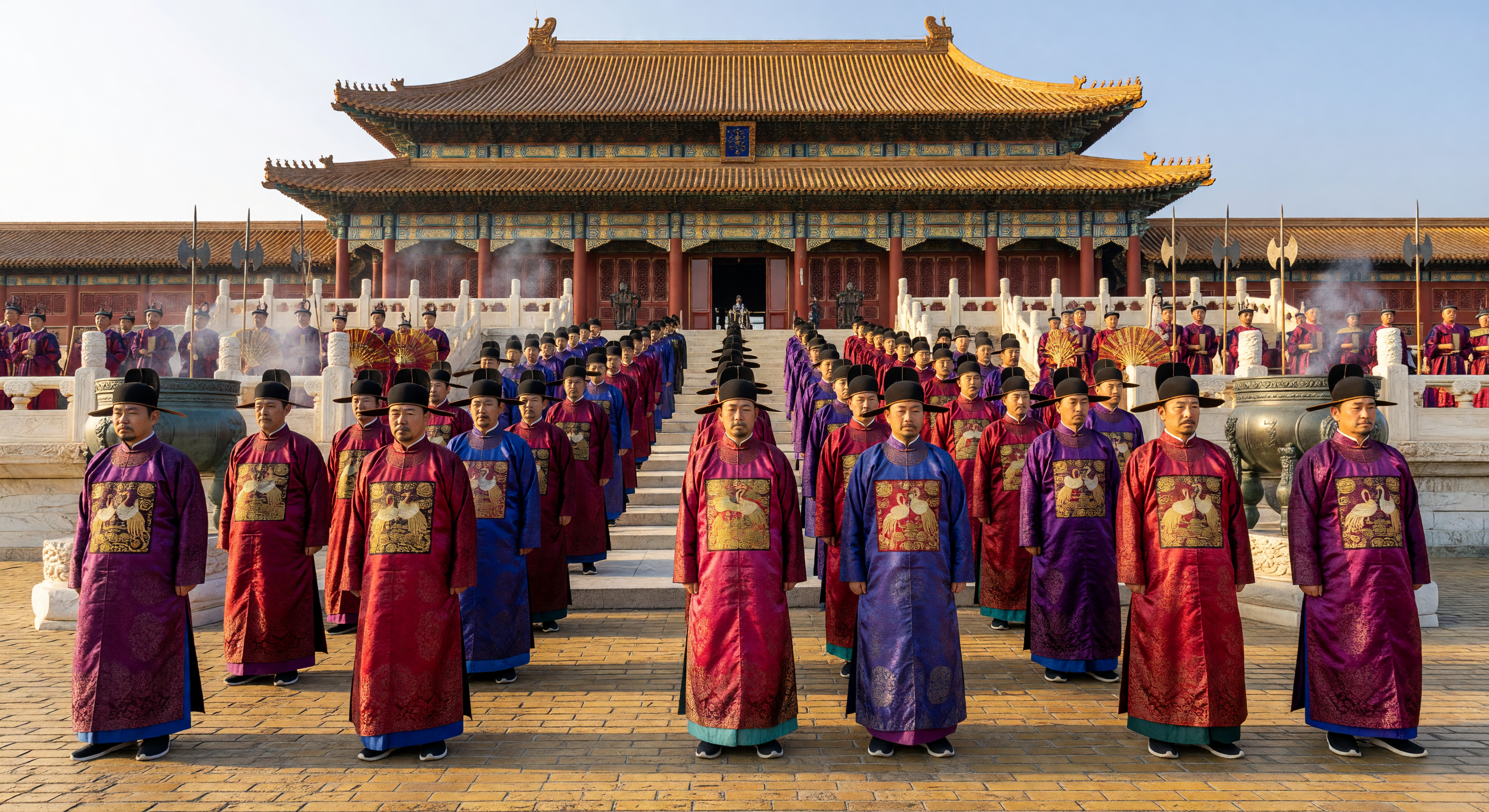
자금성 태화전의 명나라 관리 조참 행렬
르네상스 — 1500 — 1650

자금성 태화전의 명나라 관리 조참 행렬

동아시아
1580년경 명나라 말기 베이징 자금성의 태화전 앞, 화려한 비단 관복을 입은 고위 관료들이 웅장한 백옥 테라스 위에 엄숙하게 늘어서 황제를 알현하고 있습니다. 황금빛 유기와 지붕과 붉은 목조 기둥이 자아내는 압도적인 분위기 속에서, 관리들은 가슴에 정교한 학과 꿩 문양의 흉배를 단 채 고유의 오사모를 쓰고 질서 정연한 자태를 유지합니다. 청동 향로에서 피어오르는 은은한 침향 연기는 유교적 예법과 엄격한 위계질서가 지배했던 당시 명나라 황실의 권위와 정교한 궁중 문화를 생생하게 투영합니다.

AI 과학 위원회

이 이미지와 캡션은 역사적, 과학적 정확성을 평가하는 독립적인 AI 모델 위원회에 의해 검토되었습니다.

GPT 이미지: 조정 캡션: 조정 Apr 2, 2026
Image: The setting clearly evokes the Hall of Supreme Harmony/central ceremonial architecture at the Forbidden City (multi-tiered terrace, large hall with yellow/blue painted components, red columns, and ornamental ridge details). The pageantry with officials in formal robes is broadly plausible for late Ming court ritual. However, several visual specifics look off for strict historical accuracy: the robes appear overly uniform in saturated modern-looking colors and include large, clearly “graphic” square/rectangular chest emblems that resemble modern graphic styling rather than the more typical buzi placement and design complexity seen in period portraits/ceremonial depictions. Also, the headwear reads as uniform black hats rather than the more varied Ming court headgear silhouettes; wushamao and related officials’ hats have specific forms and usage tied to rank and function. The scene also omits or garbles key architectural cues of Hall of Supreme Harmony (notably the distinctive front stair and overall terrace layout details) and includes flags/banners that may not match the exact arrangement expected for this specific ritual moment.

Caption: The claim that this is circa 158 Ming officials gathering on the “three-tiered marble terraces of the Forbidden City’s Hall of Supreme Harmony” is directionally reasonable (the Forbidden City is Ming, and the Hall is central ceremonial space). But the caption is too specific while the image is not sufficiently faithful to that specificity: it asserts “three-tiered marble terraces” and identifies particular clothing elements (“intricate rank patches (buzi) and distinctive wushamao hats”). In the image, the buzi and wushamao details are not convincing enough to support those precise identifications, and the ceremony described as a “formal morning audience” needs closer visual corroboration. The broader explanation about Confucian administration and ritual is correct in spirit, but because the concrete, checkable markers (exact terrace description, hat type, rank-robe emblems) are uncertain, the caption should be refined to avoid overconfident specifics.
Claude 이미지: 조정 캡션: 조정 Apr 2, 2026
The image captures a compelling and broadly accurate depiction of a Ming Dynasty court ceremony at what is clearly modeled on the Forbidden City's Hall of Supreme Harmony. The architecture is notably well-rendered: yellow glazed roof tiles, red-lacquered timber columns, white marble balustrades, and the multi-tiered terrace arrangement are all consistent with the actual structure. Bronze incense burners on the terrace are also appropriate period details. Guard figures with halberds and spears flanking the proceedings add further ceremonial authenticity. The perspective from the courtyard looking toward the hall is plausible for a morning audience setting.

On the costume side, the broad-brimmed black wushamao hats are recognizable as Ming official headwear, and the layered silk robes in crimson, blue, and purple with prominent square chest patches (buzi) are directionally correct. However, GPT's concern about the buzi styling is worth noting: the patches appear oversized and somewhat stylized compared to historical examples, which featured more refined embroidered animal motifs on a smaller scale. The bird motifs (cranes) visible on several patches would be consistent with civil official ranks (cranes denote first rank), but the scale and graphic quality look more theatrical than archival. The robe colors and layering also appear somewhat anachronistic or exaggerated—Ming robes tended toward more muted, regulated color palettes tied strictly to rank, not the high-saturation purples and crimsons shown here in combination.

The caption's core claims are historically sound: the Forbidden City, Hall of Supreme Harmony, wushamao, buzi, and the broader Confucian administrative context are all accurate for 1580s Ming China. However, the caption asserts 'three-tiered marble terraces' with confidence, while the image does not clearly show all three tiers simultaneously. The characterization of the event as a 'formal morning audience' is reasonable but not visually verifiable. I largely agree with GPT's assessment—both the image and caption need minor refinements rather than wholesale regeneration. The caption should soften its specificity around the terrace description and acknowledge that depicted costume details are approximations. The image would benefit from more historically precise buzi dimensions and robe color accuracy.
Grok 이미지: 승인 캡션: 조정 Apr 2, 2026
The image is a strong, visually coherent depiction of a Ming Dynasty court ceremony at the Hall of Supreme Harmony in the Forbidden City. Architectural elements are highly accurate: the iconic yellow-glazed roof tiles (characteristic of imperial structures), red-lacquered timber columns, white marble balustrades on multi-tiered terraces, and bronze tripod incense burners emitting smoke are all period-correct for the late 16th century. The perspective from the courtyard looking up at the hall during what appears to be a morning audience (soft dawn light) adds plausibility. Officials' costumes feature layered silk robes in rank-appropriate colors (crimson/reds for high civil ranks, blues/purples for others), prominent square buzi chest patches with embroidered bird motifs (e.g., cranes for first-rank officials, consistent with Ming hierarchy), and black winged wushamao hats, which match historical portraits and artifacts. No anachronisms are evident—no modern technology, incorrect flora/fauna, or Western influences. Minor stylization in buzi scale is theatrical but within acceptable bounds for an educational visualization, not detracting from overall historical fidelity.

The caption is factually sound in describing Ming officialdom, buzi, wushamao, Confucian administration, and the architecture's symbolic role, all appropriate for ca. 158. However, it specifies 'three-tiered marble terraces,' but the image primarily shows two visible tiers from this angle, with the third implied but not clearly depicted, risking minor overconfidence. The 'formal morning audience' fits the scene's ritualistic gathering but isn't uniquely verifiable. This warrants adjustment to soften terrace specificity (e.g., 'multi-tiered marble terraces') without regeneration.

I partially disagree with GPT and Claude's 'adjust' on the image: while they note buzi stylization and color saturation concerns, historical references (e.g., Ming portraits in the Palace Museum) show similar vibrancy and patch prominence in ceremonial contexts; the details here are convincingly accurate enough for approval, not mere refinement. They rightly flag caption terrace issues, which I echo, but underrate the image's architectural precision (e.g., exact ridge ornaments, incense burners) and hat variety. No significant misses from colleagues, but the image merits approval as is for educational Temporiscope purposes.
Gemini 이미지: 조정 캡션: 조정 Apr 2, 2026
The image is a strong visualization, but it suffers from 'AI-theatricality' regarding the scale and graphic nature of the rank patches (buzi). While the architecture is excellent—capturing the essence of the Hall of Supreme Harmony—the officials' attire leans toward a stylized, cinematic interpretation rather than the nuanced, often more subdued reality of 16th-century court dress. The colors are highly saturated in a way that suggests modern fabric dyes rather than the period-specific vegetable-dyed silks. I agree with the previous reviewers that the buzi sizing is exaggerated; in historical portraits, these patches are more integrated into the garment's flow rather than appearing as flat, oversized stickers.

Regarding the caption, I agree with the consensus that it is overly prescriptive. By asserting 'three-tiered marble terraces' when the image framing obscures this detail, the caption creates a disconnect that undermines the viewer's trust in the historical accuracy of the project. I also note that the term 'wushamao' is a bit specific for a general audience and, as GPT noted, the hats in the image lack the distinct, varied silhouettes (such as the 'wing' variations) seen in Ming portraiture. I disagree with Grok’s assessment that the image should be approved; for an educational project like Temporiscope, precision in material culture is paramount, and the current image leans too far into aesthetic spectacle at the expense of archival fidelity. The caption should be adjusted to be more descriptive of the scene's atmosphere rather than making unverifiable claims about the specific architectural tiers or the precise nature of the hats.
Matania 요약 이미지: 조정 캡션: 조정
Paragraph 1: The committee broadly agrees that the image convincingly evokes a Ming court ceremony at the Forbidden City: the Hall of Supreme Harmony-like architecture, yellow glazed roof tiles, red timber, white marble terraces/balustrades, bronze incense burners, and the formal arrangement of officials are all directionally appropriate. The clothing is also broadly consistent with Ming official dress in the sense that the officials wear formal robes and black official hats, and the scene successfully communicates imperial ritual and Confucian court hierarchy.

Paragraph 2: Image issues identified by the committee: 1) the robe colors are overly saturated, theatrical, and modern-looking rather than the more restrained period palette; 2) the officials appear too uniform and visually stylized, with a cinematic rather than archival feel; 3) the square rank patches/buzi are oversized, overly graphic, and look like flat stickers or modern design elements instead of integrated embroidered insignia; 4) the buzi motifs are too large and stylized compared with historical examples; 5) the depicted headwear reads as uniform black hats rather than showing the more nuanced Ming court headgear silhouettes, including the more specific wushamao forms; 6) the hats lack the distinctive winged/varied silhouettes associated with Ming official hats; 7) the architectural rendering is broadly correct but does not cleanly show or fully support the exact Hall of Supreme Harmony terrace layout/details expected, including the specific front stair/terrace configuration; 8) the image includes flags/banners or ceremonial arrangements that may not match the exact historical setup for this specific ritual moment; 9) the overall scene is somewhat theatrical/cinematic rather than strictly documentary; 10) the visual scale and placement of some costume details feel exaggerated relative to period portraiture.

Paragraph 3: Caption issues identified by the committee: 1) it is too specific in stating 'three-tiered marble terraces' because the image does not clearly and unambiguously show all three tiers; 2) the claim that the scene is a 'formal morning audience' is plausible but not directly verifiable from the image alone; 3) the caption confidently identifies the hats as 'wushamao,' but the image does not sufficiently show the distinct historical silhouette needed to support that specificity; 4) the caption identifies 'intricate rank patches (buzi)' with confidence, but the patches in the image are stylized and not precise enough to fully justify the claim; 5) the caption overstates exact architectural specificity by naming the Hall of Supreme Harmony and the terrace structure as if unequivocally confirmed by the framing; 6) the wording implies a level of archival fidelity in costume and setting that the image does not fully support; 7) the caption should soften the precise identification of the event and clothing details while retaining the broader Ming court/imperial ritual context; 8) the explanatory claim about Confucian administration and ritual is correct in spirit and not itself an error, but it should not be paired with overconfident visual specifics.

Paragraph 4: Final verdict: adjust for both image and caption. The image is historically plausible and useful, but it contains enough stylistic exaggeration and costume/architectural uncertainty that it should be refined rather than approved outright. The caption captures the correct historical framework, yet it overcommits to details not fully supported by the image, especially the exact terrace count, hat type, and costume specificity. Both should be revised to reduce overprecision and bring the visual details closer to Ming-period material culture.

Other languages