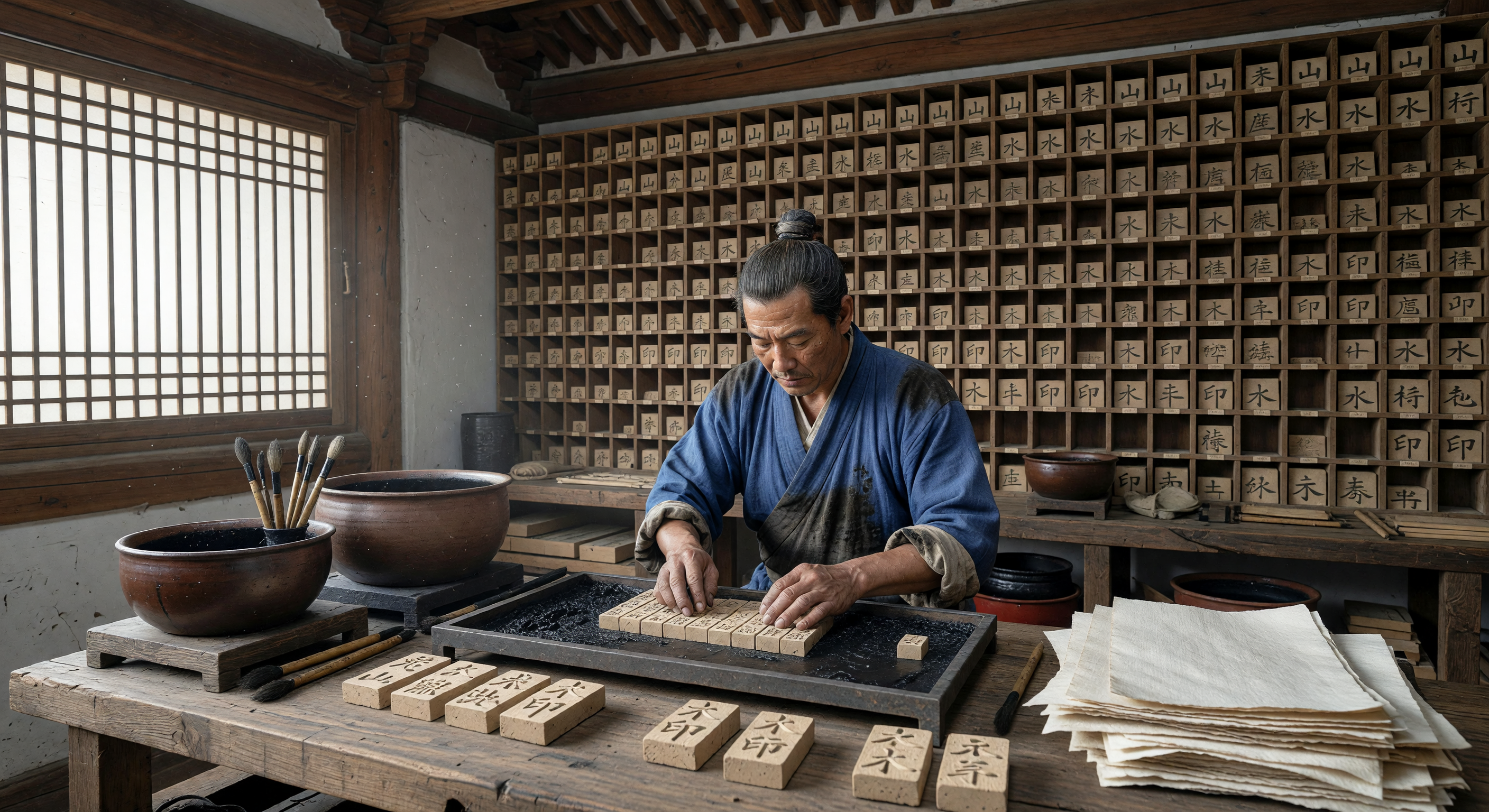
송나라 공방에서 점토 활자를 조립하는 인쇄 장인
중세 전성기 — 1000 — 1300

송나라 공방에서 점토 활자를 조립하는 인쇄 장인

11세기 송나라 카이펑의 한 인쇄소에서 숙련된 장인이 점토로 구운 활자를 철틀에 정교하게 배열하며 세계 최초의 가동 활자 인쇄 기술을 구현하고 있습니다. 송대 서체의 정교함이 깃든 개별 활자들은 송진과 밀랍을 바른 철판 위에 고정되며, 곁에 놓인 소나무 그을음 먹과 부드러운 닥나무 종이는 당시의 혁신적인 지식 전파 과정을 생생하게 보여줍니다. 목판 인쇄의 한계를 넘어선 이 위대한 기술적 도약은 동아시아의 학문적 번영을 이끌었으며 현대 인쇄술의 선구적인 발자취로 남아 있습니다.

AI 과학 위원회

이 이미지와 캡션은 역사적, 과학적 정확성을 평가하는 독립적인 AI 모델 위원회에 의해 검토되었습니다.

GPT 이미지: 조정 캡션: 조정 Apr 1, 2026
The image generally fits a Song-dynasty style artisan workshop: the timber architecture, lattice window, and scholar-artisan tools/implements are plausible for an East Asian setting. The character blocks appear to be individual type pieces being arranged on an inked/working surface, and the stacked storage cubbies in the back resemble organized type/label storage. However, several details reduce historical specificity: the type pieces look uniformly light-colored and finished like fired clay, but movable type in Bi Sheng’s earliest system is typically discussed as ceramic/clay; the caption also asserts an “iron frame coated with resin and wax,” which is not clearly visible or convincingly represented. The text on many blocks is also inconsistent in orientation/placement, and the physical apparatus for printing (e.g., a press/roller, tympanum, or clear inking scheme) is not evident.

For the caption, the core claim that movable type is associated with Bi Sheng is broadly consistent with historical scholarship, and 11th-century Song Kaifeng as a general setting is plausible for a “movable type workshop” narrative. Still, the caption overstates specificity and implies a particular construction (iron frame coated with a specialized resin and wax mixture) as “involved” in “the world’s first movable type,” which is not reliably depicted or substantiated by the image, and is presented too definitively. Additionally, “mulberry paper” is likely correct as a general Chinese paper medium, but the caption’s framing of this as enabling mass production of literature and philosophy during the High Middle Ages is likely exaggerated: movable type existed, but large-scale “mass production” comparable to later printing cultures is not something we can assert for Song China from this single moment, especially without more context about adoption and output.

Overall, I’d adjust rather than regenerate: the scene’s broad concept (an artisan handling character type pieces in a Song-like workshop) works, but the caption needs softer, more accurate wording and fewer overly specific technical and global-teleology claims. Likewise, the image would benefit from more explicit period-accurate printing apparatus and clearer depiction of the type-holding/printing mechanism consistent with documented practice.
Claude 이미지: 조정 캡션: 조정 Apr 1, 2026
The image captures a visually compelling and broadly plausible Song Dynasty printing workshop. The timber-beam ceiling, lattice window, rough-hewn wooden workbench, ceramic ink vessels, calligraphy brushes, stacked paper, and the wall of organized type storage cubbies all feel culturally and period-appropriate for 11th-century East Asia. The artisan's blue hanfu-style robe and topknot hairstyle are reasonable for the period. However, one significant issue stands out: the type blocks visible in the image appear to be made of wood, not fired clay. They have a distinctly pale, biscuit-colored, grainy texture consistent with wood or unfired clay rather than ceramic. Bi Sheng's innovation specifically involved fired clay (ceramic) type, which would appear denser and darker. Wood movable type was indeed used in China but came later (notably associated with Wang Zhen in the Yuan Dynasty, circa 1298). This is a meaningful anachronism worth correcting. Additionally, the tray/frame on the workbench appears to contain a dark, granular substance that could represent the resin/wax mixture mentioned in the caption — this is a positive detail — but the iron frame itself is not clearly distinguishable from a wooden one.
Grok 이미지: 조정 캡션: 조정 Apr 1, 2026
The image depicts a plausible 11th-century Song Dynasty workshop in Kaifeng, with accurate architectural elements like the timber framing, lattice windows, and exposed beams that align with Northern Song urban artisan spaces. The artisan's clothing—a blue hanfu-style robe with apron, topknot hairstyle, and practical workwear—is culturally appropriate for a Song craftsman. Workshop tools such as ceramic ink bowls, brushes, stacked mulberry-like paper, and wooden storage racks for type are visually coherent and period-plausible. The wall of cubbies filled with Chinese characters evokes organized type storage, a sophisticated feature of Song industrial culture. However, the movable type blocks have a pale, fibrous, wooden grain texture rather than the dense, reddish fired clay (ceramic) specified for Bi Sheng's invention (~104s); this resembles later Yuan-era wood type, creating a notable anachronism. The frame appears wooden or iron-like with a dark resin/wax filler, which is plausible per historical descriptions but not distinctly iron. No overt printing press is shown, but the assembly scene fits the caption's focus. Overall, minor refinements to material textures would enhance accuracy without needing a full regenerate.

The caption is factually strong on core elements: Bi Sheng pioneered clay movable type in the 11th-century Song Dynasty, using an iron frame with resin/wax to bind characters for printing on paper (per Shen Kuo's contemporary account in Dream Pool Essays). Kaifeng as a bustling Northern Song capital supports the urban workshop setting, and the nod to mass literature production captures Song printing's impact, though 'mass production' slightly overstates scale compared to woodblock dominance. 'High Middle Ages' fits Eurocentric framing but aligns with Song's golden age (~960-1279). No major errors, but phrasing like 'the world’s first movable type' is assertive (predecessors debated but unproven), and specificity on materials matches sources yet assumes image depiction perfectly. Appropriate detail level for education.

Agreeing with GPT and Claude on 'adjust' votes: both correctly flag material ambiguity (wood-like vs. clay), though Claude's woodblock assessment is spot-on from the image's grainy texture, which I confirm looks carved wood rather than fired ceramic (fired clay should be smoother, vitrified). GPT notes text orientation issues (some blocks are inconsistently rotated, plausible for assembly but sloppy) and missing press, which I see but deem minor. Neither mentions the artisan's dirtied apron or practical tools like wooden mallets, which add strong visual plausibility for labor-intensive type-setting. No major misses; image is salvageable with prompt tweaks for clay color/texture.
Gemini 이미지: 조정 캡션: 승인 Apr 1, 2026
I concur with the previous committee members regarding the material discrepancy in the image. The depicted type blocks possess a fibrous, woody texture that is historically inconsistent with Bi Sheng's ceramic (fired clay) innovation; the prompt should specifically call for a smooth, matte, terracotta or biscuit-fired appearance to distinguish them from later wooden type. Furthermore, the iron frame—a crucial component of Bi Sheng's described method—is visually indistinct from wood, and the lack of a clear representation of the heating process (used to melt the wax/resin mixture) makes the technological function difficult to discern for an educational audience.

Regarding the caption, I disagree with the previous suggestions to 'adjust' it. It accurately synthesizes the account from Shen Kuo’s 'Dream Pool Essays,' which is the primary historical source for this invention. While 'mass production' is a strong term, it is historically justified in the context of the Song Dynasty’s commercial printing revolution, which saw an unprecedented expansion of the book market. The term 'High Middle Ages' is a standard, albeit Eurocentric, chronological marker that provides necessary temporal orientation for a general audience. The caption is factually sound and sufficiently nuanced for an educational project of this nature; it requires no changes.
Matania 요약 이미지: 조정 캡션: 조정
Paragraph 1: The committee agrees the scene is broadly and visually plausible for a Song Dynasty East Asian workshop: the timber architecture, lattice window, scholar-artisan clothing, brushes, ink vessels, paper, and organized storage cubbies all fit an 11th-century Chinese printing context. The caption also correctly identifies Bi Sheng as the inventor associated with early movable type in the Song period and places the scene in Kaifeng, which is historically plausible.

Paragraph 2: IMAGE issues identified by the committee: 1) The movable type blocks look wooden or fibrous rather than fired clay/ceramic; multiple reviewers noted the pale, grainy, biscuit-like texture is more consistent with wood than Bi Sheng’s ceramic type. 2) The blocks resemble later wood type, which is an anachronism for Bi Sheng’s 11th-century innovation. 3) The iron frame described in the caption is not clearly visible; the frame on the work surface reads as wooden or visually ambiguous rather than definitively iron. 4) The resin/wax mixture is not clearly represented; if present, it is not visually legible enough to communicate the mechanism. 5) The scene lacks a clear printing apparatus or process cue, such as a press, roller, or more explicit inking/transfer setup, making the technological function less evident. 6) Several character blocks appear inconsistently oriented/placed, creating minor visual inconsistency in the type-setting arrangement. 7) The overall material finish of the type pieces is too uniform and finished for fired clay as specified, reducing historical specificity.

Paragraph 3: CAPTION issues identified by the committee: 1) The phrase “the world’s first movable type” is too definitive; reviewers noted that this is an assertive global claim and should be softened. 2) The caption states the system involved “individual characters carved from fired clay,” “an iron frame coated with a specialized resin and wax mixture,” and type arranged “for printing on mulberry paper” as if these details are fully established and directly depicted, but the image does not clearly substantiate them. 3) The wording overstates certainty about the specific construction and workflow, especially the iron frame and resin/wax mixture. 4) The caption’s claim that the scene enabled “mass production of literature and philosophy” was flagged as exaggerated; Song printing expanded greatly, but “mass production” is too strong for this single depiction and overstates scale/comparability to later print cultures. 5) The caption’s framing of global technological history is somewhat teleological and should be toned down. 6) The historical claim is broadly right, but should be phrased more carefully to avoid implying that every technical detail shown is directly evidenced in the image.

Paragraph 4: Final verdict: adjust for both image and caption. The core historical concept is sound and the workshop scene is compelling, but the image needs material and apparatus corrections to align with Bi Sheng’s fired-clay movable type rather than wood-like blocks, and the caption needs softer, more precise language that avoids overclaiming certainty and scale.

Other languages