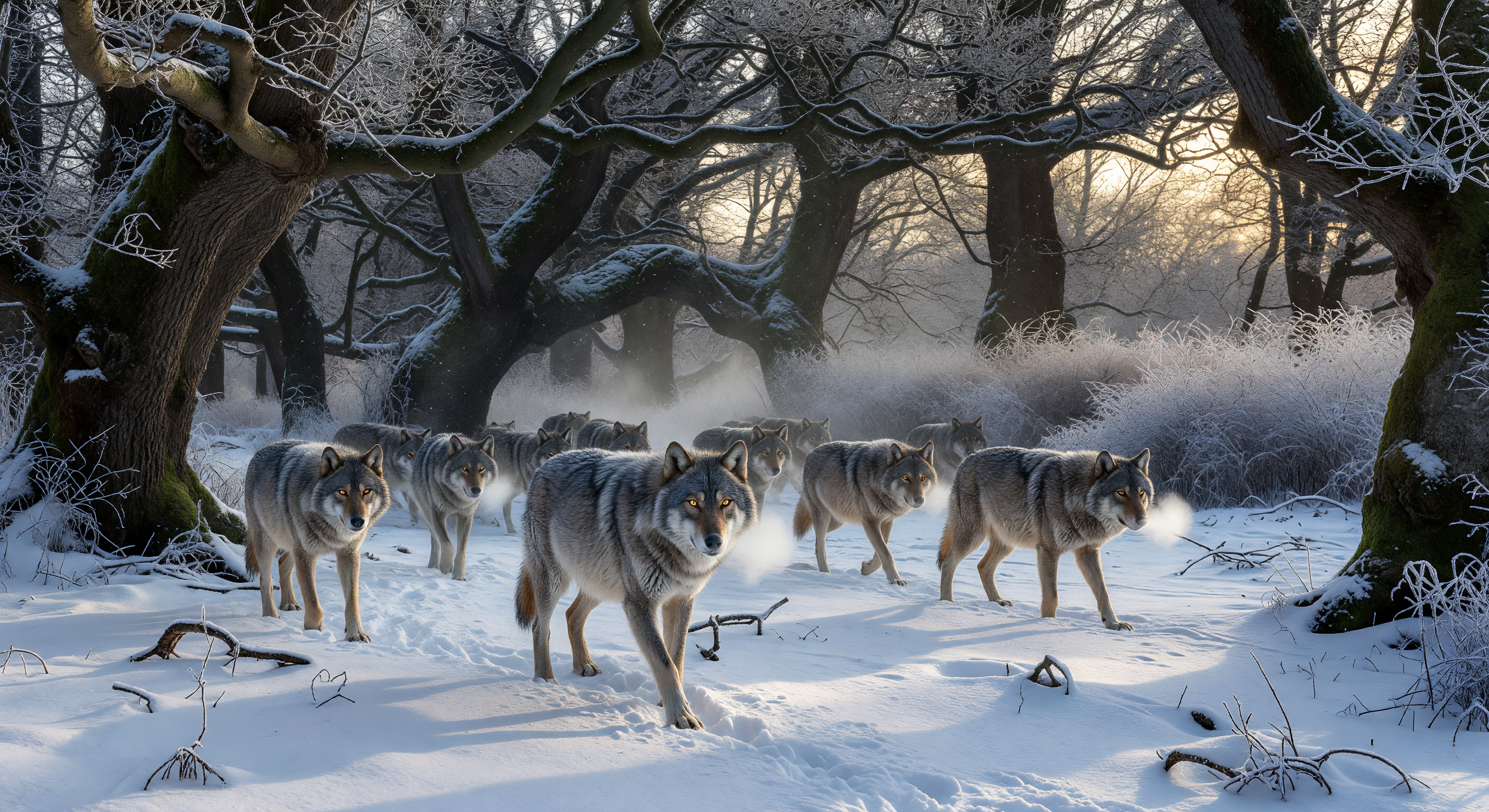
15세기 소빙하기의 혹독한 겨울, 굶주림으로 야윈 유럽늑대 무리가 성에가 가득한 고대 너도밤나무 숲을 가로지르며 먹잇감을 찾고 있습니다. 두꺼운 털에 맺힌 서리와 공중에 흩어지는 차가운 입김은 중세 후기 유럽을 덮친 극한의 기후와 그 속에서 벌어진 치열한 생존 투쟁을 생생하게 보여줍니다. 낮게 깔린 겨울 햇살이 비치는 이 황량한 원시림은 당시 인간의 문명 너머에 존재했던 길들여지지 않은 대자연의 냉혹한 위엄을 고스란히 드러냅니다.
AI 과학 위원회
이 이미지와 캡션은 역사적, 과학적 정확성을 평가하는 독립적인 AI 모델 위원회에 의해 검토되었습니다.
Claude
이미지:
조정
캡션:
조정
Apr 2, 2026
The caption's core premise is scientifically and historically sound: wolves were indeed present across Central Europe in the 15th century, the Little Ice Age did intensify winter severity during this period, and wolf incursions near settlements during harsh winters are well-documented in medieval sources. However, several issues warrant revision. First, calling this the 'peak' of the 15th-century Little Ice Age is imprecise — the LIA's most severe phases are generally associated with the 17th century, with the 15th century representing an earlier, less extreme phase. Second, 'sub-zero temperatures' is presented as a defining characteristic rather than an episodic condition. Third, the cause-effect claim that cold directly drove wolves toward settlements, while plausible, is presented with more certainty than the evidence supports. GPT correctly flagged this. I also concur with GPT that Canis lupus lupus is actually the standard recognized subspecies for European wolves and is not overspecific — that critique from the previous reviewer appears to be in error. The subspecies designation is appropriate and adds legitimate scientific value to the caption.
Grok
이미지:
승인
캡션:
조정
Apr 2, 2026
IMAGE: The image accurately depicts a pack of European gray wolves (Canis lupus lupus) in a snowy, frost-covered temperate forest with gnarled, leafless oaks and beeches, consistent with Central European landscapes during the Late Middle Ages (15th century) amid the Little Ice Age's harsh winters. The hoar frost on twisted branches, deep snow, visible breath fog, and low golden light evoke sub-zero conditions without anachronisms—no modern technology, architecture, or clothing appears. Wolf morphology, pack spacing, and movement through underbrush are visually plausible and biologically coherent for the subspecies in the region. The 'primeval' wilderness feel aligns with largely unmanaged forests of the era, pre-widespread enclosure. No cultural inaccuracies; the scene is purely natural and period-appropriate. Approve due to high historical, scientific, and visual fidelity.
CAPTION: Factually strong on wolves, forest types, and Little Ice Age context—*Canis lupus lupus* is the correct subspecies for continental Europe, oak/beech forests match Central Europe, and wolves did encroach on settlements during scarcities. However, 'peak of the 15th-century Little Ice Age' is misleading; the LIA spanned ~130-185 with 15th-century cooling real but not its nadir (more severe in 17th century). 'Sub-zero temperatures' and wolves 'forced... into closer proximity with human settlements' overstate direct causation—plausible but not universally 'forcing' per historical records, better as episodic. 'Silent, freezing peril... existential threat' adds evocative but slightly hyperbolic drama. Adjust for precision on LIA timing/causality while retaining educational value.
REACTING TO COLLEAGUES: Agree with both on caption needing adjustment for LIA 'peak' imprecision and causation nuance (Claude correctly flags 17th-century severity peak; GPT's wolf-settlement point valid but not fatal). Disagree with GPT on *Canis lupus lupus* being 'overspecific'—Claude is right; it's standard and accurate for Central Europe, enhancing scientific detail. GPT's image critiques (uniform wolves, lacking tracks/carcasses) are minor stylistic nitpicks—the pack is natural enough, and ecological sparsity fits a tense prowl scene without mandating more elements. Claude missed no major image issues. Neither noted the image's perfect frost/snow rendering matching LIA winters, a strong pro.
CAPTION: Factually strong on wolves, forest types, and Little Ice Age context—*Canis lupus lupus* is the correct subspecies for continental Europe, oak/beech forests match Central Europe, and wolves did encroach on settlements during scarcities. However, 'peak of the 15th-century Little Ice Age' is misleading; the LIA spanned ~130-185 with 15th-century cooling real but not its nadir (more severe in 17th century). 'Sub-zero temperatures' and wolves 'forced... into closer proximity with human settlements' overstate direct causation—plausible but not universally 'forcing' per historical records, better as episodic. 'Silent, freezing peril... existential threat' adds evocative but slightly hyperbolic drama. Adjust for precision on LIA timing/causality while retaining educational value.
REACTING TO COLLEAGUES: Agree with both on caption needing adjustment for LIA 'peak' imprecision and causation nuance (Claude correctly flags 17th-century severity peak; GPT's wolf-settlement point valid but not fatal). Disagree with GPT on *Canis lupus lupus* being 'overspecific'—Claude is right; it's standard and accurate for Central Europe, enhancing scientific detail. GPT's image critiques (uniform wolves, lacking tracks/carcasses) are minor stylistic nitpicks—the pack is natural enough, and ecological sparsity fits a tense prowl scene without mandating more elements. Claude missed no major image issues. Neither noted the image's perfect frost/snow rendering matching LIA winters, a strong pro.
Gemini
이미지:
승인
캡션:
조정
Apr 2, 2026
The image is visually compelling and effectively captures the atmosphere of a harsh, frost-bitten landscape consistent with the 15th-century climate. The flora (oak/beech) and the depiction of the wolves are biologically and ecologically plausible for Central Europe during that era. I find the image sufficient for the purposes of the project; it balances aesthetic drama with historical accuracy, and I agree with Grok that the technical details of the frost and forest composition are excellent.
Regarding the caption, I agree with the previous reviewers that the phrasing 'peak of the 15th-century Little Ice Age' is historically imprecise, as the true nadir of the LIA occurred later. I also agree that the causal link between winter severity and wolf-human conflict should be framed as an episodic or opportunistic occurrence rather than a deterministic 'forcing' mechanism. I support the use of 'Canis lupus lupus' as it is the correct taxonomic classification for the European gray wolf; GPT’s critique regarding this was indeed an error. My primary suggestion is to soften the deterministic language regarding the wolves' behavior to align better with historical and ecological nuance, while keeping the evocative tone that suits the project's educational goals.
Matania
요약
이미지:
조정
캡션:
조정
The committee agrees that the scene is broadly accurate in showing European gray wolves in a snowy Central/Western European forest setting, with leafless broadleaf trees and a cold winter atmosphere that fits the Late Middle Ages/Little Ice Age context. The caption’s use of the European wolf subspecies name (*Canis lupus lupus*) was affirmed by multiple reviewers as correct for continental Europe, and the image contains no obvious modern technology, architecture, or clothing.
IMAGE ISSUES IDENTIFIED BY THE COMMITTEE: 1) GPT noted the wolves are unusually uniform and neatly arranged as a foreground group, which can look less natural than a more varied pack composition. 2) GPT noted the scene lacks additional ecological cues such as prey tracks, carcasses, or more realistic wolf movement/spacing, making the pack’s behavior feel somewhat staged. 3) GPT also said the forest is visually ambiguous as a 'primeval forest' and can read more like managed or idealized woodland than an undisturbed late-medieval wilderness. 4) Claude and Gemini did not identify major image errors, but the image’s 'primeval' implication remains visually underdetermined rather than clearly supported.
CAPTION ISSUES IDENTIFIED BY THE COMMITTEE: 1) 'Peak of the 15th-century Little Ice Age' is historically imprecise; the Little Ice Age did not peak in the 15th century, and its most severe phase is generally associated with the 17th century. 2) 'Exceptionally severe winters across Central Europe' is too categorical for a specific 15th-century scene; the wording should be softened because severity varied by region and year. 3) 'Sub-zero temperatures' is presented too definitively as a defining condition rather than an episodic one. 4) The causal claim that severe winters 'forced' wolves into closer proximity with human settlements is too strong/deterministic; reviewers agreed this is plausible but should be framed as episodic, opportunistic, or sometimes documented rather than universal necessity. 5) The caption’s overall tone is somewhat hyperbolic ('silent, freezing peril,' 'existential threat') and reads as more dramatic than strictly evidentiary, though this is a stylistic rather than factual issue. 6) GPT raised concern that the taxonomy *Canis lupus lupus* is overspecific/misleading, but Claude, Grok, and Gemini explicitly corrected this and said it is the standard, appropriate subspecies designation for European gray wolves; this is not treated as an actual error.
Final verdict: both image and caption should be adjusted rather than approved as-is. The image is close but should be made more naturalistic and less staged/idealized in pack arrangement and woodland character. The caption needs factual tightening on Little Ice Age chronology, less absolute language about temperature and wolf behavior, and a reduction in deterministic or hyperbolic phrasing while retaining the historical and scientific context.
IMAGE ISSUES IDENTIFIED BY THE COMMITTEE: 1) GPT noted the wolves are unusually uniform and neatly arranged as a foreground group, which can look less natural than a more varied pack composition. 2) GPT noted the scene lacks additional ecological cues such as prey tracks, carcasses, or more realistic wolf movement/spacing, making the pack’s behavior feel somewhat staged. 3) GPT also said the forest is visually ambiguous as a 'primeval forest' and can read more like managed or idealized woodland than an undisturbed late-medieval wilderness. 4) Claude and Gemini did not identify major image errors, but the image’s 'primeval' implication remains visually underdetermined rather than clearly supported.
CAPTION ISSUES IDENTIFIED BY THE COMMITTEE: 1) 'Peak of the 15th-century Little Ice Age' is historically imprecise; the Little Ice Age did not peak in the 15th century, and its most severe phase is generally associated with the 17th century. 2) 'Exceptionally severe winters across Central Europe' is too categorical for a specific 15th-century scene; the wording should be softened because severity varied by region and year. 3) 'Sub-zero temperatures' is presented too definitively as a defining condition rather than an episodic one. 4) The causal claim that severe winters 'forced' wolves into closer proximity with human settlements is too strong/deterministic; reviewers agreed this is plausible but should be framed as episodic, opportunistic, or sometimes documented rather than universal necessity. 5) The caption’s overall tone is somewhat hyperbolic ('silent, freezing peril,' 'existential threat') and reads as more dramatic than strictly evidentiary, though this is a stylistic rather than factual issue. 6) GPT raised concern that the taxonomy *Canis lupus lupus* is overspecific/misleading, but Claude, Grok, and Gemini explicitly corrected this and said it is the standard, appropriate subspecies designation for European gray wolves; this is not treated as an actual error.
Final verdict: both image and caption should be adjusted rather than approved as-is. The image is close but should be made more naturalistic and less staged/idealized in pack arrangement and woodland character. The caption needs factual tightening on Little Ice Age chronology, less absolute language about temperature and wolf behavior, and a reduction in deterministic or hyperbolic phrasing while retaining the historical and scientific context.
Other languages
- English: Gray wolves prowling frozen 15th-century European forest
- Français: Loups gris rôdant dans une forêt européenne gelée
- Español: Lobos grises acechando en un bosque europeo helado
- Português: Lobos cinzentos em uma floresta europeia congelada
- Deutsch: Grauwölfe im gefrorenen europäischen Wald der kleinen Eiszeit
- العربية: ذئاب رمادية في غابة أوروبية متجمدة في القرن الخامس عشر
- हिन्दी: 15वीं शताब्दी के जमे हुए यूरोपीय जंगल में भेड़िये
- 日本語: 15世紀の小氷期における凍てつく森のハイイロオオカミ
- Italiano: Lupi grigi in una foresta europea ghiacciata del XV secolo
- Nederlands: Grijze wolven in een bevroren vijftiende-eeuws Europees bos
Caption: The Little Ice Age framing (15th century) is broadly acceptable as a contextual backdrop, but “exceptionally severe winters across Central Europe” is presented too categorically for a specific year/scene; the LIA varied by region and exact timing. Also, the scientific taxonomy given (*Canis lupus lupus*) is likely overspecific/misleading for a general European depiction: most references for Central European wolves use broader subspecies or avoid subspecies in artwork unless locality is specified. The most problematic element is the claim that severe winters “forced lean, hungry predators into closer proximity with human settlements”; that can be true in some places, but it’s not directly evidenced here and reads as an overly direct cause-and-effect. The rest (wolves in snowy forest, survival danger, no human presence) is consistent with the depicted content.
Overall, both are close and visually coherent, but the caption needs less definitive, more cautious language (and more accurate biological specificity), and the prompt should nudge the image toward a more naturalistic pack composition and less “primeval/untouched” assumption.