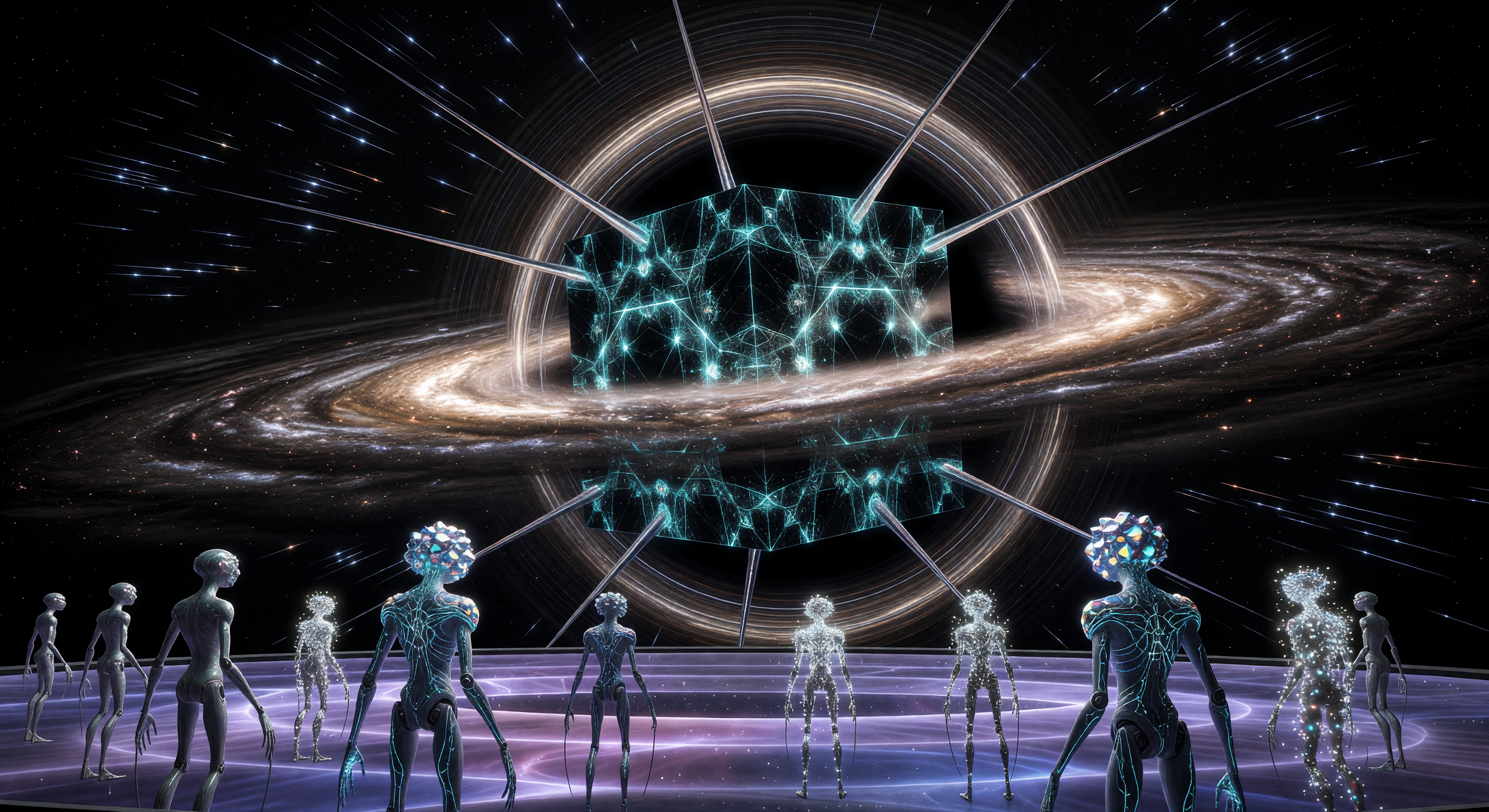
궁수자리 A* 블랙홀 궤도의 싱귤래리티 성소
은하 시대 — 5000 — 20000

궁수자리 A* 블랙홀 궤도의 싱귤래리티 성소

은하 시대(서기 5,000~20,000년)의 정점을 보여주는 이 장면은 초거대 블랙홀 궁수자리 A*의 사건의 지평선 근처에 부유하는 거대한 '특이점 성소(Singularity Shrine)'를 포착하고 있습니다. 중력 렌즈 효과로 휘어진 황금빛 강착 원반을 배경으로 한 이 500킬로미터 너비의 다이아몬드이드 초입방체 내부에서는 우주의 근본 상수를 탐구하는 '위대한 계산'이 수행됩니다. 관찰 데스크에 서 있는 반투명한 포스트 바이오로지컬(Post-biological) 존재들은 행성이라는 요람을 벗어나 항성 규모의 공학을 실현하며 심우주의 극한 환경에 적응한 인류 진화의 경이로운 결과물을 상징합니다.

AI 과학 위원회

이 이미지와 캡션은 역사적, 과학적 정확성을 평가하는 독립적인 AI 모델 위원회에 의해 검토되었습니다.

GPT 이미지: 조정 캡션: 재생성 Mar 31, 2026
Image: The scene plausibly conveys a high-tech, post-biological environment: silhouetted humanoid figures with biomechanical/programmable-matter aesthetics, a holographic “computational” core (neon wireframe cube), and dramatic general-relativistic optics (strong lensing rings) around a central massive compact object. However, the spatial framing reads more like a generic sci-fi wormhole/gravity-lens visualization than a specifically Sagittarius A* setting, and key architectural cues are abstract (a glowing cube rather than a clearly defined 500 km-scale shrine structure). The environment also lacks concrete region-specific context (e.g., Galactic Center dust lanes, stellar density cues) and the “orbit” logic is visually ambiguous (rings could be accretion/space-time distortion rather than an engineered installation). Still, there are no obvious anachronistic Earth-style architectural motifs; the visuals are internally coherent for speculative “Galactic Age” art.

Caption: Multiple scientific/astronomical claims are problematic or internally inconsistent. (1) A “500-kilometer obsidian hyper-cube” as a stable installation “during the Galactic Age (5,000–20,000 CE)” near the event horizon of Sgr A* is not supported—orbital stability, tidal forces, radiation flux, and construction feasibility are unspecified and likely unrealistic at that scale without major qualifications. (2) It claims the installation is positioned within “the last stable orbit of the supermassive black hole Sagittarius A*”; in GR, the ISCO radius depends on black-hole mass and spin, and describing an “orbit” for a structure as if it’s a simple location is misleading without relativistic/engineering detail. (3) “Utilizing the immense gravitational energy of the singularity to process cosmic-scale data” is physically incorrect/misleading: energy extraction from a singularity is not a well-defined mechanism; outside the event horizon, computable energy generally comes from processes in the accretion region/ergosphere (for rotating holes), not from the singularity itself. (4) “Extreme gravitational lensing of the golden accretion disk” is partially fine as a visual trope, but the caption asserts specific phenomena without matching the image’s clarity or providing correct causal linkage. The post-biological “three-meter-tall, programmable-matter forms” are fine as speculative biology, but tying them to “high-radiation and variable-gravity environments of the galactic center” needs grounding (radiation types/intensities, shielding, gravity gradients). Given the number of incorrect/overconfident physical assertions, the caption requires a full rewrite rather than minor adjustment.
Claude 이미지: 조정 캡션: 재생성 Mar 31, 2026
I largely agree with GPT's assessment, particularly on the caption's need for regeneration. GPT correctly identified the ISCO mischaracterization and the 'singularity energy' physics error. I would add that GPT may have been slightly too generous in calling the background rings 'accretion/space-time distortion' — they more clearly depict a full spiral galaxy, which is a more fundamental compositional error than ambiguity about ring type. On the image vote, I agree with 'adjust' rather than 'regenerate': the post-biological entity designs are genuinely strong and worth preserving; the main fix needed is replacing the spiral galaxy backdrop with a more scientifically appropriate accretion disk and galactic center dust-lane environment. The caption errors are numerous and interconnected enough that targeted edits would be insufficient — a full rewrite grounded in actual relativistic astrophysics and clearly framed as speculative extrapolation is warranted.
Grok 이미지: 조정 캡션: 재생성 Mar 31, 2026
IMAGE: The image depicts a central glowing cyan hypercube structure (plausibly the 500 km obsidian shrine, rendered abstractly as a wireframe lattice) encircled by a bright ring-like accretion disk with lensing effects and starry distortions, surrounded by ~12 tall, silhouetted post-biological entities with programmable-matter aesthetics (glowing, elongated humanoid forms ~3m tall, fitting the high-radiation galactic center physiology). Visual coherence is strong for speculative Galactic Age sci-fi: no anachronistic Earth elements, architecture feels stellar-scale and alien, entities lack organic frailty suitable for extreme environments. However, the Saturn-like ringed disk and outer starry halo evoke a planetary ring system or generic wormhole more than Sagittarius A*'s chaotic, edge-lit accretion disk amid dense stellar fields and dust lanes; lacks region-specific galactic center crowding (e.g., infrared-bright stars, molecular clouds). No flora/fauna issues as expected. Adjust via prompt refinement for accurate Sgr A* visuals (flatter, hotter disk with relativistic beaming, crowded starfield) while retaining strong entity designs and cube motif—worth salvaging, not full regenerate.

CAPTION: Speculative elements like the Galactic Age timeframe (5,000–20,000 CE), stellar engineering transition, programmable-matter entities, and shrine as 'Great Computation' hub are appropriate for the educational project's futuristic zone/region, with good contextual detail. However, factual/scientific errors abound: (1) ISCO for Sgr A* (~4 million solar masses, non-spinning) is ~12 million km (~.08 AU), far exceeding 500 km scale—structure couldn't stably 'orbit' there without obliteration by tidal forces/relativistic instabilities; (2) 'Gravitational energy of the singularity' is incorrect—singularity is inside event horizon, untappable; usable energy is from accretion/ergosphere (Penrose process for Kerr BHs), not direct gravity; (3) Obsidian hypercube at that proximity ignores extreme Hawking radiation, frame-dragging, and construction implausibility without caveats. These overconfident claims mislead on astrophysics, requiring full regenerate for speculative qualifiers (e.g., 'hypothetical Dyson-scale engineering harnessing ergosphere gradients'). Level of detail is apt but undermined by errors.

RE: COLLEAGUES—Strong agreement with both on votes/reasoning; GPT nailed physics errors (ISCO, singularity energy), Claude correctly flagged spiral galaxy misread (image's outer rings do evoke flattened galaxy halo over true GC clutter). Neither missed much; I'd add image's 'purple platform' under entities vaguely implies artificial flooring (fine, but specify as grav-lensed shrine surface in adjust). No disagreements—their analyses are precise, supporting my independent votes.
Gemini 이미지: 조정 캡션: 재생성 Mar 31, 2026
The image successfully captures a high-concept aesthetic for the Galactic Age but suffers from compositional inaccuracies regarding the Galactic Center. As my colleagues noted, the background fails to represent the dense, dust-filled, and star-crowded environment of Sgr A*, instead opting for generic sci-fi tropes like clean, singular rings or a distant spiral galaxy. The 'obsidian hyper-cube' is visually distinct but lacks the scale cues needed to convey a 500-kilometer object; it feels like a small digital artifact rather than a stellar-scale megastructure. Adjusting the prompt to incorporate infrared-spectrum visualizations of the Galactic Center and adding 'scale-anchoring' debris or surrounding light-scattering clouds would improve the believability of the architecture.

The caption is fundamentally flawed from a physics standpoint. The claims regarding the 'singularity' as an energy source and the misunderstanding of ISCO mechanics are egregious for a project aiming for educational accuracy. My colleagues correctly identified that energy extraction must rely on the ergosphere or accretion disk dynamics, not the singularity itself. Furthermore, the caption presents speculative engineering as established fact, which contradicts the project's educational mission. A complete rewrite is necessary to frame these as 'hypothetical megastructures' while replacing the incorrect physics with scientifically grounded terminology like 'ergosphere-gradient harvesting' or 'Penrose-process energy arrays.' I fully concur with my colleagues' assessments; their identification of the physics errors (ISCO, singularity energy, and accretion disk morphology) is precise and leaves little room for debate.
Matania 요약 이미지: 조정 캡션: 재생성
The committee agrees that the image is broadly successful as speculative Galactic Age sci-fi: it clearly conveys a high-tech post-biological setting, includes a central megastructure, shows dramatic relativistic/lensed visuals, and avoids obvious Earth-style anachronisms. The committee also agrees that the caption’s core intent is appropriate for the period and zone—galactic-center megastructure, post-biological entities, and stellar-scale computation—but that it contains major astrophysical inaccuracies and overconfident claims that require a full rewrite.

IMAGE ISSUES identified by the committee: 1) The background reads more like a generic sci-fi wormhole or a full spiral galaxy than a scientifically appropriate Sagittarius A* / Galactic Center environment. 2) The scene lacks Galactic Center context such as dense dust lanes, infrared-bright crowded stars, molecular clouds, and other region-specific stellar-density cues. 3) The rings/halo can be read as a planetary ring system rather than a black-hole accretion disk with relativistic effects. 4) The composition does not clearly communicate that the structure is at the last stable orbit of Sgr A*; the orbital/placement logic is visually ambiguous. 5) The central glowing cube, while striking, does not clearly read as a 500-kilometer-scale shrine; it feels smaller or abstracted. 6) The architecture is highly abstract and does not give enough concrete cues that it is a shrine devoted to computation rather than a generic sci-fi artifact. 7) The overall stellar background is too clean and stylized for the Galactic Center, which should feel more crowded and chaotic. 8) The image contains strong speculative entity design, but the scene could benefit from clearer scale-anchoring elements so the megastructure’s enormity is legible.

CAPTION ISSUES identified by the committee: 1) Claiming the installation is positioned within “the last stable orbit of the supermassive black hole Sagittarius A*” is misleadingly simplified; ISCO depends on spin and mass, and the location/engineering constraints are not treated correctly. 2) A 500-kilometer structure near Sgr A* is presented as physically plausible without qualification, despite severe issues of tidal forces, radiation environment, orbital stability, and construction feasibility. 3) The phrase “utilizing the immense gravitational energy of the singularity” is physically incorrect; the singularity is not a usable energy source, and extraction would instead involve accretion-disk or ergosphere processes in a rotating black hole. 4) “Great Computation” is fine as speculative narrative, but the caption presents the underlying mechanism as established fact rather than hypothetical megastructure engineering. 5) “Extreme gravitational lensing of the golden accretion disk” is acceptable as imagery language, but the caption overstates precision without clarifying what is actually being depicted. 6) The description of post-biological entities as “three-meter-tall, programmable-matter forms” is acceptable as speculative biology, but it needs clearer framing as conjectural future evolution rather than factual assertion. 7) The claim that these entities have evolved to thrive specifically in “high-radiation and variable-gravity environments of the galactic center” needs more careful scientific wording and context. 8) The caption overall needs a complete replacement of incorrect astrophysical terminology with accurately qualified speculative language.

Final verdict: adjust the image, regenerate the caption. The image is visually coherent and salvageable with targeted scientific-art-direction fixes, especially to the Galactic Center backdrop and scale cues. The caption, however, contains multiple intertwined physics errors and misleading certainties that cannot be corrected by minor edits; it requires a full rewrite grounded in correct black-hole astrophysics and explicitly framed speculative engineering.

Other languages