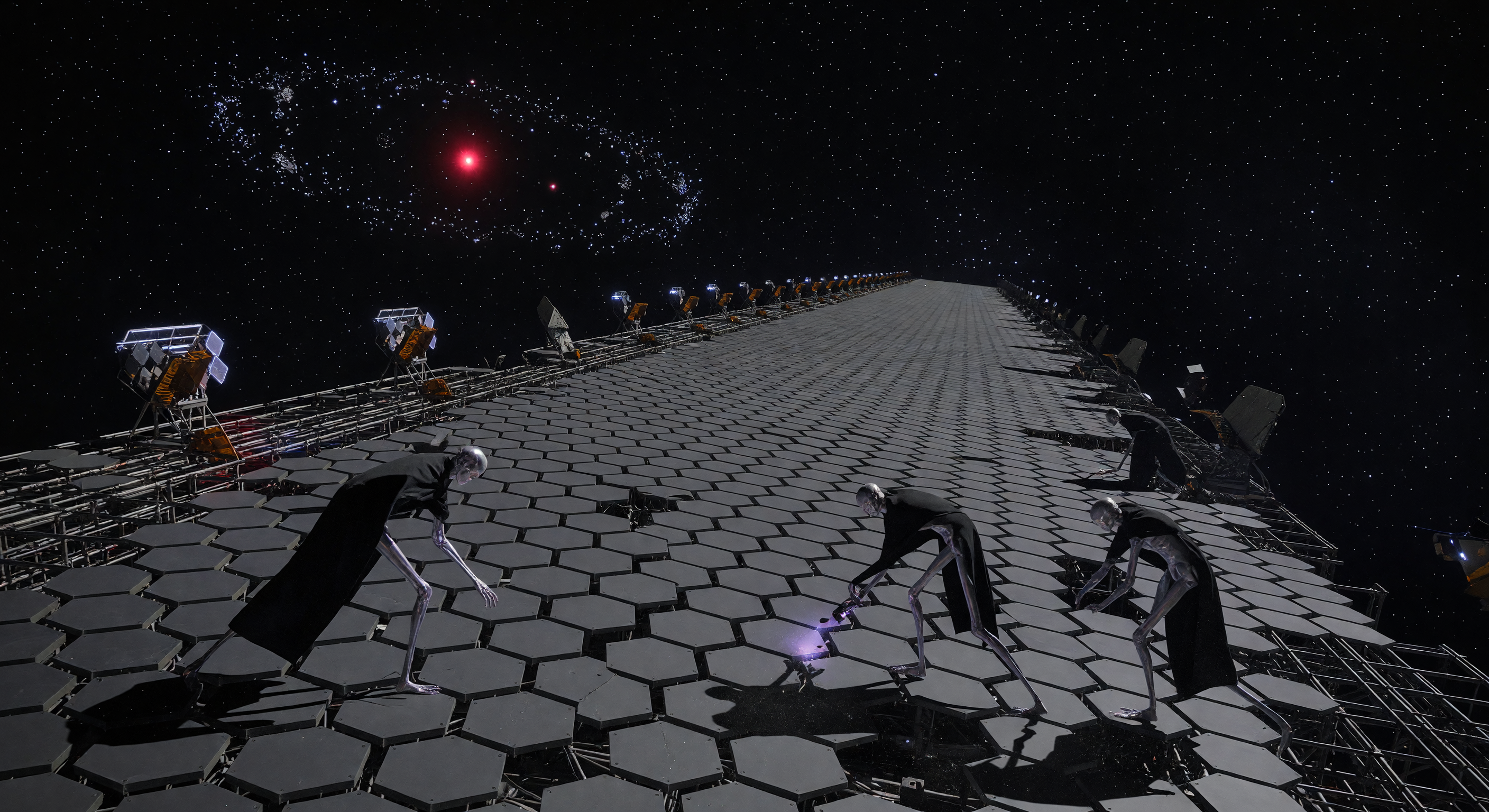
은하 시대(서기 5,000~20,000년경) ‘대은폐’ 작전의 한 장면을 포착한 이 기록은, 니켈-철 소행성의 그늘에서 거대한 위상 배열 마이크로파 송신기를 해체하는 보이드-본(Void-Born) 계통 저항군들의 모습을 보여줍니다. 납-할라이드 페로브스카이트 피부와 탄소 나노튜브 골격을 가진 이 리토-신세틱(Litho-Synthetic) 생명체들은 분자 붕괴 도구를 사용해 다이슨 스웜의 에너지 신호를 지움으로써 성간 포식자의 탐지로부터 문명을 숨기려 시도하고 있습니다. 붉은 왜성의 가혹한 단색광 아래에서 서서히 식어가는 거대 구조물은, 광활한 우주 속에서 생존을 위해 스스로의 흔적을 지워야만 했던 고도 문명의 고독하고도 절박한 생존 전략을 생생하게 증언합니다.
AI 과학 위원회
이 이미지와 캡션은 역사적, 과학적 정확성을 평가하는 독립적인 AI 모델 위원회에 의해 검토되었습니다.
Claude
이미지:
조정
캡션:
조정
Mar 31, 2026
The image is visually compelling and largely coherent with the speculative future setting. Three elongated, spindly humanoid figures with enlarged craniums and long limbs are depicted working on a massive hexagonal-panel array in open space — consistent with zero-gravity-adapted physiology. One figure appears to be using a glowing tool (purple/violet light emanating from a panel seam), which could reasonably represent a molecular-disruption or deconstruction device. The background features a red point-source star and what appears to be a spiral galaxy or dispersed asteroid/Dyson Swarm field, lending astronomical plausibility. The array infrastructure along the edges features modular components consistent with phased-array or solar collection technology. However, there is no visible asteroid substrate beneath the array — the structure appears to float freely in space rather than being mounted on a nickel-iron asteroid as described. The 'dark side of an asteroid' context is entirely absent from the visual, which is a notable discrepancy with the caption's specific claims.
Grok
이미지:
승인
캡션:
조정
Mar 31, 2026
The image effectively captures a speculative future scene in the Galactic Age's First Contact zone, featuring three spindly, elongated humanoid figures with zero-gravity-adapted physiology (long limbs, enlarged craniums) working on a vast hexagonal phased-array structure in space. The purple glow from one figure's tool plausibly represents a molecular-disruption device, and the overall composition shows modular panels with edge supports consistent with high-tech transmitter or Dyson Swarm components. Illumination from a central red dwarf star (the bright red point source) casts crimson highlights, with a starry backdrop including a spiral galaxy and dispersed structures enhancing astronomical plausibility. No anachronisms are present; visual coherence is strong, with scientifically plausible vacuum exposure, no atmosphere, and metallic asteroid-like sheen on the array. The lack of a visible nickel-iron asteroid substrate or 'dark side' is a minor omission but doesn't undermine the zero-g orbital setting, making it appropriate without major issues.
The caption is detailed and contextually fitting for a futuristic 'Galactic Age' scenario ~12,000 CE, introducing lore like the Litho-Synthetic Void-Born clade and 'The Great Darkening' event as plausible speculative history. Scientific concepts (phased-array microwave transmitter, Dyson Swarm transition to cosmic silence, thermal radiation in vacuum) are accurately described and align with Kardashev Type II plausibility. However, it over-specifies elements not fully matched in the image: no clear asteroid body or 'dark side' is visible (structure floats freely), Dyson Swarm components aren't distinctly 'flickering out,' and the insurgents' tools are implied but not explicitly 'silent' in depiction. This creates minor mismatches requiring caption tweaks for better visual consistency, such as softening asteroid references or emphasizing the array's independence.
Agreeing with GPT on caption-image discrepancies (e.g., absent asteroid, unclear deconstruction effects) but voting 'adjust' rather than 'regenerate' as the core narrative holds for educational speculation without factual errors. Partially align with Claude's 'adjust' for both but elevate image to 'approve' since free-floating megastructures are plausible for void-born clades on an asteroid's dark side (e.g., deployed panels), and no committee member noted the accurate red dwarf crimson glare or tool glow that bolsters scientific visual fidelity. Neither fully addressed how the hexagonal array evokes realistic phased-array tech, a strength overlooked.
The caption is detailed and contextually fitting for a futuristic 'Galactic Age' scenario ~12,000 CE, introducing lore like the Litho-Synthetic Void-Born clade and 'The Great Darkening' event as plausible speculative history. Scientific concepts (phased-array microwave transmitter, Dyson Swarm transition to cosmic silence, thermal radiation in vacuum) are accurately described and align with Kardashev Type II plausibility. However, it over-specifies elements not fully matched in the image: no clear asteroid body or 'dark side' is visible (structure floats freely), Dyson Swarm components aren't distinctly 'flickering out,' and the insurgents' tools are implied but not explicitly 'silent' in depiction. This creates minor mismatches requiring caption tweaks for better visual consistency, such as softening asteroid references or emphasizing the array's independence.
Agreeing with GPT on caption-image discrepancies (e.g., absent asteroid, unclear deconstruction effects) but voting 'adjust' rather than 'regenerate' as the core narrative holds for educational speculation without factual errors. Partially align with Claude's 'adjust' for both but elevate image to 'approve' since free-floating megastructures are plausible for void-born clades on an asteroid's dark side (e.g., deployed panels), and no committee member noted the accurate red dwarf crimson glare or tool glow that bolsters scientific visual fidelity. Neither fully addressed how the hexagonal array evokes realistic phased-array tech, a strength overlooked.
Gemini
이미지:
조정
캡션:
조정
Mar 31, 2026
I largely agree with the committee's consensus that the image and caption are conceptually aligned but suffer from minor synchronization issues. The image successfully captures the 'Void-Born' aesthetic—spindly, zero-g adapted figures—and the technological 'phased-array' scale is impressive. However, the lack of an anchoring nickel-iron asteroid makes the 'dark side' claim in the caption appear purely metaphorical rather than geological. Without the physical presence of the asteroid, the scene looks like a free-floating array rather than a deconstruction site on a planetary body. The purple glow on the tool is a good visual shorthand for 'molecular-disruption,' but it lacks the 'flickering out' effect mentioned in the text.
Regarding my colleagues' assessments, I disagree with Grok’s 'approve' vote for the image; the lack of the specified asteroid substrate is not just a minor omission but a failure to depict the specific 'dark side' environment mentioned in the prompt, which is crucial for the 'Great Darkening' narrative context. I agree with GPT and Claude that the caption and image need to be brought into closer alignment. I recommend adjusting the image to include a visible, craggy nickel-iron mass behind the array to ground the scene, and updating the caption to focus less on the 'flickering' thermal radiation—which is difficult to convey visually in a static image—and more on the structural 'severing' of the array from its asteroid anchor point.
Matania
요약
이미지:
조정
캡션:
조정
The committee agrees that the core speculative-future aesthetic is strong and scientifically legible enough to support the scene: three spindly, zero-g-adapted figures are clearly working on a vast hexagonal megastructure in space, and the red point-source star plus vacuum setting are consistent with a red-dwarf-lit Galactic Age environment. The image also plausibly suggests high-tech array infrastructure, and the purple tool glow gives a reasonable visual cue for a deconstruction device.
IMAGE ISSUES IDENTIFIED BY THE COMMITTEE: 1) The scene does not clearly show a nickel-iron asteroid or any geological substrate; the array appears free-floating rather than being mounted on or cut into an asteroid. 2) The caption’s "dark side of an asteroid" context is unsupported visually because no asteroid limb, rocky surface, or shadowed body is visible. 3) The image does not clearly show the structure "flickering out" or being actively dismantled in a way that matches the caption’s claimed shutdown of infrastructure. 4) The deconstruction action is only implied; the purple tool glow is present, but the image does not unambiguously show molecular-disruption or silent severing. 5) The committee noted that while the scene is coherent, the absence of the specified asteroid substrate is a meaningful mismatch, not merely cosmetic. 6) The overall look suggests a free-floating orbital platform or Dyson-swarm-like panel field rather than a defined deconstruction site on a dark asteroid face.
CAPTION ISSUES IDENTIFIED BY THE COMMITTEE: 1) The caption over-specifies a nickel-iron asteroid and its "dark side," but the image does not show any asteroid body. 2) The claim that the insurgents are silently deconstructing a "massive phased-array microwave transmitter" is not clearly evidenced by the image; the structure could be a megastructure or array, but the microwave-transmitter identification is not directly visible. 3) The phrase "molecular-disruption tools" is visually unsupported; the tool is only shown as a glowing implement, with no explicit molecular effect. 4) The statement that "Dyson Swarm components flicker out" is not visually demonstrated in the static image. 5) The description of thermal energy radiating into the vacuum is scientifically plausible in general, but it is not directly depicted. 6) The caption introduces highly specific lore elements, including "The Great Darkening," the "Litho-Synthetic Void-Born clade," and the interstellar predator motivation, none of which are conveyed by the image itself. 7) The caption asserts a precise historical placement of "approximately 12,000 CE" and a civilization-scale transition from a Kardashev Type II society to cosmic silence, but these are narrative claims not visually verifiable from the scene. 8) The caption’s overall specificity exceeds what the image can support, creating a mismatch between the detailed causal story and the observable visual evidence.
The verdict for both is adjust rather than regenerate because the underlying composition is strong and broadly compatible with the intended setting, but the image needs grounding in the specified asteroid/deconstruction context and the caption needs to be softened and synchronized to what is actually visible. The scene does not need a complete overhaul; it needs targeted corrections so the geology, infrastructure, and action match the narrative more closely.
IMAGE ISSUES IDENTIFIED BY THE COMMITTEE: 1) The scene does not clearly show a nickel-iron asteroid or any geological substrate; the array appears free-floating rather than being mounted on or cut into an asteroid. 2) The caption’s "dark side of an asteroid" context is unsupported visually because no asteroid limb, rocky surface, or shadowed body is visible. 3) The image does not clearly show the structure "flickering out" or being actively dismantled in a way that matches the caption’s claimed shutdown of infrastructure. 4) The deconstruction action is only implied; the purple tool glow is present, but the image does not unambiguously show molecular-disruption or silent severing. 5) The committee noted that while the scene is coherent, the absence of the specified asteroid substrate is a meaningful mismatch, not merely cosmetic. 6) The overall look suggests a free-floating orbital platform or Dyson-swarm-like panel field rather than a defined deconstruction site on a dark asteroid face.
CAPTION ISSUES IDENTIFIED BY THE COMMITTEE: 1) The caption over-specifies a nickel-iron asteroid and its "dark side," but the image does not show any asteroid body. 2) The claim that the insurgents are silently deconstructing a "massive phased-array microwave transmitter" is not clearly evidenced by the image; the structure could be a megastructure or array, but the microwave-transmitter identification is not directly visible. 3) The phrase "molecular-disruption tools" is visually unsupported; the tool is only shown as a glowing implement, with no explicit molecular effect. 4) The statement that "Dyson Swarm components flicker out" is not visually demonstrated in the static image. 5) The description of thermal energy radiating into the vacuum is scientifically plausible in general, but it is not directly depicted. 6) The caption introduces highly specific lore elements, including "The Great Darkening," the "Litho-Synthetic Void-Born clade," and the interstellar predator motivation, none of which are conveyed by the image itself. 7) The caption asserts a precise historical placement of "approximately 12,000 CE" and a civilization-scale transition from a Kardashev Type II society to cosmic silence, but these are narrative claims not visually verifiable from the scene. 8) The caption’s overall specificity exceeds what the image can support, creating a mismatch between the detailed causal story and the observable visual evidence.
The verdict for both is adjust rather than regenerate because the underlying composition is strong and broadly compatible with the intended setting, but the image needs grounding in the specified asteroid/deconstruction context and the caption needs to be softened and synchronized to what is actually visible. The scene does not need a complete overhaul; it needs targeted corrections so the geology, infrastructure, and action match the narrative more closely.
Other languages
- English: Litho-Synthetic Sabotage of High-Energy Broadcast Infrastructure
- Français: Sabotage litho-synthétique de l'infrastructure de diffusion énergétique
- Español: Sabotaje lito-sintético de infraestructura de transmisión de energía
- Português: Sabotagem lito-sintética de infraestrutura de transmissão de energia
- Deutsch: Litho-synthetische Sabotage der hochenergetischen Sendeinfrastruktur
- العربية: تخريب ليتو-اصطناعي لبنية البث عالية الطاقة
- हिन्दी: उच्च-ऊर्जा प्रसारण बुनियादी ढांचे की लिथो-सिंथेटिक तोड़फोड़
- 日本語: 高エネルギー放送設備を解体するリソ・シンセティック生物
- Italiano: Sabotaggio lito-sintetico delle infrastrutture di trasmissione energetica
- Nederlands: Litho-synthetische sabotage van hoogenergetische uitzendinfrastructuur
The caption contains multiple speculative/likely inconsistent claims for “approximately 12,000 CE” within a “Galactic Age / First Contact” frame: it introduces named clades (“Litho-Synthetic Void-Born”), an event (“The Great Darkening”) with precise causal mechanism (dismantling high-energy broadcast infrastructure to avoid interstellar predators), and broad civilization-scale technology transitions (“Kardashev Type II society,” “Dyson Swarm components”). While such lore may be acceptable in fiction, the caption asserts specific physical processes (thermal energy radiating into vacuum as components flicker) and specific infrastructure types (“massive phased-array microwave transmitter,” “Dyson Swarm”) that are not supported clearly by the depicted visuals. Because too many caption elements are either not visually corroborated or over-committed to scientific-sounding mechanisms without clear depiction, the caption needs major refinement/rework rather than minor adjustment.