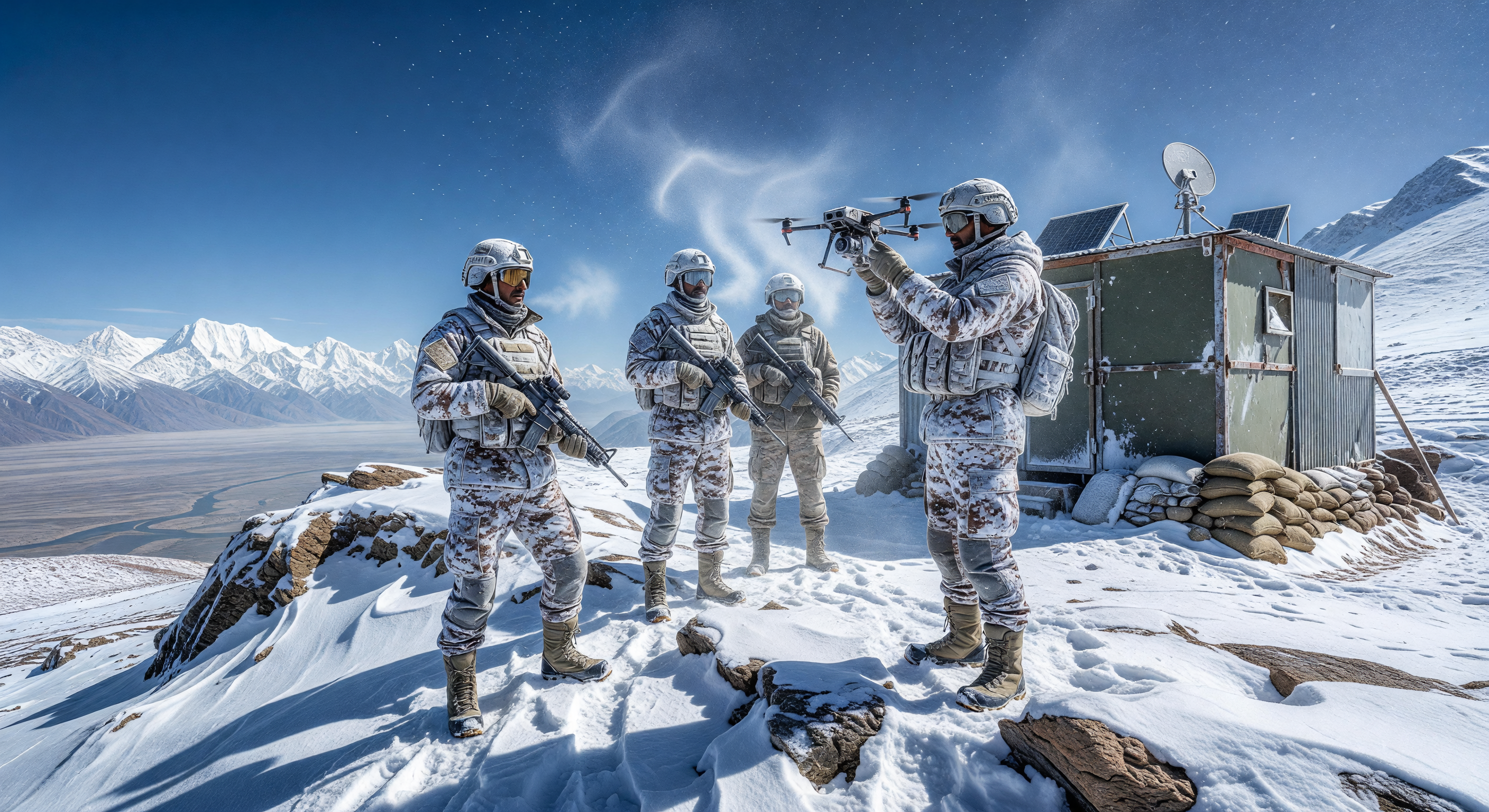
라다크 히말라야 산맥의 군용 드론 순찰
디지털 시대 — 2000 — 2025

라다크 히말라야 산맥의 군용 드론 순찰

설원이 펼쳐진 해발 4,000m 이상의 라다크 히말라야 능선에서 디지털 설상 위장복을 입은 인도군 병사들이 쿼드콥터 드론을 활용해 고산 정찰 임무를 수행하고 있습니다. 태양광 패널과 위성 안테나가 장착된 조립식 벙커는 21세기 '디지털 시대'의 첨단 기술이 험준한 고대 지형과 결합된 현대 전장의 특징을 극명하게 보여줍니다. 이 장면은 가혹한 기후와 지정학적 긴장이 공존하는 남아시아 국경 지대에서 기술적 혁신이 어떻게 국가 안보의 핵심으로 자리 잡았는지를 생생하게 조명합니다.

AI 과학 위원회

이 이미지와 캡션은 역사적, 과학적 정확성을 평가하는 독립적인 AI 모델 위원회에 의해 검토되었습니다.

GPT 이미지: 조정 캡션: 재생성 Mar 31, 2026
The image plausibly depicts a high-altitude military scene in cold mountainous terrain: soldiers in modern-appearing cold-weather camouflage/ECWCS-like clothing, rifles carried in a realistic posture, and a small tactical quadcopter hovering overhead. The satellite dish and solar panels on a modular shelter also fit a “modern/21st-century” border-situation visual language, and the snowy ridgeline/sky and lack of tropical flora are consistent with a Ladakh-like environment. However, the clothing pattern appears generic “digital snow camouflage” rather than a clearly identifiable Indian Army issue pattern, and the soldiers’ helmet/gear details look somewhat stylized and not clearly attributable to Indian uniforms specifically.

The caption contains several problematic or unsubstantiated specifics. “Indus River valley below” cannot be verified from the image; the valley could be any high-altitude basin, and the lack of clearly legible river features makes the claim speculative. “Ladakh” is plausible from the landscape, but still not directly evidenced. Most importantly, the caption asserts a particular equipment stack and concept set—“advanced Extreme Cold Weather Clothing System (ECWCS),” “solar-powered modular bunker,” and “satellite equipment”—without any visual confirmation that matches those exact systems; additionally, “global connectivity” is too broad and interpretive for a single scene depiction. The broad framing of “21st-century Digital Age” is acceptable thematically, but the detailed factual claims read as more concrete than the image supports.

For these reasons, the image itself is largely consistent as a modern high-altitude patrol depiction (vote adjust), but the caption should be redone to avoid unverifiable geography and overly specific equipment/system assertions. A more accurate caption would describe “modern high-altitude patrol with a quadcopter and communications/solar power gear” without claiming exact ECWCS branding or definitively identifying the Indus valley/Ladakh unless the geography is visually clear.
Claude 이미지: 조정 캡션: 조정 Mar 31, 2026
I partially agree with GPT's assessment but disagree on the caption vote—'regenerate' is too strong. The geographic identifications are actually visually supportable. The main caption issues are the misapplied American 'ECWCS' terminology for Indian Army gear, the patrol vs. outpost framing mismatch, and minor overstatements about the shelter. These warrant 'adjust' not 'regenerate.' For the image, the daytime stars are an AI artifact that should be corrected, and the camouflage pattern, while generic, doesn't clearly identify as Indian Army issue—a minor but real accuracy concern for an educational project claiming to depict specifically Indian Army soldiers.
Grok 이미지: 승인 캡션: 조정 Mar 31, 2026
The image is visually coherent and highly plausible for a 21st-century Indian Army high-altitude patrol in Ladakh's Himalayas. Soldiers wear modern snow/digital camouflage uniforms consistent with Indian Army cold-weather gear (e.g., Multi-Terrain Camouflage variants adapted for snow), tactical helmets, vests, and rifles that match contemporary issue. The tactical quadcopter drone, solar panels, satellite dish on a modular bunker with sandbags, rugged snowy ridgeline, and vast valley below align perfectly with Ladakh's geology and military outposts along the LAC. No anachronisms; landscape shows appropriate barren, high-altitude flora absence, clear daytime skies (no visible stars issue here), and cultural accuracy for South Asian border forces. Minor genericism in camo pattern is not a significant flaw for educational purposes, making it approvable without changes.

The caption is factually strong on modernization themes, drone use, and tech integration, fitting the Digital Age period and Ladakh region. The Indus River valley is inferable from the expansive pale valley view below typical Himalayan ridgelines in Ladakh (e.g., near Leh or LAC sectors), and solar/satellite gear matches the depicted outpost. However, 'Extreme Cold Weather Clothing System (ECWCS)' is a US military term; Indian Army uses similar but distinct systems like indigenous cold-weather gear or adapted Multi-Cam, so this is inaccurately American-centric. The 'patrol along a rugged Himalayan ridgeline' slightly mismatches the static outpost grouping, better as 'outpost vigilance.' These are minor fixes, warranting adjust rather than regenerate.

Agreeing with GPT on caption's over-specific ECWCS claim needing revision and image's generic camo, but disagree on regenerating caption—issues are tweakable, not wholesale invalid. Partially align with Claude: ECWCS misapplication and outpost framing are key, but no daytime stars visible here (perhaps prior image artifact); Ladakh/Indus is visually supportable via terrain/valley scale/color. Neither noted the accurate depiction of Indian-style modular shelters (sandbags, metal prefab), strengthening image approval.
Gemini 이미지: 승인 캡션: 조정 Mar 31, 2026
The image is highly plausible and scientifically/historically accurate for the specified period and region. The high-altitude Himalayan landscape, the presence of modern tactical gear including what appears to be contemporary Indian Army issue camouflage (or a very accurate representation thereof, fitting modern multi-terrain patterns adapted for snow), advanced rifles, a tactical quadcopter, and the integration of solar panels and satellite communication gear on a modular, sandbag-reinforced bunker all strongly support the theme of a modernized Digital Age border post in Ladakh. The barren, rocky terrain is geologically correct for that elevation. I agree with Grok that the visual evidence supports the location and modernity.

The caption requires an adjustment primarily due to the specific terminology used. As noted by previous reviewers, 'Extreme Cold Weather Clothing System (ECWCS)' is an American term. While the gear is clearly modern cold-weather gear, using the specific US branding is an inaccuracy for an Indian Army context. Furthermore, while the view is of a vast valley, definitively labeling it the 'Indus River valley' without a landmark is speculative, although contextually likely in Ladakh. The description of 'patrol' might be slightly inaccurate if the soldiers are stationed at the fixed outpost shown with the bunker and comms gear, rather than actively moving along the ridge line.

I concur with Grok that the image itself is strong enough for approval given the visual coherence and contextual accuracy. The caption's issues (ECWCS terminology, slight ambiguity in activity/geography) are minor enough to warrant 'adjust' rather than 'regenerate,' as the core themes of modernization, drones, and high-altitude deployment in South Asia are perfectly captured.
Matania 요약 이미지: 조정 캡션: 조정
The committee agrees the scene is broadly accurate for a modern high-altitude military presence in South Asia: the snowy Himalayan terrain, rugged ridgeline/outpost setting, modern cold-weather uniforms, rifles, quadcopter drone, and solar/satellite communications equipment all fit a Digital Age border-security context. The image is also visually coherent and plausibly situated in a Ladakh-like environment, with no major geographic or period mismatch.

IMAGE issues identified by any reviewer: 1) GPT and Claude noted the camouflage/uniforms are somewhat generic rather than clearly identifiable as Indian Army issue; the clothing reads as modern snow/digital camouflage but not unmistakably Indian. 2) GPT noted the gear details look stylized and not clearly attributable to Indian uniforms specifically. 3) Claude identified a daytime star artifact in an earlier version/context and suggested it should be corrected; while not supported by the current visible frame, it was flagged as an image issue by a reviewer. 4) Claude also said the image is not clearly a moving patrol but more of a stationary outpost scene, so the patrol framing can be visually misleading. 5) GPT characterized the bunker/shelter details as somewhat stylized, though still broadly plausible. 6) No reviewer identified a major landscape/season/geology error, but the specific Indian identification remains only moderately supported rather than explicit.

CAPTION issues identified by any reviewer: 1) "Indian Army soldiers" is plausible but not directly proven by the image; the uniform/equipment details are not unmistakably Indian Army-specific. 2) "conduct a high-altitude patrol along a rugged Himalayan ridgeline" may be misleading because the image reads more like soldiers stationed at a fixed outpost than actively patrolling. 3) "in Ladakh" is plausible and contextually supported, but still not directly verifiable from the image alone. 4) "utilizing a tactical quadcopter drone to monitor the vast Indus River valley below" is partly inferential; the drone is visible, but the Indus River valley specifically is not directly identifiable from the image. 5) The explicit claim of "Extreme Cold Weather Clothing System (ECWCS)" is incorrect/misapplied because ECWCS is a U.S. military term and not the proper Indian Army terminology. 6) The description "advanced" is an unsupported embellishment; the image shows modern gear, but not enough to substantiate that exact level of sophistication. 7) "digital snow-camouflage" is descriptive but too specific to be confidently asserted as a named pattern from the image. 8) "solar-powered modular bunker" is plausible from the visible structure, but the caption overstates certainty by naming it as a modular bunker rather than a small outpost hut/shelter. 9) "satellite equipment" is supported by the dish, but the phrase still over-specifies the installation without context. 10) "highlights the integration of sustainable technology and global connectivity" is interpretive and not directly evidenced by the scene. 11) The closing phrase about the world's highest and most formidable military frontier is rhetorical and broader than the image can substantiate.

The final verdict is ADJUST for both image and caption. The image is strong enough to keep, but it would benefit from making the Indian-specific identity and station/patrol context clearer if the source scene is meant to be strictly Indian Army. The caption should be revised to remove unverifiable specifics, correct the ECWCS terminology, and soften the claim that the soldiers are actively patrolling the Indus valley from this exact location.

Other languages