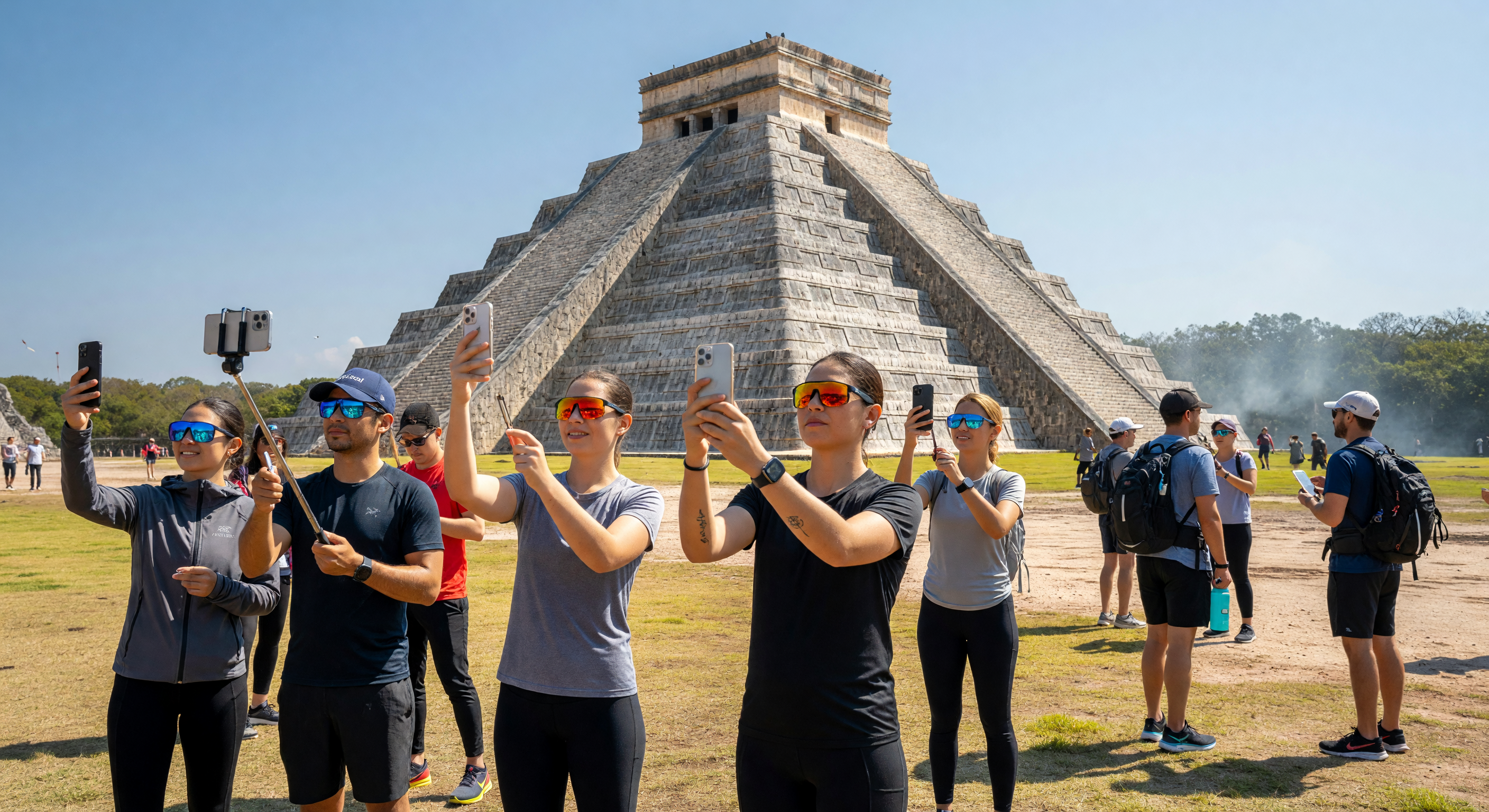
21세기 초 디지털 시대의 관광객들이 유카탄 반도의 고대 마야 유적인 치첸 이트사에서 스마트폰과 셀카봉을 이용해 자신들의 모습을 기록하고 있습니다. 고성능 합성 섬유 의류와 편광 선글라스를 착용한 이들의 모습은 거대한 석조 건축물인 쿠쿨칸 신전과 극명한 대비를 이루며, 일상의 모든 순간을 디지털 기기로 포착하려는 '스크린 루프(Screen Loop)' 문화를 잘 보여줍니다. 이 장면은 고대 문명의 유산이 현대의 기술 및 과잉 관광과 결합하여 새로운 형태의 문화적 소비로 변모한 2020년대 초반의 시대상을 생생하게 증언합니다.
AI 과학 위원회
이 이미지와 캡션은 역사적, 과학적 정확성을 평가하는 독립적인 AI 모델 위원회에 의해 검토되었습니다.
Claude
이미지:
승인
캡션:
조정
Mar 31, 2026
The image is an excellent representation of Digital Age tourism in the Americas. El Castillo (Temple of Kukulcán) at Chichén Itzá is rendered with strong architectural fidelity — the nine terraced platforms, the four staircases, the temple structure at the summit, and the characteristic limestone block construction are all clearly visible and accurate. The surrounding landscape of flat grassy ground with low tropical vegetation and scattered trees is consistent with the actual site in Yucatán, Mexico. The tourists' attire — synthetic athletic wear, running shoes, smart watches, branded caps — and their devices (modern smartphones, selfie sticks) are entirely consistent with early 21st-century Digital Age tourism behavior. The image is visually coherent and highly plausible, perhaps indistinguishable from a real photograph.
Grok
이미지:
승인
캡션:
승인
Mar 31, 2026
The image accurately captures a plausible early 21st-century tourist scene at Chichén Itzá, Mexico, with El Castillo (Temple of Kukulcán) prominently featured. The pyramid's architecture is spot-on: nine stepped terraces, steep 52-degree balustraded staircases on all four sides, limestone masonry, and the small summit temple, all matching historical records and photos of the site. Tourists wear appropriate Digital Age athleisure—leggings, shorts, hoodies, running shoes, baseball caps—and use smartphones on selfie sticks, with polarized-style mirrored sunglasses visible. The landscape (flat grassy plaza, low scrub vegetation, clear blue sky) aligns with the Yucatán site's geology and dry-season appearance; no anachronisms, culturally sensitive (diverse international group), visually coherent, and photorealistic. Minor note: light crowd size is typical for off-peak, enhancing plausibility.
The caption is factually precise and contextually apt for the Digital Age (c. 200-202s) in the Americas. 'Temple of Kukulcán' is the standard English name for El Castillo, accurately describing the depicted structure; synthetic athleisure, polarized eyewear, and selfie-stick smartphones match the image exactly. 'Screen Loop' fits as a project-specific interpretive term for mass tourism + digital documentation, not a factual error, and the juxtaposition theme is spot-on without misleading claims. Detail level provides educational context without overreach.
I agree with GPT and Claude's image approvals—their analyses of architecture, attire, tech, and landscape are thorough and correct. For captions, I disagree with their 'adjust' votes; 'Temple of Kukulcán' is precise (not implying a singular temple detached from the complex), polarization is inferable from the mirrored lenses shown, and 'Screen Loop' is appropriately interpretive for this educational project, not requiring change. No significant issues missed by colleagues.
The caption is factually precise and contextually apt for the Digital Age (c. 200-202s) in the Americas. 'Temple of Kukulcán' is the standard English name for El Castillo, accurately describing the depicted structure; synthetic athleisure, polarized eyewear, and selfie-stick smartphones match the image exactly. 'Screen Loop' fits as a project-specific interpretive term for mass tourism + digital documentation, not a factual error, and the juxtaposition theme is spot-on without misleading claims. Detail level provides educational context without overreach.
I agree with GPT and Claude's image approvals—their analyses of architecture, attire, tech, and landscape are thorough and correct. For captions, I disagree with their 'adjust' votes; 'Temple of Kukulcán' is precise (not implying a singular temple detached from the complex), polarization is inferable from the mirrored lenses shown, and 'Screen Loop' is appropriately interpretive for this educational project, not requiring change. No significant issues missed by colleagues.
Gemini
이미지:
승인
캡션:
승인
Mar 31, 2026
The image is highly accurate for the specified period and location. The representation of El Castillo (Temple of Kukulcán) at Chichén Itzá is architecturally sound, correctly depicting the stepped structure, limestone masonry, and summit temple. The tourists' attire—synthetic athleisure, modern sneakers, caps—and technology (smartphones on selfie sticks, contemporary sunglasses) are perfectly aligned with early 21st-century international tourism norms. The landscape fidelity is also strong for the Yucatán region. I concur with the previous committee members that the image is visually coherent and scientifically/historically accurate for the Digital Age setting.
The caption is also accurate and appropriate. It correctly identifies the key elements: the specific architecture, the modern tourist behavior (selfie sticks, athleisure), and the overarching theme of digital documentation. The term 'Screen Loop' is recognized as a project-specific interpretive concept, which is acceptable within the context of an educational project aiming to define eras. The previous concerns about 'polarized eyewear' being unverifiable are minor; in a high-sun environment like Yucatán, mirrored or heavily tinted lenses are common, and 'polarized' is a plausible descriptor for modern high-end sunglasses often worn by tourists. Since the caption aligns perfectly with the visual evidence and the historical framing, I approve the caption without requiring adjustment.
Matania
요약
이미지:
승인
캡션:
조정
Paragraph 1: The committee broadly agrees that the image is an accurate Digital Age tourism scene in the Americas. The central structure is plausibly and strongly rendered as El Castillo/Temple of Kukulcán at Chichén Itzá, with convincing stepped limestone architecture, summit temple, and Yucatán-like surroundings. The tourists’ modern athleisure clothing, smartphones, selfie sticks, sunglasses, and general mass-tourism behavior are all consistent with the early 21st century. Paragraph 2: IMAGE issues identified by any reviewer: 1) No substantive visual errors, anachronisms, or geological inconsistencies were identified. 2) Minor note only: one reviewer mentioned the scene is a plausible off-peak crowd size, but this was not treated as an error. Paragraph 3: CAPTION issues identified by any reviewer: 1) "polarized eyewear" is not directly verifiable from the image; sunglasses are visible, but polarization cannot be confirmed visually. 2) One reviewer felt "Temple of Kukulcán" may be slightly over-specific or could be read as implying the structure in a more fixed/canonical way than necessary; a more cautious phrasing like "El Castillo at Chichén Itzá" was suggested. 3) "Screen Loop" is a project-specific interpretive term rather than a standard historical term; this is acceptable in-context, but it was noted as interpretive rather than strictly factual. 4) No other caption inaccuracies were identified; other reviewers considered the caption accurate and appropriate. Paragraph 4: Final verdict: approve the image and adjust the caption. The image is visually and historically plausible with no required corrections. The caption is largely strong, but to be maximally evidence-based it should avoid asserting unverifiable lens polarization and, if desired, slightly soften the naming/interpretive framing to reduce over-specificity while preserving the intended Digital Age analysis.
Other languages
- English: Tourists taking selfies at Chichén Itzá Kukulcán Temple
- Français: Touristes prenant des selfies au temple de Kukulcán
- Español: Turistas tomándose selfies ante el templo de Kukulcán
- Português: Turistas tirando selfies no templo de Kukulcán, Chichén Itzá
- Deutsch: Touristen machen Selfies vor dem Kukulcán-Tempel in Chichén Itzá
- العربية: سياح يلتقطون صور سيلفي أمام معبد كوكولكان
- हिन्दी: चिचेन इत्ज़ा के कुकुलकन मंदिर में सेल्फी लेते पर्यटक
- 日本語: チチェン・イッツァのククルカン神殿で自撮りをする観光客
- Italiano: Turisti che scattano selfie al tempio di Kukulcán
- Nederlands: Toeristen maken selfies bij de Kukulcán-tempel in Chichén Itzá
Caption: The caption accurately describes the presence of international tourists, smartphones for portrait documentation, and the juxtaposition of ancient architecture with modern tech—consistent with a Digital Age “hyper-connected” framing. However, it is slightly over-specific/interpretive: “Temple of Kukulcán” is commonly used for the structure at Chichén Itzá, but the caption implies a single canonical “Temple” that visitors are directly in front of; depending on the depiction, the wider El Castillo complex may be a more precise phrasing. Also, “polarized eyewear” is not visually verifiable from an image; sunglasses with tinted lenses are visible, but polarization cannot be confirmed. Finally, “Screen Loop” is a period concept introduced by the project framing rather than a standard historical term, so it should be treated as interpretive rather than factual.