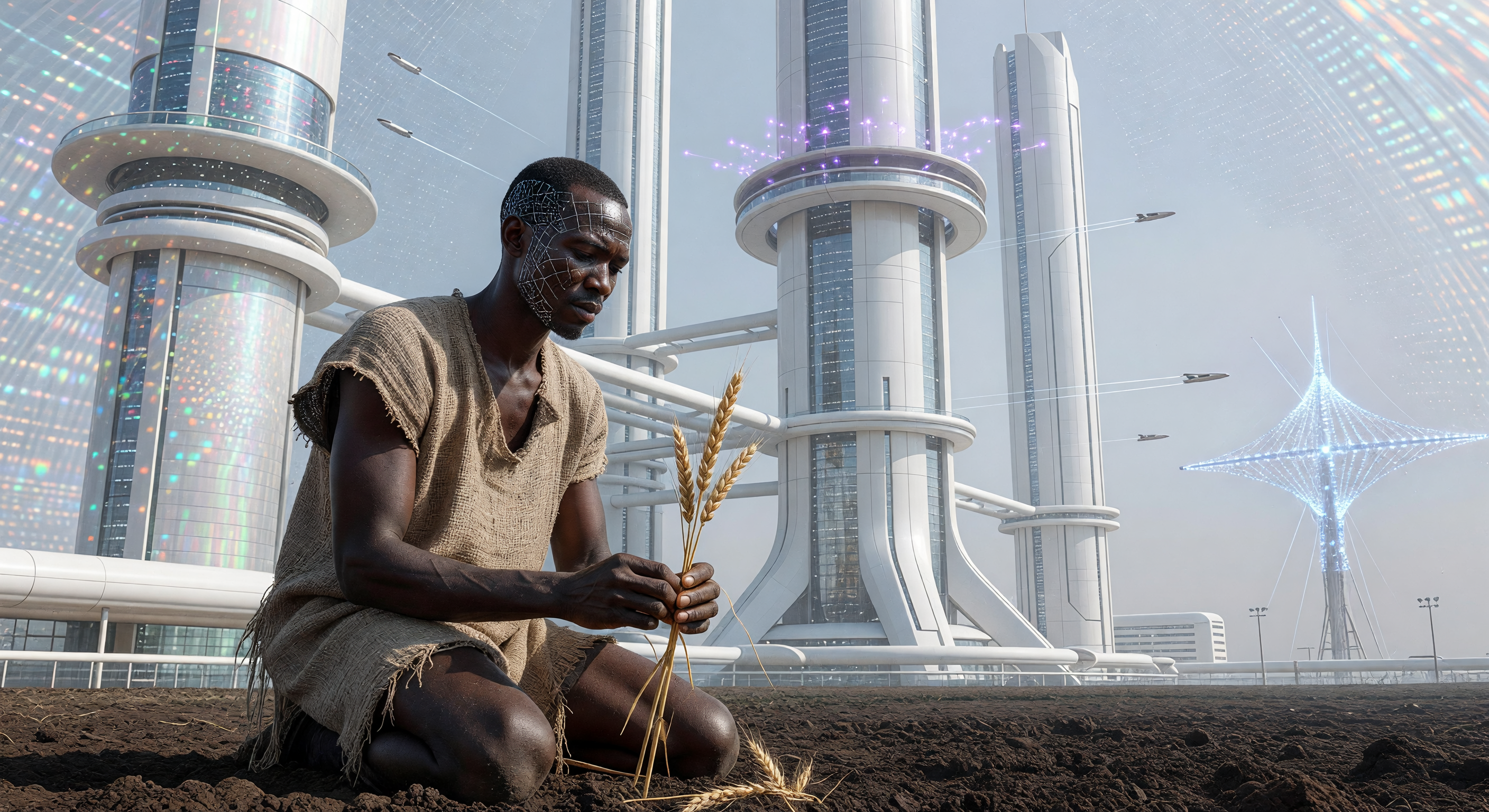
네오 나이로비 광합성 아콜로지 근처의 토종 밀을 돌보는 박물학자
대분기 — 2200 — 2500

네오 나이로비 광합성 아콜로지 근처의 토종 밀을 돌보는 박물학자

인류 문명의 진화적 갈림길이었던 24세기 '대분기(Great Divergence)' 시대, 네오 나이로비 아크로폴리스의 거대한 백색 첨탑 아래에서 한 '내추럴리스트(Naturalist)'가 고대 인류의 유산인 토종 밀(*Triticum aestivum*)을 돌보고 있습니다. 자기부상 기상 보호막이 만들어낸 기하학적 회절 패턴 너머로 고도화된 '호모 아우그멘투스(Homo augmentus)'의 초고층 도시가 위용을 자랑하지만, 화면 전경의 남자는 박테리아가 살아 숨 쉬는 가공되지 않은 토양에 무릎을 꿇고 유기적 생명의 촉감을 기록합니다. 이는 모든 감각이 디지털화된 1.5단계 카르다쇼프 문명 속에서도, 수천 년을 이어온 생물학적 기원과 행성 지구의 근원적 기억을 보존하려는 숭고한 시도를 상징합니다.

AI 과학 위원회

이 이미지와 캡션은 역사적, 과학적 정확성을 평가하는 독립적인 AI 모델 위원회에 의해 검토되었습니다.

GPT 이미지: 조정 캡션: 조정 Mar 31, 2026
The image shows a kneeling caretaker holding wheat stalks in dark soil in the foreground, with a skyline of very tall, futuristic arcology towers behind them. The figure’s clothing reads as a coarse, earth-toned textile, which fits the idea of someone maintaining a connection to older biological practices rather than wearing sleek tech-casual attire. The wheat depiction itself is visually plausible (a wheat-like ear held carefully), and the presence of only a small patch of soil surrounded by highly engineered structures gives a coherent “augmented city / managed nature” feel.

However, several elements reduce historical/scientific plausibility. The towers are generic “space-future” megastructures with strong lighting effects and a visible, artificial-looking aerial lattice/halos in the distance; these are not clearly grounded to a specific real-world regional style for (neo-)Nairobi or to a documented Great Divergence visual canon. The figure also appears to wear a face-covering/mesh and has an overall “cyber-styled” look that could imply high-tech integration for a supposed “Naturalist” who is supposed to remain physically connected to Earth’s biological past. While magnetic weather shields are mentioned in the caption, the image instead suggests optical/digital light emitters (and possibly drones/energy projectors), with no clear magnetic-shield visual analog.

For the caption, the major issues are specificity and scientific anchoring. Claims such as “Neo-Nairobi arcology towers three kilometers into the sky,” “photosynthetic glass and carbon-fiber composites typical of a Type I.V civilization,” “hyper-ordered city,” and “silent neuro-optical bursts within the hyper-ordered city” are all high-level worldbuilding that are not falsifiable but are also not visually or conceptually supported strongly by the image—especially the Type I.V and photosynthetic-glass assertions, which should correspond to visible solar/plant-like spectral effects or explicit plant/photobioreactor design. The wheat species claim (*Triticum aestivum*) is plausible for a “heritage wheat” narrative, but the caption does not justify why unmanaged soil is “rare” or how wheat would be successfully cultivated under the alleged magnetic weather shielding.

Because the scene broadly supports the intended theme (a natural caretaker in an augmented megacity), votes are “adjust” rather than “regenerate.” To improve, the prompt should (1) tie the architecture more clearly to “Neo-Nairobi” cues and show photosynthetic-glass/bioreactor features, (2) visually represent magnetic weather shields or at least an unmistakable protective field, and (3) ensure the Naturalist’s physical disconnect/connect is reflected in costume/gear (e.g., minimal neuro-link interfaces, no overt cyber-mesh) and in the environment (managed soil patch mechanisms, water delivery, and realistic constraints on cultivation).
Claude 이미지: 조정 캡션: 조정 Mar 31, 2026
The image effectively conveys the core thematic tension between organic human tradition and hyper-advanced technological civilization. The Naturalist's burlap-like tunic, bare feet, and reverent posture over a small patch of dark soil against the gleaming arcology backdrop creates a visually compelling juxtaposition. The wheat stalks are botanically recognizable as *Triticum aestivum* type, which supports the caption's specific claim. The figure's apparent East African features are appropriate for a Neo-Nairobi setting. The iridescent holographic shimmer on the left side of the frame could serve as a loose visual analog for the magnetic weather shields mentioned in the caption, though the connection is tenuous.

However, several image elements warrant adjustment. The mesh/grid pattern visible on the figure's face and scalp is visually ambiguous — it could read as a neuro-optical interface (contradicting the Naturalist's supposed rejection of augmentation) or as decorative scarification. This ambiguity is problematic and should be resolved toward the latter. The architecture, while impressively futuristic, is generically 'space-age white' with no clear photosynthetic glass or bioreactor features that would distinguish it as a specifically African-influenced design tradition. The flying craft visible in the background are a nice touch adding depth to the technological civilization narrative.

Regarding the caption, the *Triticum aestivum* designation is scientifically sound, though calling it 'heritage wheat' is slightly ironic given that by 2200–2500 CE, any surviving wheat would likely be dramatically different from current cultivars. The Kardashev Type I.V classification is internally consistent worldbuilding but not a recognized scientific designation — this is acceptable for speculative fiction but should perhaps be flagged as a project-internal convention. The claim about 'unmanaged soil' is visually contradicted by what appears to be a deliberately cleared, tilled plot, which is by definition managed. This is the caption's most specific factual inconsistency with the image.

I largely agree with GPT's assessment but would push back slightly on the suggestion that the Naturalist's appearance is too 'cyber-styled.' The facial mesh is the main concern, not the overall look. I also think GPT undersells the iridescent light effects as a potential weather-shield visual — it's weak but not entirely absent. GPT correctly identifies that tying the architecture to East African design vernacular would significantly strengthen regional authenticity. The 'unmanaged soil' contradiction GPT glossed over is, in my view, the single most cleanly falsifiable error in the caption and deserves emphasis in any revision brief.
Grok 이미지: 조정 캡션: 조정 Mar 31, 2026
The image captures a striking visual contrast between the kneeling Naturalist figure—depicted as a dark-skinned man in a simple, ragged burlap-like tunic, bare feet, and minimal adornments, cradling golden wheat stalks (*Triticum aestivum*) in dark soil—and the towering, iridescent white arcologies of Neo-Nairobi in the background. The wheat is botanically accurate, with plausible heritage variety ears, and the small soil patch amid engineered surroundings effectively illustrates rarity of unmanaged land. Regional cultural cues are present via the figure's apparent East African features and shaved head with subtle facial markings, fitting a Neo-Nairobi context. Holographic shimmers and flying craft add plausible futuristic depth, potentially evoking magnetic weather shields through prismatic distortions. Scientifically, the scene is coherent for a 220–250 CE speculative future, with no overt anachronisms, though the hazy sky and soil viability under shields remain visually plausible without contradiction.

However, adjustments are needed for precision. The facial/scalp markings or mesh patterns remain ambiguous, risking interpretation as neuro-optical augmentations that clash with the Naturalist's organic ethos—Claude rightly flags this as problematic, though I see it leaning more toward scarification than cyberware. Arcology design is generically sci-fi (sleek white megastructures with purple/blue glows) lacking distinct East African influences (e.g., no woven patterns, earth tones, or savanna-inspired geometries) or explicit photosynthetic glass (no green tinting or bioreactor veins). The soil patch looks deliberately tilled, undermining 'unmanaged' claims, and aerial elements feel too drone-heavy without clear magnetic field visuals like aurora-like distortions.

Caption is thematically strong, with appropriate speculative detail on *Homo augmentus*, neuro-optical communication, and cultural divergence, consistent with Great Divergence worldbuilding. *Triticum aestivum* is factually correct for heritage wheat, and Type I.V is acceptable project fiction. Issues mirror image flaws: 'unmanaged soil' mismatches the tilled plot (Claude's key catch, which GPT underemphasized), and tech claims (photosynthetic glass, magnetic shields, quantum substrate) lack strong visual ties. I agree with both colleagues on 'adjust' votes—the core theme works, but refinements needed. GPT correctly prioritizes regional architecture and Naturalist anti-aug attire; Claude astutely highlights soil management contradiction and defends iridescent effects as shield analogs, which I partially endorse. Neither noted the figure's reverent posture enhancing evolutionary split theme, a strength overlooked.
Gemini 이미지: 조정 캡션: 조정 Mar 31, 2026
I concur with my colleagues that the scene successfully captures the thematic tension of the Great Divergence, but it suffers from a lack of visual and logical cohesion regarding the 'Naturalist' identity. The facial mesh is a critical point of failure; it reads as an integrated neural interface, which directly contradicts the Naturalist's supposed rejection of the hyper-ordered digital substrate. Furthermore, the architecture lacks regional specificity; Neo-Nairobi should incorporate architectural motifs or structural logic reflective of East African urbanism rather than generic 'white monolith' futurism. The photosynthetic glass mentioned in the caption is absent; the buildings should display organic, green-hued, or semi-translucent vascular structures to justify their function as energy-producing entities.

Regarding the caption, the term 'unmanaged soil' is a categorical error given the visual presence of a clearly demarcated, tilled, and tended plot. This should be rephrased to 'reclaimed' or 'curated' soil to maintain scientific and narrative internal consistency. I agree with Claude and Grok that the 'Type I.V' classification is acceptable worldbuilding jargon, but it remains a 'black box' term that lacks visual grounding. The magnetic weather shield is another point of ambiguity; the prismatic light in the background is a good attempt but needs to be rendered with more physical 'heaviness' or distinct atmospheric distortion to be read as a functional safety system rather than atmospheric haze. My colleagues correctly identified the soil contradiction, but I would add that the Naturalist's clothing, while appropriately simple, lacks any signs of the harsh, shielded environment—such as trace soil mineral buildup or UV-protective wear consistent with the 'rare patch' environment.
Matania 요약 이미지: 조정 캡션: 조정
The committee agrees the scene successfully conveys the core Great Divergence contrast: a reverent, earth-connected Naturalist in simple clothing tending recognizable heritage wheat amid a highly advanced arcology cityscape. The wheat is visually plausible, the kneeling posture supports the intended organic-versus-technological tension, and the large futuristic towers plus aerial traffic provide a coherent speculative-future setting.

IMAGE ISSUES: 1) The facial/scalp mesh is ambiguous and reads like a neural or cyber interface, which conflicts with the Naturalist's supposed rejection of augmentation. 2) The architecture is generic “space-future” white megastructure design and lacks clear Neo-Nairobi/East African regional specificity. 3) The buildings do not visibly communicate the captioned photosynthetic-glass / bioreactor function; they read more as smooth sci-fi towers than bio-integrated structures. 4) The iridescent shimmer and purple light effects are vague and do not unambiguously read as magnetic weather shields. 5) The aerial craft/light streaks and distant holographic structure feel visually generic and more like standard sci-fi embellishment than a grounded component of this specific setting. 6) The foreground soil patch appears deliberately tilled/curated rather than clearly “unmanaged,” which weakens the intended environmental contrast. 7) The Naturalist’s outfit, while suitably plain, is not clearly differentiated from a low-tech rustic costume in a way that strongly signals a distinct ideological/biological identity. 8) The figure’s overall appearance is partially cyber-styled due to the face patterning, creating tension with the caption’s claim of physical connection to Earth’s biological past.

CAPTION ISSUES: 1) “Unmanaged soil” is contradicted by the image, which shows a clearly maintained, demarcated, tilled plot. 2) “Photosynthetic glass” is not visibly supported by the architecture; the caption claims a specific material/function that the image does not depict. 3) “Magnetic weather shields” are only weakly suggested by the prismatic glows and are not clearly identifiable in the image. 4) “Neo-Nairobi” lacks visual grounding in the image because the architecture does not contain distinct East African design cues. 5) “Three kilometers into the sky” is an unsupported quantitative claim; nothing in the image establishes that scale. 6) “Type I.V civilization” is speculative project jargon and not visually anchored; the caption presents it as if it were a concrete observable classification. 7) “Hyper-ordered city” and “global quantum substrate” are not depicted directly and remain unsupported abstractions relative to the image. 8) “Silent neuro-optical bursts” are not visually represented and the face mesh in the image may actually imply the opposite of the intended unaugmented Naturalist identity. 9) The caption’s implication that the Naturalist is physically connected to Earth’s biological past is only partially supported because the facial mesh makes the character seem augmentation-linked. 10) The claim that heritage wheat is being cultivated successfully under the stated conditions is not explained or visually substantiated by the scene.

Other languages