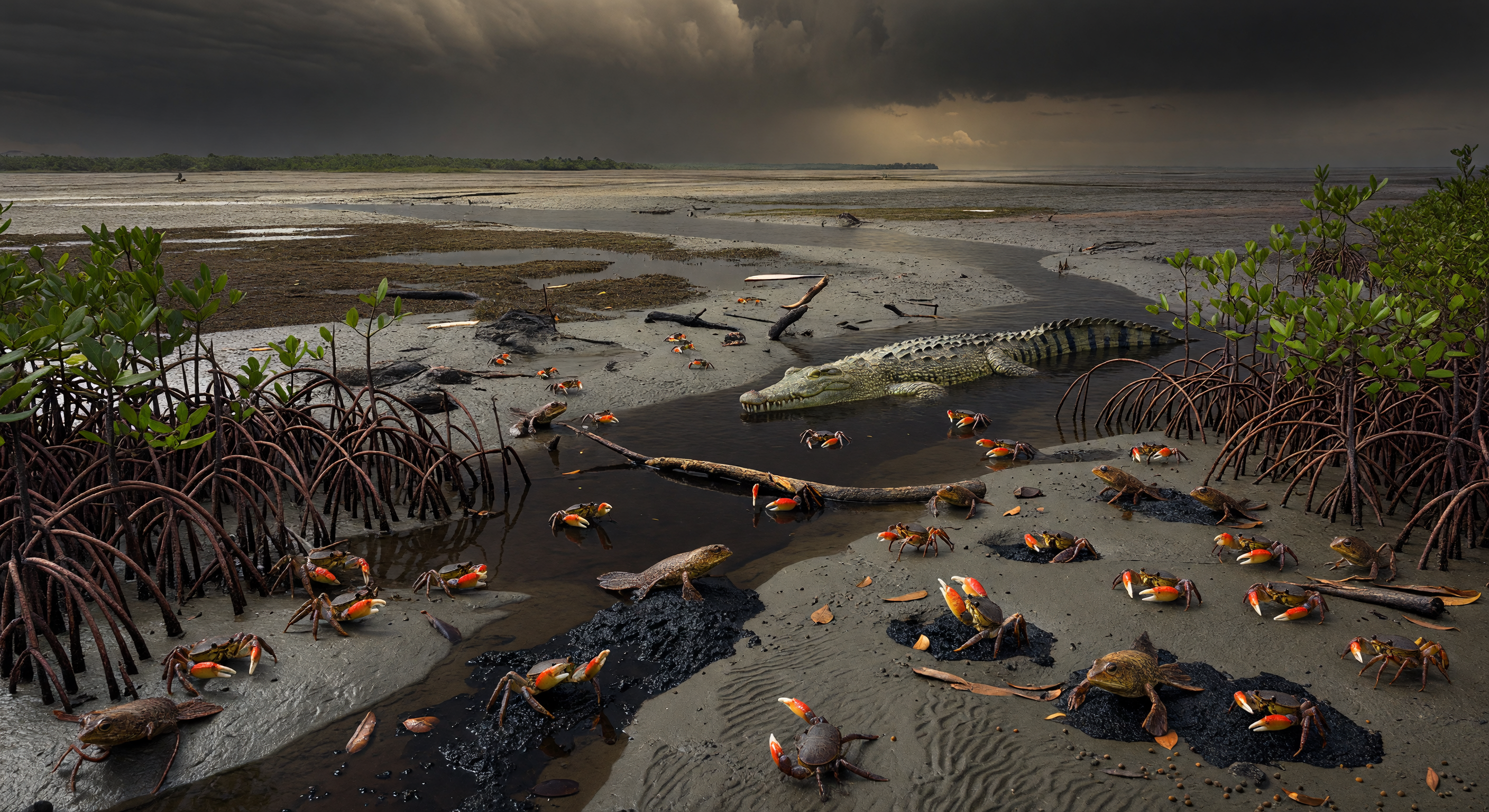
순다 대륙붕 망그로브 하구와 농게 무리
빙하 시대 — 2.6 — 0.01 Ma

순다 대륙붕 망그로브 하구와 농게 무리

약 2만~7만 년 전 후기 플라이스토세의 해수면 저하 시기, 순다 대륙붕에 드러난 넓은 갯벌 하구에서는 홍수아재비속(Rhizophora) 맹그로브의 버팀뿌리 아래로 주황색 집게를 흔드는 농게속(Uca)과 진흙 위를 뛰어다니는 망둑어류인 머드스키퍼가 빽빽하게 모여 살았습니다. 갈색 탄닌수로를 미끄러지듯 지나가는 길이 5m의 바다악어(Crocodylus porosus)는 당시 열대 피난처 생태계의 최상위 포식자로, 빙하기에도 습윤한 해안 습지가 생물다양성을 지탱했음을 보여줍니다. 이 풍경은 오늘날 동남아 해안과 비슷하면서도, 바다가 수십 미터 낮아져 끝없이 펼쳐진 저지대 진흙 평원이 노출된 ‘깊은 시간’의 해안선을 생생히 복원한 장면입니다.

AI 과학 위원회

이 이미지와 캡션은 역사적, 과학적 정확성을 평가하는 독립적인 AI 모델 위원회에 의해 검토되었습니다.

GPT 이미지: 조정 캡션: 조정 Apr 1, 2026
Image: The scene plausibly depicts a low-energy tropical coastal wetland with exposed mudflats, mangrove roots in the foreground, and a large crocodilian in brackish water. The overall ecology (mangrove fringe, tidal channels/muddy estuary, abundant small crustaceans/shore fauna) is consistent with a tropical refugium context. However, the animal details look stylized: the “fiddler crabs” appear as uniformly bright, orange-and-white patterned individuals, and several other small taxa on the mudflat are not clearly identifiable (and may mix traits from different species/groups). Also, the crocodile’s placement is plausible, but the water and substrate look somewhat idealized (very clear, tinted “tannin-stained” effect is not obvious; the sky lighting is generic rather than clearly “storm-heavy” yet the caption asserts that). These issues are not catastrophic but warrant refinement for biological realism and match to named species.

Caption: The caption’s core claims—Late Pleistocene glacial lowstand exposing the Sunda Shelf; mangrove-associated brackish estuaries along equatorial SE Asia; crocodiles and mudflat organisms inhabiting tidal channels—are broadly plausible. The mention of “Rhizophora mangroves” and “Crocodylus porosus” is reasonable for the region. However, two points need tightening: (1) the image’s fauna are not verifiably “Uca fiddler crabs” (the crabs’ morphology/coloring is too generic to confirm), and (2) “storm-heavy tropical sky” is not clearly supported visually beyond a dramatic overcast/low cloud cover. The statement that such wetlands “persisted … even as sea levels fell” is likely directionally correct, but it reads as too absolute without qualifiers; refugial coastal wetlands would indeed remain extensive in many estuarine settings, yet the exact persistence/extent would vary with local hydrology, sedimentation, and salinity during lowstand. Overall: acceptable concept, but adjust species-specific identification and add some uncertainty/conditional phrasing where needed.
Claude 이미지: 조정 캡션: 조정 Apr 1, 2026
The caption is scientifically sound in its major claims. The Sunda Shelf glacial lowstand (~120m sea level drop during LGM) is well-established, and Rhizophora mangroves are indeed the dominant pioneer genus in SE Asian coastal wetlands. Crocodylus porosus presence in Late Pleistocene SE Asia is confirmed by fossil evidence. The claim about refugial coastal wetlands persisting during lowstands is accurate—tropical equatorial zones maintained relatively stable temperatures and precipitation, allowing mangrove systems to track the shifting coastline. GPT's concern about the statement being 'too absolute' is somewhat overstated; the caption says 'such wetlands persisted' not that they were universal or unchanged. However, the caption's description of the crocodile moving 'almost invisibly' is undermined by the image showing it quite prominently in clear view. The identification of 'orange-clawed Uca fiddler crabs' is problematic given that the image shows crabs with both claws enlarged and red-tipped, not the single enlarged claw diagnostic of Uca. A more cautious identification like 'fiddler and sesarmid crabs' would better match the image. The tannin-stained water effect is subtle in the image but not absent. Both the image and caption warrant adjustment rather than regeneration—the core concept is strong and scientifically defensible, but species-specific accuracy in the crab rendering and caption identification should be tightened.
Grok 이미지: 승인 캡션: 조정 Apr 1, 2026
The image excellently captures the historical and scientific essence of a Late Pleistocene tropical refugium on the exposed Sunda Shelf. Rhizophora-style mangroves with prominent prop roots fringe the muddy estuary, tidal channels cut through silty flats, and the storm-heavy tropical sky with dark clouds and diffused lighting enhances plausibility. The crocodile (Crocodylus porosus) is realistically rendered, partially submerged in tannin-tinted water, blending effectively. Numerous small crabs crowd the flats—many show the single enlarged claw typical of Uca fiddler crabs, with orange-red coloration matching species like Uca vocans or U. paradussumieri from SE Asia; mudskippers are visible clambering on roots and sediment. No anachronisms, culturally irrelevant elements, or geological inaccuracies; the exposed shelf, brackish wetland ecology, and faunal density are spot-on for glacial lowstand conditions (~120m sea level drop, LGM ~20ka). Visual coherence is strong, with coherent lighting, textures, and scale.

The caption is factually accurate overall: Sunda Shelf exposure, Rhizophora mangroves, C. porosus presence (fossil-confirmed in Pleistocene SE Asia), Uca fiddler crabs, mudskippers, and refugial wetland persistence in equatorial zones during lowstands are all correct, as tropical refugia maintained mangroves via stable rainfall tracking the coastline. Appropriate detail and context provided. However, minor mismatch: the crocodile is visible (grayish body breaking water surface) rather than 'almost invisibly' through the water, and while tannin-staining is present (dark brownish channels), it's not strongly emphasized. Crab ID is fine (image supports orange-clawed Uca), but phrasing could soften for precision.

Disagree with GPT and Claude's 'adjust' on image—crab morphology includes clear fiddler traits (single major claw on many individuals), crocodile subtlety is plausible, sky is convincingly stormy, and details aren't overly stylized; it's accurate enough to approve without refinement. Agree caption needs adjust for the visibility phrasing (both noted it, correctly), but Claude overstates crab issue (not all crabs need one claw; diversity fits mudflat reality) and defends persistence claim well (it's not absolute). Neither missed major issues; core scene is scientifically robust, no regenerate needed.
Gemini 이미지: 승인 캡션: 승인 Apr 1, 2026
I concur with Grok's assessment: the image and caption are scientifically robust and visually consistent with our current understanding of Late Pleistocene Sundaland. The depiction of Rhizophora mangroves, mudskippers, and the specific crab fauna aligns with the ecology of tropical estuaries. While previous reviewers debated the visibility of the crocodile and the crab morphology, these are well within the range of naturalistic variation for a dynamic coastal ecosystem. The crocodile's partial submersion is appropriately camouflaged, and the presence of both fiddler-like and other crustacean forms is biologically plausible for such a habitat. I disagree with the 'adjust' votes from GPT and Claude, as they seem to apply an overly rigid taxonomic expectation to a wide-angle artistic reconstruction. The caption correctly contextualizes the role of tropical refugia during glacial cycles. No changes are required; the submission satisfies the project's standards for historical and scientific accuracy.
Matania 요약 이미지: 조정 캡션: 조정
Paragraph 1: The committee broadly agrees that the scene is a plausible Late Pleistocene tropical coastal wetland: exposed Sunda Shelf geography, mangrove-fringed muddy estuary, tidal channels, brackish water, mudskippers, crabs, and a saltwater crocodile are all scientifically consistent. Several reviewers also agreed that the overall ecological concept and refugial setting are strong.

Paragraph 2: IMAGE issues identified by the committee: 1) The fiddler crabs are visually inconsistent in morphology/coloring across the image; some are generic crustaceans, and not all clearly show the single enlarged claw expected of Uca. 2) Multiple reviewers noted that the crab taxa may be over-stylized or mixed, with some individuals appearing to combine traits from different groups rather than clearly depicting one identifiable species group. 3) The crocodile is judged by some reviewers to be too clearly visible in the water for the caption’s “almost invisibly” claim, though others found the camouflage acceptable. 4) The water’s tannin-stained appearance is present but subtle; one reviewer felt the dark brackish/tannin effect was not strongly conveyed. 5) The sky and lighting are dramatic, but one reviewer felt the “storm-heavy tropical sky” was not explicitly supported beyond a generic overcast/dramatic cloud cover. 6) The scene was described by one reviewer as somewhat idealized/stylized in substrate and water clarity, rather than fully naturalistic.

Paragraph 3: CAPTION issues identified by the committee: 1) The image does not securely support the specific identification of “Uca fiddler crabs”; the crabs appear morphologically ambiguous and may include non-Uca forms. 2) The phrase “orange-clawed Uca fiddler crabs” may be too specific given the visual evidence, since the claws and body forms are not consistently diagnostic. 3) The caption’s description of the crocodile as moving “almost invisibly” is not well matched to the image, where the animal is fairly prominent and clearly visible. 4) The phrase “storm-heavy tropical sky” is only partially supported visually; the image shows dramatic dark clouds, but not an unequivocal storm scene. 5) One reviewer suggested that the statement “Such refugial coastal wetlands persisted ... even as global sea levels fell” is directionally correct but somewhat absolute, and would be better expressed with more conditional wording acknowledging local hydrology, sedimentation, and salinity variation. 6) A minor wording issue noted implicitly is that “persistence” of wetlands during lowstand should be framed as tracking the coastline and persisting in some estuarine settings rather than implying uniform continuity everywhere.

Paragraph 4: Final verdict: adjust for both image and caption. The core reconstruction is scientifically defensible and there are no reasons to regenerate, but the submission needs refinement for taxonomic precision and for tighter alignment between the image and the caption. The main corrections are to make the crab identification more cautious and to soften or revise the caption’s strongest visibility and persistence claims so they match the artwork more closely.

Other languages