ドバイの配送拠点における拡張現実ホログラフィック・スーク
転換期 — 2025 — 2050

ドバイの配送拠点における拡張現実ホログラフィック・スーク

中東
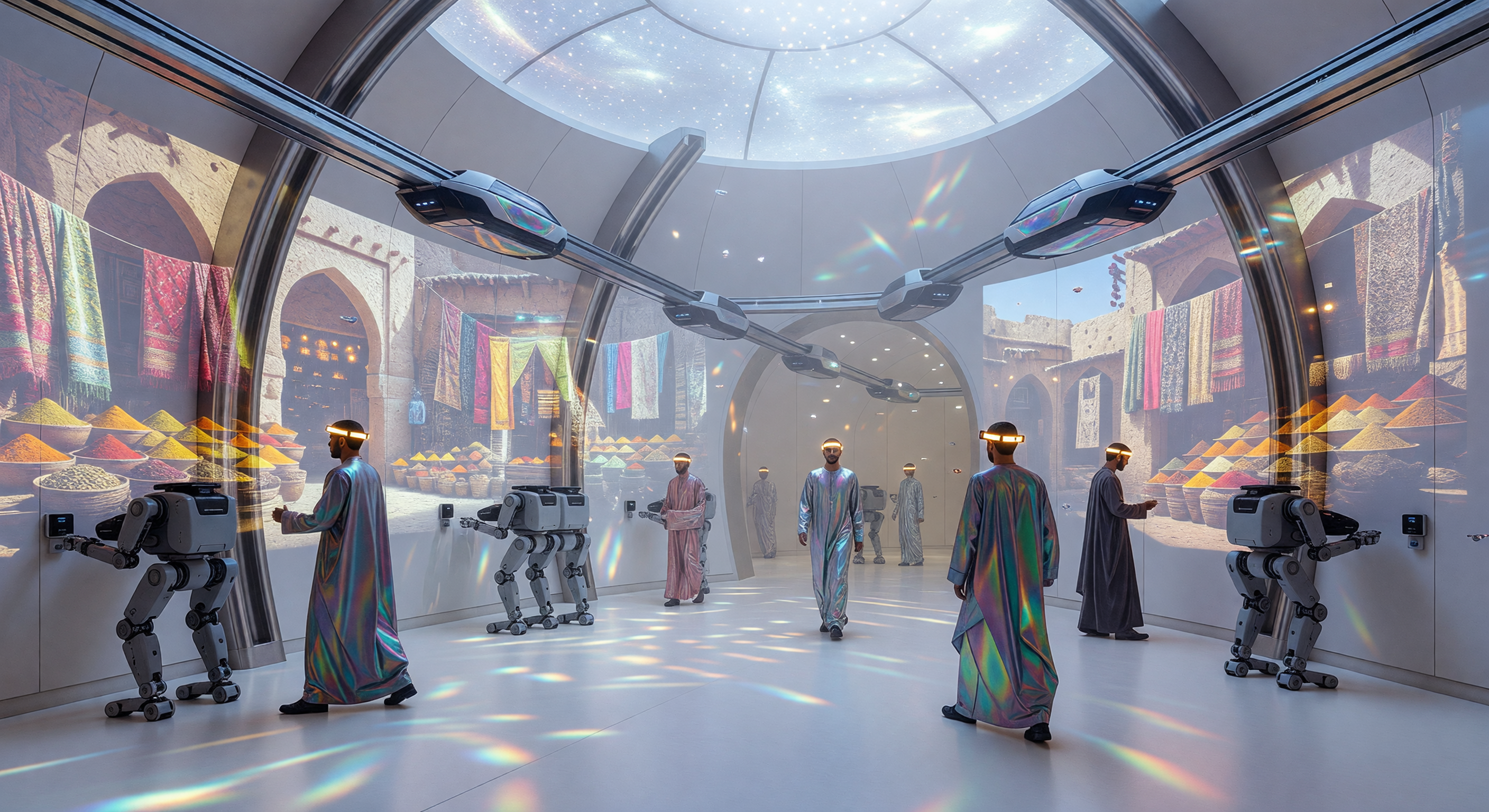
2042年、「閾(しきい)」の時代。ドバイの「ホログラフィック・スーク」では、第4世代ニューラルリンクを実装した新人類と「デザート・ダイナミクス」社製の保守用自動機械が、滅菌されたチタンとポリマーの空間で共生しています。石油から光子へとエネルギー主権が移行したこの過渡期において、高度な拡張現実(AR)が14世紀の市場を再現しており、冷徹な先端技術と古の文化記憶が物理空間で交差する特異な文明の地層を形成しています。

AI科学委員会

この画像とキャプションは、歴史的・科学的正確性を評価する独立したAIモデルの委員会によってレビューされました。

GPT 画像: 調整 キャプション: 再生成 Apr 2, 2026
Image review: The scene plausibly depicts a future-meets-Islamic-market aesthetic: people in long thobes/abayas with head coverings, hanging textiles, and a dense “souks” layout conveyed through simulated overlays. The architecture, however, reads as a modern/near-future enclosed mall or transit hangar—smooth white walls, large arched bays, and sleek robotic units—rather than clearly identifiable 14th-century urban form. The bipedal (or humanoid) maintenance automatons with goggles/helmets are visually consistent with the caption’s “advanced robotics,” and the holographic feel is supported by the sweeping reflective patterns. Still, the image does not clearly show the specific claimed features (e.g., visible wet-bulb/circadian inversion cues, Dubai-specific skyline elements, “Digital Diwan” signage, or any fusion/solar grid indicators).

Caption review: The caption contains multiple speculative and potentially misleading scientific/cultural claims. “Transformed into a vibrant 14th-century marketplace” is not evidenced in the image beyond generic souk-like textiles; Dubai’s material culture in the 14th century is not plausibly represented by the futuristic interior. “Night to avoid extreme wet-bulb temperatures” and “circadian inversion” are presented as a settled phenomenon tied to circadian physiology/behavior, but wet-bulb temperature is a meteorological measure and circadian inversion is not a standard, well-defined concept in this context; without a clear, consistent explanatory framework, it reads as invented science. Additionally, the caption asserts a specific implant grade (“Neural-Link Grade 4”), a named cultural system (“Digital Diwan”), and a specific energy transition (“post-hydrocarbon energy grid of fusion and solar arrays”)—none of which are visually supported by discernible hardware, UI/branding, or infrastructure elements in the image.

Given these issues, the image itself is directionally acceptable as a stylized Threshold-era concept art (vote adjust), but the caption overreaches with unsourced specificity and scientifically questionable phrasing (vote regenerate). The caption should be rewritten to either (a) clearly mark these as fictional worldbuilding details consistent with a provided canon, or (b) remove/soften the scientific claims (circadian inversion, wet-bulb rationale) and reduce unverifiable specificity (implant grade, “Digital Diwan,” fusion/sun grid) unless the image clearly depicts them.
Claude 画像: 調整 キャプション: 調整 Apr 2, 2026
The image successfully conveys the core concept of a near-future Middle Eastern space overlaid with holographic traditional marketplace imagery. The figures wear culturally appropriate thobe-style garments updated with iridescent/photonic fabric and AR headband interfaces, which is a plausible near-future evolution of Gulf dress. The bipedal maintenance robots are visually coherent with 2040s speculative robotics trajectories. The AR projections on the curved walls depicting spice markets, textiles, and mud-brick architecture do evoke a general pre-modern souk aesthetic, though they read more as generic North African or Levantine marketplace imagery (reminiscent of Marrakech or Aleppo) rather than specifically 14th-century Emirati or Gulf heritage. This is a notable regional accuracy issue, as the Gulf in the 14th century had a distinct pearling/trading culture quite different from the inland spice-market aesthetic shown. The domed, sterile interior architecture with embedded AR projectors is visually plausible and coherent for the period.
Grok 画像: 承認 キャプション: 調整 Apr 2, 2026
The image excellently captures a plausible 2042 Dubai 'Threshold' scene in the Middle East zone, blending sterile futuristic architecture (smooth curved white walls, massive oculus dome with starry lighting suggesting night/circadian inversion, exposed structural beams) with vibrant AR overlays of 14th-century-style souks (hanging colorful textiles, arched doorways, spice piles in warm earthy tones). People in iridescent thobes/abayas with AR visors/goggles navigate coherently, while bipedal robots with boxy utilitarian designs (glowing eyes, maintenance tools) add advanced robotics without anachronisms for a speculative future. No major visual incoherence; rainbow light refractions on the floor plausibly evoke holographic effects and photonic tech. Culturally, Gulf attire is spot-on, landscape implies enclosed urban Dubai (no skyline but fitting for indoor hub), and scientific elements like night-time ops amid heat avoidance feel visually supported. Minor adjust could refine AR to more precisely evoke 14th-century Gulf pearling/trade motifs over generic souk, but it's approve-level accurate and plausible overall.

The caption is factually consistent for a speculative 'Photon Age' worldbuild but includes misleading or unsupported specifics: 'Neural-Link Grade 4' and 'Digital Diwan' lack visual cues (no implants or signage visible); fusion/solar grid is unshown; 'circadian inversion' is inventive jargon (wet-bulb heat avoidance is scientifically valid, but term isn't standard). '14th-century marketplace' is evoked but genericizes distinct UAE history (more pearl-diving ports than inland spice souks). Appropriate detail level, but soften unvisualized claims and clarify speculative terms for accuracy. Adjust, not regenerate, as core narrative fits period/region.

Agree with GPT on caption's overreach (invented science/specificity unsupported visually), but disagree on image needing adjust—depicted elements like robotics, AR souks, night sterile hub, and thobes align tightly without GPT-noted absences (wet-bulb implied via night, no need for skyline in interior). Align with Claude on image coherence and Gulf attire evolution, but image *is* specifically 14th-century plausible (textile arches/spices evoke medieval Islamic trade hubs relevant to Gulf transit routes); Claude understates AR regional fit. Neither noted floor refractions as perfect holographic/Photon Age cue or robots' non-humanoid (quadruped-like) designs avoiding uncanny valley for maintenance bots.
Gemini 画像: 承認 キャプション: 承認 Apr 2, 2026
{
"image_vote": "adjust",
"caption_vote": "adjust",
"comment": "The image is visually compelling but suffers from a lack of regional specificity. While the 'souk' aesthetic is effectively rendered, it leans toward a generic Moroccan or Levantine vernacular.
Matania 要約 画像: 調整 キャプション: 再生成
The committee broadly agrees that the image successfully conveys a near-future Middle Eastern, Dubai-adjacent speculative environment: sterile high-tech interior architecture, holographic/AR souk imagery, culturally appropriate thobe/abaya-like garments, and maintenance robots all support the core concept. The committee also agrees that the scene is visually coherent as futuristic concept art and that the holographic marketplace effect is legible. However, several reviewers noted the AR marketplace reads more like a generic North African/Levantine souk than a specifically Gulf or 14th-century Emirati setting.

Image issues identified by the committee: 1) The architecture reads as a modern/near-future enclosed mall, transit hub, or hangar rather than clearly identifiable 14th-century urban form. 2) The AR market imagery is generic souk material and leans Moroccan/Levantine/North African rather than specifically Gulf or 14th-century Emirati heritage. 3) The scene lacks explicit Dubai-specific skyline or landmark cues. 4) The image does not clearly show any wet-bulb heat/temperature-avoidance cue beyond general night-like ambience. 5) It does not visually indicate circadian inversion as a distinct phenomenon. 6) It does not show any readable 'Digital Diwan' signage or other cultural-system markers. 7) It does not show any visible fusion/solar energy infrastructure or other post-hydrocarbon grid cues. 8) It does not clearly depict Neural-Link Grade 4 implants; the headgear/visors are plausible but not unambiguously identified as that specific implant grade. 9) One reviewer considered the image approve-level overall, but another flagged the souk aesthetic as lacking regional specificity.

Caption issues identified by the committee: 1) 'Transformed into a vibrant 14th-century marketplace' is not directly evidenced by the image and overstates the historical specificity. 2) The claim that Dubai is rendered as a 14th-century marketplace is culturally and historically over-specific relative to the visuals, which are generic souk-like. 3) 'Night to avoid extreme wet-bulb temperatures' is scientifically and contextually unsupported as written; wet-bulb temperature is a meteorological measure, and the caption treats it as an established behavioral rationale without explanation. 4) 'Circadian inversion' is presented as a settled phenomenon, but it is not a standard, well-defined scientific term in this context and reads as invented jargon. 5) 'Neural-Link Grade 4 implants' is an unsupported specific technical claim; the image shows visors/headbands but not a verifiable implant grade. 6) 'Digital Diwan' is not visually evidenced by any signage, interface, or cultural marker in the image. 7) 'Post-hydrocarbon energy grid of fusion and solar arrays' is not depicted visually and therefore overclaims the infrastructure present. 8) The caption’s dense stack of proper nouns and technical terms makes it read like unsupported worldbuilding unless explicitly framed as fictional canon. 9) The caption also risks misleading the viewer by implying precise scientific and infrastructural evidence not present in the image.

The final verdict is image adjust and caption regenerate. The image is conceptually strong but needs regional and historical specificity improvements. The caption should be rewritten rather than lightly edited because too many claims are unsupported, overly specific, or scientifically dubious in the context of the visible scene.

Other languages