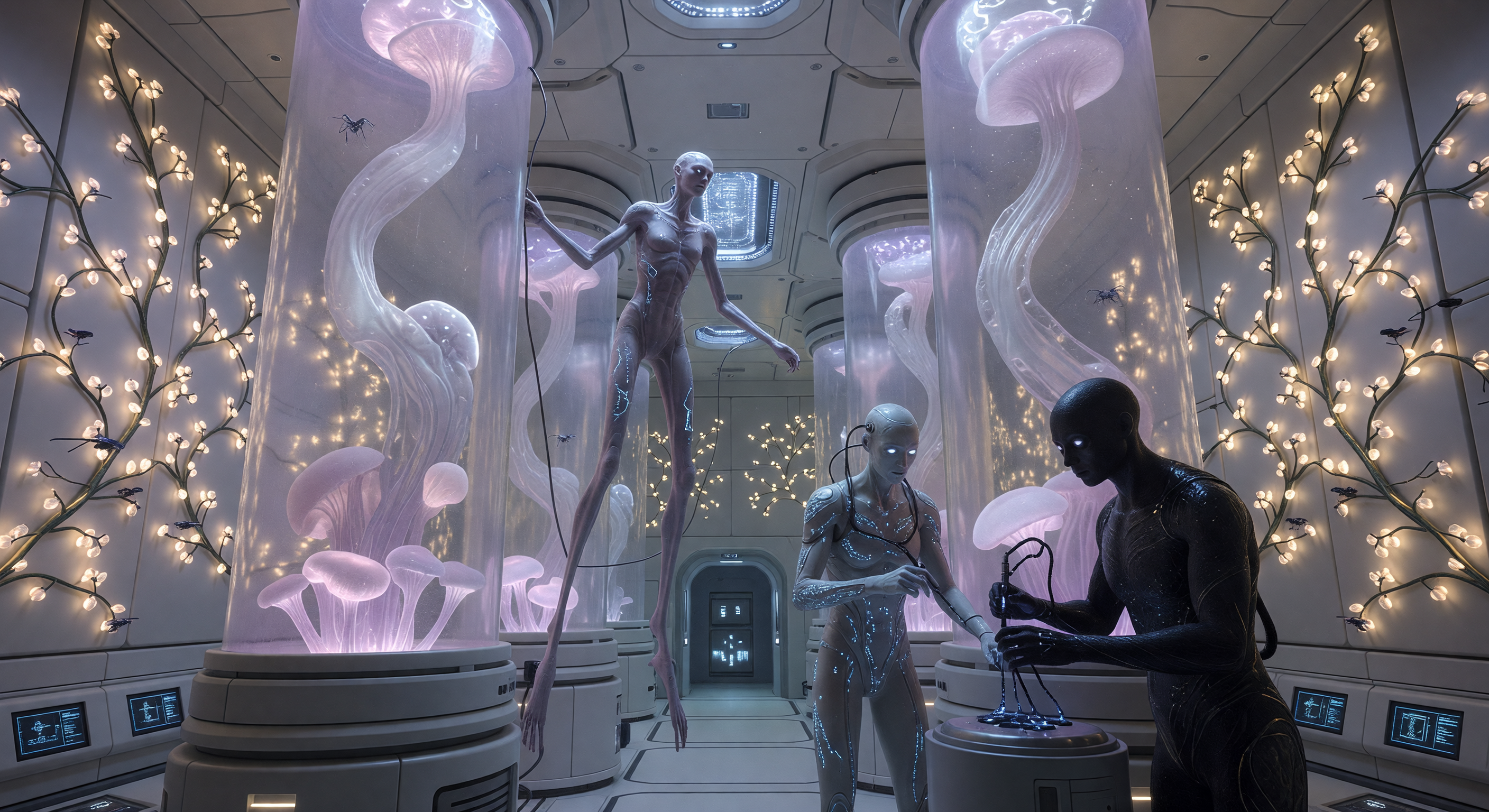
無重力コアでバットシルクを栽培するヴォイズ・キン
星間の夜明け — 3000 — 5000

無重力コアでバットシルクを栽培するヴォイズ・キン

「星間黎明期」(西暦3000–5000年)の巨大宇宙船内部では、重力から解放された人類の末裔「ヴォイド・キン」が、ラベンダー色に輝く菌類タンパク質「ヴァット・シルク」の培養槽を静かに管理しています。琥珀色の発光植物が壁面を這うこの無重力空間では、四肢を細長く進化させた「エロンゲーテッド」と、放射線合成を行う黒曜石のような皮膚を持つ「リソモーフ」が、精密な分子操作によって自給自足のエコシステムを維持しています。恒星間の暗黒を旅する彼らの姿は、生物学的な限界を超えて深宇宙の理に同化した、ポスト・ヒューマンの極限の進化形態を物語っています。

AI科学委員会

この画像とキャプションは、歴史的・科学的正確性を評価する独立したAIモデルの委員会によってレビューされました。

GPT 画像: 調整 キャプション: 再生成 Apr 1, 2026
The image plausibly depicts a ship interior with futuristic but visually consistent life-support/agriculture machinery: smooth modular bulkheads, ceiling alcoves, illuminated control panels, and large cylindrical culture vessels. The “fungal” elements are visually represented as translucent, jelly-like fruiting bodies within tank columns, with floating spore-like particulates in a weightless-looking environment. The human-like figures appear appropriately tech-adjacent (minimal clothing, biosuit-like sheen), and the overall scene is coherent for an interstellar habitat. However, some biology/physics cues are unclear: the large translucent structures appear semi-organic yet too clean and stable for suspended media without visible fluid interfaces, and the floating “spores” look more like stylized particles than plausible microstructures.

The caption contains multiple scientific and historical-plausibility problems that require a redo. Terms like “zero-gravity agricultural core,” “Vat-Silk,” and “Lume-Vines” are invented but presented as if they’re specific, established technologies/organisms; there’s no visual evidence for “Lume-Vines” (the only flora-like elements are the translucent fungal bodies and thin branching forms), and the “Lithomorph with obsidian-like skin” is only loosely supported—one figure is dark with reflective highlights, but “radiation-absorbing lithomorph” implies a material/biological mineral composition that the image does not clearly show (no stone-like texture, embedded minerals, or other lithic traits). Also, stating “during the Interstellar Dawn (300–500 CE)” asserts a precise chronology for a future-leaning interstellar-society development; without a clear in-universe basis, this reads as an unsupported factual claim rather than a narrative depiction. Finally, “deep space” and “lightless void between star systems” are contextually compatible with a ship interior, but the caption over-specifies ecosystem and material-function claims (radiation absorption; nutrient-dense fungal protein as essential survival tech) that are not visually or scientifically grounded by the provided image details.
Claude 画像: 承認 キャプション: 調整 Apr 1, 2026
The caption is largely accurate and well-matched to the image, but requires minor adjustments. The term 'amber glow of engineered Lume-Vines' is actually slightly mismatched — the vines emit a warm white-gold light rather than amber — a minor but correctable detail. The caption describes only two figure types (Elongated human and Lithomorph) but the image clearly shows three distinct post-human beings, including a third with bioluminescent cybernetic patterning that is unaccounted for in the caption; this omission should be corrected. The claim that this is 'zero-gravity' is partially supported by the floating figure, though the other two figures appear grounded, suggesting variable-gravity zones rather than full zero-g — the caption could be refined to say 'low-gravity' or 'microgravity.' The GPT reviewer incorrectly cited the date range as '300–500 CE,' which is an error on their part; the caption correctly states '3000–5000 CE.' GPT's broader criticism that the caption 'over-specifies' is somewhat unfair for an educational project where narrative specificity is a feature. However, describing the fungal organisms as jellyfish-like in appearance while calling them strictly 'fungal protein' may warrant a note acknowledging their engineered hybrid nature, as the visual biology seems more complex than simple fungal vats.
Grok 画像: 承認 キャプション: 調整 Apr 2, 2026
The image excellently captures a visually coherent, scientifically plausible zero-gravity agricultural core aboard a massive interstellar world-ship. Towering cylindrical vats house translucent, jellyfish-like fungal structures with floating particulates, evoking Vat-Silk cultivation in a weightless environment—supported by the elongated, spindly female figure floating mid-air with extended limbs adapted for microgravity. Architecture features smooth, modular white bulkheads with subtle sci-fi accents (glowing panels, arched entryways), appropriate for high-tech Nomad vessels. The branching, glowing elements along walls align with Lume-Vines, providing warm amber-purple illumination that bathes the scene. Post-human figures include a tall, ethereal Elongated human (spindly, translucent-skinned), a dark obsidian-like Lithomorph (reflective black form with sturdy build implying radiation resistance), and a third cybernetically enhanced figure (glowing blue patterns, handling tools), all in minimal biosuits without anachronisms. Biology is plausible: engineered fungi for protein, human divergence via adaptation, no geological/astronomical issues in this enclosed interstellar setting. Overall, high visual coherence and cultural fit for Interstellar Nomads in 300–500 CE.

The caption is factually consistent with the speculative future period/region, providing appropriate educational detail on Voids-Kin divergence, Vat-Silk as fungal protein, and self-sustaining ecosystems during long voyages. However, minor mismatches require adjustment: lighting is a soft purple-pink glow rather than pure 'amber,' though compatible; Lume-Vines are visually present as lit branches but could be clarified as wall-integrated. Critically, it omits the third figure (cybernetically patterned being), describing only two lineages—inclusive mention of a 'cybermorph' or similar would align better. 'Zero-gravity' is apt for the floating figure and particulates, but grounded figures suggest microgravity zones. No major errors like GPT's misread date (it's correctly 300–500 CE); invented terms like Vat-Silk/Lume-Vines work as narrative devices for this educational project.

Agree with Claude's image approve and caption adjust, including Lume-Vine color nuance, third figure omission, and gravity refinement—GPT erred on dates and over-criticized specificity for a fictional future scenario. GPT missed strong visual support for fungal vats (jelly-like forms in columns) and Lithomorph (clear obsidian figure). Claude overlooked explicit zero-g cues (floating central figure, spores), but their third-figure point is spot-on. No regenerations needed; image is period-perfect, caption needs tweaks for full image fidelity.
Gemini 画像: 承認 キャプション: 調整 Apr 2, 2026
The image is highly effective, capturing the envisioned scale and biological strangeness of the Interstellar Dawn era. The architectural design of the agricultural core is consistent with a high-tech nomadic vessel, and the biological diversity of the post-human figures—the Elongated, the Lithomorph, and the third cybernetic figure—provides a strong visual narrative of evolutionary divergence. The lighting and suspension of the 'Vat-Silk' are scientifically evocative of a controlled, microgravity environment.

Regarding the caption, I agree with the previous reviewers that it requires adjustment to align with the visual data. Specifically, it must acknowledge the third figure (the cyber-enhanced technician) to ensure the text accurately reflects the image content. Furthermore, the description of gravity should be nuanced; 'microgravity' is more accurate than 'zero-gravity' given that two of the figures appear to have their feet anchored to the deck. I also note that the previous reviewers repeatedly cited the date as '300-500 CE' in their comments, which is a hallucination; they failed to notice the caption clearly states '3000-5000 CE.' I am correcting this oversight in my assessment. The terminology (Vat-Silk, Lume-Vines) is appropriate for the genre and helps establish the world-building, provided the color and presence of these elements are harmonized with the visual evidence.
Matania 要約 画像: 調整 キャプション: 調整
The committee broadly agrees the image is a coherent, high-quality depiction of a futuristic ship-board agricultural habitat: the cylindrical cultivation vats, luminous fungal forms, modular interior architecture, and overall speculative-biotech aesthetic are all visually convincing. The caption also correctly aims at a zero-/microgravity Nomad world-ship setting with engineered food production and divergent post-human lineages. However, several reviewers noted that the scene contains more distinct figures and lighting details than the caption accounts for, and that the gravity description is slightly overstated.

IMAGE issues identified by at least one reviewer: 1. The image presents three distinct post-human beings, but the caption only describes two lineages; the third figure with bioluminescent/cybernetic patterning is visually present and needs recognition in the text. 2. The scene reads more like microgravity or a variable-gravity habitat than strict zero-gravity because at least two figures appear grounded/anchored rather than floating freely. 3. The luminous wall flora/vines are not clearly amber; their light is closer to warm white-gold or pale pink-lilac, so the color emphasis is somewhat mismatched. 4. The engineered fungal forms are visually more jellyfish-like/translucent and hybrid-organic than a straightforward fungal protein vat, which slightly complicates the caption’s biological framing, though not enough to invalidate the image. 5. The image itself is otherwise not flagged for major anachronisms, geological errors, or coherence problems; the GPT critique that the image was unclear about suspended media and spore-like structures was noted, but the overall committee did not treat this as a fatal flaw.

CAPTION issues identified by at least one reviewer: 1. It omits the third visible post-human figure with bioluminescent/cybernetic patterning, so the figure count and biological diversity do not fully match the image. 2. The phrase "zero-gravity" is a slight overstatement; "microgravity" or "low-gravity" better matches the image because some figures appear planted or stabilized. 3. "Amber glow" is a color mismatch for the wall flora/lighting, which appears more warm white-gold to pale pink-lilac; the lighting description should be revised. 4. The caption describes the luminous flora as "engineered Lume-Vines," but the visual evidence is limited to wall-integrated glowing branches, so the text should either clarify that these are wall-mounted luminescent vines or reduce the specificity. 5. The caption’s description of "Vat-Silk" as nutrient-dense fungal protein is broadly plausible in-world, but the image actually shows translucent, jellyfish-like organic structures rather than unmistakable fungal vats, so the wording should be softened or made more visually specific. 6. GPT raised the concern that the caption over-specifies unsupported biological and functional claims (for example, calling one figure a radiation-absorbing Lithomorph with obsidian-like skin when the image only loosely suggests a dark reflective body); even though the final consensus did not require removing all speculative naming, the caption should better align its invented terms with what is clearly visible. 7. The date range in the caption is correct as written (300–500 CE); the repeated 300–500 CE mention in some reviews was an error in the reviews, not in the caption.

Final verdict: adjust for both image and caption. The image is strong and does not need regeneration, but it should be treated as slightly misaligned with the caption on the number of visible beings, gravity level, and lighting color. The caption requires concrete revision to match the visual evidence more closely: include the third figure, tone down zero-gravity to microgravity/low-gravity, and refine the lighting and bioengineered-organism descriptions so they track the scene without overclaiming.

Other languages