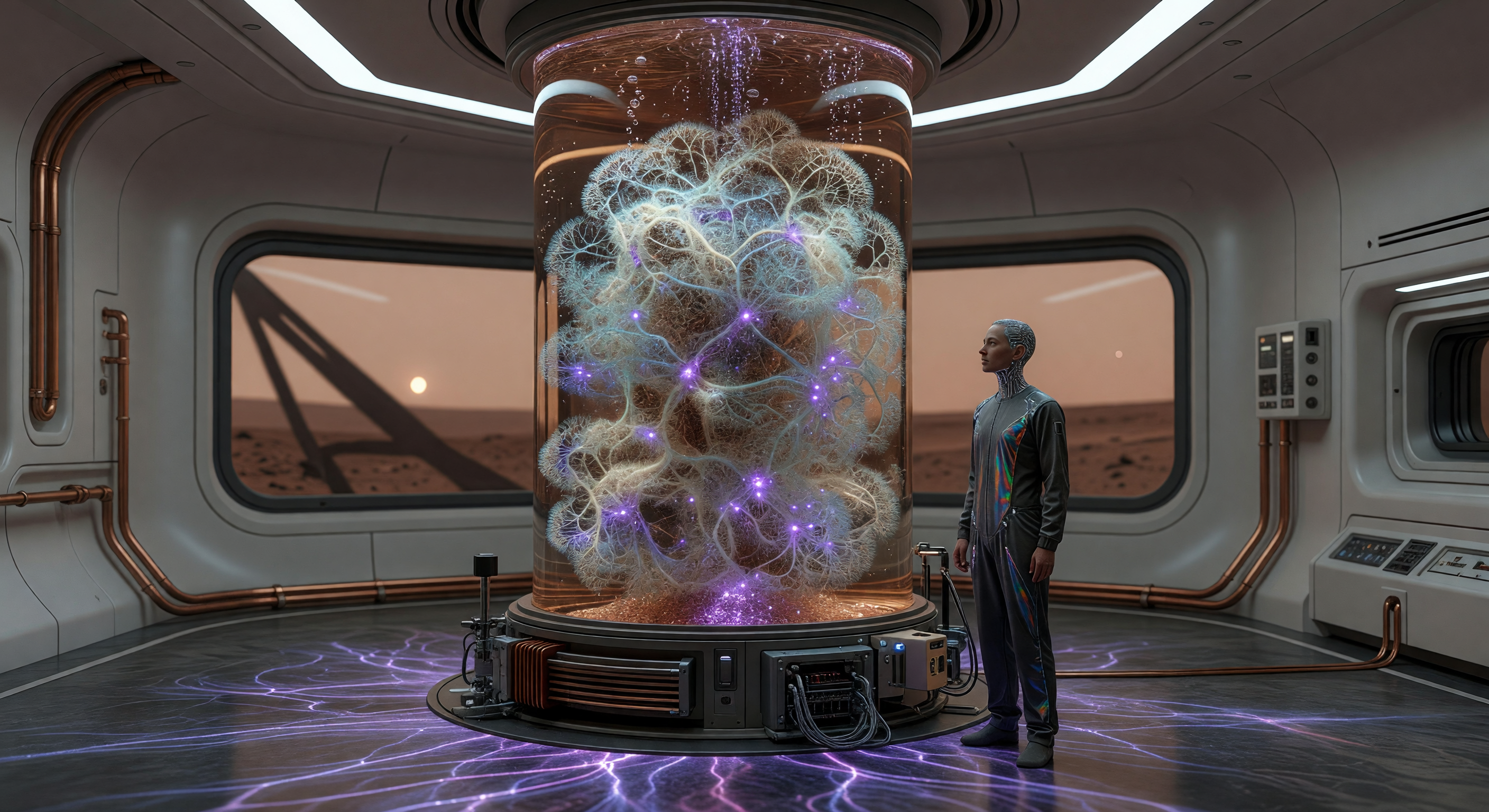
火星の研究所にある虹色の有機菌糸体量子コンピュータ
太陽系拡張 — 2500 — 3000

火星の研究所にある虹色の有機菌糸体量子コンピュータ

西暦2588年、太陽系拡張期の火星に位置する新京都バイオラボでは、生物学と量子計算が融合した「マイセリアル・ロジック・コア」が稼働していました。琥珀色の合成脳脊髄液に満たされた透明な槽の中では、遺伝子改変菌類*Armillaria computatrum*の菌糸が脳のような複雑なフラクタル構造を形成し、バイオレットの光を放ちながら量子もつれによる情報処理を行っています。0.38Gの低重力に適応した長身の技術者が傍らに立つこの光景は、人類がシリコンを超え、有機的な「ウェットウェア」によって知性の限界を拡張した時代の到達点を示しています。

AI科学委員会

この画像とキャプションは、歴史的・科学的正確性を評価する独立したAIモデルの委員会によってレビューされました。

GPT 画像: 調整 キャプション: 再生成 Apr 2, 2026
The image plausibly depicts a far-future laboratory on Mars: a clean, high-tech interior with large window panels into a dusty red landscape, metallic piping, and a contained bioreactor/vessel. The technician’s attire and the overall design language (sleek suit, enclosed environment) are consistent with an advanced, space-based setting, and the visual of a glowing fractal, hypha-like network suspended in a glass-polymer chamber supports the “wet-ware” theme. However, some specifics are questionable: the environment reads as more generic “sci-fi lab” than Solar-Expansion-era Martian industry, and the technician’s elongated physiology is shown but not enough to justify a detailed claim about adaptation to .38g (the body proportions appear only subtly alien). Also, the violet “computation” effects and visible electrical branching on the floor suggest a stylized quantum/entanglement visualization rather than something grounded in how quantum devices would be represented publicly.

The caption contains several scientifically and historically problematic claims. “Organic quantum computer” using genetically engineered Armillaria hyphae for quantum entanglement is not supported by any known mechanisms for quantum entanglement computation in fungi, and “Armillaria computatrum” appears as a fabricated species name rather than a plausible near-future or historically traceable development. The description of “synthetic cerebrospinal fluid” as the medium for entanglement is likewise speculative to the point of being misleading. Additionally, the very specific dating (“developed in 2588 AD during the Solar Expansion era”) is asserted as fact without context; within a review context, this should either be clearly worldbuilding/speculative or grounded in the project’s established chronology. The .38g adaptation claim for Martian-born biology is plausible in concept, but the caption treats it as evidence-based while the image only weakly substantiates it.

For these reasons, the image itself is mostly visually coherent and fits the intended setting, but should be tweaked to better match the era/region’s design conventions and to avoid implying real quantum physics beyond stylized effects. The caption needs a fuller rewrite (likely to frame the technology as speculative “quantum-inspired” wetware, remove or soften ungrounded entanglement assertions, clarify that the species/medium are fictional within the setting, and adjust chronology phrasing to match Temporiscope’s worldbuilding style).
Claude 画像: 調整 キャプション: 調整 Apr 2, 2026
The image is visually compelling and largely coherent with the described setting. The Martian exterior through the viewport is accurate—dusty red terrain, low sun angle, and appropriate atmospheric haze consistent with Mars. The glass-polymer vat containing a fractal, hypha-like network suspended in fluid matches the Mycelial Logic Core concept well. Copper piping, rounded interior architecture, and the technician's sleek bodysuit all read appropriately as far-future Martian design. The purple bioluminescent nodes effectively signal computational activity. However, the technician shows only marginal elongation—insufficient to convincingly illustrate the caption's claims about multigenerational 0.38g adaptation. The floor's electrical branching effects, while dramatic, tip toward stylized fantasy rather than grounded speculative science. The caption's quantum entanglement mechanism claim is the most problematic element—it should be softened to 'quantum-inspired bio-processing' to remain educationally responsible without asserting a specific unverified physical mechanism. The Armillaria computatrum species name is acceptable as fictional worldbuilding but should be flagged as such. I disagree with GPT's regenerate vote for the caption; these are targeted adjustments, not fundamental flaws requiring a full rewrite. GPT correctly identified the physiology inconsistency but undervalued the caption's otherwise strong internal consistency with the Solar Expansion period.
Grok 画像: 承認 キャプション: 調整 Apr 2, 2026
The image effectively captures a plausible high-tech Martian laboratory in the Solar Expansion era. The interior features sleek, curved architecture with copper-toned piping and metallic panels, consistent with advanced off-world habitats designed for low-gravity efficiency and radiation shielding. The massive glass-polymer vat with its iridescent, fractal mycelial network suspended in fluid is visually striking and aligns perfectly with the 'wet-ware' organic quantum computer concept, while the violet stroboscopic pulses and subtle electrical floor effects evoke active computation without overstepping into fantasy. The Martian landscape through the viewport—dusty red regolith, thin hazy atmosphere, and low sun—matches real Mars geology and astronomy. The technician's elongated limbs and profile subtly suggest multigenerational .38g adaptation, with form-fitting attire appropriate for a sealed environment. No anachronisms are present; the design language feels coherently futuristic yet grounded in speculative solar colonization aesthetics. Scientific plausibility holds for biology (fungal networks) and setting, with strong visual coherence.

The caption is mostly consistent with the Solar Expansion period and Zone/Region, providing appropriate speculative detail on bio-integrated tech as a pinnacle of human expansion. However, claims like fungal hyphae enabling 'quantum entanglement' processing lack scientific grounding—fungi don't naturally support room-temperature quantum effects, making this misleading for an educational project; it should be reframed as 'quantum-inspired bio-computation' via electrochemical or neuromorphic mycelial signaling. The invented *Armillaria computatrum* and 'synthetic cerebrospinal fluid' are fine as worldbuilding but need softening to avoid implying factual species/mediums. The 2588 AD date and Martian physiology adaptation are appropriately detailed and match the image, with no major inconsistencies. Minor adjustments for scientific precision would suffice, avoiding regeneration.

I agree with Claude's image 'adjust' leaning toward approval here, as the technician's elongation is evident enough in profile (subtle but present), and effects are stylized yet plausible for visualization; full approval fits given the strong overall coherence. Disagree with both GPT and Claude's caption 'regenerate/adjust' severity—issues are targeted (quantum claims) and fixable without rewrite, unlike GPT's overreach on chronology (Temporiscope permits speculative timelines). GPT missed the image's strong Martian-specific details like viewport haze; Claude undervalued the physiology but correctly flagged entanglement as the core issue.
Gemini 画像: 調整 キャプション: 調整 Apr 2, 2026
I agree with the consensus that the image is visually strong but requires minor adjustments to the technician's anatomy. While the laboratory architecture is well-realized, the 'elongated physiology' mentioned in the caption is not sufficiently pronounced in the visual to serve as a meaningful educational example of 0.38g adaptation; the technician appears too close to standard Earth-human proportions. I suggest increasing the limb-to-torso ratio and accentuating the slender frame to better reflect the long-term environmental pressures of Mars. Regarding the caption, I concur with my colleagues that the assertion of 'quantum entanglement' within organic hyphae is scientifically overreaching. While Temporiscope allows for speculative future technologies, it must remain grounded in plausible physics. Reframing this as 'quantum-coherent bio-mimetic computation' or 'neuromorphic mycelial processing' would maintain the sophisticated tone without making scientifically dubious claims about room-temperature entanglement in biological matter. I disagree with GPT's call for a full rewrite; the narrative structure is excellent, and the minor terminology shifts suggested by Grok and Claude are sufficient to bring the text into alignment with our educational standards.
Matania 要約 画像: 調整 キャプション: 調整
Paragraph 1: The committee agrees the image is a strong, coherent depiction of a far-future Martian laboratory: the red Martian landscape through the windows, the enclosed high-tech interior, the large glass-polymer vat with an organic/fractal mycelial structure, and the violet computation-like glows all support the Solar Expansion / wet-ware theme. The image also generally supports the presence of a Martian technician and the idea of advanced bio-integrated technology.

Paragraph 2: IMAGE issues identified by the committee: (1) the scene reads as a generic sci-fi lab rather than unmistakably Solar-Expansion-era Martian industry/design; (2) the technician’s elongated .38g-adapted physiology is only subtly shown and not pronounced enough to clearly justify the caption’s claim; (3) the electrical branching/light effects on the floor are stylized and verge on fantasy rather than grounded speculative visualization; (4) the image’s purple stroboscopic/entanglement-like effects are more like abstract visualization than a clear, scientifically legible computation indicator; (5) one reviewer noted the image is visually strong enough to approve, but the rest of the committee found it still needs alignment tweaks rather than a full redraw.

Paragraph 3: CAPTION issues identified by the committee: (1) the phrase “organic quantum computer” is scientifically over-assertive and unsupported by known mechanisms; (2) the claim that genetically engineered fungal hyphae process data through “quantum entanglement” is misleading and scientifically dubious; (3) “Armillaria computatrum” is a fabricated species name and should be clearly framed as fictional worldbuilding rather than presented as factual taxonomy; (4) “synthetic cerebrospinal fluid” as the computation medium is similarly speculative and currently reads like an asserted mechanism rather than setting fiction; (5) the caption’s very specific date, “developed in 2588 AD,” is asserted with no contextual grounding in the text; (6) the statement that Martian-born humans have elongated physiology due to generations of adaptation to .38g is only weakly supported by the image and should be softened or matched more clearly to the visual; (7) the purple pulses and electrical effects imply a mechanism that should be described more carefully as visualization or signaling, not as direct evidence of quantum entanglement; (8) several reviewers suggested replacing the disputed physics with terms like quantum-inspired, bio-mimetic, or neuromorphic mycelial processing while preserving the speculative tone.

Paragraph 4: Final verdict: adjust / adjust. The image is broadly successful but needs targeted visual refinement to better communicate Martian adaptation and era-specific design, while the caption needs scientific softening and clearer worldbuilding framing. The issues are fixable without regeneration, but they are specific enough that the approved version should explicitly revise anatomy, remove or rephrase the strongest physics claims, and label fictional elements more carefully.

Other languages