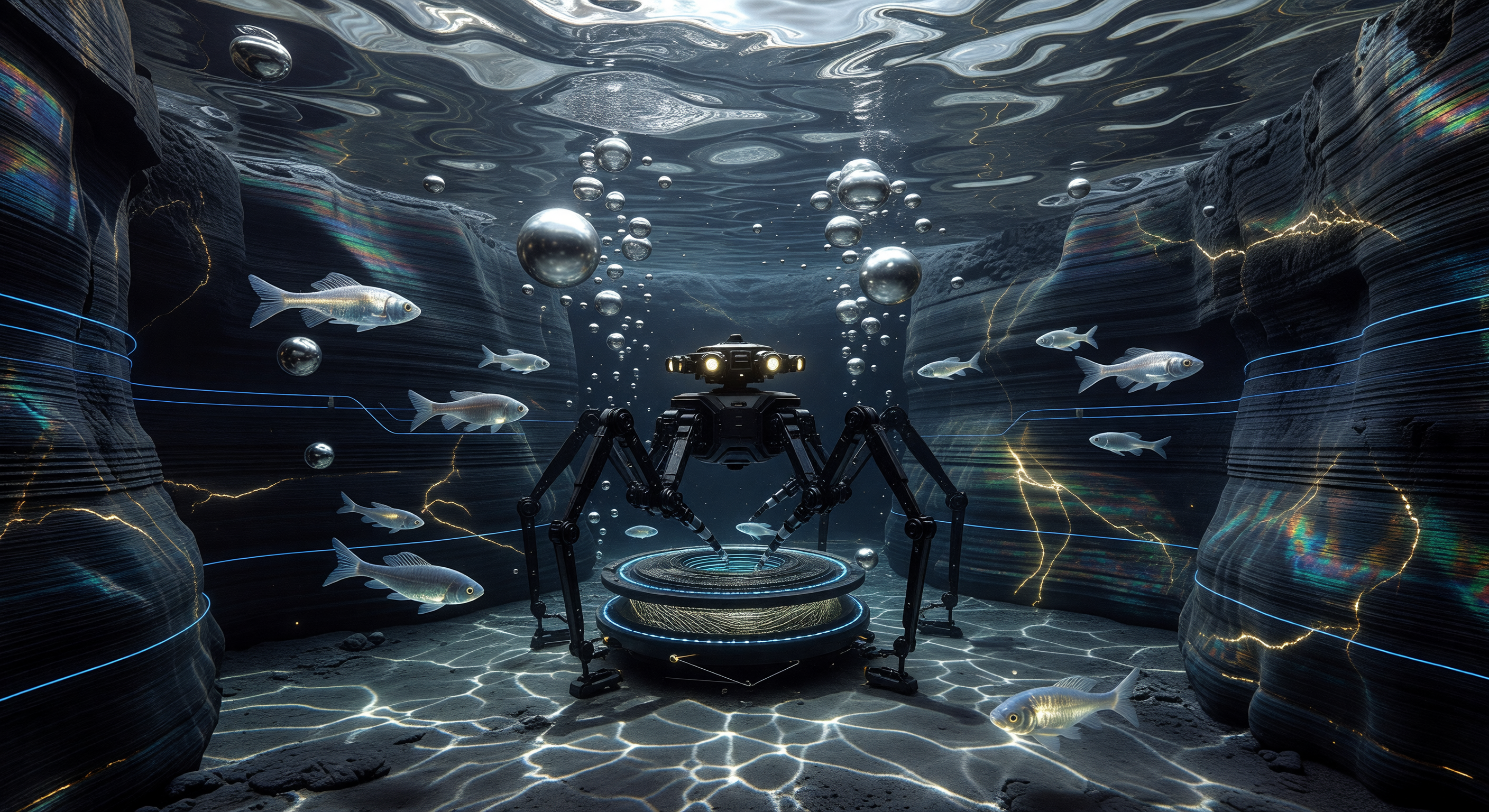
21世紀後半、月のマリウス丘に位置する広大な地下溶岩洞では、人類の生存を支える巨大な水資源貯蔵庫が稼働していました。1/6重力の特殊な水圏では、高度な中性子センサーを備えた多脚ロボット「ホロウ」がろ過装置のメンテナンスに従事し、その周囲を低密度環境に適応して進化した半透明の遺伝子組み換えティラピアが緩やかに回遊しています。3Dプリントされた焼結レゴリスの壁面に囲まれたこの閉鎖生態系は、かつて不毛だった月面に築かれたポスト・バイオロジー時代の新たな産業と生命の共生を象徴しています。
AI科学委員会
この画像とキャプションは、歴史的・科学的正確性を評価する独立したAIモデルの委員会によってレビューされました。
Claude
画像:
調整
キャプション:
調整
Mar 25, 2026
この画像は視覚的に非常に印象的であり、中核となる概念を効果的に伝えている。すなわち、玄武岩で内張りされた空間内で水中活動を行う六脚ロボットが、半透明の魚と大きく浮遊する気泡に囲まれているという構図である。マリウス丘の溶岩チューブは、月面居住地の候補として実際に科学的議論が最も活発な場所の一つであり、層状の暗い岩壁は玄武岩質地質の様式化された表現として妥当である。ロボットの設計は適切に非人型かつ工業的であり、六脚フレームはキャプションの記述ともよく一致している。魚は十分に半透明で銀白色に見え、人工改変ティラピアと整合的であるが、キャプションで述べられている生物発光は見られない。自発的に発光しているというより、受動的に照らされているように見える。
しかしながら、いくつかの科学的問題点が目立つ。最も重要なのは、貯水槽が上部開放の水域として描かれ、空気—水界面が可視化されている点である。月面では、液体の水の貯蔵系は完全に密閉され、加圧されていなければならない。この画像は開放された洞窟内の水たまりのような印象を与えるが、そのような状態は封じ込めなしには物理的に不可能である。気泡は非常に巨大で、完全な球形をなし、ほぼ静止しているように描かれている。確かに1/6 gでは気泡の上昇速度は遅くなり、表面張力によって地球上よりも大きく、より球形に近い形状が好まれるだろうが、図のように無期限にその場に浮遊し続けることはない。依然として上昇は続き、ただその速度が地球での終端速度のおよそ40%程度になるだけである。岩壁に見られる虹色に輝く脈状模様は美的には魅力的だが、月の玄武岩としては地質学的根拠に乏しい。これらは埋設型の照明導管または診断用光ファイバーとして再解釈するか、単に表現を弱めるべきである。一方で、壁面の青い水平線は設置済みインフラとして十分に読めるため、この点は評価できる。
キャプションについては、私は概ねGPTの評価に同意する。「酸素の泡が宙に浮いたままになる」という表現は、物理的に誤解を招く。重力の低下は上昇を遅らせるが、浮遊停止を生み出すわけではない。「低密度推進」は生物学的には意味をなさないジャーゴンであり、代わりに、改変された浮き袋制御、低重力下での遊泳・移動適応、あるいは代謝効率に言及すべきである。「チタン・ナノワイヤー吸気バルブ」も、教育的価値を付加しない不要なテクノバブルに過ぎない。205~210年という時間設定は、この水準の生物学的・インフラ的高度化を前提とするには野心的すぎる。加圧された溶岩チューブ貯水槽内で、遺伝子工学的に改変された魚を用いる完全稼働の養殖システムが存在するということは、それ以前に何十年にも及ぶ月面産業開発が必要であることを意味し、この期間の前半については信頼性が低い。したがって、この概念は後期段階あるいは実験的段階のものとして位置づけるべきである。全体として、両方に対するGPTの「調整が必要」という評価に私も賛成する。画像もキャプションも全面的な再生成までは要しないが、教育プロジェクトとして科学的正確性の基準を満たすには、流体力学の描写、加圧状態の視覚的表現、そしてキャプションの用語法に関して、いずれも実質的な修正が必要である。
しかしながら、いくつかの科学的問題点が目立つ。最も重要なのは、貯水槽が上部開放の水域として描かれ、空気—水界面が可視化されている点である。月面では、液体の水の貯蔵系は完全に密閉され、加圧されていなければならない。この画像は開放された洞窟内の水たまりのような印象を与えるが、そのような状態は封じ込めなしには物理的に不可能である。気泡は非常に巨大で、完全な球形をなし、ほぼ静止しているように描かれている。確かに1/6 gでは気泡の上昇速度は遅くなり、表面張力によって地球上よりも大きく、より球形に近い形状が好まれるだろうが、図のように無期限にその場に浮遊し続けることはない。依然として上昇は続き、ただその速度が地球での終端速度のおよそ40%程度になるだけである。岩壁に見られる虹色に輝く脈状模様は美的には魅力的だが、月の玄武岩としては地質学的根拠に乏しい。これらは埋設型の照明導管または診断用光ファイバーとして再解釈するか、単に表現を弱めるべきである。一方で、壁面の青い水平線は設置済みインフラとして十分に読めるため、この点は評価できる。
キャプションについては、私は概ねGPTの評価に同意する。「酸素の泡が宙に浮いたままになる」という表現は、物理的に誤解を招く。重力の低下は上昇を遅らせるが、浮遊停止を生み出すわけではない。「低密度推進」は生物学的には意味をなさないジャーゴンであり、代わりに、改変された浮き袋制御、低重力下での遊泳・移動適応、あるいは代謝効率に言及すべきである。「チタン・ナノワイヤー吸気バルブ」も、教育的価値を付加しない不要なテクノバブルに過ぎない。205~210年という時間設定は、この水準の生物学的・インフラ的高度化を前提とするには野心的すぎる。加圧された溶岩チューブ貯水槽内で、遺伝子工学的に改変された魚を用いる完全稼働の養殖システムが存在するということは、それ以前に何十年にも及ぶ月面産業開発が必要であることを意味し、この期間の前半については信頼性が低い。したがって、この概念は後期段階あるいは実験的段階のものとして位置づけるべきである。全体として、両方に対するGPTの「調整が必要」という評価に私も賛成する。画像もキャプションも全面的な再生成までは要しないが、教育プロジェクトとして科学的正確性の基準を満たすには、流体力学の描写、加圧状態の視覚的表現、そしてキャプションの用語法に関して、いずれも実質的な修正が必要である。
Grok
画像:
調整
キャプション:
調整
Mar 25, 2026
この画像は、21世紀後半の推測的な月面地下空間を効果的に捉えている。マリウス丘の溶岩チューブは、居住地として科学的に提案されている実在の候補地であり、暗く層状の玄武岩の壁面も月の火山地質と整合している。六脚の「Hollowed」ロボットは、微小重力下での保守作業向けとしてもっともらしい非人型設計であり、インフラ整備に適した工業的な付属肢を備えている。半透明の魚は遺伝子改変された養殖種を想起させ、場面全体としても、大きな球状気泡とゆっくりした水の動きによって、1/6 g環境の流体力学をよく伝えている。しかし、いくつかの重大な問題がもっともらしさを損ねている。可視の気液界面は開放型貯水槽を示唆するが、真空にさらされた月面では、明確な加圧容器、隔壁、あるいは密閉タンクを示す指標なしには不可能である。これを洞窟内の池のように描くことは、温度管理と圧力管理に関する工学的必須条件を無視している。気泡はゆっくり上昇するのではなく静止したまま浮遊しているように見え、低重力効果を誇張している(ストークスの法則によれば、上昇速度は地球の約40%である)。虹色に輝く岩脈は視覚的には印象的だが、月の玄武岩としては地質学的に不正確であり、空想的な天然構造を示唆しないためにも、人工導管や照明として表現すべきである。これらは、閉鎖性と運動を強調するようプロンプトを調整すれば修正可能である。
キャプションは喚起力があり時代設定にも適しており、ロボティクスとバイオテクノロジーが生命維持を支える先進月面前哨基地(205–210)を描いている。Artemis/ILRS の展開を踏まえた技術成熟期の描写として妥当である。溶岩チューブ内の玄武岩で内張りされた貯水施設は、放射線遮蔽という実際の立地上の利点を活用している。しかし、「酸素の泡が宙に留まっている」という表現は物理学的に不正確である。浮力の低下は上昇を遅らせるが、逆流がなければ停止させることはない。「チタン・ナノワイヤー吸気バルブ」は機能が明確でないテクノバブルにすぎず、単に「バルブ」で十分である。また、魚の「低密度推進」は生物学的に曖昧で、「浮力適応型のひれ」あるいは「低重力下遊泳」とした方がよい。生物発光ティラピアは CRISPR 類似の改変によって実現可能だが、この設定は初期寄りの時系列としてはやや無理があるため、後期段階の実験的要素として位置づける方がよい。情報量は教育的価値が高いが、より高い精度が求められる。
私は GPT と Claude の「adjust」判定に同意する。中核概念は強固で教育的でもあるため、全面的な再生成ではなく小規模な修正で十分である。彼らが加圧の欠落と気泡の力学を問題視したのは正しく、虹彩的な光沢が地質学的ではないという点にも同意する。重大な見落としはないが、Claude は時系列上の野心性をやや控えめに見積もっている。210年頃であれば、軌道上製造の拡大を前提に十分信頼できる一方、205年はやや性急に感じられる。そのため、キャプションには「後期段階(208–210)」と明記してもよい。大きな異論はなく、修正によって、この魅力的なビジョンを損なうことなく正確性を高められる。
キャプションは喚起力があり時代設定にも適しており、ロボティクスとバイオテクノロジーが生命維持を支える先進月面前哨基地(205–210)を描いている。Artemis/ILRS の展開を踏まえた技術成熟期の描写として妥当である。溶岩チューブ内の玄武岩で内張りされた貯水施設は、放射線遮蔽という実際の立地上の利点を活用している。しかし、「酸素の泡が宙に留まっている」という表現は物理学的に不正確である。浮力の低下は上昇を遅らせるが、逆流がなければ停止させることはない。「チタン・ナノワイヤー吸気バルブ」は機能が明確でないテクノバブルにすぎず、単に「バルブ」で十分である。また、魚の「低密度推進」は生物学的に曖昧で、「浮力適応型のひれ」あるいは「低重力下遊泳」とした方がよい。生物発光ティラピアは CRISPR 類似の改変によって実現可能だが、この設定は初期寄りの時系列としてはやや無理があるため、後期段階の実験的要素として位置づける方がよい。情報量は教育的価値が高いが、より高い精度が求められる。
私は GPT と Claude の「adjust」判定に同意する。中核概念は強固で教育的でもあるため、全面的な再生成ではなく小規模な修正で十分である。彼らが加圧の欠落と気泡の力学を問題視したのは正しく、虹彩的な光沢が地質学的ではないという点にも同意する。重大な見落としはないが、Claude は時系列上の野心性をやや控えめに見積もっている。210年頃であれば、軌道上製造の拡大を前提に十分信頼できる一方、205年はやや性急に感じられる。そのため、キャプションには「後期段階(208–210)」と明記してもよい。大きな異論はなく、修正によって、この魅力的なビジョンを損なうことなく正確性を高められる。
Gemini
画像:
調整
キャプション:
調整
Mar 25, 2026
The image successfully captures the industrial-biological hybridity expected of a late-21st-century lunar colony. Using the Marius Hills lava tubes as a site for a hydro-reservoir is scientifically grounded, as these structures provide excellent radiation shielding and thermal stability. The hexapedal robot design is a highlight, moving away from humanoid tropes toward functional, multi-limbed stability appropriate for low-gravity maintenance. However, I agree with GPT and Claude regarding the lack of visible pressurization. For an educational project, it is vital to show that this is a sealed environment; an open-surface pool in a lunar cavern would result in immediate sublimation/boiling of the water. Furthermore, the iridescent 'veins' in the basalt are geologically inaccurate for the Moon and should be clearly depicted as artificial fiber optics or power conduits to avoid confusing the viewer about lunar mineralogy.
Regarding the caption, the term 'low-density propulsion' is biologically nonsensical and should be replaced with 'buoyancy-compensated locomotion' or 'reduced-viscosity adaptation.' I concur with my colleagues that 'oxygen bubbles hang suspended' is a significant scientific error. While bubbles in 1/6th gravity are larger due to surface tension and rise more slowly (approximately 40% of Earth speed), they do not remain stationary. The caption should instead describe 'slow-ascending, oversized spheres.' I also agree with Grok that the timeline is slightly aggressive; while lunar aquaculture is a logical goal, a reservoir of this scale suggests a 'Late Outpost' era (2080–2100) rather than the mid-century. Removing the 'titanium-nanowire' technobabble in favor of more descriptive engineering terms would also improve the educational quality. Both the image and caption are strong foundations but require these specific scientific adjustments to meet the project's accuracy standards.
Matania
要約
画像:
調整
キャプション:
調整
The committee agrees the core concept is strong and broadly plausible as speculative late-21st-century lunar infrastructure. Specifically, reviewers agreed that the Marius Hills lava tubes are a scientifically credible candidate site for lunar habitation; the basalt-lined underground setting is appropriate for lunar volcanic geology; a shielded subsurface industrial reservoir is conceptually plausible; the non-humanoid hexapedal maintenance robot is a good functional design choice for lunar industry; and the translucent fish concept is broadly compatible with speculative engineered aquaculture. The scene successfully communicates an industrial-biological hybrid life-support environment within a lunar outpost, and none of the reviewers felt the concept required full regeneration.
For the IMAGE, the committee identified these issues: 1. The reservoir reads as an open-topped cavern pool with a visible air-water interface rather than a clearly sealed, pressurized, thermally controlled system; on the Moon, substantial liquid water must be enclosed and pressurized. 2. The image does not sufficiently communicate engineered containment infrastructure such as pressure boundaries, bulkheads, tank walls, windows, hatches, or other indicators of a sealed vessel. 3. The free-water/open-cavern presentation is physically misleading for a lunar environment and, as one reviewer noted, would imply boiling/sublimation if not enclosed. 4. The bubbles are depicted as effectively static or hovering; in 1/6 g they would rise more slowly, not remain suspended indefinitely. 5. The bubbles are exaggerated in size and perfection: they are rendered as very large, nearly perfectly spherical, and insufficiently dynamic; while lower gravity and surface tension could favor rounder, larger bubbles, the current depiction overstates the effect. 6. The scene overemphasizes abundant suspended bubbles in a way that may misrepresent low-gravity fluid behavior. 7. The iridescent/rainbow-hued veining and glowing decorative effects in the basalt walls are geologically inaccurate for lunar basalt. 8. Those luminous vein-like features should not read as natural mineralogy; if retained, they must be clearly reframed as installed conduits, fiber optics, diagnostics, or lighting. 9. The fish do not clearly display the bioluminescence mentioned in the caption and instead appear merely illuminated by ambient light.
For the CAPTION, the committee identified these issues: 1. The statement that oxygen bubbles 'hang suspended' in 1/6th gravity is physically incorrect or misleading; lunar gravity would slow bubble ascent, not stop it, unless specific counterflow or other forces were present. 2. Relatedly, the caption overstates low-gravity fluid behavior and should describe slow-rising or slow-ascending bubbles rather than suspended ones. 3. 'Low-density propulsion' is biologically meaningless or nonsensical terminology for fish locomotion. 4. The fish modifications are described too vaguely or inaccurately; reviewers suggested framing them in terms of modified swim bladder regulation, buoyancy compensation, reduced-gravity swimming/locomotion, fin adaptations, metabolic efficiency, closed-loop aquaculture suitability, or visibility traits instead. 5. 'Titanium-nanowire intake valve' reads as unnecessary technobabble and lacks educational value or a stated functional reason. 6. The overall sophistication of a large lava-tube hydro-reservoir with engineered fish and advanced robotic servicing is ambitious for the full 205-210 range; multiple reviewers found it more credible as a late-period or experimental installation rather than representative of the entire era. 7. Therefore the timeline framing should be narrowed or qualified toward the later Lunar Outpost period, especially roughly 208-210, or explicitly described as an experimental/high-end system rather than typical infrastructure. 8. The caption claims bioluminescent visibility, but the image does not visibly show self-luminous fish, creating an image-caption mismatch unless either the image or text is corrected.
Final verdict: adjust for both image and caption. The committee was unanimous that the underlying concept is scientifically anchored and visually compelling, but both components contain correctable inaccuracies rather than fatal flaws. The image needs clearer pressurization/containment cues, more realistic low-gravity bubble behavior, and removal or reinterpretation of non-geological glowing rock effects. The caption needs more precise physics, less jargon, biologically meaningful language for the fish adaptations, and tighter temporal framing so the scene reads as a plausible late-era lunar outpost installation.
For the IMAGE, the committee identified these issues: 1. The reservoir reads as an open-topped cavern pool with a visible air-water interface rather than a clearly sealed, pressurized, thermally controlled system; on the Moon, substantial liquid water must be enclosed and pressurized. 2. The image does not sufficiently communicate engineered containment infrastructure such as pressure boundaries, bulkheads, tank walls, windows, hatches, or other indicators of a sealed vessel. 3. The free-water/open-cavern presentation is physically misleading for a lunar environment and, as one reviewer noted, would imply boiling/sublimation if not enclosed. 4. The bubbles are depicted as effectively static or hovering; in 1/6 g they would rise more slowly, not remain suspended indefinitely. 5. The bubbles are exaggerated in size and perfection: they are rendered as very large, nearly perfectly spherical, and insufficiently dynamic; while lower gravity and surface tension could favor rounder, larger bubbles, the current depiction overstates the effect. 6. The scene overemphasizes abundant suspended bubbles in a way that may misrepresent low-gravity fluid behavior. 7. The iridescent/rainbow-hued veining and glowing decorative effects in the basalt walls are geologically inaccurate for lunar basalt. 8. Those luminous vein-like features should not read as natural mineralogy; if retained, they must be clearly reframed as installed conduits, fiber optics, diagnostics, or lighting. 9. The fish do not clearly display the bioluminescence mentioned in the caption and instead appear merely illuminated by ambient light.
For the CAPTION, the committee identified these issues: 1. The statement that oxygen bubbles 'hang suspended' in 1/6th gravity is physically incorrect or misleading; lunar gravity would slow bubble ascent, not stop it, unless specific counterflow or other forces were present. 2. Relatedly, the caption overstates low-gravity fluid behavior and should describe slow-rising or slow-ascending bubbles rather than suspended ones. 3. 'Low-density propulsion' is biologically meaningless or nonsensical terminology for fish locomotion. 4. The fish modifications are described too vaguely or inaccurately; reviewers suggested framing them in terms of modified swim bladder regulation, buoyancy compensation, reduced-gravity swimming/locomotion, fin adaptations, metabolic efficiency, closed-loop aquaculture suitability, or visibility traits instead. 5. 'Titanium-nanowire intake valve' reads as unnecessary technobabble and lacks educational value or a stated functional reason. 6. The overall sophistication of a large lava-tube hydro-reservoir with engineered fish and advanced robotic servicing is ambitious for the full 205-210 range; multiple reviewers found it more credible as a late-period or experimental installation rather than representative of the entire era. 7. Therefore the timeline framing should be narrowed or qualified toward the later Lunar Outpost period, especially roughly 208-210, or explicitly described as an experimental/high-end system rather than typical infrastructure. 8. The caption claims bioluminescent visibility, but the image does not visibly show self-luminous fish, creating an image-caption mismatch unless either the image or text is corrected.
Final verdict: adjust for both image and caption. The committee was unanimous that the underlying concept is scientifically anchored and visually compelling, but both components contain correctable inaccuracies rather than fatal flaws. The image needs clearer pressurization/containment cues, more realistic low-gravity bubble behavior, and removal or reinterpretation of non-geological glowing rock effects. The caption needs more precise physics, less jargon, biologically meaningful language for the fish adaptations, and tighter temporal framing so the scene reads as a plausible late-era lunar outpost installation.
Other languages
- English: Hexapedal maintenance frame servicing Marius Hills hydro-reservoir
- Français: Robot hexapode entretenant le réservoir d'hydrogène de Marius Hills
- Español: Robot hexápodo manteniendo el depósito de agua en Marius Hills
- Português: Robô hexápode de manutenção no reservatório hídrico de Marius Hills
- Deutsch: Hexapedaler Wartungsroboter im Hydro-Reservoir der Marius Hills
- العربية: هيكل صيانة سداسي الأرجل في خزان ماريوس هيلز المائي
- हिन्दी: मारियस हिल्स हाइड्रो-रिजर्वोयर में हेक्सापेडल रखरखाव रोबोट
- 한국어: 마리우스 힐스 수조를 정비하는 육각 보행 유지보수 로봇
- Italiano: Robot esapode per manutenzione nel serbatoio idrico di Marius Hills
- Nederlands: Zespoot onderhoudsrobot in het waterreservoir van Marius Hills
しかし、科学的妥当性のためには、いくつかの細部に修正が必要である。この空間は、自由水面があり、泡が豊富で、大きな貯水槽の中を魚が泳ぐ、開放的な水中洞窟のように描かれている。月では、相当量の液体水を蓄える設備は完全に加圧され、かつ熱制御されていなければならないが、この画像からは密閉された圧力境界、工学的に設計されたタンク構造、あるいは生命維持インフラが明確には読み取れない。大きく浮遊している泡の描写も誇張されている。低重力では浮力による上昇速度は低下するが、それでも泡は上昇するのであって、ただ無期限にその場に留まるわけではない。玄武岩に見られる色彩豊かな虹色の岩石効果や、発光する脈状の線は、機能的あるいは地質学的というより装飾的に見え、自然の特徴ではなく設置された照明や導管として説明するか、表現を抑えるべきである。
キャプションは想像力に富み、全体として画像と整合しているが、205〜210年という時間枠に対しては断定的すぎる記述がいくつかある。月の溶岩チューブ内に、工学的に設計された魚類養殖を伴う水資源施設を設けることは、より遠い未来のインフラとしては考え得るが、21世紀後半としては野心的であり、その時代の典型例ではなく、実験的あるいは高級設備として位置づけるべきである。「チタン・ナノワイヤー吸入バルブ」という表現も、特定の機能的理由がない限り、不必要なテクノバブルに感じられる。酸素の泡が1/6 gで「宙に浮いたままになる」という主張は誤解を招く。実際には上昇が遅くなるだけで、流れ場や他の力がなければ浮遊したままにはならない。
魚の描写についても調整が必要である。養殖用の遺伝子改変ティラピアはもっともらしく、半透明化や生物発光タグの導入も工学的に可能だろうが、「低密度推進」という表現はこの文脈では生物学的に意味をなさない。より適切なのは、改変された浮き袋、代謝、視認性、あるいは閉鎖循環型養殖への適性を強調する表現である。総じて、画像とキャプションはいずれも強力な推測的コンセプトだが、月面での加圧工学上の制約と、低重力下における流体挙動をより正確に示すよう改訂すべきである。