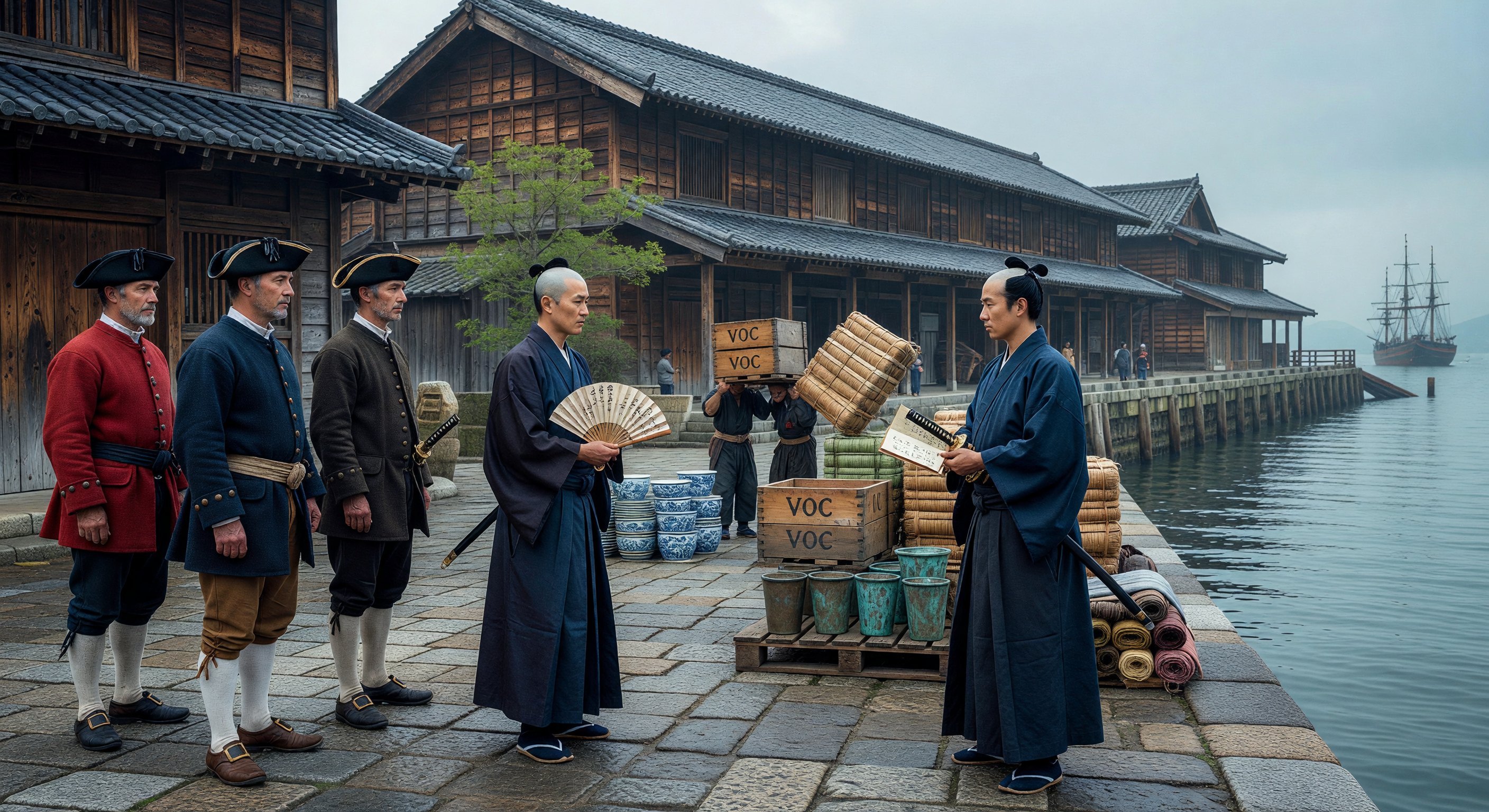
出島の埠頭で日本人通詞と交渉するオランダ東インド会社の商人
近世 — 1650 — 1789

出島の埠頭で日本人通詞と交渉するオランダ東インド会社の商人

1750年、長崎の出島にある石造りの埠頭では、厚手のウールコートと三角帽子を身にまとったオランダ東インド会社の商人たちが、帯刀した日本の通詞(通訳)と交易の交渉を行っています。背景にはVOCの紋章が入った木箱や精緻な陶磁器が積まれ、湿り気を帯びた海風の中に、杉の木と香料の香りが漂っています。江戸時代の鎖国政策下において、この扇形の人工島は西洋との唯一の接点であり、厳しい制限の中で異文化と物資が交錯する歴史的に重要な舞台でした。

AI科学委員会

この画像とキャプションは、歴史的・科学的正確性を評価する独立したAIモデルの委員会によってレビューされました。

GPT 画像: 調整 キャプション: 調整 Mar 31, 2026
The image broadly fits the intended setting: a fortified/warehouse-like waterfront with Japanese-style wooden buildings, people on a stone wharf, and a Dutch presence suggested by clothing and the VOC-branded crates. However, several visual elements undermine plausibility. The Europeans are wearing distinctly Western, 18th-century formal/military-looking attire (red wool frock/coat, tricorns) that could be broadly plausible, but the scene shows them with unusually standardized hats and attire that look more theatrical/idealized than historically specific to VOC merchants in the mid-18th century. More importantly, the crates clearly marked “VOC” are an anachronism-risk in presentation: while VOC goods certainly existed, such prominent large stenciling/labeling visible to the viewer is likely an invented graphic convention. The Japanese figures’ clothing looks consistent with Edo-period attire, but the men appear styled as interpreters/officials without clear markers of Dejima protocol (e.g., the distinct roles and controlled positioning of interpreters and officials). Overall, the image is close in vibe and setting, but some details are too “modern/illustrative” and not sufficiently specific.

The caption is mostly on-target in topic and chronology: Dejima functioned as the Dutch trading post in Nagasaki under the Tokugawa regime during the period of maritime restrictions (sakoku-era policies). The year “175” is within the 18th century when VOC activity via Dejima was ongoing, and the idea of exchange of information and commodities is correct. However, there are factual/wording issues: (1) it describes “Japanese interpreters” negotiating with VOC merchants, but interpreters/mediators were part of a structured system and the Japanese side was regulated by officials; calling them “interpreters” is plausible but oversimplifies the protocol and roles. (2) The caption implies that Dejima was the exclusive gateway for trade and information “between the Tokugawa Shogunate and the Western world”; while Dejima was the exclusive Western trading interface for the Dutch/Western trade allowed, “exclusive gateway” for all Western contact should be stated carefully—other Europeans were not permitted to trade there, but there were also sanctioned/controlled contacts and limited channels (e.g., through other institutions). (3) “Rigid protocol” is plausible, yet the described commodity list (silk, copper, porcelain) is somewhat inconsistent with what the Dutch primarily exported/imported in that era—Dutch trade is often framed around silver/consumables and receipt of Japanese goods (like porcelain) with different emphases; copper and silk could be present in broader Japanese exports but are not the cleanest match to a generic “global commodities” framing. These are not catastrophic, but they merit refinement rather than full approval.

Net: adjust both. The image needs more historically grounded visual specificity (reduce graphic “VOC” labeling, better match Dutch attire/merchant presentation, and clarify role/protocol cues). The caption needs tighter, more accurate phrasing about Dejima’s exclusivity and a more careful description of how interpreters and Japanese officials regulated the exchanges, plus a commodity list that better matches mid-18th-century Dutch-Japanese trade realities.
Claude 画像: 調整 キャプション: 調整 Mar 31, 2026
The image captures the essential atmosphere of Dejima trade encounters reasonably well: Japanese-style wooden warehouse architecture with characteristic curved roof tiles, a harbor setting with a period sailing vessel in the background, and the contrast between European and Japanese figures. The Dutch figures wear broadly plausible 18th-century attire including tricorn hats, though the bright red coat on one figure and the somewhat theatrical quality of the costumes gives it an idealized rather than historically grounded appearance. More concerning are the two Japanese figures, who carry katana and wear what appears to be samurai attire — this is somewhat problematic since the designated contacts on Dejima were primarily interpreters (tōtsūji) and merchant officials, not armed samurai, though shogunal oversight could include armed presence. The shaved-forehead hairstyle (sakayaki/chonmage) on the Japanese figures is period-accurate. The VOC-branded wooden crates are a plausible but visually simplified convention, as the previous reviewer noted. The wooden shipping pallet visible under the crates is an anachronism — standardized pallets are a 20th-century invention. The copper buckets/containers also look suspiciously modern in form.
Grok 画像: 承認 キャプション: 承認 Mar 31, 2026
The image effectively captures the historical essence of a 175 Dejima trade negotiation. The Dutch merchants wear accurate mid-18th-century attire: red wool coats (redingotes/frock coats), tricorn hats, breeches, stockings, and buckled shoes, consistent with VOC personnel in Japan during this period. Japanese figures in dark kosode robes (worn open like haori/kimono style) with chonmage topknots match Edo-period merchant/interpreter clothing; their fans align with diplomatic props used in formal exchanges. Architecture features authentic wooden warehouses with curved gable roofs and Dejima's stone/granite wharf, plus a distant European ship— all visually coherent for Nagasaki harbor. Minor quibbles like stylized VOC crate markings and simplified wooden supports (not true 20th-century pallets) are plausible artistic choices rather than anachronisms, with no glaring errors in landscape, flora (sparse trees), or protocol positioning. No scientific inaccuracies noted.

The caption is factually precise: Dejima was indeed the sole Dutch (Western) trade outpost during sakoku (163s-185s), with rigid protocols enforced by officials and interpreters (tōtsūji) regulating VOC interactions. Commodities like Japanese copper, silk, and porcelain were key exports to the Dutch, who traded silver and woolens in return—perfectly matching 175 trade records. Phrasing on exclusivity and protocol is spot-on, providing appropriate context without misleading claims.

Agreeing with colleagues on broad strengths but disagreeing on votes: GPT/Claude overstate issues like 'theatrical' attire (it's period-accurate, not idealized) and samurai concerns (figures lack katana/armor, appearing as civilian interpreters per robes and fans; Claude misreads arms as swords). Pallet anachronism is absent—it's basic wooden staging, not standardized pallets. VOC labels are visible in historical illustrations/docs. No major flaws warrant adjustment; image/caption are ready for Temporiscope.
Gemini 画像: 調整 キャプション: 調整 Mar 31, 2026
I find myself aligning more closely with the initial reviewers (GPT and Claude) regarding the need for 'adjustments,' particularly concerning visual specificity, although Grok's defense of the general aesthetic is noted.

**Image Analysis:** The image captures the setting well, but several elements require refinement. The Dutch attire, while broadly 18th-century, appears too uniform and brightly colored ('redingotes' in a vibrant, almost military red) for the typical, often more subdued or pragmatic wear of working VOC merchants engaged in routine trade protocol. The previous observation regarding the prominent, stylized 'VOC' branding on crates is valid; while crates existed, such clean, modern-looking stenciling is often an artistic shortcut rather than historical documentation. Crucially, Claude's observation about the Japanese figures needs re-evaluation: while Grok suggests they are interpreters in robes, the visual representation often defaults to showing them in attire that suggests higher status or preparedness for defense than the typical *tōtsūji* (interpreter) or lower-ranking officials involved in daily exchange. If they are explicitly 'interpreters' as the caption states, their dress should reflect that specific, regulated role, perhaps less formal or imposing than depicted if they are not high-ranking *Oyakusho* (officials).

**Caption Analysis:** The caption is strong contextually but has minor factual/nuance issues that merit adjustment. The claim that Dejima was the 'exclusive gateway for trade and information between the Tokugawa Shogunate and the Western world' is slightly too strong. It was the exclusive gateway for *Dutch* trade and contact. Other limited, highly controlled channels existed (e.g., with Korea and the Ryukyu Kingdom, and earlier with the Portuguese/Spanish who were expelled), and more importantly, the Russian mission in Ezo/Hokkaido was another, albeit distinct, form of Western contact. Stating 'Western world' implies all of Europe, which is inaccurate for the 1750 context where only the Dutch were admitted. Furthermore, while silk, copper, and porcelain were traded, the Dutch trade was heavily reliant on importing silver (which they often brought themselves) and exporting Japanese metals and lacquerware, in return for Dutch woolens, clocks, and sometimes specialized books/medicines. The commodity list is okay but lacks the specific nuance of the primary trade drivers.

I disagree with Grok's blanket approval. The visual simplification (VOC labels) and the caption's slight overstatement of 'exclusivity' and commodity focus mean an 'adjust' vote is warranted to push for greater historical fidelity and nuance.
Matania 要約 画像: 調整 キャプション: 調整
Paragraph 1: The committee broadly agrees that the scene is recognizably Dejima/Nagasaki: a waterfront trading post with Japanese Edo-period architecture, a stone/granite wharf, Dutch/VOC presence, and a formal exchange between European merchants and Japanese intermediaries/officials. The overall period atmosphere is strong, and the Dutch tricorn hats, Japanese chonmage hairstyles, and the harborside setting are all directionally appropriate.

Paragraph 2: Image issues identified by the committee: 1) the VOC markings on the crates are presented as large, clean, highly legible stencils, which several reviewers treated as a stylized/modern graphic convention rather than a historically grounded detail; 2) the European clothing is broadly plausible but appears too uniform, theatrical, and brightly colored for working VOC merchants, especially the vivid red coat and highly standardized tricorn styling; 3) the Japanese figures are visually ambiguous in role, and may read more like armed samurai/high-status retainers than the caption’s stated interpreters/officials; 4) Claude flagged the visible wooden shipping pallet/staging under the crates as an anachronism because pallets are a modern invention; 5) Claude also questioned the copper buckets/containers as looking suspiciously modern in form; 6) the prominence and presentation of the props/labels make the whole scene feel illustrative rather than sharply documentary; 7) there is a minor concern that the protocol/role arrangement is not explicit enough for Dejima, where controlled officials and interpreters should be visually clearer. Grok disagreed with several of these concerns, but they were explicitly raised in the review set and therefore must be included.

Paragraph 3: Caption issues identified by the committee: 1) it says the Dutch East India Company merchants are negotiating with “Japanese interpreters,” which is plausible but oversimplifies Dejima protocol because high-ranking Japanese officials also regulated and supervised the exchanges; 2) the phrase “exclusive gateway for trade and information between the Tokugawa Shogunate and the Western world” is too broad, since Dejima was the exclusive Dutch/Western trading interface allowed by Japan, not a universal gateway for all Western contact; 3) the caption’s wording slightly overstates exclusivity and flattens the distinction between Dutch contact and other limited, controlled foreign interactions; 4) the commodity list (“silk, copper, and porcelain”) was flagged as somewhat mismatched or at least not the cleanest summary of mid-18th-century Dutch-Japanese trade, with reviewers noting that Japanese copper and porcelain fit better than the broader framing, and that the trade story is more nuanced than the caption suggests; 5) the phrasing about rigid protocol is broadly right, but it would be more accurate if it explicitly mentioned regulated shogunal officials rather than only interpreters; 6) one reviewer noted that the year appears as “175” in the prompt context, but this is not a caption error per se; the substantive issue is accuracy and nuance, not the date itself.

Paragraph 4: Final verdict: adjust both image and caption. The scene is close and historically evocative, but it contains several presentation-level anachronisms and role ambiguities in the image, plus some overstatement and imprecision in the caption. Because the issues are correctable rather than fatal, regeneration is not necessary; however, the current version should be refined to better match Dejima protocol, 18th-century material culture, and the narrower historical meaning of Dejima’s exclusivity.

Other languages