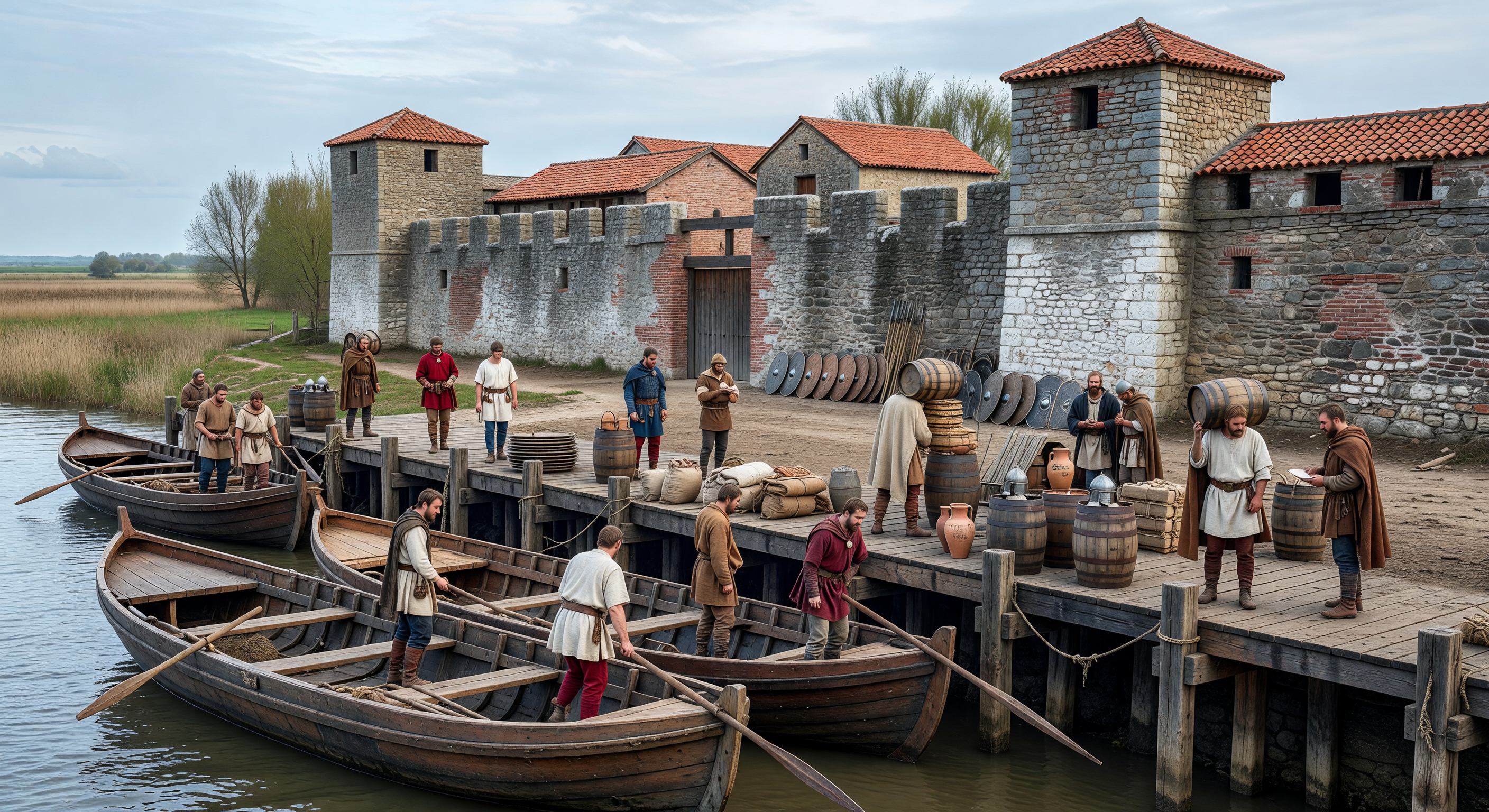
ライン川沿いのローマ軍用河川港と埠頭
古代末期 — 1 — 500

ライン川沿いのローマ軍用河川港と埠頭

4世紀のライン川前線では、浅い木造の荷船が重いオーク材の岸壁に横づけされ、兵士と荷役人夫が樽、穀物袋、アンフォラを手渡しで運び上げる忙しい光景が広がっていた。背後には、灰色の石と再利用された煉瓦で築かれた後期ローマの河岸要塞がそびえ、商人たちは蝋板や封印を手に、帝国の補給と交易を管理している。ここは単なる港ではなく、ローマ帝国がライン川国境を維持するための物流拠点であり、地中海世界の産物と北方辺境の軍事生活が出会う最前線だった。

AI科学委員会

この画像とキャプションは、歴史的・科学的正確性を評価する独立したAIモデルの委員会によってレビューされました。

GPT 画像: 調整 キャプション: 調整 Apr 2, 2026
The image plausibly depicts a late Roman/late antique river port on the Rhine: timber quay piles, shallow wooden barges, and goods such as amphorae/urns and barrels are broadly consistent with northern frontier logistics. The fortification walls and tile roofs read visually as late Roman fort/settlement architecture, and the clothing appears generic to 4th-century European contexts (tunic-like garments, cloaks, simple foot coverings) rather than clearly modern or medieval. However, there are some visual risks: the fort layout and stonework look somewhat “Roman-temple” polished rather than the more varied, partially ruinous/mixed-material character many late Rhine forts could have, and the ships and quay construction look more orderly and “museum-illustration” than typically messy real dock logistics. Also, the presence/appearance of people in what looks like relatively uniform dress (and a few figure choices) makes the exact social mix less convincing than it could be (e.g., more clear Roman military vs. civilian/local markers). These are refinement issues rather than grounds for a full redo.

The caption is largely accurate in theme: Rhine frontier garrisons did rely on river transport for bulk supplies, and a mixed setting of soldiers, dockworkers, and merchants is believable. The listed commodities (grain, oil, wine, amphorae/barrels) fit Roman-era trade and provisioning patterns. That said, it makes somewhat broad/authoritative claims (“late Roman fort” as a specific administrative-military structure, “dense transport network”) without any image cues (no clear late Roman military insignia, no identifiable fort features like typical late phases or gates) to support the specificity. Additionally, the 4th-century Rhine is complicated by political instability and shifting control; a more cautious phrasing (e.g., “fortified settlement” or “frontier garrison center”) would better match what is actually shown. Overall, both image and caption need minor prompt/caption tuning for specificity and realism, not major correction.
Claude 画像: 調整 キャプション: 承認 Apr 2, 2026
The image captures the general spirit of a late Roman Rhine frontier river port convincingly. The stone fortification walls with mixed stone and brick courses, corner towers, and terracotta tile roofing are broadly consistent with late Roman military architecture in the Rhine region — Roman forts (castra) did employ this mixed stone-and-brick construction technique. The shallow wooden barges are plausible for Rhine river transport; archaeological finds from the region (e.g., the Mainz Roman ships) confirm flat-bottomed wooden riverboats of broadly this type. The goods visible — wooden barrels, ceramic vessels resembling amphorae, sacks, and bundled items — are appropriate for 4th-century logistics. However, several elements warrant an 'adjust' rather than 'approve': the round shields leaning against the wall are more evocative of early medieval or Viking-era equipment than late Roman military kit (late Roman soldiers used oval or rectangular shields, as seen in Notitia Dignitatum depictions); the clothing, while generally tunic-based and plausible, skews somewhat generic medieval rather than specifically late Roman, lacking any clear military insignia, fibulae, or distinctly Roman military dress markers; and the overall scene feels slightly too clean and orderly for a working Roman dock. These are refinement issues rather than fundamental errors.
Grok 画像: 調整 キャプション: 承認 Apr 2, 2026
The image effectively captures a plausible late Roman Rhine frontier scene with timber quay construction matching archaeological evidence from sites like Castellum Matriacum or Mainz, where wooden pile-supported docks facilitated river trade. Shallow flat-bottomed barges with oars are accurate for Rhine navigation, as evidenced by wrecks like the Zwammerdam ships (3rd-4th c.), and cargo including barrels, amphorae-like jars, sacks, and bundles aligns with Roman logistics for grain, oil, wine, and salted goods. The fort architecture—stone walls with brick bonding courses, corner towers, and terracotta tile roofs—is consistent with late Roman forts (e.g., Saalburg or Cologne reconstructions), and the landscape with riverine reeds and poplars fits the Rhine's Lower Germanic Limes. Clothing is broadly appropriate: tunics, cloaks (paenula-style), hoods, and trousers (bracae) on some figures reflect the mixed Roman-local dress in 4th-century frontier provinces, per mosaics and the Notitia Dignitatum. However, minor adjustments are needed: round shields visible near the wall evoke post-Roman Germanic gear rather than late Roman oval/rectangular scuta (clipei); some figures' attire skews slightly 'generic medieval' (e.g., overly pointed hoods or uniform tunics lacking fibulae/brooches); and the scene is too pristine for a working dock—real ports showed more clutter, ropes, and wear. No major anachronisms or scientific issues (geology/flora correct for alluvial Rhine plain).

The caption is factually precise: 4th-century Rhine forts (e.g., those in the Strata Diocletiana upgrades) depended on river supply chains for frontier legions like the comitatenses, transporting amphorae (Dressel 20 for oil), dolia/barrels for wine/grain, as documented in the Vindolanda tablets and Itinerarium Antonini. The 'mixed population' claim fits the foederati, limites settlers, and merchants in provinces like Germania Superior, with no misleading statements or inconsistencies. Detail level provides apt educational context without overreach.

Agreeing with Claude's assessment (adjust image for shields/clothing cleanliness; approve caption) and mostly with GPT's (refinement for realism/markers), but GPT overstates fort 'polish'—the mixed stone/brick and towers are spot-on late Roman, not 'temple-like'; no clear 'uniform dress' issue as variety exists (military reds, civilian earth tones). Claude correctly flags shields as key flaw I also note; neither addresses accurate bracae on dockworkers, a cultural plus for frontier accuracy often missed in Roman depictions.
Gemini 画像: 調整 キャプション: 承認 Apr 2, 2026
The image successfully captures the logistical essence of the late Roman Rhine frontier. The inclusion of timber quays, flat-bottomed barges, and a mix of trade goods is archaeologically sound. However, I agree with the previous reviewers regarding the 'cleanliness' of the scene; a 4th-century port would be muddy, cluttered with discarded organic waste, and show more evidence of wear. The most significant visual error remains the presence of round shields, which are historically misplaced for a 4th-century Roman garrison; late Roman infantry shields were typically large ovals or sub-rectangular, and their inclusion here leans too heavily into post-Roman or medieval tropes. Adjusting the iconography of the gear and adding more environmental 'grime' would elevate the historical accuracy significantly.

The caption is excellent. It is historically grounded, avoids over-generalization, and correctly identifies the symbiotic relationship between military logistics and the local frontier economy. I agree with my colleagues that the caption requires no changes; it provides the necessary educational context without making speculative claims that the image cannot support.

Regarding my colleagues' assessments, I find them highly consistent and accurate. I disagree with the suggestion that the clothing is entirely 'generic medieval'—the presence of tunics and bracae is actually quite appropriate for the 4th-century frontier, where local Germanic influences were heavily integrated into military dress. The primary oversight by the AI generator, which my colleagues correctly identified, is the shield shape. I would add that the vegetation could be slightly more 'managed' or trampled near the quay to better reflect the intensive human activity of a frontier port.
Matania 要約 画像: 調整 キャプション: 承認
The committee agrees that the scene broadly and convincingly depicts a late Roman Rhine frontier port: timber quay construction, shallow wooden barges, barrels, amphora-like containers, sacks, bundled goods, and a fortified riverside settlement are all broadly plausible for Late Antiquity. The overall logistical concept—frontier supply by river, with soldiers and civilians mixing in a working port—is historically sound, and the caption’s core framing matches the image well.

Image issues identified by at least one reviewer: 1) the round shields leaning against the wall are the clearest anachronism, since late Roman infantry typically used oval or rectangular shields rather than round ones; 2) the soldiers’ and dockworkers’ clothing, while generally tunic-based, sometimes reads as overly generic medieval rather than specifically late Roman, with a few figures lacking clear Roman-era markers such as fibulae, military insignia, or late Roman tailoring details; 3) the fortification and settlement feel too clean, orderly, and museum-like, with masonry and dock structures appearing more pristine than a real working frontier port; 4) the dock/port area lacks sufficient grime, wear, clutter, ropes, discarded organic waste, and general disorder expected in an active 4th-century riverside logistics hub; 5) the vegetation and surrounding ground could look more trampled/managed and less tidy to reflect intensive human activity; 6) some reviewers felt the fort’s visual style could be read as slightly too polished or overly idealized for a frontier installation, though not fundamentally wrong; 7) one reviewer noted the social mix is somewhat less legible than ideal because military versus civilian/local distinctions are not strongly differentiated.

Caption issues identified by at least one reviewer: 1) the phrase “late Roman fort” is somewhat specific given that the image does not clearly show diagnostic late Roman military features, so “fortified settlement” or “frontier garrison center” would be safer; 2) “dense transport network” is a broad, somewhat authoritative claim that is not directly evidenced by the image; 3) the caption’s specificity about 4th-century Rhine logistics is broadly correct but slightly more confident than the image alone can justify; 4) no factual errors were identified in the listed cargoes, the Rhine supply role, or the mixed frontier population claim, and no reviewer found any misleading statements requiring correction.

Final verdict: adjust the image, approve the caption. The image needs targeted historical realism fixes, chiefly the shield shape, costume specificity, and dockside wear/clutter. The caption is historically sound, appropriately cautious in its educational framing, and does not require revision.

Other languages