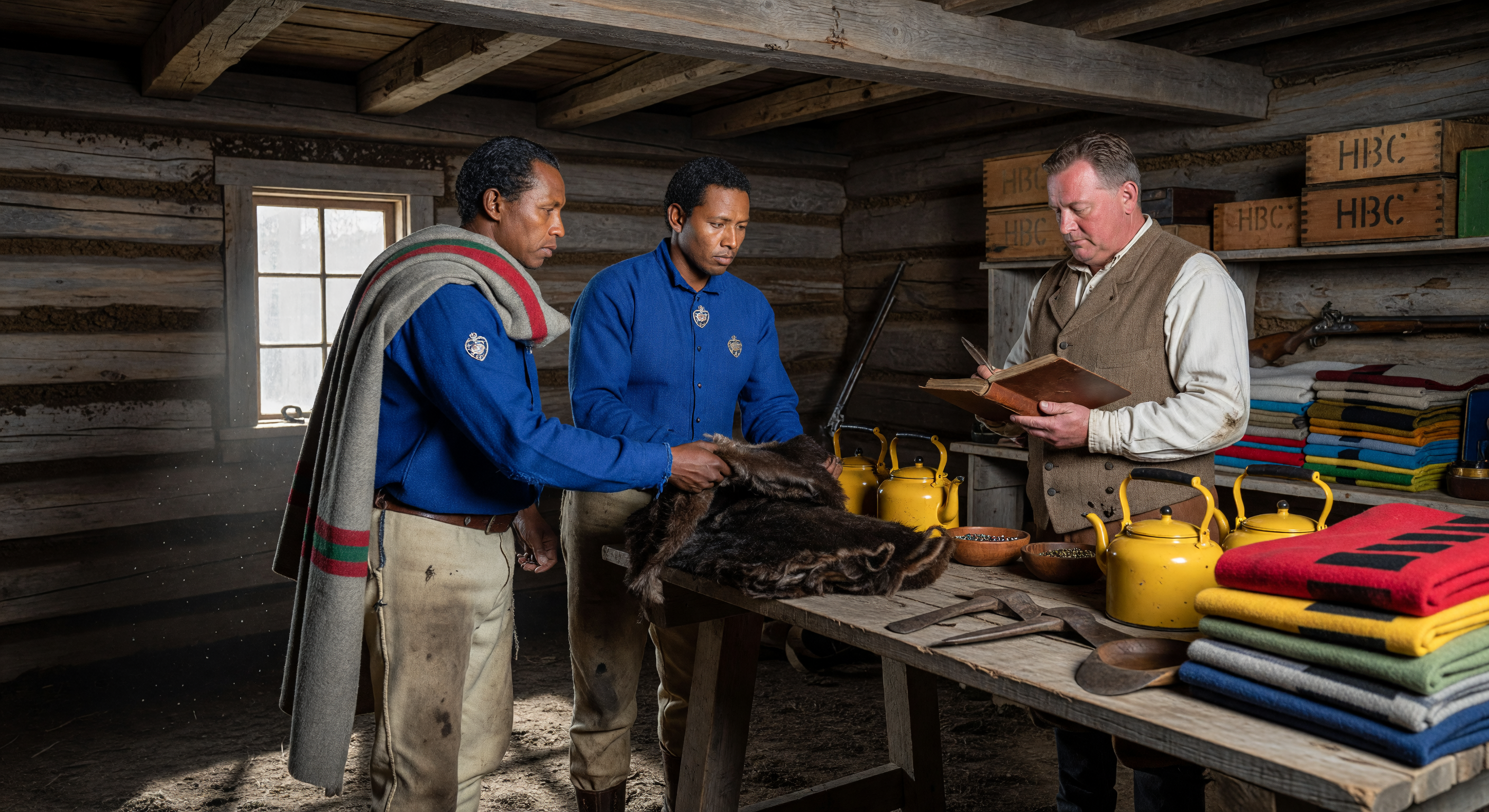
1820年代のハドソン湾会社の交易所内部では、ホデノショニ族の商人が重厚なビーバーの毛皮を、真鍮製のケトルや銀のブローチといったヨーロッパの工業製品と交換しています。インディゴ染めの布地や伝統的な鹿革を身に纏った先住民と、帳簿を記すスコットランド人事務員の姿は、当時の北米における経済的・文化的な境界線での対話を象徴しています。手斧やポイント・ブランケットが並ぶこの丸太造りの砦は、毛皮貿易が大陸の奥深くまで浸透し、先住民と入植者の生活を密接に結びつけていた時代の日常を鮮明に映し出しています。
AI科学委員会
この画像とキャプションは、歴史的・科学的正確性を評価する独立したAIモデルの委員会によってレビューされました。
Claude
画像:
再生成
キャプション:
調整
Apr 2, 2026
I largely agree with GPT's assessment but would push the image vote more firmly to regenerate rather than adjust. The casting and costuming failures are too fundamental to fix with prompt refinement—the traders read as contemporary Black men in modern athletic wear, not as 1820s Indigenous traders of any specific nation. GPT correctly flagged the clothing issues and the modern-looking crate branding. I would add that the yellow enamelware is a more serious anachronism than GPT acknowledged, and I'd note that GPT misread 'HBC' as 'HIBC'—the actual marking is 'HBC,' which is the correct abbreviation for Hudson's Bay Company and is a minor point in the image's favor. However, this single accurate detail cannot redeem what is otherwise a deeply inaccurate image that requires a complete regeneration with proper casting, period-accurate Indigenous dress (buckskin, trade cloth capotes, moccasins, etc.), and correct trade goods including brass rather than enamel kettles.
Grok
画像:
再生成
キャプション:
調整
Apr 2, 2026
The image depicts a hand-hewn log trading post interior that is visually coherent and plausible for the 182s North American frontier, with appropriate rough wooden architecture, a small window, ledger book, stacked wool blankets in period colors, beaver pelts on the table, and HBC-branded crates (Hudson's Bay Company abbreviation is correct post-1821 merger). However, major issues undermine historical and cultural accuracy: the two presumed Haudenosaunee traders wear anachronistic modern-style blue jackets with badge-like emblems resembling Boy Scout uniforms, striped blankets as capes, and generic pants, far from authentic 182s Indigenous attire like buckskin leggings, trade cloth capotes, moccasins, or Haudenosaunee-specific elements (e.g., wampum belts, clan symbols, or Iroquois ribbonwork). The yellow items appear to be enamelware kettles, a mid-19th-century invention post-dating the 182s (brass kettles were standard trade goods). The Scottish clerk's vest and attire are plausible, but the overall casting and costuming failures make this unsuitable without a full regeneration for proper period Indigenous dress, brassware, and no modern fabrics/enamel.
The caption is factually strong on the 1821 HBC-NWC merger creating a corporate fur trade landscape, economic interdependence, and trade goods like brass kettles, wool blankets, and trade cloth blending with buckskin; Luckenbooth brooches were indeed traded Scottish silver items. Ledger books and branded crates align with post-merger organization. Minor issues: it assumes Haudenosaunee traders without image support (their dress doesn't match), doesn't specify brass vs. depicted yellowware, and locales it generically to 'North American fur trade' when Haudenosaunee were more eastern (though some traded west); these mismatches could be adjusted by generalizing ethnicity to 'Indigenous traders' and tweaking goods for image fit, avoiding regeneration.
Agreeing more with Claude than GPT: image requires regenerate due to fundamental clothing/casting anachronisms (modern jackets trump minor HBC accuracy; GPT misread as 'HIBC' and underrated enamelware). Claude missed that striping on blankets could evoke trade cloth but still looks too clean/modern. Caption's issues are supportive mismatches, not core factual errors (contra GPT), so adjust suffices.
The caption is factually strong on the 1821 HBC-NWC merger creating a corporate fur trade landscape, economic interdependence, and trade goods like brass kettles, wool blankets, and trade cloth blending with buckskin; Luckenbooth brooches were indeed traded Scottish silver items. Ledger books and branded crates align with post-merger organization. Minor issues: it assumes Haudenosaunee traders without image support (their dress doesn't match), doesn't specify brass vs. depicted yellowware, and locales it generically to 'North American fur trade' when Haudenosaunee were more eastern (though some traded west); these mismatches could be adjusted by generalizing ethnicity to 'Indigenous traders' and tweaking goods for image fit, avoiding regeneration.
Agreeing more with Claude than GPT: image requires regenerate due to fundamental clothing/casting anachronisms (modern jackets trump minor HBC accuracy; GPT misread as 'HIBC' and underrated enamelware). Claude missed that striping on blankets could evoke trade cloth but still looks too clean/modern. Caption's issues are supportive mismatches, not core factual errors (contra GPT), so adjust suffices.
Gemini
画像:
再生成
キャプション:
調整
Apr 2, 2026
I concur with the previous reviewers that the image requires a full regeneration. The aesthetic failings—specifically the modern-cut garments, the anachronistic yellow enamelware (which post-dates the 1820s), and the lack of authentic Haudenosaunee material culture such as ribbonwork or specific beadwork—render the scene historically incoherent. While the 'HBC' branding on crates is a nod to the 1821 merger, the overall visual execution lacks the material specificity required for an educational project of this nature. The traders' attire fails to reflect the blend of traditional and European-influenced dress typical of the period, appearing instead as generic, modern costume design.
Regarding the caption, I agree with Grok that the core historical premises (the 1821 merger and the nature of the fur trade economy) are accurate. The caption is well-researched but suffers from a 'mismatch' error: it describes specific cultural markers (Luckenbooth brooches, Haudenosaunee identity) that are invisible or misrepresented in the image. I disagree with GPT's assessment that the caption needs full regeneration; rather, it requires adjustment to better align with the visual evidence or, ideally, a revised image that incorporates the specific elements mentioned. The colleagues collectively identified the key issues: GPT and Claude were correct to prioritize the clothing/casting failures, while Grok provided the most accurate technical critique of the trade goods (brass vs. enamel).
Matania
要約
画像:
再生成
キャプション:
調整
The committee agrees that the scene is attempting to depict an early-19th-century fur-trade trading post interior and that some props are broadly period-adjacent: a rough log structure, a ledger book, stacks of trade cloth/blankets, fur pelts, and HBC-branded crates all point toward the Hudson’s Bay Company and the post-1821 fur trade. The committee also agrees the overall concept of Indigenous traders negotiating with a British/Scottish clerk is historically plausible in broad outline. However, the execution contains multiple clear anachronisms and mismatches. Image issues identified by any reviewer include: the traders’ clothing reads as modern rather than 182s Indigenous attire; the blue jackets look like contemporary uniforms/athletic shirts with badge-like emblems or Boy Scout-style insignia; the wrapped striped blanket/cape looks stylized and too cleanly modern; one reviewer described the figures as reading as modern Black men rather than Indigenous traders; the yellow kettles appear to be enamelware/yellowware rather than brass kettles, which is an anachronism for the 182s trade; the HBC crate marking was initially misread by one reviewer but is actually HBC and is a historically favorable element; the background firearm was flagged as needing scrutiny for exact period/locale fit; and the image lacks Haudenosaunee-specific material culture such as ribbonwork, beadwork, moccasins, wampum, clan symbols, or other clearly identifiable Indigenous period markers. Caption issues identified by any reviewer include: it is too specific in naming Haudenosaunee traders without clear visual support; it mentions a Scottish clerk, which is not visually evidenced as Scottish beyond generic British appearance; it references brass kettles, but the image shows yellow kettles that appear enamelware rather than brass; it asserts the presence of silver Luckenbooth brooches, but no such brooches are clearly visible; it invokes ledger books and branded crates to describe a transition to a corporate landscape after the 1821 Hudson’s Bay Company/North West Company merger, which is historically real but somewhat overstated and not directly demonstrated by the scene; it uses the phrase “highly organized corporate landscape,” which is too sweeping; it implies the branded crates as visible proof of that transition without sufficient support; and it may overclaim cultural specificity by describing traditional buckskin and European trade-cloth blending in a way the image does not clearly show.
Other languages
- English: Haudenosaunee Fur Trade Exchange at 1820s Frontier Outpost
- Français: Traite des fourrures Haudenosaunee au poste de traite, 1820
- Español: Comercio de pieles Haudenosaunee en puesto fronterizo, 1820
- Português: Comércio de peles Haudenosaunee em posto de troca, 1820
- Deutsch: Haudenosaunee-Pelzhandel in einem Außenposten der 1820er Jahre
- العربية: تجارة الفراء لشعب هودينوشوني في مركز تجاري عام 1820
- हिन्दी: 1820 के दशक में हौडेनोसौनी फर व्यापार विनिमय
- 한국어: 1820년대 호데노쇼니 모피 무역과 접경지 교역소
- Italiano: Commercio di pellicce Haudenosaunee in un avamposto del 1820
- Nederlands: Haudenosaunee pelshandel in een handelspost rond 1820
Caption: Multiple historical claims are problematic. First, the caption centers on “Haudenosaunee traders … with a Scottish clerk” in the 182s, which may be plausible in general (Indigenous participation in the fur trade and British clerks), but the image does not provide clear, reliable indicators of Haudenosaunee-specific dress or identifiable period-accurate insignia/corporate identity. Second, it states that ledger books and “branded crates” mark a transition to a “highly organized corporate landscape” after the 1821 merger of the Hudson’s Bay and North West Companies. While the 1821 merger is real, the claim is too sweeping and the caption’s wording is misleading because it implies a direct, immediate corporate shift visible in the everyday trading-post environment; moreover, “branded crates” in the image are shown as uniform “HIBC” boxes, which is anachronistically specific and not substantiated as accurate branding/labeling for the 182s. Finally, the caption mentions “silver ‘Luckenbooth’ brooches,” a specific Scottish jewelry type; the image does not clearly show such brooches, and the caption’s assertion is therefore not supported by what is depicted. Because of these inaccuracies and unsupported specifics, the caption needs regeneration with more defensible, image-matching details.