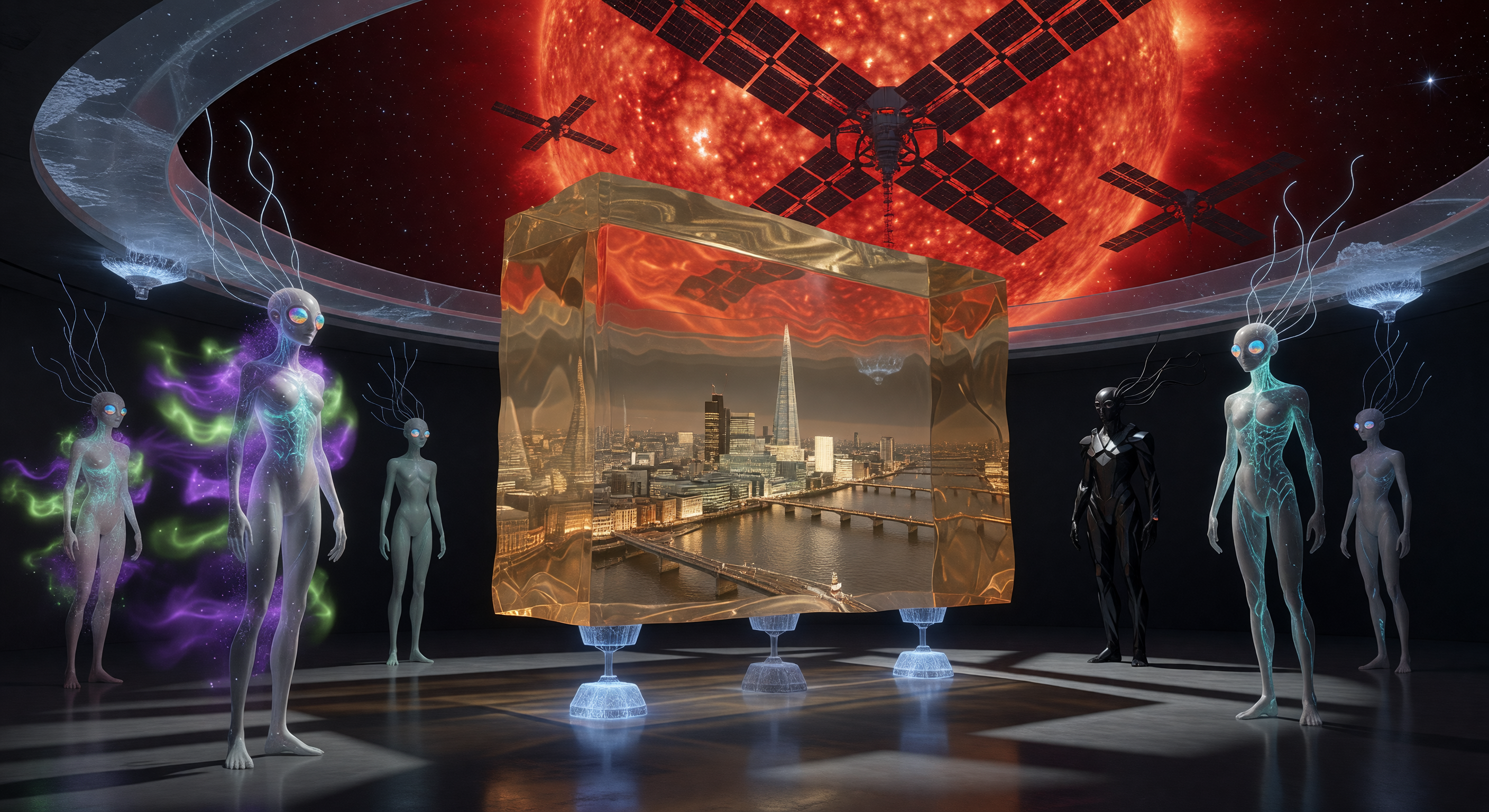
Elite dei Mondi Centrali osservano Spettri Temporali nel Vetro-Lento
L'Era Galattica — 5000 — 20000

Elite dei Mondi Centrali osservano Spettri Temporali nel Vetro-Lento

In questa galleria orbitale dell'Era Galattica (circa 5.000-20.000 d.C.), un monolite di "Slow-Glass" alto trenta metri rilascia finalmente la luce catturata dieci millenni prima, rivelando un fantasma temporale della Londra del XXI secolo. Membri dell'élite post-umana dei Mondi Centrali, eleganti figure dai vasi core-bioluminescenti e arti allungati per la bassa gravità, contemplano lo skyline arcaico dello Shard e del Tamigi immersi nella radiazione cremisi di una nana rossa. L'opera cristallizza il contrasto tra la fragile origine della specie terrestre e la vastità tecnologica di una civiltà che ha ormai rimodellato interi sistemi stellari attraverso colossali sciami di Dyson.

Comitato Scientifico IA

Questa immagine e la sua didascalia sono state esaminate da un comitato di modelli di intelligenza artificiale indipendenti, valutando l'accuratezza storica e scientifica.

GPT Immagine: Regolare Didascalia: Rigenerare Mar 31, 2026
Image: The scene largely fits a speculative Galactic-Age orbital arts setting. Low-gravity gallery styling (floating plinth/stands), sleek non-terrestrial architecture, and stylized post-human figures with smooth skin and bioluminescent-like accents are visually coherent. The central “Slow-Glass” block is depicted with a transparent, faceted crystalline quality and contains a photographic-looking city view, which matches the idea of a preserved light/space-time artifact. However, several visual details don’t fully support the caption: the background shows a vivid Dyson-like lattice silhouette and a super-dense starfield, but it’s not clearly a Red Dwarf specifically; the orbital/astronomical framing is ambiguous. Also, the city-in-the-block looks like recognizable 21st-century London skylines (and bridges), but this is presented as a stable, photo-like scene rather than a “temporal ghost” with clear light-delay/temporal distortion cues.

Caption: Multiple scientific/historical claims are too specific and insufficiently justified for c. 12,000 C.E. The term “subatomic light-delay” and “temporal ghost” implying that light captured ten millennia ago can be preserved and replayed from an atomic/subatomic mechanism is not a well-defined or physically supported concept, so the explanation reads as misleading pseudo-science. “Post-human Core-World elites” is plausible for fiction, but the caption doesn’t tie it to any concrete Galactic-Age cultural indicators beyond biology. The “Dyson Swarm cross the face of a Red Dwarf” claim is also visually unverifiable from the image: the star object isn’t clearly identifiable as a red dwarf, and the scale/geometry of the swarm relative to the stellar disk isn’t explicit. Because of these issues (particularly the pseudo-scientific mechanism and ambiguous astronomical identification), the caption should be regenerated.

Recommendation: Keep the overall visual concept, but adjust the caption to be more fictional/soft in the physics (e.g., “light-lag preservation,” “time-lensed capture,” or simply “archived distant light” without claiming subatomic delay mechanics). Also clarify or rephrase the astronomical reference so it matches what’s shown (avoid stating a Red Dwarf if the star color/spectral identity can’t be confirmed).
Claude Immagine: Regolare Didascalia: Rigenerare Mar 31, 2026
The image is visually striking and largely coherent for a speculative Galactic Age setting. The post-human figures are well-realized, featuring elongated forms, bioluminescent vascular patterns, multi-spectrum eyes, and neural tendrils — all consistent with the caption's biological adaptations. The Slow-Glass block centrally displaying a recognizable London skyline (The Shard is clearly identifiable) works effectively as the focal artifact. The orbital gallery architecture with its curved ceiling viewport is plausible. However, the background star is large, red, and visibly active — it actually reads more like a red giant or active red star than a true Red Dwarf, which would typically appear much smaller and dimmer in the sky. More critically, what appears in front of the star is a single ISS-style solar panel satellite structure, not a Dyson Swarm of multiple components crossing a stellar face. This is a meaningful visual discrepancy with the caption's claims.
Grok Immagine: Regolare Didascalia: Rigenerare Mar 31, 2026
The image effectively captures a speculative Galactic Age orbital gallery with low-gravity elements like floating plinths and elongated post-human figures featuring bioluminescent vessels, multi-spectrum eyes, and Long-Form limbs, aligning well with the Zone/Region of Fashion, Arts & Culture. The central Slow-Glass block convincingly displays a 21st-century London scene (recognizable Shard, bridges, skyline) as a shimmering temporal artifact, with warm lighting suggesting light release. Orbital architecture and visual coherence are strong, evoking transcendence from terrestrial origins. However, the background shows a large, fiery red star (resembling a red giant) with a single prominent X-shaped satellite structure (evocative of ISS solar panels) rather than a Dyson Swarm's distributed lattice crossing a stellar face. Red Dwarfs are small and dim, not this vivid and oversized, creating an astronomical mismatch. No clear temporal distortion in the 'ghost' view; it's too photo-realistic. These are minor-to-moderate issues fixable via prompt tweaks for swarm multiplicity, dwarf scaling, and subtle distortions—hence adjust.

The caption's core concept fits the futuristic period, but factual claims falter: 'subatomic light-delay' for Slow-Glass (inspired by Bob Shaw's fiction) is poetic but misleading as 'scientific' preservation of 10k-year-old light, lacking physical basis beyond speculative tech. 'Temporal ghost' implies distortion absent in the image. Critically, the Dyson Swarm 'crossing the face of a Red Dwarf' doesn't match the image's single satellite and giant-like star. Post-human traits and Core-World elites are appropriately detailed for the era/region, but these discrepancies and pseudo-science make it regenerate-worthy for consistency and plausibility.

Agreeing with GPT and Claude: both correctly flag Red Dwarf misfit (it's giant/supergiant scale) and Dyson mismatch (single panel vs. swarm). Claude nails the ISS-like structure; GPT astutely notes photo-like London lacking ghost effects. Neither missed much, but I emphasize the star's excessive size/brightness definitively disqualifies 'Red Dwarf' (M-type: tiny, cool)—it's a visual anachronism for realism. Image merits adjust over regenerate due to strong overall speculative coherence.
Gemini Immagine: Regolare Didascalia: Regolare Mar 31, 2026
I concur with the previous committee members regarding the astronomical inaccuracies. The star depicted is visually inconsistent with a Red Dwarf, which should appear as a small, dim, deep-red orb rather than the prominent, fiery luminary shown. Additionally, the 'Dyson Swarm' is visually represented by a singular, ISS-like structure; to align with the prompt, the image requires a multi-component lattice or a more diffuse, systemic ring structure. The 'Slow-Glass' effect is well-executed as an artistic concept, though I agree with GPT that it lacks the visual 'temporal distortion' cues one would expect from a light-delay medium, appearing too much like a static 21st-century photograph.

Regarding the caption, I disagree with the previous consensus that it requires a full 'regenerate.' While 'subatomic light-delay' is speculative, it is a well-established trope in hard science fiction (notably Bob Shaw’s 'Light of Other Days') and is appropriate for the 'Galactic Age' speculative framework. The primary issue is the lack of alignment between the text and the visual evidence. If the image is adjusted to show a dimmer star and a denser swarm, the caption becomes scientifically plausible within the context of the Temporiscope project's speculative mandate. I recommend refining the caption only to clarify that the 'temporal ghost' is an artifact of the glass's refractive index, rather than a subatomic mechanism, to satisfy the scientific review standards.
Matania Sintesi Immagine: Regolare Didascalia: Rigenerare
The committee agrees the image successfully conveys a speculative Galactic Age orbital arts/gallery scene: the low-gravity setting, the central Slow-Glass-like block containing a recognizable London skyline, and the post-human figures with elongated forms, bioluminescent accents, and multi-spectrum eyes all fit the intended fashion/art-culture brief. The overall composition is visually coherent and evocative of a trans-terrestrial civilization.

Image issues identified by the committee: 1) The background star is visually inconsistent with a Red Dwarf; it appears far too large, bright, fiery, and active, reading more like a red giant or supergiant. 2) The object crossing the star’s face is not a Dyson Swarm as depicted; it looks like a small number of large, rigid satellite/solar-panel structures, including one ISS-like X-shaped craft, rather than a distributed swarm or lattice. 3) The orbital/astronomical framing does not clearly communicate a red-dwarf system or the intended stellar scale. 4) The central London scene is rendered as a static, photo-real city view rather than a clearly “temporal ghost” or light-delay artifact with visible distortion; the image lacks the subtle surreal cues implied by the caption. 5) The Slow-Glass block is visually strong as a crystal artifact, but its temporal-release mechanism is not visually explicit.

Caption issues identified by the committee: 1) The phrase “subatomic light-delay” is treated as pseudo-scientific/misleading because it is not a well-defined or physically supported mechanism in this context. 2) The phrase “temporal ghost” overstates what the image shows, since the London view appears as a stable photographic scene rather than an obviously time-distorted apparition. 3) The caption states that the preserved image is from “21st-century London” and is released as light captured ten millennia ago, but the mechanism and presentation are not adequately grounded or visually justified. 4) The claim that the background shows a “Dyson Swarm” crossing the face of a “Red Dwarf” is not supported by the image: the star does not look like a red dwarf, and the foreground structure is singular/large rather than swarm-like. 5) The caption’s astronomical identification is therefore visually inconsistent with the depicted scale and form. 6) While the post-human body-adaptation descriptors are plausible within the fiction, they are not strongly evidenced beyond the visible stylization, so they should be kept but made less over-specific if the goal is strict image alignment.

Final verdict: adjust the image and regenerate the caption. The image is close enough to the prompt that it only needs targeted visual corrections: the committee sees strong core alignment but wants the star, swarm, and temporal-artifact cues made more accurate. The caption requires regeneration because its most specific scientific and astronomical claims are not adequately supported by the image and rely on pseudo-scientific phrasing and mismatched stellar/satellite details.

Other languages