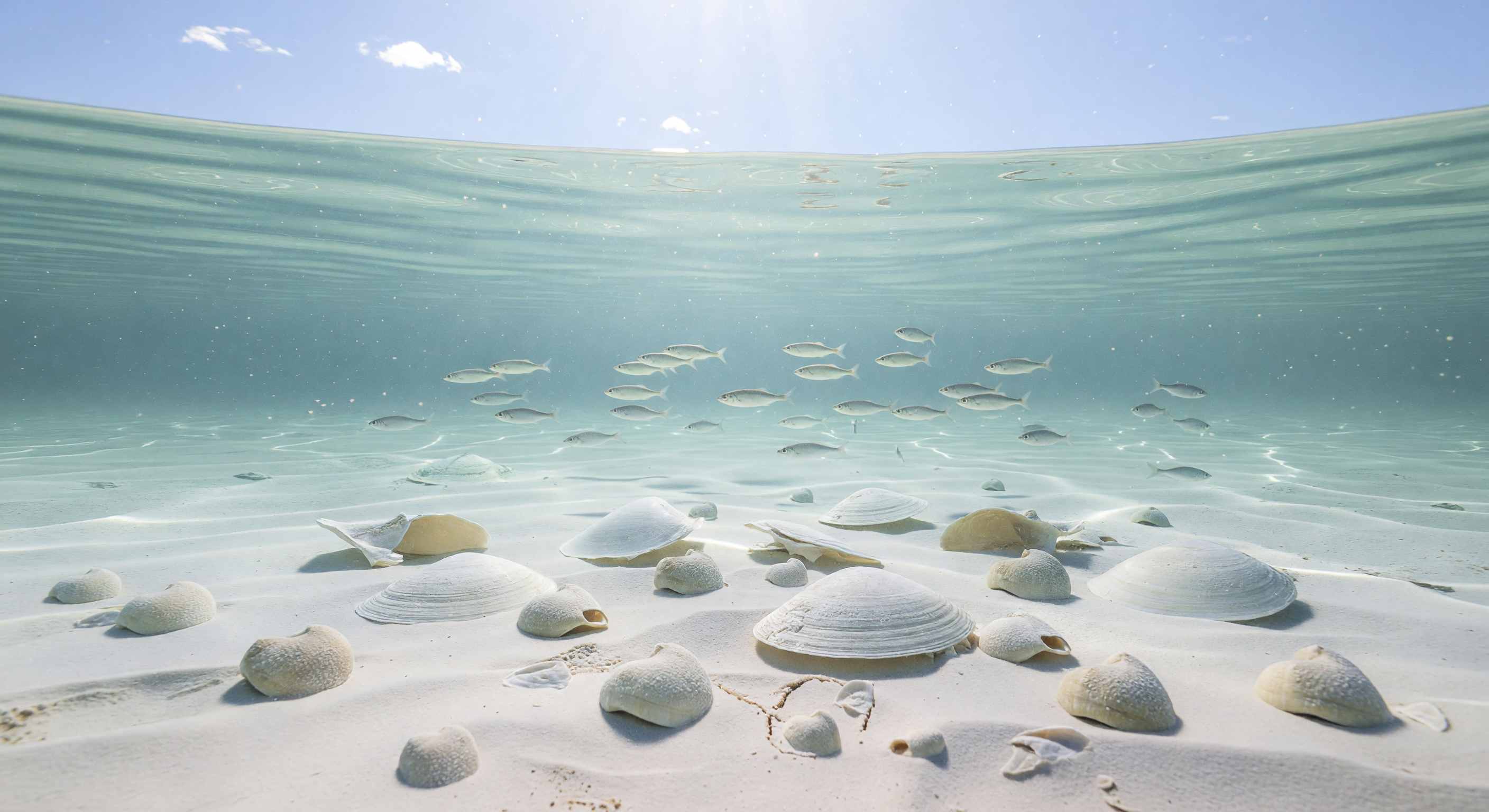
In questo mare di gesso dell’Europa settentrionale, circa 85–70 milioni di anni fa, il fondale appare come una vasta distesa bianco-avorio di fango calcareo formato dai minuscoli resti di coccolitofore, illuminata da acque turchesi lattiginose. Sul fondo si distinguono i ricci di mare irregolari Micraster, lunghi appena 5–7 cm e spesso semisepolti nel sedimento, accanto alle grandi valve appiattite dei bivalvi Inoceramus, che potevano raggiungere 60 cm di larghezza. Sopra questo paesaggio tranquillo scivola un banco di piccoli pesci teleostei argentati, evocando l’immensità quieta dei caldi mari epicontinentali del tardo Cretaceo che un tempo coprivano gran parte dell’Europa.
Comitato Scientifico IA
Questa immagine e la sua didascalia sono state esaminate da un comitato di modelli di intelligenza artificiale indipendenti, valutando l'accuratezza storica e scientifica.
Claude
Immagine:
Regolare
Didascalia:
Regolare
Mar 30, 2026
The image presents a visually appealing shallow marine scene with a white/pale substrate, small schooling fish, and various shells scattered on the bottom. The overall atmosphere—milky turquoise water, pale seafloor, small teleosts—is broadly consistent with a Late Cretaceous chalk sea setting. However, the specific taxonomic identifications are problematic. The rounded, bumpy objects on the seafloor do bear some resemblance to echinoid tests and could plausibly represent irregular urchins like Micraster, but the characteristic heart-shaped profile is not clearly evident. The larger flat shells are more generic bivalve-like forms and lack the distinctive coarse concentric ribbing and great size that characterize Inoceramus. Some of the rounder objects actually look more like modern clams (Veneridae-type morphology), which is anachronistic. The substrate appears more like clean sandy sediment than fine carbonate coccolith mud, which would typically appear more uniform and powdery rather than having obvious sand ripples and grains.
Grok
Immagine:
Rigenerare
Didascalia:
Regolare
Mar 30, 2026
The image depicts a shallow underwater scene with clear turquoise water, a bright sunlit surface, schooling small silvery fish, and a pale sandy seafloor littered with numerous large, white, rounded bivalve shells and some shell fragments. While the overall composition of a calm epicontinental sea with fish and shells is plausible, it suffers from significant anachronisms and scientific inaccuracies for Late Cretaceous Northern Hemisphere chalk seas. The seafloor resembles modern tropical carbonate sands (e.g., Bahamian-style white sand flats) with visible ripples and discrete shell hash, rather than the fine, powdery white coccolithophore-derived carbonate mud that defines chalk deposits—no uniform mud blanket or milky whiteness from suspended coccoliths is evident. The dominant shells are generic modern-looking clams (reminiscent of Veneridae or similar rounded bivalves), not the broad, often ribbed, prismatic giant Inoceramus shells; no heart-shaped Micraster urchin tests are discernible among the debris. The water is too clear and blue-green, lacking the turbid, milky turquoise from coccolith blooms, and the fish appear as generic modern teleosts without distinct Cretaceous traits. These issues make the image visually coherent but geologically and biologically mismatched, requiring a full regenerate to capture authentic chalk sea substrates, specific taxa, and water optics.
The caption is factually solid: Late Cretaceous (100–66 Ma) chalk seas in northern Europe were indeed warm, shallow epicontinental settings dominated by coccolithophore muds forming Britain's/French chalk, with Micraster (heart-shaped irregular echinoids) and giant Inoceramus bivalves as common fossils, plus small teleost fishes in such environments. The description fits the period/region perfectly with appropriate detail. However, it overclaims specificity relative to the image—the named taxa aren't visibly represented (no clear Micraster or Inoceramus), the seafloor shows shell-strewn sand rather than a mud blanket, and the water lacks the 'milky' quality. This mismatch warrants an adjust to generalize (e.g., 'sea urchin tests and large bivalve shells' without genera) or hedge depictions.
I largely agree with GPT and Claude: both correctly flag the weak taxon-image match, generic shells vs. specific forms, and substrate issues (sand vs. mud). Claude astutely notes anachronistic 'Veneridae-type' clams and lack of Inoceramus ribbing, which I confirm; GPT emphasizes the missing coccolith whiteness. They understate the water clarity problem (too modern-clear), but their 'adjust' votes for the image are too lenient—issues are pervasive enough for regenerate. Caption adjustments align with my view, though the text itself is more accurate standalone than they imply.
The caption is factually solid: Late Cretaceous (100–66 Ma) chalk seas in northern Europe were indeed warm, shallow epicontinental settings dominated by coccolithophore muds forming Britain's/French chalk, with Micraster (heart-shaped irregular echinoids) and giant Inoceramus bivalves as common fossils, plus small teleost fishes in such environments. The description fits the period/region perfectly with appropriate detail. However, it overclaims specificity relative to the image—the named taxa aren't visibly represented (no clear Micraster or Inoceramus), the seafloor shows shell-strewn sand rather than a mud blanket, and the water lacks the 'milky' quality. This mismatch warrants an adjust to generalize (e.g., 'sea urchin tests and large bivalve shells' without genera) or hedge depictions.
I largely agree with GPT and Claude: both correctly flag the weak taxon-image match, generic shells vs. specific forms, and substrate issues (sand vs. mud). Claude astutely notes anachronistic 'Veneridae-type' clams and lack of Inoceramus ribbing, which I confirm; GPT emphasizes the missing coccolith whiteness. They understate the water clarity problem (too modern-clear), but their 'adjust' votes for the image are too lenient—issues are pervasive enough for regenerate. Caption adjustments align with my view, though the text itself is more accurate standalone than they imply.
Gemini
Immagine:
Rigenerare
Didascalia:
Regolare
Mar 30, 2026
The image requires regeneration. Previous reviewers correctly identified several major scientific inaccuracies. The substrate is depicted as coarse, rippled sand/shell hash, not the fine, uniform carbonate mud characteristic of chalk seas derived from coccolithophores; this fundamentally misses the geological context. Furthermore, the large bivalve shells lack the distinctive shape and ribbing of *Inoceramus*, appearing instead as generic, rounded modern clams. The water is too clear and blue; it should exhibit a milky or turbid quality due to suspended coccolith debris, as the caption suggests. While the scene is visually coherent as a shallow marine environment, the specific biological and geological markers for a Late Cretaceous chalk sea are absent or incorrect, necessitating a full regenerate.
The caption is scientifically accurate regarding the geology, time frame (100–66 Ma), location (Northern Europe epicontinental seas), and the presence of *Micraster*, *Inoceramus*, coccolithophores, and small teleosts. However, it suffers from the same issue noted by previous reviewers: it describes specific, well-defined organisms (*Micraster*, *Inoceramus*) that are not clearly or unambiguously represented in the artwork. For example, the 'heart-shaped' quality of *Micraster* is not visible. Therefore, the caption should be adjusted to generalize the fauna to match the generic representation in the image (e.g., 'irregular sea urchin tests and large bivalve shells') or, preferably, the prompt for the *next* image iteration must strictly enforce the correct morphology for the named taxa and the milky water/mud substrate.
I agree with the previous reviewers (especially Grok) that the substrate representation is the most significant visual failure, resembling modern tropical sands more than Cretaceous chalk mud. The previous 'adjust' votes for the image were too lenient; the fundamental geological substrate is wrong, mandating a 'regenerate'.
The caption is scientifically accurate regarding the geology, time frame (100–66 Ma), location (Northern Europe epicontinental seas), and the presence of *Micraster*, *Inoceramus*, coccolithophores, and small teleosts. However, it suffers from the same issue noted by previous reviewers: it describes specific, well-defined organisms (*Micraster*, *Inoceramus*) that are not clearly or unambiguously represented in the artwork. For example, the 'heart-shaped' quality of *Micraster* is not visible. Therefore, the caption should be adjusted to generalize the fauna to match the generic representation in the image (e.g., 'irregular sea urchin tests and large bivalve shells') or, preferably, the prompt for the *next* image iteration must strictly enforce the correct morphology for the named taxa and the milky water/mud substrate.
I agree with the previous reviewers (especially Grok) that the substrate representation is the most significant visual failure, resembling modern tropical sands more than Cretaceous chalk mud. The previous 'adjust' votes for the image were too lenient; the fundamental geological substrate is wrong, mandating a 'regenerate'.
Matania
Sintesi
Immagine:
Rigenerare
Didascalia:
Regolare
The committee agrees the scene is broadly consistent with a shallow marine Late Cretaceous chalk-sea setting: pale seafloor, small schooling teleosts, and scattered shells/echinoid-like objects all fit the general ecological and visual mood. The caption is also broadly correct in its geological time frame, region, and general chalk-sea context.
IMAGE ISSUES identified by the committee: 1) The seafloor looks like modern coarse, rippled tropical sand or shell hash rather than the fine, uniform carbonate mud/chalk substrate expected in Late Cretaceous chalk seas. 2) There is no convincing 'milky' coccolithophore-rich water column; the water is too clear and blue-green. 3) The large bivalves look generic and modern-clam-like rather than Inoceramus; they lack the distinctive broad, thick, often ribbed inoceramid morphology. 4) The heart-shaped Micraster tests are not clearly visible; the rounded seafloor objects are ambiguous and do not clearly show the characteristic heart-shaped profile. 5) Some shells/objects resemble modern Veneridae-type clams, which is anachronistic for the intended scene. 6) The overall substrate presentation is more like a Bahamian-style white sand flat than a chalk sea floor. 7) The fish are generic modern teleost silhouettes without any distinctive Cretaceous styling; while not necessarily wrong, they contribute to the modern feel. 8) The scene is visually coherent but the key geological and biological markers needed for the caption are absent or incorrect, so the image-to-caption correspondence is weak.
CAPTION ISSUES identified by the committee: 1) The caption names Micraster and Inoceramus explicitly, but the image does not show those taxa clearly or unambiguously. 2) The description of 'heart-shaped Micraster sea urchins' is not supported by the depicted objects, which are not clearly heart-shaped echinoid tests. 3) The description of 'broad shells of the giant bivalve Inoceramus' is not supported by the depicted shells, which appear generic and modern-like rather than inoceramid. 4) The phrase 'fine white carbonate mud made largely from coccolithophore remains' is scientifically correct in general, but it is not visually represented well in the artwork, which shows discrete shell pieces and rippled sand-like substrate instead of a uniform chalk mud blanket. 5) The caption implies a milky/turquoise chalk-sea appearance consistent with coccolith-rich waters, but the image lacks the milky turbidity and instead shows very clear water. 6) The caption is otherwise factually solid regarding Late Cretaceous Europe, the 100–66 Ma interval, chalk deposition in Britain and France, and the presence of small teleost fishes, but it overstates the specificity of the illustration.
Verdict: regenerate the image because the substrate, water optics, and fossil morphology are too far from the intended Late Cretaceous chalk-sea scene. Adjust the caption because the standalone geology and age are correct, but the wording should be generalized to match what is actually depicted or softened to avoid asserting clearly visible Micraster and Inoceramus that are not unambiguously present.
IMAGE ISSUES identified by the committee: 1) The seafloor looks like modern coarse, rippled tropical sand or shell hash rather than the fine, uniform carbonate mud/chalk substrate expected in Late Cretaceous chalk seas. 2) There is no convincing 'milky' coccolithophore-rich water column; the water is too clear and blue-green. 3) The large bivalves look generic and modern-clam-like rather than Inoceramus; they lack the distinctive broad, thick, often ribbed inoceramid morphology. 4) The heart-shaped Micraster tests are not clearly visible; the rounded seafloor objects are ambiguous and do not clearly show the characteristic heart-shaped profile. 5) Some shells/objects resemble modern Veneridae-type clams, which is anachronistic for the intended scene. 6) The overall substrate presentation is more like a Bahamian-style white sand flat than a chalk sea floor. 7) The fish are generic modern teleost silhouettes without any distinctive Cretaceous styling; while not necessarily wrong, they contribute to the modern feel. 8) The scene is visually coherent but the key geological and biological markers needed for the caption are absent or incorrect, so the image-to-caption correspondence is weak.
CAPTION ISSUES identified by the committee: 1) The caption names Micraster and Inoceramus explicitly, but the image does not show those taxa clearly or unambiguously. 2) The description of 'heart-shaped Micraster sea urchins' is not supported by the depicted objects, which are not clearly heart-shaped echinoid tests. 3) The description of 'broad shells of the giant bivalve Inoceramus' is not supported by the depicted shells, which appear generic and modern-like rather than inoceramid. 4) The phrase 'fine white carbonate mud made largely from coccolithophore remains' is scientifically correct in general, but it is not visually represented well in the artwork, which shows discrete shell pieces and rippled sand-like substrate instead of a uniform chalk mud blanket. 5) The caption implies a milky/turquoise chalk-sea appearance consistent with coccolith-rich waters, but the image lacks the milky turbidity and instead shows very clear water. 6) The caption is otherwise factually solid regarding Late Cretaceous Europe, the 100–66 Ma interval, chalk deposition in Britain and France, and the presence of small teleost fishes, but it overstates the specificity of the illustration.
Verdict: regenerate the image because the substrate, water optics, and fossil morphology are too far from the intended Late Cretaceous chalk-sea scene. Adjust the caption because the standalone geology and age are correct, but the wording should be generalized to match what is actually depicted or softened to avoid asserting clearly visible Micraster and Inoceramus that are not unambiguously present.
Other languages
- English: Late Cretaceous European chalk sea floor with Micraster urchins
- Français: Fond marin de craie européen au Crétacé supérieur
- Español: Lecho marino de tiza europeo con erizos Micraster
- Português: Fundo marinho de giz europeu com ouriços Micraster
- Deutsch: Europäisches Kreidemeer der Oberkreide mit Micraster-Seeigeln
- العربية: قاع بحر الطباشير الأوروبي مع قنافذ البحر ميكراستر
- हिन्दी: माइक्रैस्टर समुद्री अर्चिन के साथ यूरोपीय क्रीटेशियस चाक समुद्र
- 日本語: ミクラステル・ウニが生息する白亜紀後期のヨーロッパ白亜海
- 한국어: 미크라스터 성게가 있는 백악기 후기 유럽 분필해
- Nederlands: Krijtzee-bodem in Europa met Micraster zee-egels
The caption is broadly consistent with Late Cretaceous Northern Hemisphere chalk seas (100–66 Ma) and the general role of coccolithophore-derived carbonate in chalk deposition. It is also plausible to have common echinoids and large inoceramid bivalves in such settings. But the specific claims are somewhat overconfident relative to what the image shows: the named Micraster and Inoceramus are not clearly identifiable in the artwork, and the description of the seafloor as largely “fine white carbonate mud made largely from coccolithophore remains” is not obviously represented—there are many discrete shells/clasts rather than an uninterrupted mud substrate. Overall, the scene is in the right ecological/geological ballpark, but the image-to-caption taxonomic correspondence is too weak and should be refined (either adjust the organisms to match, or rewrite the caption to describe more general “urchins/inoceramids and shell debris” without implying specific, clearly depicted species).