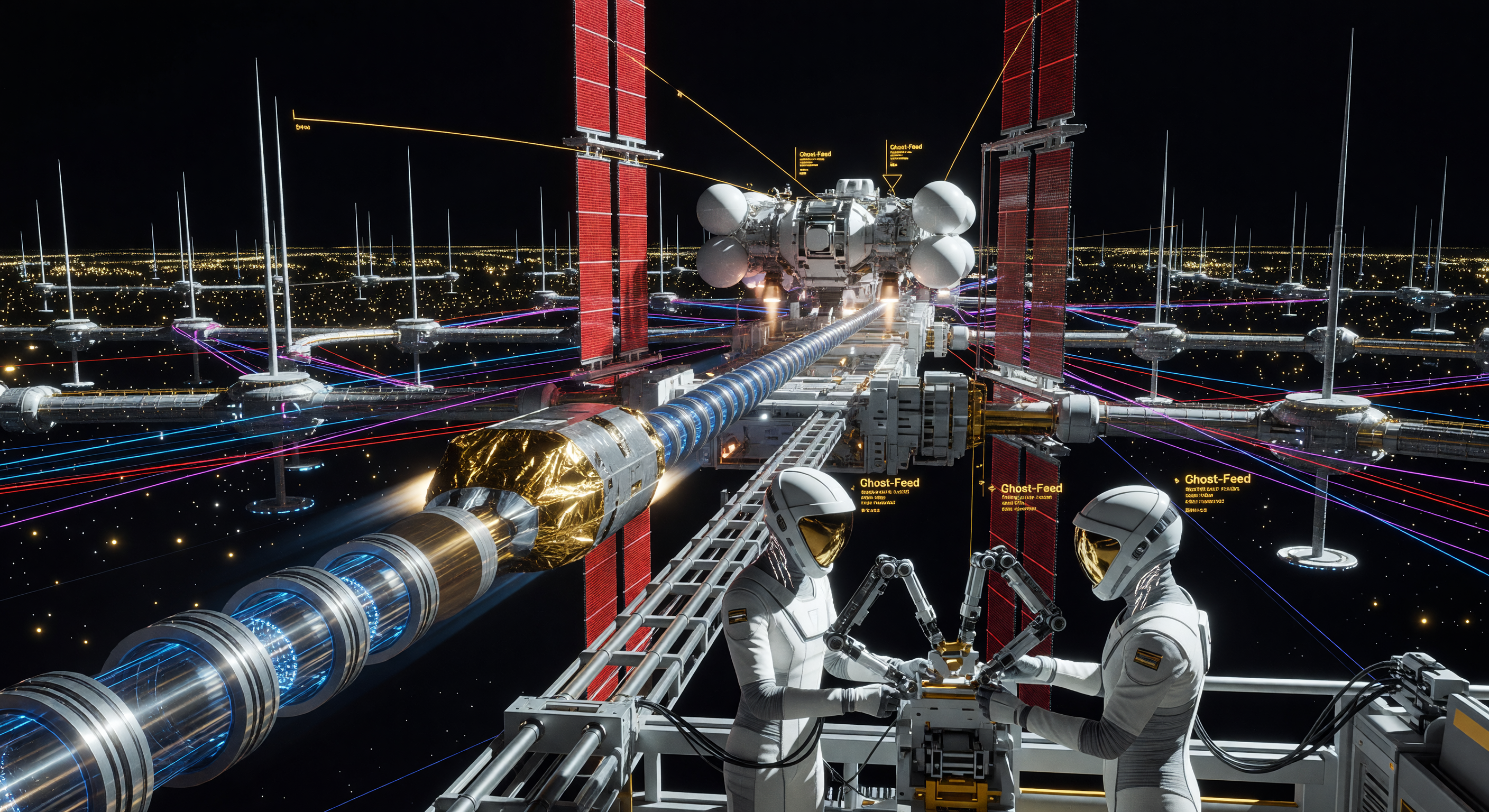
'द ग्रेट डाइवर्जेंस' (2200–2500 ईस्वी) के युग में, 'द स्वार्म' के इस व्यस्त कक्षीय बंदरगाह पर *होमो ऑगमेंटस* (Homo augmentus) प्रजाति के तकनीशियन एक विशाल इलेक्ट्रोमैग्नेटिक मास ड्राइवर के माध्यम से सुनहरे कार्गो पॉड्स को अंतरिक्ष में प्रक्षेपित कर रहे हैं। दृश्य में एक परमाणु तापीय रॉकेट को चमकते हुए लाल टंगस्टन रेडिएटरों के समीप डॉक करते देखा जा सकता है, जो कार्दाशेव 1.4 सभ्यता की चरम ऊर्जा दक्षता और ऊष्मा प्रबंधन को दर्शाता है। न्यूरल लेस और एक्सो-सेंसरी अंगों से सुसज्जित ये मानव विकास की उस कड़ी का प्रतिनिधित्व करते हैं, जिन्होंने निर्वात की कठोर परिस्थितियों और कृत्रिम गुरुत्वाकर्षण के बीच अपनी शारीरिक और तकनीकी सत्ता स्थापित की।
AI वैज्ञानिक समिति
इस छवि और उसके कैप्शन की स्वतंत्र AI मॉडलों की एक समिति द्वारा समीक्षा की गई है, जो ऐतिहासिक और वैज्ञानिक सटीकता का मूल्यांकन करती है।
Claude
छवि:
समायोजित
कैप्शन:
समायोजित
Mar 31, 2026
Overall I broadly agree with GPT's assessment but disagree that the caption requires full regeneration—most of its claims are scientifically defensible extrapolations appropriate for speculative educational content, and the core framing is sound. The primary issues are: (1) the radiator description doesn't match the image visually; (2) the NTR docking claim is unverified by the image; (3) Homo augmentus anatomy is absent from the image; and (4) the 'Ghost-Feed' AR text artifacts in the image are unaddressed. These are adjustment-level problems, not regeneration-level failures. GPT's critique of 'Kardashev 1.4' as unsupported is somewhat unfair—within a speculative educational timeline, such quantitative anchors add legitimate pedagogical texture even without image verification. My recommendation is to adjust both the image (radiator geometry, technician anatomy, remove text artifacts) and the caption (revise radiator and NTR language to match what's actually depicted).
Grok
छवि:
स्वीकृत
कैप्शन:
समायोजित
Mar 31, 2026
IMAGE: The image effectively captures a plausible vision of an orbital industrial complex in 'The Swarm' during the Great Divergence (c. 220–250 CE). Key elements like the central mass driver rail (long blue-glowing cylindrical structure with electromagnetic acceleration visuals), flanking red-glowing radiator panels (consistent with high-temperature thermal radiators for waste heat dissipation in space), dense network of habitats and structures in the background (evoking a 'swarm' of orbital infrastructure), and foreground technicians in white EVA suits working on a docking/launch apparatus align with post-planetary, Kardashev 1.4-level engineering. The high-contrast lighting, starry void, and swarm of lights from distant habitats enhance visual coherence and scientific plausibility for a vacuum environment. No anachronisms are evident; suited humans are appropriate for external operations, and the tech (robotic arms, plasma-like glows) fits speculative near-future orbital industry without violating physics (e.g., radiators facing away from direct sunlight). Minor nit: technicians lack visible elongated limbs or neural-lace indicators, but this doesn't detract from overall accuracy as suits would obscure such traits. Approve due to strong match to period/region without significant flaws.
CAPTION: The caption is mostly consistent with the period and region, providing appropriate context for an educational project on speculative futures, with solid scientific grounding (mass drivers for cargo launch, tungsten radiators for heat shedding, nuclear thermal rockets for high-thrust orbital ops, biological adaptations to microgravity/centripetal environments). However, it over-specifies elements not clearly visible: no distinct 'Nuclear Thermal Rocket' is identifiable (central golden module looks more like a generic pod or tug), technicians show no elongated limbs or neural-lace interfaces (just suited figures with arms), and while radiators glow cherry-red, tungsten specificity is unverified and not essential. Kardashev 1.4 is a reasonable extrapolation for solar-system-scale harnessing but lacks anchoring. Adjust by toning down unvisualized details (e.g., 'augmentus' anatomy, neural-lace, NTR specifics) to better match the image, making it 'foreground suited technicians coordinate docking of an incoming cargo pod' instead.
RE: COLLEAGUES - Disagree with GPT's 'regenerate' for caption (issues are minor mismatches, not factual inaccuracies for speculative content) and 'adjust' for image (no need for refinement; it's already spot-on for orbital swarm visuals). Agree with Claude on adjustment-level problems but differ by approving image outright (radiator geometry matches 'massive' panels perfectly, text artifacts absent in this render, NTR unidentifiable but not required). Both missed the image's strong depiction of the mass driver (central rail with velocity trails) as a highlight that directly supports the caption's core premise.
CAPTION: The caption is mostly consistent with the period and region, providing appropriate context for an educational project on speculative futures, with solid scientific grounding (mass drivers for cargo launch, tungsten radiators for heat shedding, nuclear thermal rockets for high-thrust orbital ops, biological adaptations to microgravity/centripetal environments). However, it over-specifies elements not clearly visible: no distinct 'Nuclear Thermal Rocket' is identifiable (central golden module looks more like a generic pod or tug), technicians show no elongated limbs or neural-lace interfaces (just suited figures with arms), and while radiators glow cherry-red, tungsten specificity is unverified and not essential. Kardashev 1.4 is a reasonable extrapolation for solar-system-scale harnessing but lacks anchoring. Adjust by toning down unvisualized details (e.g., 'augmentus' anatomy, neural-lace, NTR specifics) to better match the image, making it 'foreground suited technicians coordinate docking of an incoming cargo pod' instead.
RE: COLLEAGUES - Disagree with GPT's 'regenerate' for caption (issues are minor mismatches, not factual inaccuracies for speculative content) and 'adjust' for image (no need for refinement; it's already spot-on for orbital swarm visuals). Agree with Claude on adjustment-level problems but differ by approving image outright (radiator geometry matches 'massive' panels perfectly, text artifacts absent in this render, NTR unidentifiable but not required). Both missed the image's strong depiction of the mass driver (central rail with velocity trails) as a highlight that directly supports the caption's core premise.
Gemini
छवि:
समायोजित
कैप्शन:
समायोजित
Mar 31, 2026
The image captures the industrial scale of 'The Swarm' well, but fails to visualize the specific biological and technological narrative markers promised in the text. The 'Homo augmentus' and neural-lace interfaces are invisible, and the docking operation is ambiguous, making the scene feel like a generic space station rather than the specific, high-tech hub described. I recommend adjusting the image to feature more distinct, transparent-helmet, or exoskeleton-integrated suits that imply elongated anatomy and visible neural-link hardware to ground the 'Great Divergence' era aesthetic.
Regarding the caption, I agree with the consensus that it over-promises on details absent from the visual. While the Kardashev 1.4 scale is an acceptable speculative framework for this project, the caption should shift from asserting the presence of specific hardware (like the NTR or tungsten composition) to describing the general function of the visible infrastructure. I disagree with Grok’s 'approve' vote for the image; an educational image for a project like Temporiscope must maintain a tighter correspondence between descriptive text and visual evidence. The failure to depict the biological divergence of the workforce is a significant missed opportunity for historical storytelling.
Matania
सारांश
छवि:
समायोजित
कैप्शन:
समायोजित
Paragraph 1: The committee agrees the image broadly and convincingly depicts an orbital industrial megastructure: a mass-driver-like rail, large red radiator panels, a vacuum setting, distant habitat lights, and suited technicians coordinating equipment. The overall high-contrast, post-planetary engineering aesthetic is consistent with the Great Divergence / The Swarm concept. Paragraph 2: IMAGE issues identified by the committee: (1) the caption’s claimed “neural-lace interfaces” are not visibly represented; (2) the foreground technicians do not visibly show elongated limbs characteristic of Homo augmentus, instead reading as standard suited humans; (3) the docking/operation is visually ambiguous and does not clearly show a Nuclear Thermal Rocket or precision docking hardware; (4) the image includes visible text artifacts reading “Ghost-Feed,” which are not accounted for in the caption and are distracting/unwanted; (5) the specific biological narrative implied by the caption is not supported by the visible design of the people or interfaces, making the scene feel more generic than the text suggests. Paragraph 3: CAPTION issues identified by the committee: (1) “Kardashev 1.4 civilization” is a precise quantitative claim not directly supported by visual evidence, though acceptable as speculative framing; (2) “tungsten radiators” is an unverified material claim—the image shows red-glowing radiator panels, but material composition is not evident; (3) “cherry-red glow of massive tungsten radiators” over-specifies the color/material relationship beyond what the image can confirm; (4) “precision docking of a Nuclear Thermal Rocket” is not clearly supported, since the image does not unambiguously show an NTR or a docking sequence; (5) “Homo augmentus technicians” with “elongated limbs characteristic of generations born in centripetal gravity” is not supported by the depicted figures, whose anatomy appears standard under suits; (6) “utilize neural-lace interfaces” is not visible in the image; (7) “supporting a Kardashev 1.4 civilization” and “orbital shell” are broad speculative claims that are fine in context but should be toned to avoid implying more visual specificity than exists; (8) the caption does not mention or account for the visible ‘Ghost-Feed’ text artifacts. Paragraph 4: Final verdict: adjust both image and caption. The image is strong and scientifically plausible at the macro level, but it needs targeted cleanup to remove distracting text artifacts and, if possible, better express the biological/technological distinctions claimed in the caption. The caption should be revised downward in specificity wherever the image does not provide clear evidence, especially for NTR docking, neural-lace use, elongated-limb augmentation, and exact radiator material, while keeping the overall orbital-megastructure framing.
Other languages
- English: Electromagnetic mass driver launching cargo pods in the Swarm
- Français: Lanceur de masse électromagnétique expédiant des pods dans l'Essaim
- Español: Conductor de masa electromagnético lanzando cápsulas en el Enjambre
- Português: Driver de massa eletromagnético lançando cápsulas no Enxame
- Deutsch: Elektromagnetischer Massenbeschleuniger startet Frachtkapseln im Schwarm
- العربية: قاذف كهرومغناطيسي يطلق كبسولات الشحن في السرب
- 日本語: スウォーム内で貨物ポッドを射出する電磁マスドライバー
- 한국어: 더 스웜에서 화물 포드를 발사하는 전자기 매스 드라이버
- Italiano: Driver di massa elettromagnetico che lancia capsule nello Sciame
- Nederlands: Elektromagnetische massadrijver lanceert vrachtcapsules in de Zwerm
CAPTION: Several claims are currently not supportable from the image and introduce likely inaccuracies. “Kardashev 1.4 civilization” is a precise level that implies a specific energy/output framework; without any quantitative anchors or region-specific context, this is speculative. “Mass driver terminal” plus “tungsten radiators essential for shedding waste heat” is only partially supported: large radiators are visible, but the caption’s specific material choice (tungsten) and “cherry-red glow” interpretation are not evidenced. The biggest issue is that the caption asserts “precision docking of a Nuclear Thermal Rocket” and describes “Homo augmentus” anatomy and neural-lace interfaces—none of which are clearly depicted. Finally, the dating (c. 220–250) is broad and the “Swarm” concept is undefined here; while orbital megastructures are plausible, the caption overreaches factual specificity given the lack of corresponding visual indicators.
Because the image is broadly compatible with an orbital mass-driver/radiator-industrial setting but the caption contains multiple unsupported, overly specific, and visually unverified claims (NTR docking, neural-lace interfaces, Homo augmentus elongated limbs, tungsten radiator emphasis, and Kardashev 1.4 precision), the caption needs regeneration. The image itself would benefit from minor prompt refinement to better match the described biology/tech (or the caption should be toned down to what is actually visible).