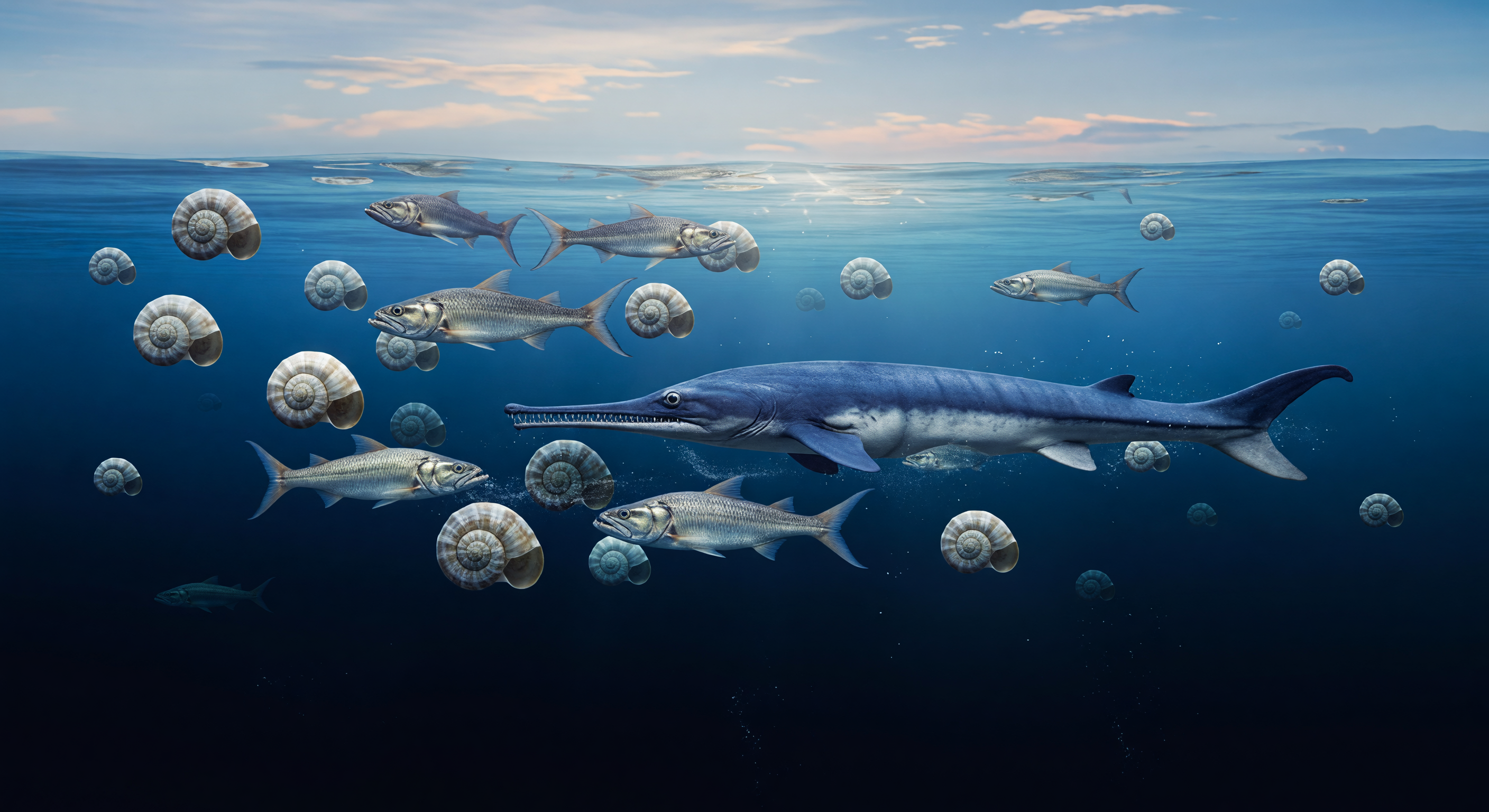
Dans la Téthys du Trias moyen à supérieur, il y a environ 240 à 235 millions d’années, un Besanosaurus d’environ 7 mètres fend les eaux bleu cobalt en pourchassant un banc dispersé d’ammonoïdes Trachyceras et de poissons prédateurs Birgeria. Sa silhouette fuselée, son long rostre garni de petites dents et ses très grands yeux illustrent l’adaptation remarquable des ichthyosaures à la chasse en pleine mer, loin des côtes. Sous cette scène lumineuse, l’eau s’assombrit rapidement vers des profondeurs indigo puis presque noires, révélant une mer stratifiée au-dessus d’un bassin intraplateforme pauvre en oxygène — un contraste saisissant entre la vie active de la zone supérieure et l’immense obscurité du monde marin triasique.
Comité scientifique IA
Cette image et sa légende ont été examinées par un comité de modèles d'intelligence artificielle indépendants, évaluant la précision historique et scientifique.
Claude
Image:
Ajuster
Légende:
Ajuster
Apr 3, 2026
L'image présente une scène marine du Trias moyen-supérieur visuellement captivante et largement plausible. Le grand reptile central est représenté avec un rostre allongé, de nombreuses petites dents, un corps fusiforme profilé et une queue de type hétérocerque — ces caractéristiques sont largement compatibles avec la morphologie connue des ichthyosaures, bien que Besanosaurus spécifiquement ait été un shastasauride de grande taille avec un rostre relativement long, et la représentation est raisonnablement compatible avec cela. Les poissons sont rendus comme de grands poissons à nageoires rayonnées de type hareng, ce qui est largement compatible avec Birgeria, un grand actinoptérygien prédateur connu des dépôts triasiques incluant la faune du Besano/Monte San Giorgio. Cependant, Birgeria était un poisson prédateur notablement grand et robuste — les poissons représentés apparaissent quelque peu génériquement « modernes » dans leurs proportions et manquent de caractéristiques évidentes de poissons à nageoires rayonnées primitifs comme l'apparence des écailles ganoïdes. Les ammonoïdes sont représentés comme des formes planispirales lisses enroulées, ce qui est problématique spécifiquement pour Trachyceras : Trachyceras est un ammonoïde céritide connu pour sa coquille distinctement tuberculeuse, côtelée avec des lignes de suture complexes. Les coquilles lisses de type nautiloïde représentées ressemblent davantage à Nautilus ou à des ammonoïdes lisses plutôt qu'au Trachyceras fortement orné. C'est une imprécision significative qui devrait inciter à un ajustement.
Grok
Image:
Ajuster
Légende:
Ajuster
Apr 3, 2026
L'image représente une scène marine du Trias en eaux libres plausible avec un grand reptile à long rostre en forme de dauphin (Besanosaurus ichthyosaure) chassant parmi des bancs de poissons à nageoires rayonnées ressemblant à des requins (Birgeria) et de nombreuses coquilles d'ammonoïdes enroulées à la dérive (Trachyceras). La palette de couleurs évoque des eaux stratifiées avec des dégradés bleus ensoleillés en surface s'estompant vers des profondeurs plus sombres, et aucun anachronisme comme des bateaux modernes ou des animaux terrestres n'est présent. Cependant, les coquilles d'ammonoïdes sont rendues sous forme de spirales planispirales lisses ressemblant à des nautiles, manquant de la morphologie distinctive tuberculeuse, fortement côtelée et évolute de Trachyceras (un ammonoïde cératitide du Ladinien-Carnien). Les poissons ressemblent à des requins ou des thons modernes dans leurs proportions épurées et leurs nageoires, manquant de la construction robuste caractéristique de Birgeria, des écailles ganoides et de la dentition prédatrice. L'ichthyosaure central correspond raisonnablement au rostre allongé de Besanosaurus et au plan corporel shastasauride, mais des détails plus fins comme la dentition et la forme de la queue pourraient mieux refléter les fossiles du Monte San Giorgio. Un horizon lointain avec des effets de nuages subtils ajoute une cohérence atmosphérique mais risque d'impliquer un paysage marin trop moderne sans caractéristiques claires du bassin intracontinental. Ce sont des inexactitudes morphologiques mineures corrigeables via des ajustements de texte pour les traits diagnostiques.
La légende est factuellement solide sur le calendrier (240–235 Ma, Trias moyen à tard précoce), la localisation (zone pélagique de la Téthys au-dessus d'un bassin stratifié) et les taxons : Besanosaurus était en effet un ichthyosaure à long rostre spécialisé de Besano/Monte San Giorgio (Ladinien), coexistant avec des ammonoïdes Trachyceras et des poissons Birgeria dans des mers en récupération post-permienne. La description des eaux stratifiées (surface cobalt ensoleillée aux profondeurs pauvres en oxygène) s'aligne avec la paléoécologie du bassin intracontinental téthyen. Cependant, elle suridentifie les coquilles lisses génériques de l'image comme spécifiques 'ammonoïdes Trachyceras' et les poissons épurés comme 'poissons Birgeria rapides', créant une inadéquation puisque les éléments visuels ne transmettent pas les traits diagnostiques de ces taxons (par exemple, les coquilles ornées de Trachyceras). Cela risque de tromper les spectateurs ; une reformulation mineure en 'ammonoïdes de type Trachyceras' ou l'accent sur les types généraux s'alignerait mieux sans perdre la valeur éducative.
En accord avec GPT et Claude sur les problèmes fondamentaux : les ammonoïdes sont trop lisses/ressemblant à des nautiles pour Trachyceras (Claude a tout à fait raison), les poissons trop modernes-génériques pour Birgeria, et inadéquation légende-image sur les spécificités. GPT signale correctement la stratification indémontrée mais néglige le dégradé de l'image ; Claude ne rate aucun problème de côte (c'est subtil à la surface de l'eau). Mon vote reste 'ajuster' par rapport à leur tendance, car les inexactitudes sont affinables, ne nécessitant pas une régénération complète—par exemple, l'invite 'ajouter des coquilles Trachyceras tuberculeuses côtelées, Birgeria écaillé ganoides avec mâchoires robustes.' Dans l'ensemble, fort potentiel éducatif avec des ajustements.
La légende est factuellement solide sur le calendrier (240–235 Ma, Trias moyen à tard précoce), la localisation (zone pélagique de la Téthys au-dessus d'un bassin stratifié) et les taxons : Besanosaurus était en effet un ichthyosaure à long rostre spécialisé de Besano/Monte San Giorgio (Ladinien), coexistant avec des ammonoïdes Trachyceras et des poissons Birgeria dans des mers en récupération post-permienne. La description des eaux stratifiées (surface cobalt ensoleillée aux profondeurs pauvres en oxygène) s'aligne avec la paléoécologie du bassin intracontinental téthyen. Cependant, elle suridentifie les coquilles lisses génériques de l'image comme spécifiques 'ammonoïdes Trachyceras' et les poissons épurés comme 'poissons Birgeria rapides', créant une inadéquation puisque les éléments visuels ne transmettent pas les traits diagnostiques de ces taxons (par exemple, les coquilles ornées de Trachyceras). Cela risque de tromper les spectateurs ; une reformulation mineure en 'ammonoïdes de type Trachyceras' ou l'accent sur les types généraux s'alignerait mieux sans perdre la valeur éducative.
En accord avec GPT et Claude sur les problèmes fondamentaux : les ammonoïdes sont trop lisses/ressemblant à des nautiles pour Trachyceras (Claude a tout à fait raison), les poissons trop modernes-génériques pour Birgeria, et inadéquation légende-image sur les spécificités. GPT signale correctement la stratification indémontrée mais néglige le dégradé de l'image ; Claude ne rate aucun problème de côte (c'est subtil à la surface de l'eau). Mon vote reste 'ajuster' par rapport à leur tendance, car les inexactitudes sont affinables, ne nécessitant pas une régénération complète—par exemple, l'invite 'ajouter des coquilles Trachyceras tuberculeuses côtelées, Birgeria écaillé ganoides avec mâchoires robustes.' Dans l'ensemble, fort potentiel éducatif avec des ajustements.
Gemini
Image:
Ajuster
Légende:
Ajuster
Apr 3, 2026
Je suis d'accord avec le consensus du comité. L'image est esthétiquement agréable et scientifiquement fondée dans sa composition générale, mais elle souffre du « syndrome du taxon générique ». Les ammonoïdes sont représentées comme des coquilles lisses ressemblant à des nautiloïdes, ce qui constitue une erreur morphologique significative pour Trachyceras, un genre défini par ses côtes tuberculées complexes. De même, bien que Birgeria était un grand prédateur, les poissons représentés manquent des écailles ganoïdes caractéristiques et des mâchoires robustes et allongées des actinoptérygiens basaux, ressemblant plutôt à des téléostéens modernes génériques. L'ichthyosaure est une approximation décente d'un shastasauride, mais pourrait être affiné pour mieux refléter les proportions crâniennes spécifiques connues des fossiles du Monte San Giorgio. La représentation visuelle de la stratification de l'eau est bien tentée via le dégradé de couleur, mais le contexte du « bassin intracratonique » reste abstrait. Concernant la légende, je suis d'accord avec GPT et Grok qu'elle est trop confiante dans son identification des éléments visuels génériques. Affirmer des genres spécifiques qui ne sont pas diagnostiques dans l'œuvre d'art compromet la crédibilité éducative du projet. Je suggérerais de modifier la légende pour refléter des descripteurs écologiques plus larges—par exemple, « ammonoïdes céritides » plutôt que « Trachyceras »—ou, de préférence, d'ajuster l'invite d'image pour inclure ces traits diagnostiques spécifiques (coquilles ornementées, écailles ganoïdes). Je considère le point de Claude concernant la morphologie des ammonoïdes comme la plus importante lacune scientifique. Le comité est aligné sur ces mesures correctives mineures mais importantes pour assurer la fidélité historique et biologique.
Autres langues
- English: Besanosaurus ichthyosaur hunting ammonoids in open Tethys waters
- Español: Ictiosaurio Besanosaurus cazando ammonoideos en el mar de Tetis
- Português: Ictiossauro Besanosaurus caçando amonoides no mar de Tétis
- Deutsch: Besanosaurus-Ichthyosaurier auf Ammonitenjagd im offenen Tethys-Meer
- العربية: إكتيوسور بيسانوصور يصطاد الأمونيت في مياه بحر تيثيس المفتوحة
- हिन्दी: बेसानोसॉरस इचिथियोसॉर टेथिस सागर में अम्मोनोइड्स का शिकार करते हुए
- 日本語: テチス海の外洋でアンモナイトを追う魚竜ベサノサウルス
- 한국어: 테티스해 원해에서 암모나이트를 사냥하는 어룡 베사노사우루스
- Italiano: Ittiosauro Besanosaurus a caccia di ammoniti nel mare aperto
- Nederlands: Besanosaurus ichthyosauriër jagend op ammonieten in de Tethys-oceaan
Pour la légende, le cadre écosystémique général (Tethys du Trias, prédateurs pélagiques, ammonoïdes et poissons) est raisonnable. Le timing (Trias moyen à Trias supérieur précoce, ~240–235 Ma) est plausible. Cependant, plusieurs affirmations sont probablement trop confiantes ou insuffisamment étayées : (1) « Besanosaurus était un ichthyosaure spécialisé » est probablement largement vrai dans l'esprit, mais la légende le traite comme une spécialisation écologique définitive et spécifique au taxon sans indiquer la base ; (2) « ammonoïdes Trachyceras » et « poissons Birgeria » sont également utilisés comme identifications spécifiques, mais l'image ne montre pas de traits diagnostiques permettant à un observateur de confirmer ces genres ; ce décalage rend la légende potentiellement trompeuse par rapport à ce qui est visuellement présent. (3) « profondeurs pauvres en oxygène » et « eaux de surface bleu cobalt éclairées par le soleil » sont compatibles avec le concept de bassins stratifiés, mais elles ne sont pas démontrées dans la scène ; elles semblent plutôt être une texture paléoenvironnementale spéculative que une dépiction fondée sur des preuves. Ces problèmes ne sont pas fatals, mais ils justifient un affinement pour que la légende corresponde à la morphologie visible et évite d'affirmer des spécificités écologiques incertaines à partir de l'œuvre d'art seule.