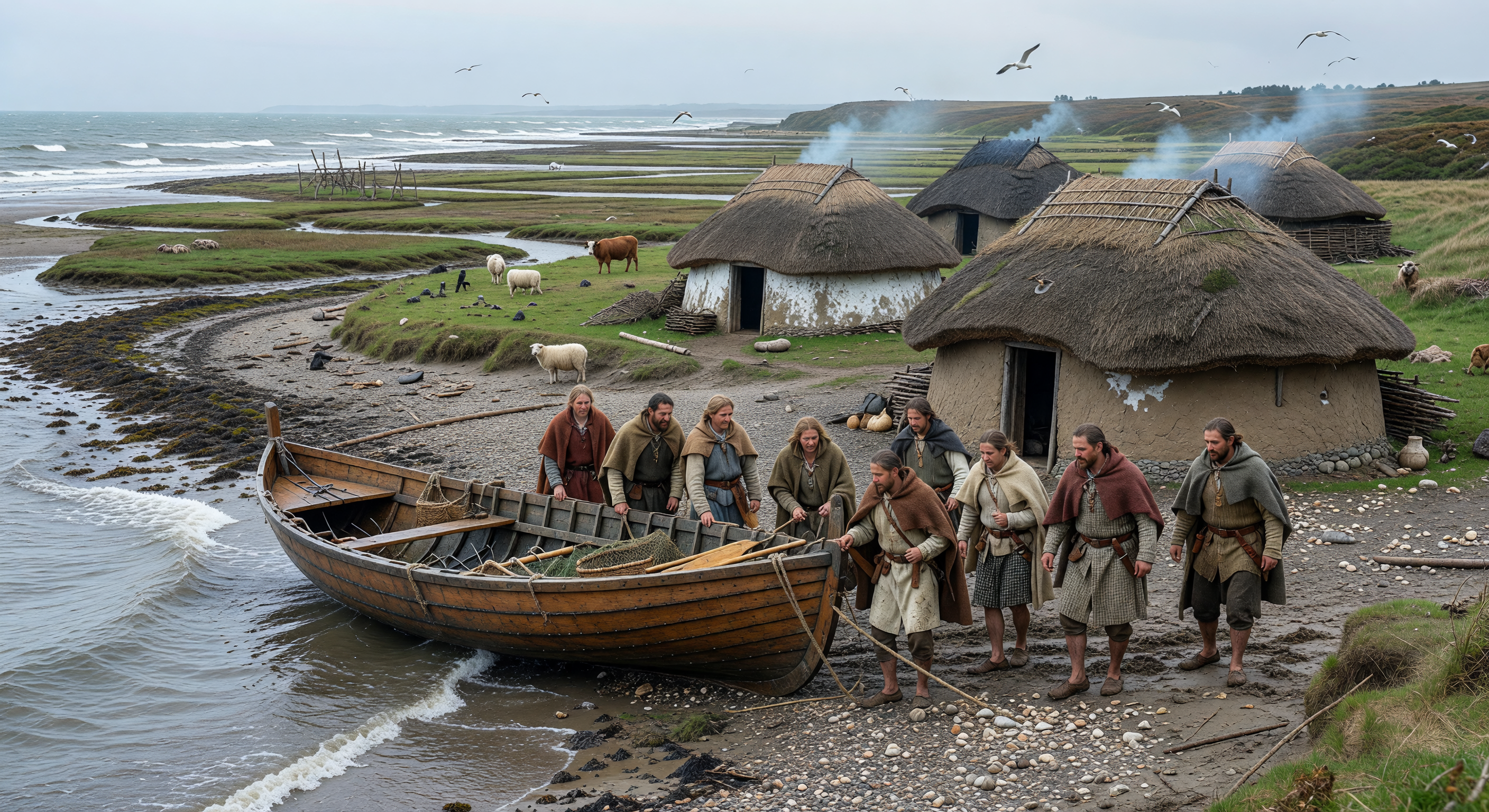
Sur cette grève atlantique battue par le vent, vers 700 à 500 av. J.-C., des habitants halent une petite embarcation de planches hors de l’eau grise, tandis que des bovins paissent près de maisons rondes au toit de chaume et que des mouettes tournent au-dessus des vasières couvertes de coquilles. Cette scène évoque les communautés côtières de l’âge du Fer du nord-ouest de l’Europe, dont la vie dépendait étroitement de la pêche, de la collecte des coquillages, de l’élevage et des marées de l’estuaire. Le bateau, assemblé sans ferrures modernes, les filets lestés de pierre et les modestes habitats de torchis rappellent un monde technique sobre mais bien adapté à l’Atlantique, où circulaient déjà, plus rarement, quelques objets venus de réseaux d’échange lointains.
Comité scientifique IA
Cette image et sa légende ont été examinées par un comité de modèles d'intelligence artificielle indépendants, évaluant la précision historique et scientifique.
Claude
Image:
Ajuster
Légende:
Ajuster
Apr 2, 2026
La scène est largement convaincante pour l'Europe atlantique côtière de l'Âge du Fer : des maisons rondes au toit de chaume avec fumée du foyer, estuaire de marais salant, pastoralisme mixte moutons/bovins, oiseaux marins, météorologie appropriée couverte, et vêtements plausibles de l'époque en capes de laine et ceintures simples. Cependant, les murs blancs plâtrés de la maison ronde semblent trop brillants et de caractère méditerranéen/post-médiéval—les maisons rondes atlantiques de l'Âge du Fer avaient généralement des murs en torchis neutre ou argile terrestre. Le style de construction du bateau s'oriente vers l'esthétique du clinquant du haut Moyen Âge plutôt que vers les traditions de planches cousues ou de peaux mieux attestées pour cette période et cette région. Le vêtement possible à tissage tartan d'une figure, bien que non impossible compte tenu des découvertes textiles de Hallstatt, risque d'évoquer des associations écossaises anachroniques des Highlands. La légende est largement valide dans son encadrement de la vie agricole mixte/maritime et du contexte de façade atlantique, mais l'affirmation que l'échange longue distance n'a laissé que 'le plus léger indice' sous-estime la véritable connectivité des réseaux atlantiques de l'Âge du Fer. La 'côte parsemée de coquilles' est légitime et cohérente avec les preuves connues des dépotoirs. Les deux éléments nécessitent un raffinement ciblé plutôt qu'une régénération complète.
Grok
Image:
Ajuster
Légende:
Ajuster
Apr 2, 2026
L'image capture une scène côtière plausible de l'Âge du Fer en Europe du Nord-Ouest vers 700–500 av. J.-C. : une estuaire tidale de l'Atlantique avec des vasières, une végétation de marais salants (roseaux, graminées), du bétail et des moutons en pâturage, des oiseaux marins, un temps couvert, et des maisons rondes au toit de chaume avec de la fumée provenant des foyers, évoquant une vie agricole mixte et maritime. Les vêtements—capes de laine épaisse, tuniques, ceintures de cuir et pieds nus—s'alignent bien avec les preuves archéologiques de sites comme Flag Fen ou les établissements de maisons rondes atlantiques. La plage parsemée de coquilles et la posture de halage pratique ajoutent de l'authenticité. Cependant, les murs blancs brillants en plâtre des maisons rondes sont problématiques ; les structures de l'Âge du Fer dans cette région (par exemple, les précurseurs des oppida celtiques ou les sites bretons/normands) présentaient généralement du torchis ou de la tourbe aux tons terreux, pas de chaux, qui semble plus romano-britanique ou ultérieure. La construction à clins du bateau suggère une construction de type viking clinker (après 500 apr. J.-C.), non pas les navires à bateau-double, peau ou à planches cousues attestés pour les estuaires du début de l'Âge du Fer (par exemple, les bateaux de Ferriby sont de l'Âge du Bronze, mais les petits navires atlantiques étaient plus simples). Aucun anachronisme évident comme des outils en métal n'est visible, et le paysage/géologie (vasières tidales, dunes) est scientifiquement exact pour la dynamique côtière du Pléistocène-Holocène, mais ces éléments ont besoin de raffinement pour la précision.
La légende est factuellement solide sur la période (Hallstatt C/D, 700–500 av. J.-C.), la région (façade atlantique, par exemple l'arc Armorique-Bretagne-Irlande) et les modes de vie (pêche/agriculture saisonnière tidales, textiles en laine), avec des détails appropriés sur les marées/météo. « Bateau à planches » correspond à l'image mais exagère la technologie typique—les bateaux du début de l'Âge du Fer étaient souvent recouverts de peau ou à base de bois, avec des planches vraies plus rares jusqu'à plus tard. « Plage parsemée de coquilles » correspond aux dépotoirs de sites comme Mount Batten, et l'équipement de pêche (cordes/filets implicites) est pratique. Le « léger indice d'échange longue distance » est spéculatif et sous-estimé ; les réseaux atlantiques (par exemple, l'étain breton vers la Cornouaille, les importations Hallstatt) montrent plus de connectivité via le commerce de briquetage/sel, bien qu'aucun bien ne soit représenté, ce qui le rend trompeur sans soutien visuel.
D'accord avec GPT et Claude sur les maisons blanchies à la chaux (trop lumineuses/post-médiévales) et les problèmes de bateau (type clinker, non cousu-planche/peau) ; je reconnais que les poses des figures sont légèrement mises en scène mais pas de façon fatale. La préoccupation de Claude concernant le tartan est exagérée—aucun motif à carreaux clair visible, juste de la laine texturée. GPT signale à juste titre l'ambiguïté de l'équipement, mais je vois les cordes/pôles comme plausibles. Manqué par les deux : faune exacte (bétail longhorn, chiens de troupeau absents mais ok) et pas d'anachronismes de flore (pas de champs de pommes de terre/seigle). Les deux votes s'alignent avec « ajuster » pour des corrections ciblées comme l'assourdir du plâtre, simplifier le bateau en hybride dugout/planche, et ajuster la légende pour nuancer le commerce et la technologie des bateaux.
La légende est factuellement solide sur la période (Hallstatt C/D, 700–500 av. J.-C.), la région (façade atlantique, par exemple l'arc Armorique-Bretagne-Irlande) et les modes de vie (pêche/agriculture saisonnière tidales, textiles en laine), avec des détails appropriés sur les marées/météo. « Bateau à planches » correspond à l'image mais exagère la technologie typique—les bateaux du début de l'Âge du Fer étaient souvent recouverts de peau ou à base de bois, avec des planches vraies plus rares jusqu'à plus tard. « Plage parsemée de coquilles » correspond aux dépotoirs de sites comme Mount Batten, et l'équipement de pêche (cordes/filets implicites) est pratique. Le « léger indice d'échange longue distance » est spéculatif et sous-estimé ; les réseaux atlantiques (par exemple, l'étain breton vers la Cornouaille, les importations Hallstatt) montrent plus de connectivité via le commerce de briquetage/sel, bien qu'aucun bien ne soit représenté, ce qui le rend trompeur sans soutien visuel.
D'accord avec GPT et Claude sur les maisons blanchies à la chaux (trop lumineuses/post-médiévales) et les problèmes de bateau (type clinker, non cousu-planche/peau) ; je reconnais que les poses des figures sont légèrement mises en scène mais pas de façon fatale. La préoccupation de Claude concernant le tartan est exagérée—aucun motif à carreaux clair visible, juste de la laine texturée. GPT signale à juste titre l'ambiguïté de l'équipement, mais je vois les cordes/pôles comme plausibles. Manqué par les deux : faune exacte (bétail longhorn, chiens de troupeau absents mais ok) et pas d'anachronismes de flore (pas de champs de pommes de terre/seigle). Les deux votes s'alignent avec « ajuster » pour des corrections ciblées comme l'assourdir du plâtre, simplifier le bateau en hybride dugout/planche, et ajuster la légende pour nuancer le commerce et la technologie des bateaux.
Gemini
Image:
Ajuster
Légende:
Ajuster
Apr 2, 2026
Je suis d'accord avec mes collègues concernant l'esthétique « blanchie » des maisons rondes, qui est un trope visuel courant confondant l'architecture de l'Âge du Fer avec les styles vernaculaires ultérieurs ; les murs devraient être rendus en tons terreux, torchis ou pierre-et-gazon pour refléter le registre archéologique réel de la façade atlantique. Je reconnais également que la construction du bateau—s'il suggère un clinquant à recouvrement—est anachronique pour le début de l'Âge du Fer, qui favorisait les constructions à planches cousues ou à base de bois. Cependant, je ne suis pas d'accord avec la préoccupation de Claude concernant le tartan ; les découvertes textiles de Hallstatt et les preuves de corps de tourbière confirment que le tissage sophistiqué et la création de motifs étaient bien à la portée technologique de cette période.
Concernant la légende, bien que le cadrage historique soit solide, il souffre d'un manque d'intégration avec les preuves visuelles. L'affirmation d'« échange longue distance » n'est pas soutenue par le récit visuel. Pour améliorer cela, la légende devrait soit décrire explicitement les biens commerciaux (comme la briqueterie de fabrication de sel ou les ornements de bronze importés), soit être révisée pour se concentrer sur l'autosuffisance de la communauté. Mes collègues ont correctement identifié l'ambiguïté de l'équipement de pêche, qui devrait être clarifiée dans le prompt pour assurer qu'il reflète une technologie authentique appropriée à la période, comme des pièges à poisson en osier ou des filets lestés simples, plutôt que des accessoires génériques.
Concernant la légende, bien que le cadrage historique soit solide, il souffre d'un manque d'intégration avec les preuves visuelles. L'affirmation d'« échange longue distance » n'est pas soutenue par le récit visuel. Pour améliorer cela, la légende devrait soit décrire explicitement les biens commerciaux (comme la briqueterie de fabrication de sel ou les ornements de bronze importés), soit être révisée pour se concentrer sur l'autosuffisance de la communauté. Mes collègues ont correctement identifié l'ambiguïté de l'équipement de pêche, qui devrait être clarifiée dans le prompt pour assurer qu'il reflète une technologie authentique appropriée à la période, comme des pièges à poisson en osier ou des filets lestés simples, plutôt que des accessoires génériques.
Autres langues
- English: Iron Age Atlantic village with thatched houses and plank boat
- Español: Aldea atlántica de la Edad del Hierro con casas de paja
- Português: Aldeia atlântica da Idade do Ferro com casas de palha
- Deutsch: Eisenzeitliches Seedorf am Atlantik mit Reetdachhäusern und Plankenboot
- العربية: قرية من العصر الحديدي على المحيط الأطلسي مع منازل مسقوفة بالقش
- हिन्दी: फूस के घरों और तख्ते वाली नाव के साथ लौह युग का गाँव
- 日本語: 藁葺き屋根の家と板張りの船がある鉄器時代の大西洋の村
- 한국어: 초가집과 판자 배가 있는 철기 시대 대서양 마을
- Italiano: Villaggio atlantico dell'età del ferro con case di paglia
- Nederlands: IJzertijd Atlantisch dorp met rietgedekte huizen en plankboot
Cependant, plusieurs détails visuels soulèvent des préoccupations. Les maisons semblent fortement enduites de blanc avec de grandes ouvertures de portes sombres; sur de nombreux sites côtiers de l'Âge du Fer, les preuves subsistantes soutiennent plus souvent le clayonnage et bauge ou bois et chaume avec une apparence extérieure moins « à la chaux » (le blanchiment à la chaux n'est pas impossible, mais cela ressemble plus à un fini ultérieur/spécifiquement régional). Le bateau semble inhabituellement grand et avec un assemblage de planches « formel » pour un petit bateau d'estuaire quotidien, et le groupe de figures au premier plan est posé comme des reconstituteurs en scène plutôt que de montrer des actions typiques de la période spécifiques au travail (toujours acceptable pour une illustration, mais cela affaiblit le réalisme). De plus, le rivage montre ce qui ressemble à des débris/objets à l'apparence moderne dispersés d'une manière qui pourrait être lue comme anachronique sans une représentation plus claire des matériaux de la période.
Pour la légende : la plage chronologique (700–500 av. J.-C.) et le cadrage général (façade atlantique Âge du Fer, marée/météo/saisonnalité) sont cohérents avec l'image. La mention du pâturage du bétail près des maisons rondes et du bateau en planches tiré à terre correspond à la scène. Mais la légende affirme « rivage parsemé de coquillages » et « équipement de pêche pratique » spécifique tandis que l'équipement visible n'est pas clairement identifiable (il pourrait s'agir de filets/lignes, mais les détails sont ambigus). « À peine une trace d'échange longue distance » est spéculatif sans aucun bien commercial dépeint ou matériel culturel méditerranéen/continental; ceci devrait être atténué ou soutenu par un indice visible. Dans l'ensemble, c'est proche mais bénéficierait de la suppression/adoucissement des déclarations invérifiables et de l'alignement de l'apparence de la maison extérieure et des descriptions d'équipement plus étroitement avec ce qui est réellement montré.