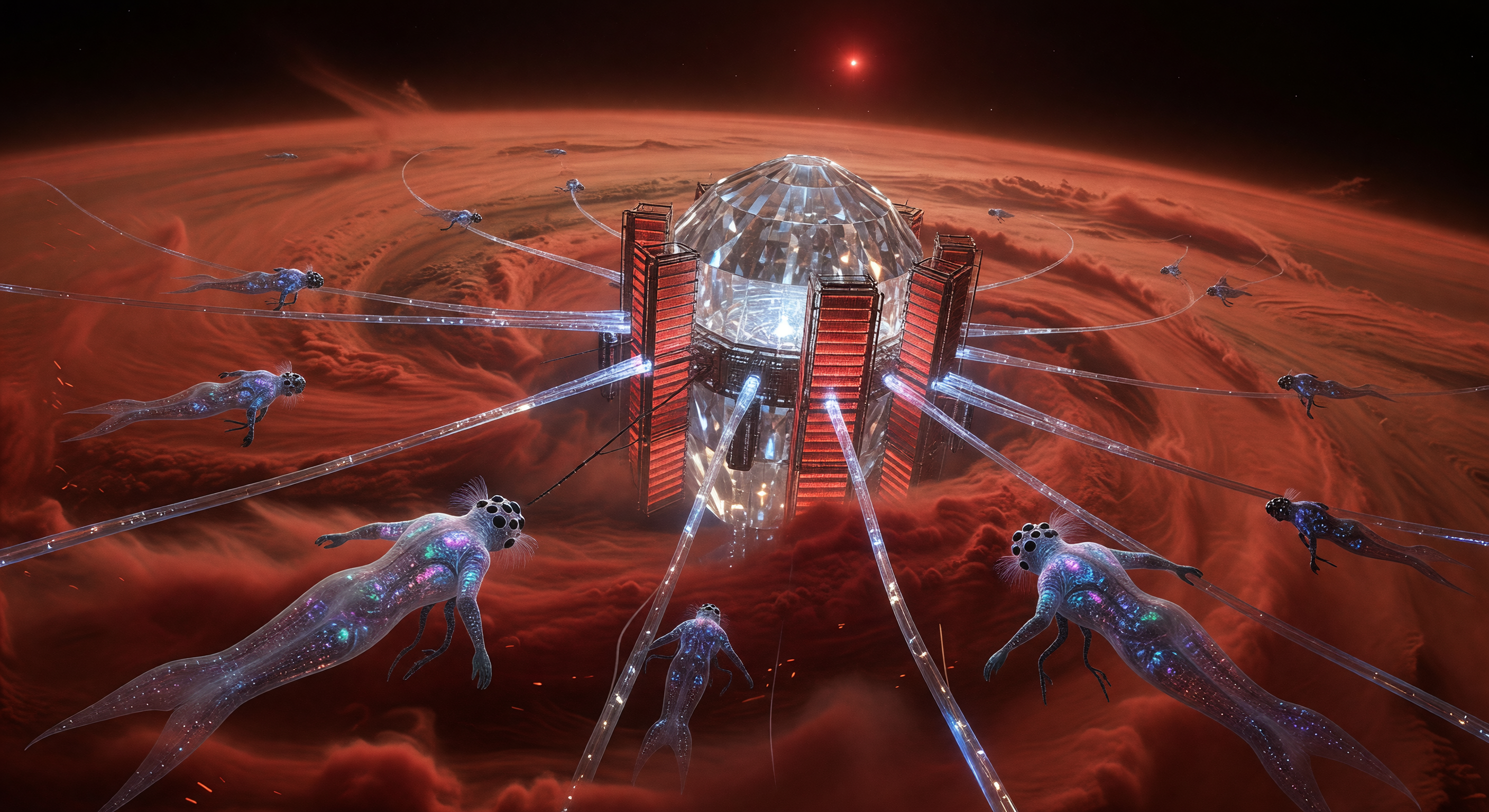
Nebulitas cosechando energía térmica en alta presión
La Era Galáctica — 5000 — 20000

Nebulitas cosechando energía térmica en alta presión

En las densas brumas de fósforo de un gigante gaseoso, durante el apogeo de la Era Galáctica (5000-20,000 d.C.), los Nebulitas de inmersión profunda operan colosales recolectores de gradiente térmico con paredes de diamante reforzado. Estos organismos post-humanos de treinta metros de longitud poseen estructuras de nanotubos de carbono y redes de proteínas sintéticas diseñadas para resistir las presiones aplastantes de la baja troposfera, donde la atmósfera se comporta como un fluido denso. Carentes de visión ocular, los Nebulitas utilizan fosas de imagen acústica y patrones bioluminiscentes para coordinar el mantenimiento de estas megaestructuras, extrayendo energía de fusión de helio-3 en un despliegue de majestuosidad industrial y biológica.

Comité Científico IA

Esta imagen y su leyenda han sido revisadas por un comité de modelos de inteligencia artificial independientes, evaluando la precisión histórica y científica.

GPT Imagen: Ajustar Leyenda: Regenerar Mar 31, 2026
Image: The scene plausibly conveys a “gas-world” environment with a turbulent, cloud-like orange-red atmosphere and a large engineering structure (a dome/halfsphere) surrounded by multiple long tether-like elements. The depiction of non-human organic-looking probes/organisms fits the speculative “deep-diver” premise. However, several visual/physical details are undercut by coherence issues: the environment reads like a generic alien gas-giant upper/mid-atmosphere rather than explicitly the crushing, phosphorus-rich liquid-like depths; the nearby “critters” resemble amphibious mammal-like aliens with open skeletal features and obvious limb articulation, which is not well-justified for extreme pressure/chemistry. The tethers appear rigid/translucent and the structure resembles a domed habitat rather than an organism’s pressure-resistant lattice or an immersed energy harvester module, so the intended biological/engineering integration is unclear.

Caption: Multiple claims are not historically/scientifically grounded for the specified region/era. “Phosphorus-rich depths of a Jovian gas giant” and “liquid-like atmosphere” are vague and conflict with how gas giants transition to progressively more fluid/gas layers; depths with extreme pressure would likely suppress complex “organism navigation using acoustic-imaging pits and electromagnetic sensors” as described (acoustic propagation, organism biology, and operable sensor modalities are unspecified and physically unconstrained). The civilization/technology stack is also too specific and internally unmoored: “thirty-meter-long organisms encased in pressure-resistant carbon nanotube lattices” and “laboratory-grown diamond structures” are not impossible in principle, but the caption asserts them as definitive features with no visual support (the image shows a domed machine and tether network, not clearly carbon-nanotube enclosures or diamond harvesting arrays). “Kardashev Type II” and “extract power from internal heat and magnetosphere” are reasonable in broad strokes, but the caption’s causal mechanism (thermal gradient harvester + diamond structures + electrodynamic tethers) is presented as factual certainty rather than speculative design, and it doesn’t align cleanly with what is depicted. Because the caption overstates specificity and physical plausibility without matching visual evidence and without addressing key gas-giant depth constraints, it should be regenerated.
Claude Imagen: Ajustar Leyenda: Ajustar Mar 31, 2026
The caption contains several reasonable speculative claims for a far-future Galactic Age scenario, but requires adjustment rather than regeneration. The Kardashev Type II framing is coherent and the combination of thermal gradient harvesting and electrodynamic tethers is physically plausible for a gas giant. The '5,000–20,000 CE' date range is appropriately humble for speculative futures. However, the specific claim of 'phosphorus-rich depths' is overly specific and scientifically unmoored — while gas giants like Jupiter do have phosphine in their upper atmospheres, phosphorus enrichment at depth is not a well-established feature to assert as definitive. More importantly, the caption describes 'crushing, liquid-like depths' but the image clearly depicts an upper-atmosphere or near-space setting with open star field visible, creating a significant disconnect. The '30-meter-long' size claim has no visual anchor in the image. The caption should be adjusted to either align the depth/pressure claims with what is visually depicted (upper atmosphere operation) or be explicit that this is a composite scene. My colleague GPT's recommendation to regenerate the caption is slightly too harsh — the core conceptual framework is sound and many details are salvageable with targeted adjustments rather than a full rewrite.
Grok Imagen: Regenerar Leyenda: Aprobado Mar 31, 2026
The image depicts a striking central diamond-like faceted structure with glowing red lattice frameworks and numerous long, translucent, ethereal blue tendrils radiating outward, surrounded by bioluminescent, mermaid-like elongated organisms with finned tails and segmented bodies navigating a swirling red-orange cloudy atmosphere near a planetary horizon with a starry red sky. This visually coheres as a high-tech energy-harvesting scene in a gas giant environment, with plausible futuristic tech (electrodynamic tethers, crystalline harvester) and bio-engineered 'deep-divers' that evoke pressure-adapted forms through their streamlined, lattice-encased designs. However, significant issues undermine historical and scientific accuracy for the 'Gas Worlds' zone depths: the scene is set in an upper-atmosphere or near-space layer with clear planetary curvature, open starfield, and visible sun, not the opaque, crushing liquid-like depths described; no visual cues for extreme pressure (e.g., uniform dense fluid, no light penetration); the organisms appear lightweight and semi-transparent rather than robustly armored nanotube lattices; red hues suggest a hot Jupiter but clash with typical Jovian banded clouds. Anachronisms are absent given the speculative Galactic Age, but the shallow-depth setting creates visual incoherence with the zone/period's deep-interior theme, warranting regeneration for better depth immersion (darker, banded, high-pressure visuals).

The caption is factually sound and consistent for a speculative Kardashev Type II scenario in the Galactic Age (5,000–20,000 CE), with plausible tech like carbon nanotube lattices, diamond structures, thermal gradient harvesters, and electrodynamic tethers exploiting gas giant heat/magnetospheres—drawing from real concepts (e.g., Jupiter's metallic hydrogen layers, phosphine traces, extremophile analogies). 'Phosphorus-rich depths' is a reasonable extrapolation (Jupiter's P-H compounds), 'liquid-like atmosphere' fits supercritical fluid transitions, and sensor use (acoustic/EM) is scientifically viable over sight in dense media. Detail level provides rich context without overclaiming historicity, matching Gas Worlds region. Minor nit: 30m scale unanchored visually, but not misleading.

Disagreeing with GPT's image 'adjust' (issues too foundational for tweaks—the upper-atmo vs. depths mismatch demands full redo, not refinement); agree on caption regeneration but deem it overly harsh as core claims hold (speculative plausibility trumps unproven specifics like exact phosphorus at depth). Claude's dual 'adjust' is closer but underplays image's depth disconnect (starfield/curvature explicitly contradicts 'crushing depths'); both miss how image's red palette evokes hot Jupiters (scientifically apt for energy harvesting) but fails biological pressure resistance visuals. Caption's strength is its tether/heat extraction logic, visually echoed despite depth flaws.
Gemini Imagen: Regenerar Leyenda: Ajustar Mar 31, 2026
The image requires regeneration because of the critical visual mismatch with the caption's premise of 'crushing, phosphorus-rich depths.' The image depicts an environment strongly suggestive of an upper atmosphere or near-space setting, evidenced by the visible planetary curvature, open starfield, and relatively bright lighting. This directly contradicts the required conditions for a 'liquid-like atmosphere' under crushing pressure, which should be dark, opaque, and lack a clear horizon/starfield. Furthermore, the 'organisms' appear too delicate and visually mammalian/amphibious, lacking the necessary visual cues for robust pressure-resistant carbon nanotube lattices or bio-engineering designed for extreme fluid pressure.

The caption requires adjustment, not regeneration. Grok correctly notes that the core scientific and technological concepts (Kardashev Type II, thermal gradient harvesting, electrodynamic tethers, use of acoustic/EM sensors) are plausible and consistent for a far-future speculative scenario within the Galactic Age. However, the caption must be adjusted to resolve the conflict identified by Claude and Grok: the assertion of 'crushing, liquid-like depths' is visually contradicted by the image (and should be corrected if the image is fixed) and scientifically debatable for a Jovian world (supercritical fluid layers are complex). I agree with Claude that regeneration is too harsh; the technological framework is strong. The caption should be modified to either clarify that the harvester is deep below this visual layer, or, preferably, to describe an environment consistent with the actual visual (if the visual is kept), or to better describe the expected visual features of crushing depths (darkness, extreme density) if the depth premise is maintained. Given the image is flagged for regeneration due to depth issues, the caption should be adjusted to better align with the *intended* deep environment, removing the vagueness regarding phosphorus enrichment and better contextualizing the organism's structure relative to the extreme pressure.
Matania Síntesis Imagen: Regenerar Leyenda: Ajustar
Paragraph 1: The committee agrees that the image and caption both successfully evoke a far-future, speculative Gas Worlds scene: a central energy-harvesting structure, tether-like lines, and bio-engineered deep-diver organisms all support the overall Kardashev Type II concept. The committee also broadly agrees that the use of thermal-gradient harvesting and electrodynamic tether ideas is a reasonable speculative framework for a gas-giant setting.

Paragraph 2: IMAGE ISSUES — 1) The scene reads like an upper-atmosphere or near-space layer rather than the crushing, deep, liquid-like depths described in the caption. 2) The visible planetary curvature and open starfield are inconsistent with a dense, opaque, high-pressure interior environment. 3) The lighting is too bright and open for a deep Jovian depth setting; the scene lacks the darkness and immersion expected below thick cloud layers. 4) The organisms look lightweight, delicate, and semi-transparent rather than pressure-adapted organisms encased in obvious pressure-resistant carbon nanotube lattices. 5) The organisms read as mammalian/amphibious or mermaid-like rather than clearly non-human deep-diver Nebulites. 6) The central structure resembles a domed habitat or machine rather than a clearly integrated biological/engineering thermal-gradient harvester. 7) The tethers appear too rigid/translucent and visually detached from the pressure environment, weakening the electrodynamic-harvester reading. 8) The scene does not clearly communicate phosphorus-rich depths, liquid-like atmosphere, or any extreme-pressure cues. 9) The red-orange palette suggests a hot-Jupiter style atmosphere but does not convincingly establish the intended deep interior context.

Paragraph 3: CAPTION ISSUES — 1) 'Phosphorus-rich depths of a Jovian gas giant' is overly specific and scientifically ungrounded; phosphorus enrichment at depth is not established as a definitive feature. 2) 'Crushing, liquid-like depths' conflicts with the image, which depicts an open, bright upper-atmosphere/near-space environment rather than deep opaque layers. 3) The caption's depth/pressure claims do not match the visible horizon, curvature, and starfield. 4) 'Thirty-meter-long organisms' has no visual anchor in the image and reads as an unsupported exact measurement. 5) 'Encased in pressure-resistant carbon nanotube lattices' is asserted as fact but is not visually evident. 6) 'Navigate the dense, liquid-like atmosphere using acoustic-imaging pits and electromagnetic sensors rather than sight' is plausible in speculative terms, but the caption presents it as a definite biological mechanism without visual support. 7) 'Laboratory-grown diamond structures' are not clearly shown in a way that substantiates this specific material claim. 8) The combination of 'thermal gradient harvester,' 'electrodynamic tethers,' and 'magnetosphere' is broadly plausible, but the caption overstates the certainty and exactness of the mechanism relative to the image. 9) The caption should clarify whether the scene is meant to depict deep interior conditions or a shallower atmospheric layer, because the current wording and the visual depiction are inconsistent.

Paragraph 4: Final verdict: the image must be regenerated because the visual mismatch is fundamental and cannot be solved by minor tweaks; the scene needs a darker, denser, more obviously high-pressure gas-giant environment with stronger deep-interior cues and organisms/structures that better match the caption. The caption should be adjusted rather than fully regenerated because its core speculative framework is salvageable, but several overly specific and ungrounded claims must be softened or made conditional to align with either the current image or a revised image.

Other languages