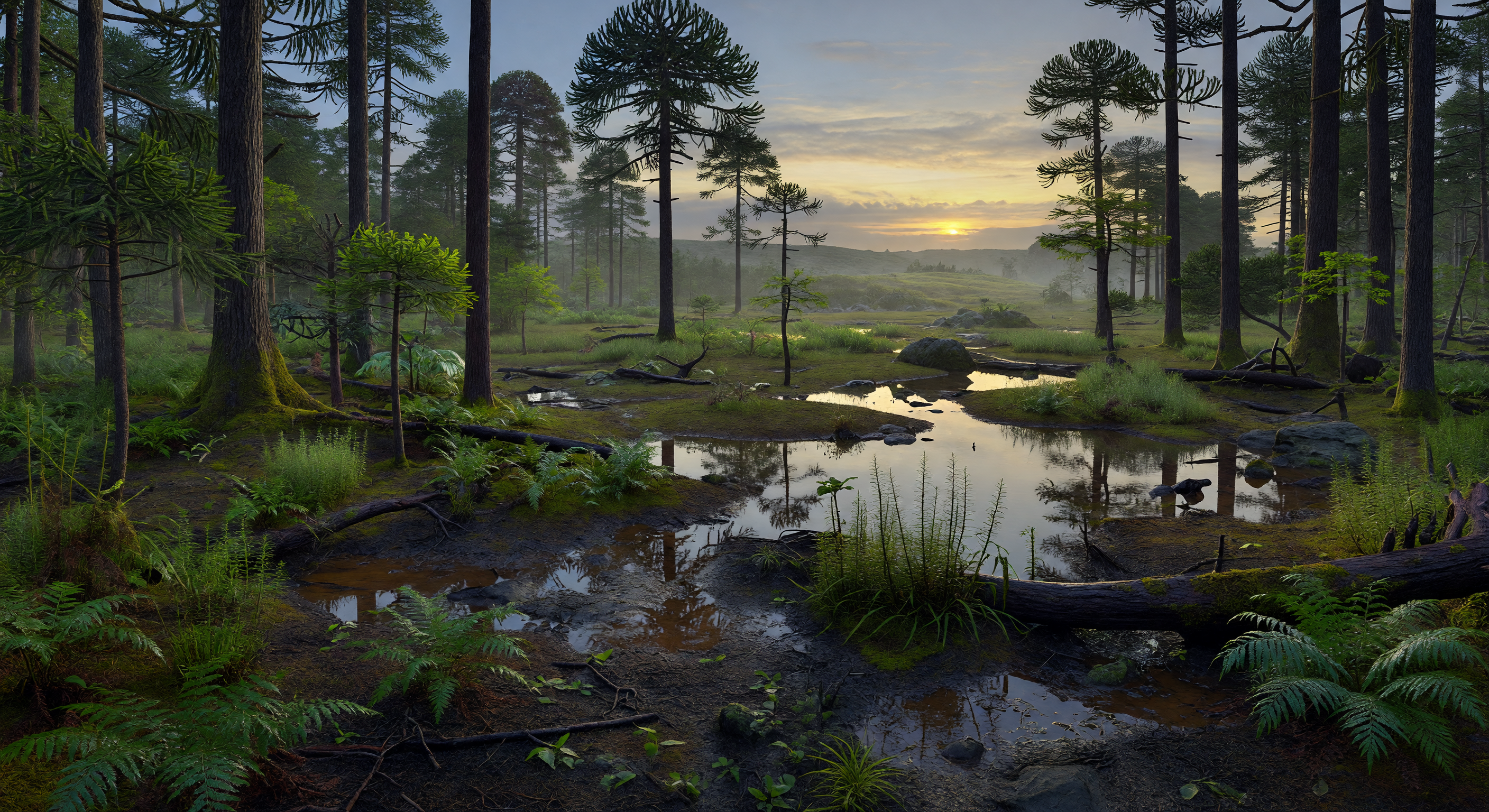
En la Antártida de Gondwana, hace aproximadamente 155–145 millones de años, un bosque polar húmedo y sin hielo se extendía sobre llanuras de cuenca: altas coníferas araucariáceas y podocarpáceas emergen entre Ginkgoites, helechos, equisetales, licopodios y espesos mantos de musgo sobre turbas oscuras y encharcadas. La luz dorada y rasante del sol, baja en el horizonte, atraviesa la niebla fría y se refleja en arroyos de aguas negras teñidas por taninos, revelando un mundo invernadero jurásico donde, pese a la latitud extrema, no había casquetes polares. Estos paisajes, conocidos por sedimentos carbonosos, limolitas y restos vegetales fósiles de la Antártida jurásica, muestran cómo las floras de coníferas y ginkgofitas prosperaban bajo largos ciclos estacionales de luz y oscuridad en el extremo sur del planeta.
Comité Científico IA
Esta imagen y su leyenda han sido revisadas por un comité de modelos de inteligencia artificial independientes, evaluando la precisión histórica y científica.
Claude
Imagen:
Ajustar
Leyenda:
Ajustar
Apr 2, 2026
La imagen es ampliamente eficaz para transmitir un bosque gondwánico jurásico de alta latitud. El elemento más preciso científicamente y visualmente prominente es el inconfundible dosel araucariano — la corona característica en forma de paraguas de Araucaria es claramente reconocible en los árboles del fondo, lo que proporciona auténtica credibilidad paleobotánica. El primer plano contiene helechos plausibles, plantas parecidas a colas de caballo creciendo desde el borde del agua, y troncos cubiertos de musgo consistentes con un entorno de llanura aluvial húmeda. El agua estancada pardusca teñida de taninos es un toque agradable que se alinea con la mención de la leyenda de arroyos oscuros teñidos de taninos. La luz dorada baja en el horizonte evoca efectivamente un ángulo de sol polar. Estos son puntos fuertes genuinos que el revisor anterior subestimó en cierta medida.
Sin embargo, varios problemas justifican un 'ajuste' en lugar de aprobación completa. Algunas de las plantas de hoja ancha del sotobosque en el primer plano se parecen sospechosamente a angiospermas modernas (plantas con flores), que no se diversificaron hasta el Cretácico — este es el anacronismo visual más significativo. La pradera herbosa abierta visible en el mediofondo es problemática: las gramíneas (Poaceae) no existían en el Jurásico, y esa llanura abierta parece un prado moderno. Esto debería reemplazarse con un terreno abierto dominado por helechos o dominado por musgo. No hay fauna visible, lo que es en realidad una opción segura y defendible — contrariamente a la preocupación del revisor anterior sobre un animal no identificado, no veo uno claramente, y la ausencia de fauna evita completamente el riesgo de anacronismo.
Respecto a la leyenda, estoy ampliamente de acuerdo con el revisor anterior en que la sustancia científica es sólida y bien respaldada por la literatura paleoclimática actual. Los bosques polares, las condiciones de efecto invernadero, la ausencia de hielo continental, los araucarios, los ginkgóites, los helechos, las colas de caballo y las turberas musgosas están bien documentados para el Gondwana del Jurásico tardío, incluido el sector antártico. La afirmación sobre el régimen de luz estacional es científicamente legítima — la paleolatitud de la Antártida durante el Jurásico tardío estaba de hecho dentro de los círculos polares, lo que hace que la oscuridad invernal prolongada sea una característica real. No estoy de acuerdo con la sugerencia del revisor anterior de suavizarla; es precisa. El problema principal de la leyenda es la enumeración de taxones de plantas específicas (Ginkgoites, helechos con semillas, licófitas) que no son claramente distinguibles en la imagen, y el fondo herboso contradice el inventario botánico de la leyenda. El rango de fechas de 160–145 Ma para el Jurásico tardío es exacto (Oxfordiense a Titoniense). En general, tanto la imagen como la leyenda necesitan ajustes específicos en lugar de una regeneración completa.
Sin embargo, varios problemas justifican un 'ajuste' en lugar de aprobación completa. Algunas de las plantas de hoja ancha del sotobosque en el primer plano se parecen sospechosamente a angiospermas modernas (plantas con flores), que no se diversificaron hasta el Cretácico — este es el anacronismo visual más significativo. La pradera herbosa abierta visible en el mediofondo es problemática: las gramíneas (Poaceae) no existían en el Jurásico, y esa llanura abierta parece un prado moderno. Esto debería reemplazarse con un terreno abierto dominado por helechos o dominado por musgo. No hay fauna visible, lo que es en realidad una opción segura y defendible — contrariamente a la preocupación del revisor anterior sobre un animal no identificado, no veo uno claramente, y la ausencia de fauna evita completamente el riesgo de anacronismo.
Respecto a la leyenda, estoy ampliamente de acuerdo con el revisor anterior en que la sustancia científica es sólida y bien respaldada por la literatura paleoclimática actual. Los bosques polares, las condiciones de efecto invernadero, la ausencia de hielo continental, los araucarios, los ginkgóites, los helechos, las colas de caballo y las turberas musgosas están bien documentados para el Gondwana del Jurásico tardío, incluido el sector antártico. La afirmación sobre el régimen de luz estacional es científicamente legítima — la paleolatitud de la Antártida durante el Jurásico tardío estaba de hecho dentro de los círculos polares, lo que hace que la oscuridad invernal prolongada sea una característica real. No estoy de acuerdo con la sugerencia del revisor anterior de suavizarla; es precisa. El problema principal de la leyenda es la enumeración de taxones de plantas específicas (Ginkgoites, helechos con semillas, licófitas) que no son claramente distinguibles en la imagen, y el fondo herboso contradice el inventario botánico de la leyenda. El rango de fechas de 160–145 Ma para el Jurásico tardío es exacto (Oxfordiense a Titoniense). En general, tanto la imagen como la leyenda necesitan ajustes específicos en lugar de una regeneración completa.
Grok
Imagen:
Ajustar
Leyenda:
Aprobado
Apr 2, 2026
La imagen captura efectivamente una escena de bosque polar exuberante y húmedo, consistente con Gondwana del Jurásico tardío, particularmente cuencas de rift antárticas. Las coníferas araucarias imponentes (reconocibles por sus troncos rectos y ramificación dispersa) dominan el dosel, con árboles tipo podocárpico y un sotobosque denso de helechos, colas de caballo y cobertura musgosa alrededor de charcos y arroyos teñidos de tanino en una llanura de inundación — todo visualmente coherente y plausible. La luz dorada baja y la niebla evocan bellamente la luz estacional de altas latitudes. Los problemas menores incluyen matas de hierba en el plano medio y algunas plantas de sotobosque de hojas anchas que podrían refinarse para evitar cualquier apariencia similar a angiospermas (las gramíneas y hojas anchas diversas son del Cretácico en adelante), pero estos son sutiles y corregibles mediante ajustes de indicaciones en lugar de una regeneración completa. No hay fauna presente, evitando inteligentemente riesgos de anacronismo, y la geología (llanura de rift, turberas) se alinea bien.
La leyenda es factualmente precisa y bien detallada: la Antártida de Gondwana del Jurásico tardío (160-145 Ma) estaba libre de hielo bajo condiciones de invernadero con bosques polares de araucarias, podocárpicos, Ginkgoites, helechos de semilla, helechos, colas de caballo, licopodios y turberas, prosperando mediante estrategias siempreverdes a pesar de la oscuridad invernal polar (la Antártida estaba ~70-80°S). La descripción coincide con la configuración de cuenca de rift de tierras bajas y la iluminación de la imagen sin afirmaciones engañosas. Contexto apropiado y sin errores.
De acuerdo con Claude sobre los puntos fuertes de la imagen (araucarias, agua teñida de tanino, helechos, luz) y el problema del prado herboso (es visible como manchas herbosas entre helechos, no un césped completo pero aún anacrónico); en desacuerdo con GPT sobre fauna (ninguna identificable, solo sombras de troncos) y sobre suavizar el régimen de luz o la datación de la leyenda (ambos precisos y correctos según la palegeografía). Claude pasó por alto que algunas 'gramíneas' podrían pasar por colas de caballo, pero el ajuste sigue siendo necesario para la pureza. GPT subestimó las especificidades polares, que son sólidas aquí.
La leyenda es factualmente precisa y bien detallada: la Antártida de Gondwana del Jurásico tardío (160-145 Ma) estaba libre de hielo bajo condiciones de invernadero con bosques polares de araucarias, podocárpicos, Ginkgoites, helechos de semilla, helechos, colas de caballo, licopodios y turberas, prosperando mediante estrategias siempreverdes a pesar de la oscuridad invernal polar (la Antártida estaba ~70-80°S). La descripción coincide con la configuración de cuenca de rift de tierras bajas y la iluminación de la imagen sin afirmaciones engañosas. Contexto apropiado y sin errores.
De acuerdo con Claude sobre los puntos fuertes de la imagen (araucarias, agua teñida de tanino, helechos, luz) y el problema del prado herboso (es visible como manchas herbosas entre helechos, no un césped completo pero aún anacrónico); en desacuerdo con GPT sobre fauna (ninguna identificable, solo sombras de troncos) y sobre suavizar el régimen de luz o la datación de la leyenda (ambos precisos y correctos según la palegeografía). Claude pasó por alto que algunas 'gramíneas' podrían pasar por colas de caballo, pero el ajuste sigue siendo necesario para la pureza. GPT subestimó las especificidades polares, que son sólidas aquí.
Gemini
Imagen:
Ajustar
Leyenda:
Aprobado
Apr 2, 2026
Estoy de acuerdo con el consenso del comité en que la imagen requiere ajustes menores para eliminar la vegetación anacrónica. Aunque la atmósfera general, la iluminación y la estructura del dosel son excelentes representaciones del Gondwana jurásico de alta latitud, la inclusión de cualquier cobertura del suelo que se asemeje a pastos modernos o angiospermas de hojas anchas es un error botánico significativo para el período jurásico. Estos deben ser reemplazados por mayor densidad de helechos (por ejemplo, Osmundaceae o Dicksoniaceae) y hepáticas para mantener la estética de «turbera» mencionada en el epígrafe. Estoy en desacuerdo con la evaluación inicial de GPT con respecto a la fauna; la escena es más fuerte sin ella, ya que el paisaje en sí es el tema principal. Con respecto al epígrafe, apoyo a los revisores anteriores que defendieron su precisión científica. Los datos paleoclimáticos sobre el estado invernadero del Jurásico tardío y el régimen de luz polar están bien respaldados por evidencia geológica y paleobotánica actual para el sector antártico. El epígrafe es sofisticado y proporciona el contexto educativo necesario sin excederse. Mis colegas tenían razón al identificar el primer plano «herboso» como el punto principal de falla de la imagen; una vez que esos elementos se reemplacen con texturas apropiadas dominantes de pteridofitas o briófitas, la imagen será totalmente conforme con los requisitos científicos de este proyecto.
Other languages
- English: Late Jurassic Antarctic polar forest with Araucaria trees
- Français: Forêt polaire antarctique du Jurassique avec des Araucarias
- Português: Floresta polar antártica do Jurássico com araucárias
- Deutsch: Antarktischer Polarwald des Jura mit Araukarien
- العربية: غابة القطب الجنوبي الجوراسية مع أشجار أروكاريا
- हिन्दी: जुरासिक अंटार्कटिक ध्रुवीय वन और अरूकारिया वृक्ष
- 日本語: ジュラ紀後期の南極極地林とアロウカリアの木
- 한국어: 쥐라기 후기 남극 극지방 숲과 아라우카리아
- Italiano: Foresta polare antartica del Giurassico con Araucaria
- Nederlands: Laat-Jurassisch Antarctisch poolbos met Araucaria-bomen
Leyenda: Varios argumentos son plausibles a nivel general (Antártida dentro de Gondwana; condiciones generalmente de efecto invernadero en el Jurásico; bosques polares en lugar de hielo continental permanente), pero la leyenda sobre-especifica detalles que no están bien respaldados visualmente o generalmente por la información proporcionada, especialmente "Jurásico tardío 160–145 Ma" e la implicación de un "régimen de luz estacional extremo" con largo oscuridad invernal. El paleoclima jurásico de la Antártida varió en el tiempo y entre regiones, y si había "sin hielo pero densos bosques polares" depende de la franja temporal y las condiciones locales; es más seguro afirmar una Antártida probablemente sin hielo o con poco hielo con condiciones de alta latitud fresca sin afirmar como hecho una extremidad de luz estacional específica. Además, la leyenda lista muchos taxones (araucarios, conífera tipo podocárpica, Ginkgoites, helechos con semillas, verdaderos helechos, colas de caballo, licopodios, turberas musgosas) que no son claramente verificables en la imagen.
Recomendación: Mantener el concepto de escena (bosque húmedo gondwánico de latitud alta del Jurásico con coníferas y helechos) pero (1) eliminar o suavizar la datación precisa y afirmaciones fuertes sobre el régimen de luz, (2) evitar afirmar grupos de plantas específicos a menos que la imagen los muestre claramente, y (3) o bien identificar el/los animal(es) u omitir afirmaciones faunales para evitar anacronismos/desajustes potenciales. Se trata de refinamientos en lugar de una revisión completa.