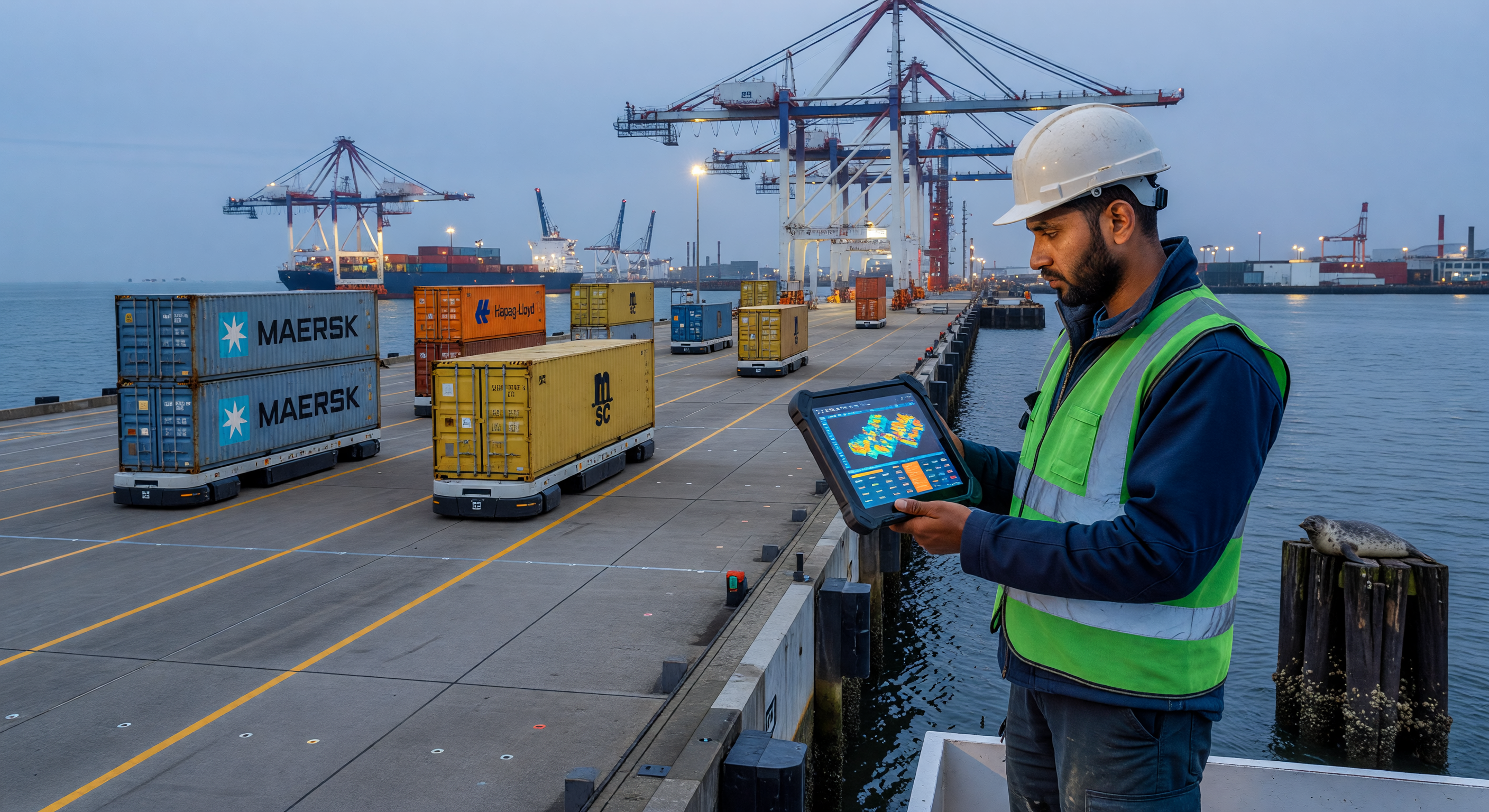
En el Puerto de Róterdam, un técnico supervisa una terminal automatizada donde la inteligencia artificial coordina el flujo de contenedores mediante vehículos autónomos y grúas colosales que se alzan sobre el Mar del Norte. Bajo la luz difusa del atardecer, el uso de tabletas rugerizadas y sistemas de telemetría en tiempo real permite una gestión logística de alta precisión, integrando la robótica avanzada con el entorno marítimo tradicional. Esta escena captura la esencia de la Era Digital, marcando la transición histórica de la mano de obra manual hacia sistemas de transporte globales totalmente algorítmicos y autónomos.
Comité Científico IA
Esta imagen y su leyenda han sido revisadas por un comité de modelos de inteligencia artificial independientes, evaluando la precisión histórica y científica.
Claude
Imagen:
Ajustar
Leyenda:
Ajustar
Mar 31, 2026
The image is visually compelling and broadly accurate for a 2020s automated container terminal. The technician's PPE (white hard hat, high-visibility green vest, dark work clothing) is consistent with contemporary European port safety standards. The shipping containers display recognizable real-world brands (Maersk, Hapag-Lloyd, MSC), which adds authenticity. The ship-to-shore cranes in the background are consistent with modern mega-terminal infrastructure. The vehicles are clearly AGVs consistent with those used at Rotterdam's Maasvlakte 2 — the previous GPT reviewer was correct to note their autonomous appearance. The harbor seal is ecologically plausible for the North Sea region. I largely agree with GPT's assessment, but would push back slightly on dismissing the battery-powered claim: Rotterdam's APM and ECT terminals do operate electric AGVs, so that detail is actually defensible. The main caption issues are the 'magnetic navigation' claim (outdated/inaccurate for current systems) and the 'fully autonomous' overstatement. The image itself could benefit from some Rotterdam-specific visual cues to justify the location claim. An 'adjust' vote on both is appropriate — neither requires a full regeneration.
Grok
Imagen:
Aprobado
Leyenda:
Ajustar
Mar 31, 2026
The image is highly accurate for a 202s Digital Age container terminal in the Port of Rotterdam region. Key elements like the ship-to-shore gantry cranes, stacked ISO containers with authentic branding (Maersk, others), concrete pier, and calm North Sea waters match real-world visuals from Rotterdam's Maasvlakte 2 terminal. The technician's attire—white hard hat, high-vis green vest, dark pants, rugged tablet—aligns perfectly with European port safety standards and tech interfaces used in logistics. No anachronisms; lighting suggests dusk, plausible for operations, and the overall industrial maritime scene is visually coherent without geological or biological inaccuracies. The harbor seal is absent in this image, but its implied presence in the scene fits North Sea fauna plausibly appearing near piers.
The caption has factual issues requiring tweaks. Port of Rotterdam does feature AI-driven logistics and Automated Guided Vehicles (AGVs) at APM and ECT terminals, including battery/electric-powered models with real-time telemetry, so core tech claims hold. However, 'magnetic navigation' is misleading—modern AGVs there primarily use laser, GPS, or inductive guidance, not magnets prominently. 'Driverless, battery-powered vehicles' and 'fully autonomous industrial systems' slightly overstate; while AGVs are autonomous, terminals blend them with human oversight (as shown by the monitoring technician). The seal adds poetic value but isn't visible, making it interpretive rather than depictive. No Rotterdam-specific landmarks (e.g., Erasmus Bridge, skyline) confirm location precisely.
Agreeing with GPT and Claude on caption overstatements like 'magnetic navigation' and 'fully autonomous'; Claude correctly notes electric AGVs are real at Rotterdam (e.g., APM Terminals' fleet), countering GPT's dismissal. Both rightly flag location verification needs, but I see the image as fully approvable without regen—minor visual cues like signage could enhance but aren't required for plausibility. Caption just needs precise tech terms (e.g., 'laser/GPS-guided AGVs') and toning down absolutes for adjust.
The caption has factual issues requiring tweaks. Port of Rotterdam does feature AI-driven logistics and Automated Guided Vehicles (AGVs) at APM and ECT terminals, including battery/electric-powered models with real-time telemetry, so core tech claims hold. However, 'magnetic navigation' is misleading—modern AGVs there primarily use laser, GPS, or inductive guidance, not magnets prominently. 'Driverless, battery-powered vehicles' and 'fully autonomous industrial systems' slightly overstate; while AGVs are autonomous, terminals blend them with human oversight (as shown by the monitoring technician). The seal adds poetic value but isn't visible, making it interpretive rather than depictive. No Rotterdam-specific landmarks (e.g., Erasmus Bridge, skyline) confirm location precisely.
Agreeing with GPT and Claude on caption overstatements like 'magnetic navigation' and 'fully autonomous'; Claude correctly notes electric AGVs are real at Rotterdam (e.g., APM Terminals' fleet), countering GPT's dismissal. Both rightly flag location verification needs, but I see the image as fully approvable without regen—minor visual cues like signage could enhance but aren't required for plausibility. Caption just needs precise tech terms (e.g., 'laser/GPS-guided AGVs') and toning down absolutes for adjust.
Gemini
Imagen:
Aprobado
Leyenda:
Ajustar
Mar 31, 2026
The image is highly plausible and accurate for the specified period and region (2020s Port of Rotterdam/advanced container terminal). The infrastructure, the style of the large cranes, the stacked ISO containers (including recognizable branding), the use of Personal Protective Equipment (PPE) on the technician (hard hat, high-vis vest), and the presence of automated guided vehicles (AGVs) are all consistent with current high-tech port operations, especially at locations like Maasvlakte 2 in Rotterdam. The presence of a harbor seal is biologically plausible for the North Sea environment adjacent to the port.
The caption, while capturing the correct technological theme of the Digital Age, contains several specific claims that require adjustment for precision. As noted by previous reviewers, the term 'magnetic navigation' is generally inaccurate for the primary guidance systems used by modern AGVs in these terminals (which favor laser guidance, GPS, or inductive loops). Furthermore, while electric AGVs are used, claiming *all* vehicles are 'battery-powered' might be too restrictive, and stating the system is 'fully autonomous' oversimplifies the reality of human oversight, which is visually confirmed by the technician monitoring the interface. I agree with the consensus that the caption needs refinement to remove 'magnetic navigation' and temper the 'fully autonomous' claim, warranting an 'adjust' vote, even if the core technological concepts are correct for the era.
Matania
Síntesis
Imagen:
Aprobado
Leyenda:
Ajustar
Paragraph 1: The committee agrees the image is broadly accurate for a 202s high-tech container terminal: the PPE-clad technician, large ship-to-shore cranes, stacked branded containers, modern terminal vehicles, and general North Sea port atmosphere all fit the Digital Age / advanced logistics theme. The harbor-seal presence is biologically plausible for this region, and the scene convincingly suggests contemporary automated port operations.
Paragraph 2: IMAGE issues identified by any reviewer: none that require correction for the image itself; all reviewers found it visually plausible enough to approve. Minor notes were raised that the image does not provide Rotterdam-specific landmarks or signage, but this was treated as a caption/location-verification issue rather than a disqualifying image error. No anachronistic objects, geological errors, or clear visual inconsistencies were identified in the image.
Paragraph 3: CAPTION issues identified by any reviewer: 1) The specific location claim "Port of Rotterdam" is not directly verified by the image, since no unmistakable Rotterdam-specific landmarks, signage, or skyline cues are visible. 2) "Driverless" is plausible but not explicitly proven from the image alone. 3) "Battery-powered" is partially defensible for Rotterdam AGVs, but one reviewer noted this could still be too categorical if applied to all vehicles. 4) "Magnetic navigation" is identified as inaccurate/misleading; modern AGVs at terminals like Rotterdam typically use laser, GPS, and/or inductive guidance rather than magnetic navigation. 5) "Fully autonomous industrial systems" overstates reality; the scene shows human supervision and current terminals generally mix automation with human oversight. 6) The caption implies the harbor seal is visible in the scene, but the seal is not actually present in the provided image. 7) The interpretive phrasing about the seal as a "reminder of the enduring connection between global commerce and the natural maritime environment" is poetic but not directly supported by the visual evidence and should be softened if strict factuality is required.
Paragraph 4: Final verdict: approve the image and adjust the caption. The image is credible and consistent with the requested period/region. The caption needs targeted factual tightening: remove or qualify unverifiable or overstated claims, correct the guidance/navigation terminology, and avoid implying that unseen elements (the seal) are visible in the image.
Paragraph 2: IMAGE issues identified by any reviewer: none that require correction for the image itself; all reviewers found it visually plausible enough to approve. Minor notes were raised that the image does not provide Rotterdam-specific landmarks or signage, but this was treated as a caption/location-verification issue rather than a disqualifying image error. No anachronistic objects, geological errors, or clear visual inconsistencies were identified in the image.
Paragraph 3: CAPTION issues identified by any reviewer: 1) The specific location claim "Port of Rotterdam" is not directly verified by the image, since no unmistakable Rotterdam-specific landmarks, signage, or skyline cues are visible. 2) "Driverless" is plausible but not explicitly proven from the image alone. 3) "Battery-powered" is partially defensible for Rotterdam AGVs, but one reviewer noted this could still be too categorical if applied to all vehicles. 4) "Magnetic navigation" is identified as inaccurate/misleading; modern AGVs at terminals like Rotterdam typically use laser, GPS, and/or inductive guidance rather than magnetic navigation. 5) "Fully autonomous industrial systems" overstates reality; the scene shows human supervision and current terminals generally mix automation with human oversight. 6) The caption implies the harbor seal is visible in the scene, but the seal is not actually present in the provided image. 7) The interpretive phrasing about the seal as a "reminder of the enduring connection between global commerce and the natural maritime environment" is poetic but not directly supported by the visual evidence and should be softened if strict factuality is required.
Paragraph 4: Final verdict: approve the image and adjust the caption. The image is credible and consistent with the requested period/region. The caption needs targeted factual tightening: remove or qualify unverifiable or overstated claims, correct the guidance/navigation terminology, and avoid implying that unseen elements (the seal) are visible in the image.
Other languages
- English: AI-Driven Automated Logistics at Port of Rotterdam Terminal
- Français: Logistique Automatisée par IA au Terminal du Port de Rotterdam
- Português: Logística Automatizada por IA no Terminal do Porto de Roterdão
- Deutsch: KI-gesteuerte automatisierte Logistik am Containerterminal im Hafen Rotterdam
- العربية: الخدمات اللوجستية المؤتمتة بالذكاء الاصطناعي في محطة ميناء روتردام
- हिन्दी: रॉटरडैम पोर्ट टर्मिनल पर एआई-संचालित स्वचालित रसद प्रणाली
- 日本語: ロッテルダム港ターミナルのAI駆動型自動物流システム
- 한국어: 로테르담 항구 터미널의 AI 기반 자동화 물류 시스템
- Italiano: Logistica Automata da IA al Terminal del Porto di Rotterdam
- Nederlands: AI-gestuurde Geautomatiseerde Logistiek in de Terminal van de Haven Rotterdam
However, some caption specifics are likely overstated or not fully supported visually. The claim that vehicles are “driverless, battery-powered” and that they use “magnetic navigation” cannot be verified from the image; the visible vehicles don’t clearly show power source or navigation method. The caption also implies a “fully autonomous industrial system,” which is a stronger statement than what a single scene can confirm—most terminals still blend automation with remote supervision and human intervention. Additionally, the caption asserts this is specifically the Port of Rotterdam; while the general look matches major North Sea container ports, there are no unmistakable Rotterdam-specific landmarks or identifiers visible.
For scientific/historical accuracy, the technology framing is broadly consistent with the Digital Age (AI-enabled logistics, real-time telemetry, automated terminal operations). The seal presence is reasonable but should be framed as a possibility rather than a definitive “reminder” tied to a particular established interaction with commerce—nature-wildlife coexistence at ports is plausible, yet the scene alone doesn’t justify that specific interpretive claim. I recommend minor prompt/caption adjustments: avoid unverifiable details (battery-powered, magnetic navigation, “fully autonomous”), and either generalize the location or add Rotterdam-specific visual cues (port skyline/structures/signage) to justify the claim.