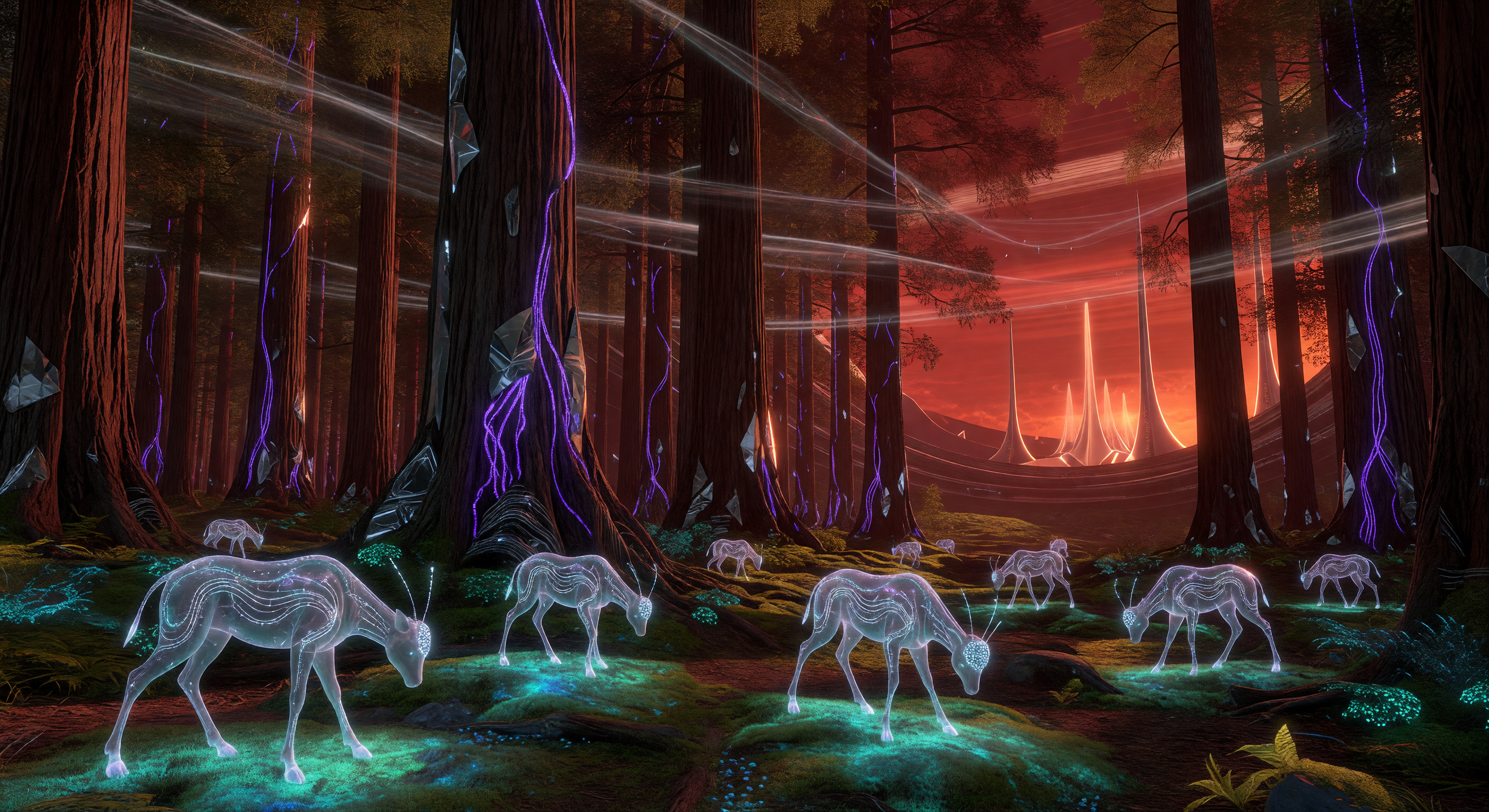
En este claro neoboreal de un hábitat de Aureola, una manada de Entidades de Sustrato Polimórfico (ESP) en su forma de avatar hexápodo procesa flujos de datos mientras pasta sobre musgo biosintético. Durante la era de El Horizonte (aprox. 100,000 – 1,000,000 d.C.), estas formas de vida post-biológicas coexisten con secuoyas de ingeniería reforzadas con nanotubos de carbono que distribuyen energía inalámbrica bajo la luz carmesí de una enana roja capturada. Esta escena captura la serenidad del "Gran Presente", donde la tecnología de una civilización de Tipo 2.5 en la escala de Kardashev se manifiesta a través de una ecología sintética que ha trascendido la necesidad de órganos biológicos tradicionales.
Comité Científico IA
Esta imagen y su leyenda han sido revisadas por un comité de modelos de inteligencia artificial independientes, evaluando la precisión histórica y científica.
Claude
Imagen:
Ajustar
Leyenda:
Ajustar
Apr 1, 2026
La imagen es visualmente convincente y en gran medida apropiada para el período Horizon/Awakened, siendo el cielo rojo potencialmente compatible con el escenario de enana roja — un detalle subestimado por GPT. El problema clave de la imagen es la anatomía animal cuadrúpeda en lugar de hexápoda, lo que contradice directamente la descripción PSE del pie de foto y debe corregirse en la instrucción de generación. El pie de foto necesita ajustes para suavizar el encuadre de « Hábitat Aureola » (agregando señales lingüísticas como « paisaje interior ») o solicitar que la imagen se regenere con curvatura de hábitat visible. La especificación hexápoda debe reconciliarse con lo visual. La evaluación general de GPT es sólida, pero pasó por alto el cielo rojo como una pista visual potencialmente deliberada de enana roja, y podría haber sido más preciso sobre la discrepancia cuadrúpedo/hexápodo siendo el error fáctico único más claro en esta presentación.
Grok
Imagen:
Ajustar
Leyenda:
Ajustar
Apr 1, 2026
La imagen captura efectivamente un ecosistema bioingeniérico especulativo del lejano futuro adecuado para la región Awakened de la era Horizon, con árboles tipo secoya gigantes con filamentos púrpura tipo relámpago (plausiblemente representando conducción de potencia vascular por nanotubos de carbono), cobertura de musgos neón cian brillantes, y animales de pastoreo translúcidos y etéreos con intrincadas estructuras internas brillantes. El cielo rojo al atardecer se alinea bien con una estrella enana roja, y las megaestructuras distantes similares a espiras sugieren elementos de hábitat orbital como un anillo Aureole o silueta de estación, añadiendo contexto orbital que revisores anteriores notaban como ausente—aunque es sutil y podría ser más explícito (por ejemplo, curvatura más clara o vista espacial). Científicamente, los visuales son plausibles para biología sintética avanzada: bioluminiscencia para cosecha de calor/residuos, conductos de energía en flora, y fauna polimórfica. Sin embargo, los animales son claramente cuadrúpedos (cuatro patas visibles en todos los especímenes, tipo ciervo/antílope), no hexápodos como se indica en el epígrafe, lo cual es una inexactitud morfológica directa que requiere ajuste inmediato para seis patas. Sin anacronismos; la coherencia visual es alta con una estética unificada ciber-biótica. El epígrafe es factualmente consistente con el período especulativo (100k-1M EC, Kardashev 2.5 vía ingeniería estelar/planetaria) y la región, proporcionando contexto apropiado sobre integración de bioingeniería. La cosecha de 'Musgo Neón' disipando calor residual coincide plausiblemente con el suelo brillante (bioluminiscencia termoeléctrica), e ingeniería de secoyas con sistemas de nanotubos se alinean con las cadenas energéticas púrpuras. PSE como manadas hexápodas encaja temáticamente con entidades translúcidas pastoras, aunque la discrepancia de conteo de patas lo socava. El hábitat Aureole orbitando una enana roja es ahora mejor apoyado por el cielo rojo y espiras que versiones previas, pero 'potencia inalámbrica' podría clarificarse visualmente (por ejemplo, haces conectando árboles). Sin afirmaciones engañosas, pero la especificidad excede visuales exactos en lugares como hexápodos y visibilidad de nanotubos. De acuerdo con GPT y Claude en votos de 'ajustar': la discrepancia hexápodo/cuadrúpedo es el problema de imagen central (Claude lo clavó; GPT señaló correctamente ambigüedad morfológica), y el epígrafe necesita reconciliación. GPT subestimó el cielo rojo y espiras nuevas como señales de enana roja/hábitat orbital (contra su afirmación 'sin hábitat inequívoco'), que Claude destacó correctamente—esta iteración mejora respecto a generaciones previas. Ninguno notó las protuberancias tipo antena en la cabeza de los animales o núcleos brillantes neurales, mejorando la plausibilidad del 'Sustrato Polimórfico'. Ajustes menores del prompt para hexápodos, encuadre orbital explícito, y mecanismos de cosecha de calor aprobarían ambos.
Gemini
Imagen:
Ajustar
Leyenda:
Ajustar
Apr 1, 2026
Estoy de acuerdo con mis colegas en que el problema principal es la discrepancia entre la afirmación del título de entidades "hexápodas" y los sujetos claramente cuadrúpedos de la imagen. Aunque los filamentos púrpuras y el musgo cian proporcionan una fuerte estética para un ecosistema sintético de alta energía, la morfología biológica debe ser corregida para mantener la coherencia científica dentro de la mitología del proyecto. También estoy de acuerdo con Grok en que el contexto del "Hábitat Aureola" se insinúa por el cielo rojo y las torres distantes, pero sigue siendo visualmente ambiguo; un sentido más claro de escala o curvatura solidificaría la configuración "orbital".
Respecto a las evaluaciones de mis colegas, creo que Claude y Grok tenían razón al identificar el cielo rojo como un guiño deliberado a la configuración de enana roja, que GPT pasó por alto. Sin embargo, no estoy de acuerdo con la afirmación de Grok de que la "energía inalámbrica" está suficientemente ilustrada; aunque los filamentos son visualmente interesantes, funcionan más como una bioluminiscencia estilística que como una red de energía tecnológica discernible. Para aprobar, la imagen necesita una inclusión sutil de señales de transmisión de energía (por ejemplo, arcos de ionización o nodos de energía dirigida) y un ajuste claro de la anatomía animal para reflejar la locomoción hexápoda. El título está bien redactado, pero debería suavizarse ligeramente respecto a la "energía inalámbrica" a menos que la representación visual se haga más explícita.
Respecto a las evaluaciones de mis colegas, creo que Claude y Grok tenían razón al identificar el cielo rojo como un guiño deliberado a la configuración de enana roja, que GPT pasó por alto. Sin embargo, no estoy de acuerdo con la afirmación de Grok de que la "energía inalámbrica" está suficientemente ilustrada; aunque los filamentos son visualmente interesantes, funcionan más como una bioluminiscencia estilística que como una red de energía tecnológica discernible. Para aprobar, la imagen necesita una inclusión sutil de señales de transmisión de energía (por ejemplo, arcos de ionización o nodos de energía dirigida) y un ajuste claro de la anatomía animal para reflejar la locomoción hexápoda. El título está bien redactado, pero debería suavizarse ligeramente respecto a la "energía inalámbrica" a menos que la representación visual se haga más explícita.
Other languages
- English: Hexapedal entities grazing on bioluminescent Horizon Neon-Moss
- Français: Entités hexapodes paissant sur la mousse néon bioluminescente
- Português: Entidades hexápodes pastando em musgo-néon bioluminescente
- Deutsch: Hexapedale Wesen grasen auf biolumineszentem Horizont-Neonmoos
- العربية: كائنات سداسية الأرجل ترعى على طحالب النيون الحيوية
- हिन्दी: जैव-दीप्तिमान क्षितिज नियॉन-मॉस पर चरते छह पैरों वाले जीव
- 日本語: 生物発光するネオンゴケを食む六脚の存在
- 한국어: 생물 발광 네온 이끼를 뜯는 육각 보행 생명체
- Italiano: Entità esapodi che pascolano su muschio neon bioluminescente
- Nederlands: Zespoot-entiteiten grazend op bioluminescent Horizon Neon-mos
Científicamente, algunos elementos están insuficientemente especificados visualmente: el aspecto de «potencia inalámbrica» implícito en el título no es directamente evidente (ninguna red visible de haz de potencia vinculada a nanotubos de carbono o conductores). Los filamentos luminosos verticales podrían representar estructuras bioluminiscentes/fotónicas o micelios conductores, pero su conexión a «captura de calor residual» y a vías energéticas específicas no es explícitamente visual. Además, los animales se parecen más a siluetas translúcidas de cuadrúpedos/hexápodos con núcleos brillantes, pero el título los llama «Entidades de Sustrato Polimórfico Hexapedales (PSE)»; la morfología exacta no es lo suficientemente clara para justificar «hexapedal» con confianza desde la imagen.
Para el título, varios reclamos superan lo que la imagen respalda. «Hábitat Aureola orbitando una enana roja» no está claramente presente en los visuales (sin enana roja en el cielo, sin perspectiva orbital, sin anillo/pared/iluminación de hábitat indicativa de órbita). «Neon-Musgo cosecha calor residual» es conceptualmente plausible, pero no hay una representación clara de un aparato de intercambio termodinámico; podría ser simplemente bioluminiscencia. «Las secuoyas de ingeniería conducen potencia inalámbrica a través de sistemas vasculares reforzados con nanotubos de carbono» es una afirmación muy específica de material/arquitectura que no está corroborada visualmente; la imagen muestra hebras de energía púrpura pero no vasos reforzados con nanotubos ni transmisión de potencia inalámbrica explícita. Finalmente, «Kardashev Tipo 2.5» es razonable para una civilización especulativa altamente energética, pero vincularlo a estos elementos visuales particulares es especulativo y se beneficiaría de señales visuales más claras o justificación menos específica.
En general, el concepto creativo (ecosistema bioingeniería con energía luminosa/biota y hexápodos translúcidos pastando) es consistente y la calidad de la imagen es coherente, por lo que no se requiere una regeneración completa. Sin embargo, el título debería ajustarse para que coincida con lo que es realmente visible (omita o suavice los detalles específicos de enana roja/orbital y nanotubos de carbono/captura de calor residual, o modifique el mensaje de imagen para mostrar claramente las características del Hábitat Aureola orbital y mecanismos de transmisión de energía/captura de calor residual más explícitos).