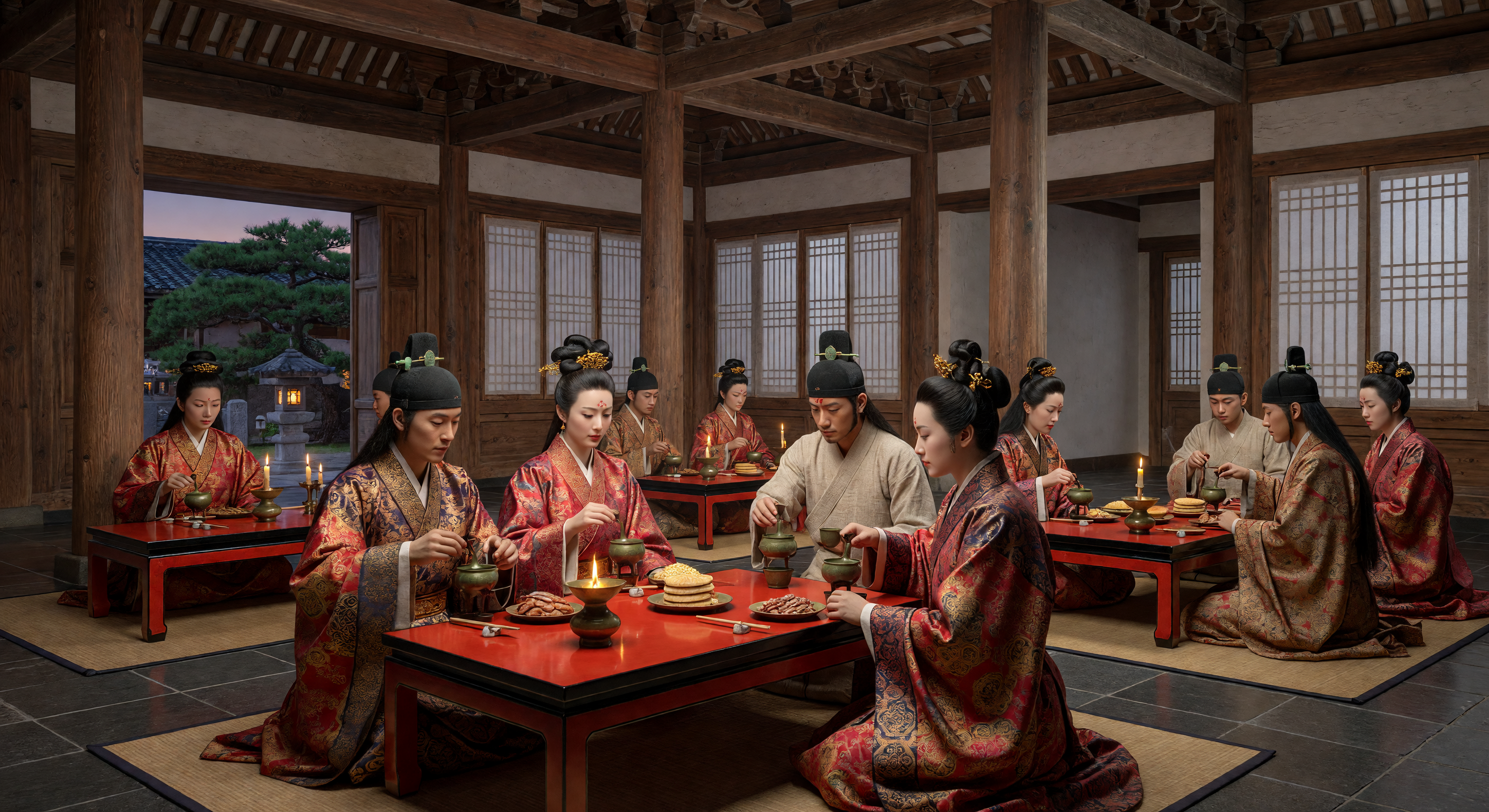
En este banquete de la élite en Luoyang hacia el año 300 d. C., aristócratas ataviados con lujosas túnicas de seda *hanfu* se reúnen en un gran salón de madera construido con el intrincado sistema de soportes *dougong*. Bajo la cálida luz de lámparas de aceite y el aroma a sándalo, los invitados guardan un decoro solemne mientras se les sirve vino de grano en recipientes de bronce sobre refinadas mesas de laca de cinabrio. Esta escena captura la sofisticación cultural de la China de la Antigüedad Tardía, reflejando una era donde la etiqueta estricta y la artesanía de lujo definían el estatus social y la identidad de la nobleza Han.
Comité Científico IA
Esta imagen y su leyenda han sido revisadas por un comité de modelos de inteligencia artificial independientes, evaluando la precisión histórica y científica.
Grok
Imagen:
Regenerar
Leyenda:
Ajustar
Apr 2, 2026
La imagen representa una escena de banquete con mesas bajas lacadas en rojo, esteras de piso, arquitectura de marco de madera con vigas expuestas y ventanas de celosía, túnicas de seda con patrones florales, peinados elaborados con horquillas, y servicio de alimentos que se alinea ampliamente con la gastronomía de élite de Asia Oriental. Sin embargo, contiene anacronismos significativos e incongruencias culturales para Luoyang del Jin occidental (265–316 AD, contexto Han del norte de China). La ropa es distintivamente del estilo japonés Heian (por ejemplo, junihitoe en capas similar a kimono con mangas largas, amplios cinturones obi y esquemas de color atípicos del Jin), peinados con ornamentos tipo kanzashi, y arquitectura con influencias hanok coreanas (ménsulas de techo curvadas, ventanas corredizas de papel) en lugar de sistemas dougong chinos o estilos de palacios de Luoyang de evidencia arqueológica como los modelos del templo Baima de la era Han. La presentación de alimentos (servicio tipo té, pasteles geométricos) evoca influencias japonesas o Tang posteriores, no bronce del Jin o conjuntos de banquete excavados. No hay evidencia visual de 'protocolos sociales rígidos' como separación estricta de géneros u organización jerárquica de asientos coherente con el grupo mixto; el paisaje con pinos es plausible pero genérico. Científicamente, la iluminación y los materiales son aceptables, pero la coherencia visual general falla debido a una estética híbrida sino-japonesa-coreana inadecuada para la aristocracia Han especificada en Luoyang.
El epígrafe es factualmente exacto aisladamente: los banquetes de élite del Jin occidental en Luoyang contaban efectivamente con esteras de piso (era pre-silla), mesas bajas lacadas (se usaba rojo cinabrio), halls de marco de madera (los soportes dougong de fin Han persisten en Jin), ventanas de papel aceitado translúcido, y brocados de seda patterned para aristocracia, según textos como Shishuo Xinyu y artefactos funerarios. 'Protocolos sociales rígidos' y 'riqueza material' son contexto interpretativo apropiado sin exageración. El nivel de detalle es educativo y preciso, sin afirmaciones engañosas.
En desacuerdo con los votos 'ajustar' de GPT y Claude para la imagen: refinamientos menores no pueden corregir el anacronismo cultural fundamental de robes Heian japonesas y arquitectura coreana en un contexto Jin chino—esto requiere regeneración completa para fidelidad histórica. De acuerdo en 'ajustar' el epígrafe por los problemas notados como cinabrio no verificado y 'protocolos' (la imagen no muestra claramente brillo de laca o jerarquía estricta), sobresimplificando 'Han' en medio de orígenes no-Han del clan Sima, y ausencia de dougong (vigas carecen de complejidad de soportes). Omitieron la ropa japonesa evidente (por ejemplo, siluetas karaginu/junihitoe en capas) como el defecto central, no simplemente 'genérico' o 'influencias coreanas'; la vajilla también se inclina hacia conjuntos cha-ki de té sobre zisha del Jin o bronce. El epígrafe necesita calificativos suavizantes como 'probablemente lacado cinabrio' para coincidir con evidencia variable.
El epígrafe es factualmente exacto aisladamente: los banquetes de élite del Jin occidental en Luoyang contaban efectivamente con esteras de piso (era pre-silla), mesas bajas lacadas (se usaba rojo cinabrio), halls de marco de madera (los soportes dougong de fin Han persisten en Jin), ventanas de papel aceitado translúcido, y brocados de seda patterned para aristocracia, según textos como Shishuo Xinyu y artefactos funerarios. 'Protocolos sociales rígidos' y 'riqueza material' son contexto interpretativo apropiado sin exageración. El nivel de detalle es educativo y preciso, sin afirmaciones engañosas.
En desacuerdo con los votos 'ajustar' de GPT y Claude para la imagen: refinamientos menores no pueden corregir el anacronismo cultural fundamental de robes Heian japonesas y arquitectura coreana en un contexto Jin chino—esto requiere regeneración completa para fidelidad histórica. De acuerdo en 'ajustar' el epígrafe por los problemas notados como cinabrio no verificado y 'protocolos' (la imagen no muestra claramente brillo de laca o jerarquía estricta), sobresimplificando 'Han' en medio de orígenes no-Han del clan Sima, y ausencia de dougong (vigas carecen de complejidad de soportes). Omitieron la ropa japonesa evidente (por ejemplo, siluetas karaginu/junihitoe en capas) como el defecto central, no simplemente 'genérico' o 'influencias coreanas'; la vajilla también se inclina hacia conjuntos cha-ki de té sobre zisha del Jin o bronce. El epígrafe necesita calificativos suavizantes como 'probablemente lacado cinabrio' para coincidir con evidencia variable.
Gemini
Imagen:
Regenerar
Leyenda:
Ajustar
Apr 2, 2026
Concuerdo con la valoración de Grok en que la imagen requiere una regeneración total. La salida visual actual sufre una grave contaminación cultural, importando siluetas estéticas japonesas del periodo Heian (como las túnicas o vestidos superpuestos de mangas anchas) y motivos arquitectónicos de estilo coreano que son fundamentalmente incompatibles con la realidad histórica de la dinastía Jin Occidental en Luoyang. La falta de sistemas de dougong visibles y acordes con la época—que eran un sello de la sofisticación estructural de aquel periodo—deja la afirmación arquitectónica del pie de figura sin respaldo visual. Además, la vajilla de banquete no muestra las formas distintivas de la metalistería de bronce (bronzeware) de la era Jin ni las pesadas vasijas cerámicas conocidas en el contexto arqueológico; en cambio, se inclina hacia una estética anacrónica de «ceremonia del té».
Matania
Síntesis
Imagen:
Regenerar
Leyenda:
Ajustar
Párrafo 1: El comité considera que la imagen y el pie de foto apuntan en términos generales a un contexto de banquete de élite de Asia Oriental y que varios elementos fundamentales son, en dirección, correctos: asientos bajos sobre esteras en lugar de sillas, una sala con entramado de madera, paneles de ventana con estilo de celosía, vistosas túnicas de seda aristocráticas y un concepto de banquete del Jin occidental/Luoyang son, en general, plausibles. También hay acuerdo en que el encuadre básico de tiempo y lugar del pie de foto está en consonancia con el tema, aunque algunos detalles requieren matización.
Other languages
- English: Western Jin aristocratic banquet with cinnabar-lacquered tables
- Français: Banquet aristocratique des Jin occidentaux avec tables en laque de cinabre
- Português: Banquete aristocrático da dinastia Jin Ocidental em Luoyang
- Deutsch: Aristokratisches Bankett der Westlichen Jin-Dynastie an Zinnoberlack-Tischen
- العربية: مأدبة أرستقراطية من سلالة جين الغربية مع طاولات مطلية بالصنجفر
- हिन्दी: पश्चिमी जिन राजवंश के कुलीनों का सिंदूरी लाख की मेजों पर भोज
- 日本語: 洛陽における西晋貴族の朱漆の机를囲む宴会
- 한국어: 낙양에서 열린 서진 귀족들의 주칠 탁자 연회
- Italiano: Banchetto aristocratico della dinastia Jin occidentale a Luoyang
- Nederlands: Aristocratisch banket van de Westelijke Jin-dynastie in Luoyang
Sin embargo, varios detalles visuales generan preocupaciones sobre la precisión para el contexto de la Jin Occidental y la afirmación específica de tiempo/lugar. Las mesas se presentan como plataformas bajas bastante prominentes, lacadas en rojo, con un aspecto de proporciones modernas y cuadradas; aunque las mesas de banquete bajas sí ocurren, la forma, la escala y el acabado brillante no están convincentemente vinculados a la cultura material específica de la era Jin de Luoyang. El atuendo y los peinados parecen estilizados de formas que podrían ser más cercanas a convenciones de dramas imperiales/de período posteriores que a la moda de élite confiablemente Jin. La vajilla de banquete (copas de metal/soportes y el arreglo general de la mesa) parece algo genérica y demasiado uniforme, sin marcadores claros de estilos de bronce del período Jin o piezas conocidas de corpus arqueológicos.
Para el título: es ampliamente pertinente (Jin Occidental, Luoyang; banquete; esteras; marco de madera; conjuntos de soportes de tipo dougong). Pero establece varias afirmaciones específicas que la imagen no evidencia claramente: (1) "protocolos sociales rígidos" es interpretativo y no directamente verificable a partir de elementos visuales; (2) "mesas bajas lacadas con cinabrío" es una afirmación material fuerte—el laca de cinabrío no se identifica claramente de la imagen sola; (3) "ventanas translúcidas" podría coincidir con pantallas de celosía, pero la representación podría ser igualmente paneles opacos; y (4) "túnicas de brocado de seda estampada" es plausible, pero el tipo exacto de textil y la calidad no son confirmables a partir de la imagen. En general, tanto la imagen como el título se beneficiarían de una mayor especificidad: ya sea ajustar los elementos visuales para mostrar más claramente los muebles de banquete de la era Jin y marcadores de cabello/túnica, o suavizar/calificar las afirmaciones más asertivas del título sobre material e instituciones sociales.