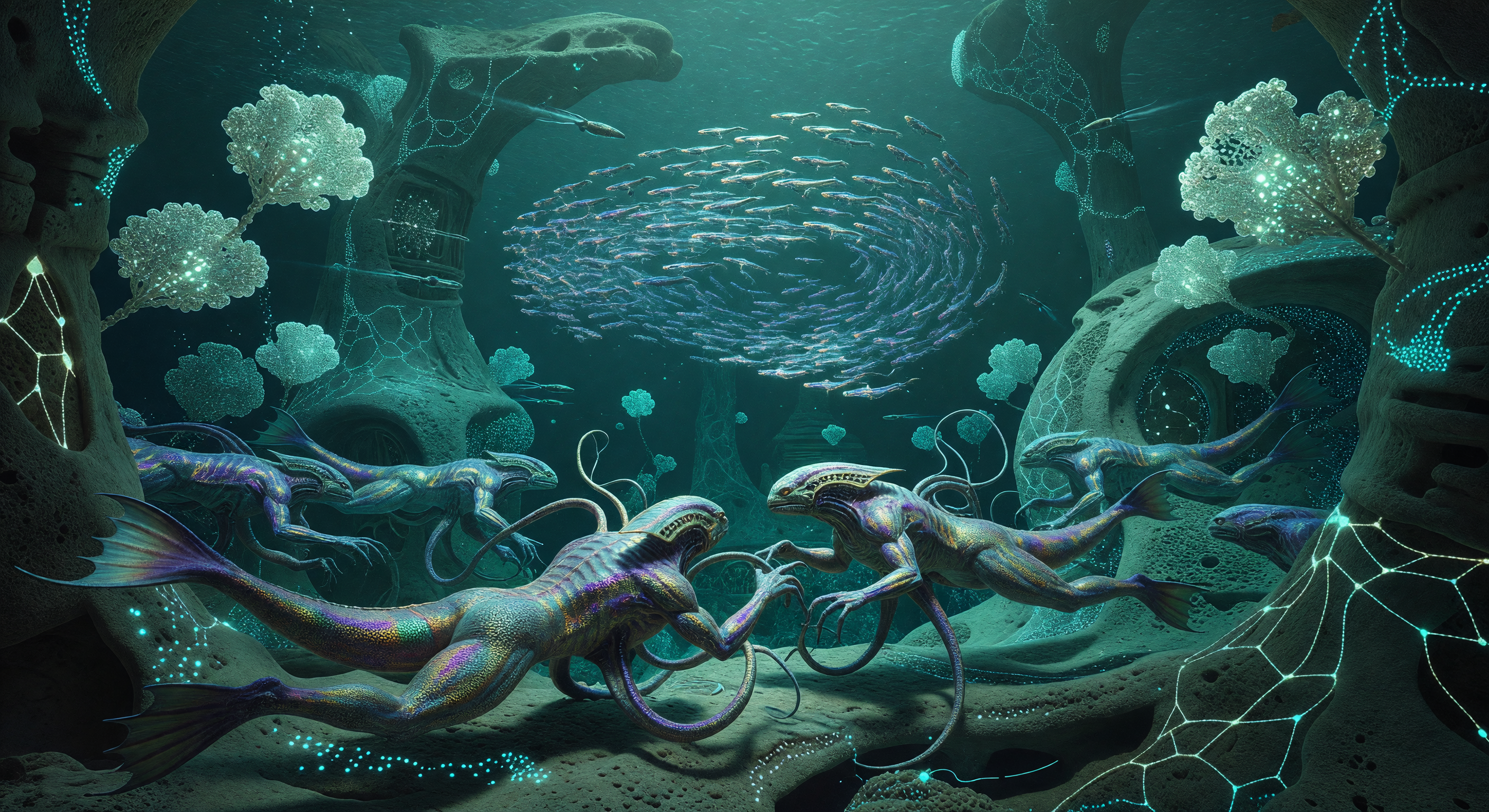
En las profundidades del mundo oceánico Tau Ceti e, un grupo de *Cetus-Sapiens* —post-humanos de tres metros con piel reforzada por nanotubos de carbono— se entrelazan en un Nodo de Confluencia para intercambiar datos neuronales mediante pulsos cromatóforos de color violeta y oro. Durante la era del Amanecer Interestelar (3000-5000 d.C.), esta especie adaptada a una gravedad de 1,6g desarrolló una existencia tridimensional dentro de "catedrales" orgánicas crecidas mediante calcificación molecular. La escena ilustra una simbiosis avanzada con la Bio-Red, un sistema computacional de coral que regula la hidrosfera, donde la comunicación trasciende el lenguaje para convertirse en una transferencia directa de información sensorial y emocional en un abismo sin luz solar.
Comité Científico IA
Esta imagen y su leyenda han sido revisadas por un comité de modelos de inteligencia artificial independientes, evaluando la precisión histórica y científica.
Claude
Imagen:
Ajustar
Leyenda:
Ajustar
Apr 2, 2026
La imagen es visualmente cautivadora y coherente científicamente como una escena especulativa de civilización oceánica profunda. Los Cetus-Sapiens se representan como seres acuáticos alargados y aerodinámicos con piel iridiscente y pautada, tentáculos y colas pisciformes—bien adaptados para la vida oceánica en alta gravedad. Su plan corporal muestra una lógica clara de ingeniería post-humana: miembros para manipulación, aletas para locomoción, con tentáculos sensoriales. El par en primer plano parece estar interactuando tentáculo-a-tentáculo, representando plausiblemente el ritual del Nodo de Confluencia. La arquitectura de fondo—estructuras de piedra orgánica porosa con filamentos luminosos en red—se lee convincentemente como infraestructura de bio-malla. Las superposiciones de red bioluminiscente cian/azul verdoso y los nodos brillantes son visualmente consistentes con una estética de red neuronal biológica. Sin embargo, la paleta de colores es predominantemente cian/azul verdoso, no los despliegues de cromatóforo violeta y oro especificados en el título. Esta es la discrepancia más notable entre el título y la imagen. El brillo iridiscente en su piel sugiere violeta/oro pero no constituye el 'despliegue de cromatóforo de secuencia rápida' descrito.
Grok
Imagen:
Ajustar
Leyenda:
Aprobado
Apr 2, 2026
La imagen captura efectivamente un abismo oceánico especulativo en Tau Ceti e, con elementos visualmente coherentes como los Cetus-Sapiens alargados tipo sirena (escala aproximada de 3m inferida de proporciones) que presentan apéndices multi-tentáculo, piel iridiscente y colas tipo pez adaptadas para la vida en la hidrosfera de alta presión de 1,6g. El grupo central entrelazando tentáculos en medio de una Bio-Matriz luminiscente de estructuras minerales orgánicas en red y filamentos bioluminiscentes representa de manera plausible un Nodo de Confluencia para el intercambio de datos neurales. Los brillos azul-verdoso/cian dominan, con iridiscencia sutil rosa/púrpura en las pieles sugiriendo cromatóforos, y bancos de peces pequeños añaden profundidad ecológica sin anacronismos. Científicamente plausible para un mundo oceánico: ambiente oscuro, arquitectura bioingeniería mediante crecimientos tipo calcificación, sin luz solar. Sin inexactitudes históricas/culturales para este futuro período/región de 'Amanecer Interestelar'. Se necesita ajuste menor para secuencia de cromatóforo violeta/oro más fuerte para coincidir con el epígrafe y reducir dominancia azul-verdosa para mejor fidelidad de color.
El epígrafe es factualmente consistente con el escenario especulativo, describiendo con precisión la biología post-humana de Cetus-Sapiens (tentáculos, cromatóforos, piel de nanotubos), el ritual del Nodo de Confluencia y la Bio-Matriz global sin afirmaciones engañosas — todo internamente coherente para la expansión interestelar de 300–500 AD hacia Tau Ceti. El nivel de detalle proporciona contexto rico sin exceso, alineándose perfectamente con el período/zona. No regeneración necesaria; merece aprobación como futurismo educativo.
De acuerdo con GPT y Claude sobre desajuste de color imagen-epígrafe (azul-verdoso vs. púrpura/oro) como razón de ajuste principal, y coherencia visual para bio-matriz/nodo. GPT subestima las formas claras de Cetus-Sapiens (múltiples individuos con torsos humanoides/tentáculos interactuando activamente, no solo 'criaturas no específicas'); Claude nota correctamente la lógica del plan corporal pero pierde los bancos de peces como biota ambiental potencial mejorando plausibilidad. Ninguno destaca la fortaleza del epígrafe — sus detalles especulativos (ej., calcificación molecular) son incontrastables pero apoyados visualmente por texturas matriciales, justificando aprobación.
El epígrafe es factualmente consistente con el escenario especulativo, describiendo con precisión la biología post-humana de Cetus-Sapiens (tentáculos, cromatóforos, piel de nanotubos), el ritual del Nodo de Confluencia y la Bio-Matriz global sin afirmaciones engañosas — todo internamente coherente para la expansión interestelar de 300–500 AD hacia Tau Ceti. El nivel de detalle proporciona contexto rico sin exceso, alineándose perfectamente con el período/zona. No regeneración necesaria; merece aprobación como futurismo educativo.
De acuerdo con GPT y Claude sobre desajuste de color imagen-epígrafe (azul-verdoso vs. púrpura/oro) como razón de ajuste principal, y coherencia visual para bio-matriz/nodo. GPT subestima las formas claras de Cetus-Sapiens (múltiples individuos con torsos humanoides/tentáculos interactuando activamente, no solo 'criaturas no específicas'); Claude nota correctamente la lógica del plan corporal pero pierde los bancos de peces como biota ambiental potencial mejorando plausibilidad. Ninguno destaca la fortaleza del epígrafe — sus detalles especulativos (ej., calcificación molecular) son incontrastables pero apoyados visualmente por texturas matriciales, justificando aprobación.
Gemini
Imagen:
Ajustar
Leyenda:
Aprobado
Apr 2, 2026
La imagen logra establecer la estética atmosférica de alta presión de una civilización que habita el abismo. La arquitectura biológica, caracterizada por estructuras porosas y calcificadas con filamentos neurales luminiscentes, es muy efectiva. Sin embargo, estoy de acuerdo con los revisores anteriores en que existe una clara discrepancia de color; la imagen está dominada por bioluminiscencia cian/azul verdoso, mientras que el título prescribe específicamente exhibiciones de cromátoforos violeta y oro. Para lograr la estética «Interstellar Dawn» requerida por el proyecto, la iluminación debe ajustarse para priorizar estos tonos más cálidos y vívidos en la señalización neural, asegurando que la imagen sirva como una ilustración directa del texto. Además, aunque los Cetus-Sapiens son distinguibles, sus «zarcillos multidedos» carecen del detalle fino necesario para transmitir claramente el «intercambio de datos neurales» descrito. Estoy de acuerdo con Claude y Grok en que el plan corporal está lógicamente adaptado para 1,6g, pero la interacción necesita más claridad focal para leerse como un ritual deliberado de «Confluence Node» en lugar de comportamiento de nado ambiental. Con respecto a las críticas de los colegas, encuentro que la crítica de GPT sobre la escala «planetaria» es demasiado pedante; en un solo fotograma, no se puede esperar ver el planeta completo, y la textura «Bio-Lattice» implica exitosamente un sistema generalizado. Grok tiene razón al señalar que el título es internamente consistente y está bien fundamentado en la tradición especulativa, sin requerir cambios. Mi recomendación principal es un retoque de la iluminación y un ligero ajuste de la interacción en primer plano para alinear la salida visual con la paleta de colores específica de cromátoforos mencionada.
Other languages
- English: Cetus-Sapiens merging at a high-pressure Confluence Node
- Français: Fusion des Cetus-Sapiens à un nœud de confluence sous pression
- Português: Fusão de Cetus-Sapiens em um nó de confluência abissal
- Deutsch: Cetus-Sapiens-Verschmelzung an einem Hochdruck-Konfluenzknoten
- العربية: اندماج مخلوقات سيتوس-سابين في عقدة التقاء عميقة
- हिन्दी: संगम नोड पर सेटस-सैपियंस का उच्च-दबाव मिलन
- 日本語: 高圧合流ノードで融合するセタス・サピエンス
- 한국어: 고압 컨플루언스 노드에서의 세투스 사피엔스 융합
- Italiano: Cetus-Sapiens in fusione presso un nodo di confluenza abissale
- Nederlands: Cetus-Sapiens versmelting bij een hogedruk confluentieknooppunt
Desde un punto de vista científico, las afirmaciones específicas del título (océano de 1,6 g, piel reforzada con nanotubos de carbono, un "Bio-Lattice" de escala planetaria cultivado mediante calcificación molecular y pantallas de cromatóforos en secuencia rápida) son internamente plausibles como biología/ingeniería especulativa futura, pero no están directamente evidenciadas por la imagen. Por ejemplo, los "cromatóforos" y el "violeta y oro" no son claramente identificables como cambios de piel tipo cromatóforo—lo que es visible es principalmente brillo verde/cian con superposiciones tipo wireframe. Del mismo modo, "Confluence Node" e "intercambio de datos neurales" se infieren de los elementos visuales de red, pero la imagen muestra un entorno amplio en lugar de un nodo focal distinto donde los individuos intercambian sincronizadamente señales neurales. Además, el título indica que "el entorno circundante presenta el Bio-Lattice, una red neural biológica de escala planetaria y un sistema arquitectónico", pero la imagen representa una geometría arquitectónica/biológica localizada en lugar de infraestructura explícitamente de escala planetaria.
Dado que el contenido de Temporiscope parece especulativo, el problema principal es la alineación entre la especificidad del título y lo que la imagen realmente representa. Mantendría el tema general (océano oscuro, red biológica luminosa, comunicación/enmarañamiento diseñados) pero ajustaría detalles: hacer coincidir mejor la paleta de colores con pantallas violeta/oro si se pretende señalización de cromatóforos; representar menos individuos Cetus-Sapiens más claros (aproximadamente tres metros) enredándose activamente y formando una interfaz Confluence Node distinta; y suavizar o reformular los mecanismos materiales más comprobables (por ejemplo, "piel reforzada con nanotubos de carbono", "calcificación molecular", "escala planetaria") a menos que la imagen pueda justificarlos visualmente.