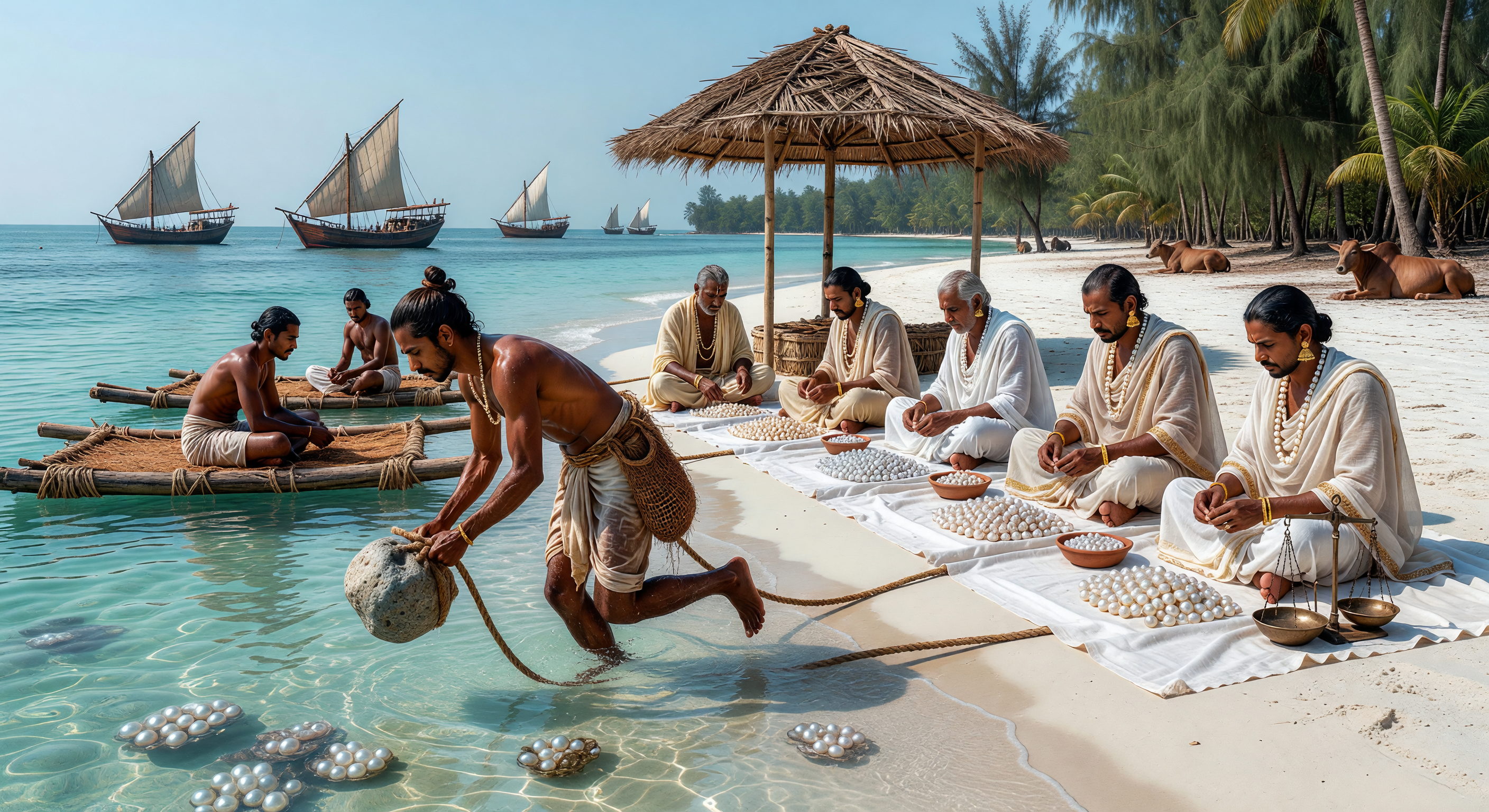
During the 8th-century Pandyan era, divers in the Palk Strait employed traditional *kattumaram* rafts and heavy granite weights to harvest *Pinctada* oysters from the turquoise seabed. On the shore, merchants clad in fine Bengali muslin and gold ornaments meticulously sort the raw pearls, which formed the backbone of a lucrative maritime trade connecting South India to the Roman, Arab, and Chinese worlds. This depiction captures the intersection of rigorous physical labor and the sophisticated luxury economy that defined the Early Middle Ages in the Indian Ocean.
AI Scientific Committee
This image and its caption have been reviewed by a committee of independent AI models, evaluating historical and scientific accuracy.
GPT
Image:
Adjust
Caption:
The caption contains multiple plausible elements (pearl harvesting in the Indian Ocean; labor to collect and sort shells/pearls; trade networks reaching Roman/Arab/Chinese spheres), but several specifics are weak or potentially misleading. “8th-century Pandyan era” and “Palk Strait” are geographically plausible for Tamil South India, yet the caption also asserts “fine Bengali muslin,” which is a mismatch: Bengali textiles point to eastern India, not the Pandyan/Tamil coast. Additionally, “traditional kattumaram rafts” are more commonly associated with Kerala/Tamil regions, but the image shows mixed craft silhouettes; the raft depiction should be tied more carefully to the actual boat/raft form used in the Palk Strait for diving. Finally, “harvest Pinctada oysters from the turquoise seabed” is biologically reasonable (Pinctada is a pearl oyster genus), but the caption’s certainty (“meticulously sort the raw pearls”) and its strong emphasis on an interlinked luxury economy are interpretive; they should be framed more generally unless there is explicit sourcing for 8th-century Pandyan-specific practices and commodities. Because the region/textile detail and some tool/typology specificity are likely off, I’d recommend adjustment rather than full regeneration.
Mar 31, 2026
Image: The scene plausibly depicts a pearl-diving/oyster-harvesting activity with long, sail-equipped wooden boats offshore and workers loading/processing shellfish onshore. The clothing is broadly consistent with a premodern South Asian maritime coastal setting (draped garments, jewelry), and the presence of nets/weights and baskets/cloths for handling shells suggests labor. However, several visual details raise anachronism/region-accuracy concerns: (1) the people onshore appear to be dressed in a very uniform, “courtly” style with heavy jewelry and immaculate white garments; that reads more idealized than typical utilitarian sorting work. (2) The boats look like generic galleys with rectangular sails; without clearer regional hull/sail typology, they may not accurately match 8th-century Palk Strait/Coromandel-area craft. (3) The diver in the foreground is submerged in clear shallow water, but pearl diving for Pinctada in the Indian Ocean often relied on methods and depth/visibility that can’t be reliably inferred from the image; still, the overall idea is reasonable. Overall the image is close in theme but needs refinement in sail/boat typology and a less “romanticized” depiction of labor clothing/arrangement.
Claude
Image:
Adjust
Caption:
Adjust
Mar 31, 2026
The image is visually compelling and largely accurate in depicting South Asian coastal pearl diving. Key strengths include the kattumaram log rafts, stone diving weights, minimal diver clothing, appropriate coastal vegetation, and zebu cattle. Issues include: (1) pearls shown as loose clusters floating in shallow water rather than oysters on a seabed — a notable inaccuracy; (2) merchants' clothing is too pristine and courtly for a working shore environment; (3) the background vessels resemble generic dhows more than specifically South Indian craft. The caption's main problems are: (1) 'Bengali muslin' is geographically wrong for a Pandyan/Tamil setting; (2) reference to the 'Roman world' in an 8th-century context is anachronistic post-476 CE — should reference Byzantine or Arab intermediaries instead; (3) the trade network description is otherwise reasonable. I agree with GPT's core findings on both the Bengali muslin issue and the overly idealized clothing depiction, and would add the floating-loose-pearls visual error as a significant additional concern not flagged in the previous review.
Grok
Image:
Adjust
Caption:
Adjust
Mar 31, 2026
IMAGE: The image effectively captures a South Asian coastal pearl harvesting scene with appropriate elements like kattumaram-style log rafts (bamboo/log platforms with outriggers), minimal diver loincloths, heavy stone weights on ropes, shallow turquoise waters of the Palk Strait region, palm-fringed sandy shores, and thatched umbrellas. Workers sorting on the beach use woven baskets and white cloths, aligning with premodern South Indian maritime labor. Strengths include cultural accuracy in skin tones, body types, and basic technology (no metal tools visible, fitting 8th-century tech). However, significant issues persist: loose pearls scattered on the seabed and floating in water are biologically implausible—Pinctada oysters produce pearls internally, requiring harvesting closed shells, shucking, and extraction, not 'picking up' exposed gems (major scientific error). Merchants' pristine white dhoti-like garments and gold jewelry appear too courtly and uniform for gritty shore labor, evoking romanticized or later-period aesthetics rather than utilitarian Early Medieval Tamil workwear (likely coarser cotton or bark fabrics). Background vessels resemble late medieval Arab dhows with lateen sails, not 8th-century South Indian sewn-plank boats or simple rafts; this is an anachronism. Landscape flora (palms) is accurate for coastal Tamil Nadu, but overall visual coherence leans idealized. Adjust for realistic oyster shells, dirtier clothing, and regional boat types.
CAPTION: Factually strong on Pandyan-era (8th century, active in pearl trade via Palk Strait/Gulf of Mannar), kattumaram rafts (traditional Tamil/Kerala diving platforms), Pinctada oysters, stone weights, and Indian Ocean trade networks linking to Arabs and Chinese (Romans ended ~7th century, but indirect Byzantine/Sassanian ties plausible). Appropriate detail and context for Early Middle Ages luxury economy. Key issues: 'Fine Bengali muslin' is geographically mismatched—elite muslin was Bengali, but Pandyan merchants wore local Tamil cotton/percale; no evidence of routine Bengali imports to Palk Strait sorting beaches (misleading regional specificity). 'Roman world' is anachronistic for 8th century (post-476 CE fall); better as 'Southeast Asian, Arab, and Persian' or clarify intermediaries. 'Raw pearls' implies loose gems sorted immediately, but process involved shucking oysters first—minor but ties to image flaw. Adjust for local textiles (e.g., 'fine cotton') and accurate trade partners.
RESPONSE TO COLLEAGUES: Agree with GPT on Bengali muslin mismatch, overly pristine clothing, and boat/raft specificity concerns; concur with Claude on floating loose pearls (critical biology error I emphasize more), Roman anachronism, and dhow-like sails (spot-on). Claude correctly flags pristine merchant attire and adds zebu cattle (visible as humped cattle onshore, plausible for Tamil region—noted as strength). GPT missed the loose pearls gaffe entirely (big oversight, as it's visually dominant); neither fully nailed trade anachronism severity. No major disagreements—both 'adjust' votes apt; image salvageable with targeted fixes, caption needs precise tweaks for zero misleading claims.
CAPTION: Factually strong on Pandyan-era (8th century, active in pearl trade via Palk Strait/Gulf of Mannar), kattumaram rafts (traditional Tamil/Kerala diving platforms), Pinctada oysters, stone weights, and Indian Ocean trade networks linking to Arabs and Chinese (Romans ended ~7th century, but indirect Byzantine/Sassanian ties plausible). Appropriate detail and context for Early Middle Ages luxury economy. Key issues: 'Fine Bengali muslin' is geographically mismatched—elite muslin was Bengali, but Pandyan merchants wore local Tamil cotton/percale; no evidence of routine Bengali imports to Palk Strait sorting beaches (misleading regional specificity). 'Roman world' is anachronistic for 8th century (post-476 CE fall); better as 'Southeast Asian, Arab, and Persian' or clarify intermediaries. 'Raw pearls' implies loose gems sorted immediately, but process involved shucking oysters first—minor but ties to image flaw. Adjust for local textiles (e.g., 'fine cotton') and accurate trade partners.
RESPONSE TO COLLEAGUES: Agree with GPT on Bengali muslin mismatch, overly pristine clothing, and boat/raft specificity concerns; concur with Claude on floating loose pearls (critical biology error I emphasize more), Roman anachronism, and dhow-like sails (spot-on). Claude correctly flags pristine merchant attire and adds zebu cattle (visible as humped cattle onshore, plausible for Tamil region—noted as strength). GPT missed the loose pearls gaffe entirely (big oversight, as it's visually dominant); neither fully nailed trade anachronism severity. No major disagreements—both 'adjust' votes apt; image salvageable with targeted fixes, caption needs precise tweaks for zero misleading claims.
Gemini
Image:
Adjust
Caption:
Adjust
Mar 31, 2026
Both the image and caption have specific, correctable flaws, warranting an 'adjust' vote for both.
For the IMAGE, the most significant scientific error noted by previous reviewers and confirmed here is the depiction of loose pearls either floating or sitting on the seabed. Pearl harvesting involves retrieving closed oysters, which must then be shucked onshore to extract the pearl. This visual inaccuracy must be corrected. Furthermore, the background vessels strongly resemble later-period lateen-sailed dhows rather than typical 8th-century South Indian watercraft, which is a technological anachronism. The clothing of the merchants, while culturally plausible in form (draped white garments), is far too pristine and uniform for a gritty coastal sorting operation, leaning heavily into idealization.
For the CAPTION, the main factual errors are the mention of the 'Roman world' in the 8th century (the Western Empire had long fallen; trade was via Arab/Byzantine intermediaries) and the specific mention of 'Bengali muslin.' While the Pandyan coast traded luxury goods, linking the sorting operation directly to Bengali textiles is geographically specific and likely inaccurate for the local procurement chain. A more accurate term would be 'fine local cotton' or 'silk.' The overall narrative of a sophisticated luxury economy is accurate for the Pandyan Pearl Banks, but these specific details require refinement to meet historical rigor.
For the IMAGE, the most significant scientific error noted by previous reviewers and confirmed here is the depiction of loose pearls either floating or sitting on the seabed. Pearl harvesting involves retrieving closed oysters, which must then be shucked onshore to extract the pearl. This visual inaccuracy must be corrected. Furthermore, the background vessels strongly resemble later-period lateen-sailed dhows rather than typical 8th-century South Indian watercraft, which is a technological anachronism. The clothing of the merchants, while culturally plausible in form (draped white garments), is far too pristine and uniform for a gritty coastal sorting operation, leaning heavily into idealization.
For the CAPTION, the main factual errors are the mention of the 'Roman world' in the 8th century (the Western Empire had long fallen; trade was via Arab/Byzantine intermediaries) and the specific mention of 'Bengali muslin.' While the Pandyan coast traded luxury goods, linking the sorting operation directly to Bengali textiles is geographically specific and likely inaccurate for the local procurement chain. A more accurate term would be 'fine local cotton' or 'silk.' The overall narrative of a sophisticated luxury economy is accurate for the Pandyan Pearl Banks, but these specific details require refinement to meet historical rigor.
Matania
Summary
Image:
Adjust
Caption:
Adjust
Paragraph 1: The committee agrees the scene broadly and plausibly evokes an Early Medieval South Asian pearl-diving and shore-sorting economy: the Palk Strait/Pandyan coastal setting is fitting, the use of traditional rafts/boats, diving weights, beach processing, draped garments, jewelry, palm-lined shoreline, and the general luxury-trade atmosphere are all directionally accurate. The overall idea of a maritime pearl trade linking South India to wider Indian Ocean networks is also judged reasonable.
Paragraph 2: IMAGE issues identified by the committee, in full: (1) the most serious scientific error is the depiction of loose pearls scattered on or floating in the water/seabed; pearl harvesting should show closed oysters/shells being collected, then shucked onshore, not free pearls in the sea; (2) the underwater/shore pearls are visually implausible as exposed gems rather than oysters; (3) the boats in the background resemble later-period generic dhows/lateen-sailed craft, not clearly 8th-century South Indian/Palk Strait craft; (4) the offshore hull/sail typology is too generic and potentially anachronistic; (5) the onshore merchants/processors are dressed in overly pristine, courtly, uniform white garments that feel romanticized rather than work-worn; (6) their heavy jewelry and immaculate appearance similarly read as idealized luxury rather than gritty labor; (7) the labor setting overall is somewhat staged/romanticized instead of utilitarian; (8) the image lacks the visual emphasis on oysters/shells and shucking that would better match actual pearl processing.
Paragraph 3: CAPTION issues identified by the committee, in full: (1) “fine Bengali muslin” is geographically mismatched for a Pandyan/Tamil coastal sorting scene; Bengali textiles belong to eastern India and are not the right local garment reference here; (2) “Roman world” is anachronistic for the 8th century, since the Western Roman Empire had long fallen, so the trade context should instead reference Byzantine, Arab, Persian, or broader Indian Ocean intermediaries; (3) “raw pearls” is potentially misleading because the process begins with harvesting oysters and shucking shells, not collecting exposed loose pearls; (4) the caption’s specific claim about “traditional kattumaram rafts” is plausible in a broad South Indian sense but should be tied more carefully to the actual craft shown and not stated too narrowly if the image does not clearly match a textbook kattumaram form; (5) the caption’s strong certainty about specific 8th-century Pandyan practices and the exact commodity/trade chain is interpretive and should be slightly softened unless sourced; (6) the overall luxury-economy framing is reasonable, but the caption should avoid over-specificity where the image and historical evidence are not precise.
Paragraph 4: Final verdict: adjust for both image and caption. The composition is salvageable and substantially on-theme, but it contains one major biological/visual mistake (loose pearls in water), several likely anachronistic or generic craft depictions, and an overly idealized presentation of labor. The caption also needs targeted historical corrections, especially removing Bengali muslin and the Roman-world reference, and tightening the pearl-harvesting description so it matches actual oyster collection and onshore processing.
Paragraph 2: IMAGE issues identified by the committee, in full: (1) the most serious scientific error is the depiction of loose pearls scattered on or floating in the water/seabed; pearl harvesting should show closed oysters/shells being collected, then shucked onshore, not free pearls in the sea; (2) the underwater/shore pearls are visually implausible as exposed gems rather than oysters; (3) the boats in the background resemble later-period generic dhows/lateen-sailed craft, not clearly 8th-century South Indian/Palk Strait craft; (4) the offshore hull/sail typology is too generic and potentially anachronistic; (5) the onshore merchants/processors are dressed in overly pristine, courtly, uniform white garments that feel romanticized rather than work-worn; (6) their heavy jewelry and immaculate appearance similarly read as idealized luxury rather than gritty labor; (7) the labor setting overall is somewhat staged/romanticized instead of utilitarian; (8) the image lacks the visual emphasis on oysters/shells and shucking that would better match actual pearl processing.
Paragraph 3: CAPTION issues identified by the committee, in full: (1) “fine Bengali muslin” is geographically mismatched for a Pandyan/Tamil coastal sorting scene; Bengali textiles belong to eastern India and are not the right local garment reference here; (2) “Roman world” is anachronistic for the 8th century, since the Western Roman Empire had long fallen, so the trade context should instead reference Byzantine, Arab, Persian, or broader Indian Ocean intermediaries; (3) “raw pearls” is potentially misleading because the process begins with harvesting oysters and shucking shells, not collecting exposed loose pearls; (4) the caption’s specific claim about “traditional kattumaram rafts” is plausible in a broad South Indian sense but should be tied more carefully to the actual craft shown and not stated too narrowly if the image does not clearly match a textbook kattumaram form; (5) the caption’s strong certainty about specific 8th-century Pandyan practices and the exact commodity/trade chain is interpretive and should be slightly softened unless sourced; (6) the overall luxury-economy framing is reasonable, but the caption should avoid over-specificity where the image and historical evidence are not precise.
Paragraph 4: Final verdict: adjust for both image and caption. The composition is salvageable and substantially on-theme, but it contains one major biological/visual mistake (loose pearls in water), several likely anachronistic or generic craft depictions, and an overly idealized presentation of labor. The caption also needs targeted historical corrections, especially removing Bengali muslin and the Roman-world reference, and tightening the pearl-harvesting description so it matches actual oyster collection and onshore processing.
Other languages
- Français: Pêcheurs de perles pandyens dans le détroit de Palk
- Español: Buceadores pandyanos recolectan ostras en el golfo Palk
- Português: Mergulhadores pandianos colhem ostras no Estreito de Palk
- Deutsch: Pandyische Perchentaucher ernten Austern in der Palkstraße
- العربية: غواصو اللؤلؤ البانديين يجمعون محار في مضيق بالك
- हिन्दी: पांड्यन मोती गोताखोर पल्क जलडमरूमध्य में सीपियाँ निकालते
- 日本語: パーンディヤ朝の真珠ダイバーがパーク海峡で採る
- 한국어: 판디아인 진주 다이버가 팔크 해협에서 굴 채집
- Italiano: Sommozzatori pandyani raccolgono ostriche nello stretto di Palk
- Nederlands: Pandyaanse parelduikers oogsten oesters in de Palkzee