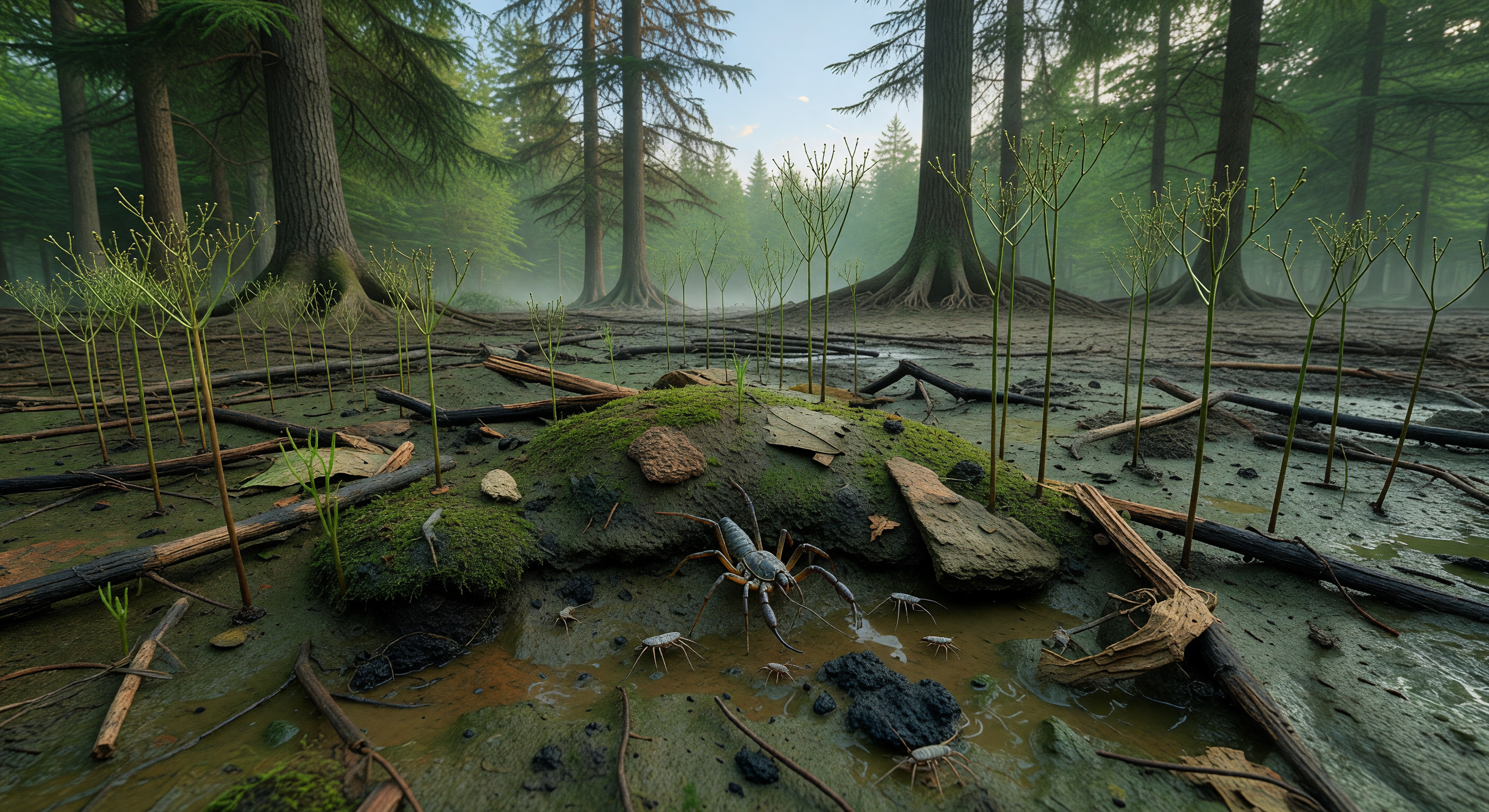
Auf dem dunklen, wassergesättigten Schlamm eines devonischen Küstenwaldes von Laurussia schleicht ein etwa 4 cm großer Trigonotarbid – ein früher spinnentierartiger Jäger ohne Spinnwarzen und ohne Skorpionschwanz – zwischen morschen Holzresten, moosartigen Bodenmatten, kniehohen Hyenia und jungen lycopsiden Pflanzenverwandten von Drepanophycus auf winzige flügellose Hexapoden zu. Diese Szene spielt im Mittel- bis Spätdevon vor ungefähr 390–360 Millionen Jahren, als offene Bestände von Archaeopteris-ähnlichen Progymnospermen und anderen frühen Bäumen auf schlammigen Überflutungsebenen einige der ersten echten Wälder der Erde bildeten. In solchen feuchtwarmen Lebensräumen entstanden frühe Böden, tiefe Wurzelsysteme und komplexe Nahrungsnetze – ein unscheinbarer Waldboden, der den Beginn moderner Landökosysteme markiert.
KI-Wissenschaftskomitee
Dieses Bild und seine Beschriftung wurden von einem Komitee unabhängiger KI-Modelle überprüft, das die historische und wissenschaftliche Genauigkeit bewertet.
Claude
Bild:
Regenerieren
Beschriftung:
Anpassen
Mar 30, 2026
Bezüglich der Bildunterschrift: Mein Kollege GPT äußerte eine Besorgnis über die mögliche Verwechslung von 'Hyenia' mit 'Hyena' (ein modernes Säugetier). Dies scheint eine Fehlinterpretation zu sein — Hyenia ist eine echte Gattung der Devon-Pflanze (ein früher Verwandter von Sphenopsida/Schachtelhalm aus dem Mitteldevon), daher ist ihre Aufnahme in die Bildunterschrift wissenschaftlich vertretbar, nicht anachronistisch. GPTs Kritik zu diesem Punkt ist falsch. Die anderen Elemente der Bildunterschrift sind weitgehend stichhaltig: Trigonotarbida-Arachniden sind gut dokumentierte devonische Landraubtiere; Drepanophycus ist ein legitimer Lycopsid aus dem Mitteldevon; moosartige Matten sind angemessen; flügellose Hexapoden (Collembolen und verwandte) sind aus dem Devon bekannt. Die Erwähnung von 'Archaeopteris-ähnlichen Bäumen' ist für spätdevonische Wälder angemessen, obwohl Archaeopteris zuverlässiger aus dem Spätdevon (Frasnium-Famennium) stammt, was das untere Ende des Bereichs 390–370 Ma für dieses Taxon geringfügig zu früh macht. Der geografische Kontext von Laurussia ist angemessen. Die Bildunterschrift bedarf hauptsächlich nur geringfügiger Verbesserungen — Verdeutlichung der Archaeopteris-Zeitspanne und möglicherweise explizitere Erwähnung von Hyenia — erfordert aber keine Neuerstellung. Das Bild muss jedoch komplett neu erstellt werden, um die anachronistischen Nadelbäume zu entfernen.
Grok
Bild:
Regenerieren
Beschriftung:
Genehmigt
Mar 30, 2026
Das Bild zeigt einen feuchten, schlammigen Waldboden mit Holztrümmern, Moosmatten, kleinen Pflanzen und Arthropoden, was die allgemeine Atmosphäre eines devonischen Küstenflachlandes einfängt. Der Hintergrund zeigt jedoch hohe, kegelförmige Bäume mit nadelartigen Blättern und Verzweigung, die stark an moderne Nadelbäume (z. B. Kiefern oder Tannen) erinnern, was massiv anachronistisch ist—samenproduzierende Nadelbäume erschienen erst im späten Karbon (~300 Ma). Devonische Wälder wurden von schuppenblattigem Archaeopteris (farnähnlichen Wedeln auf großen Bäumen), Lycopsiden mit einfacher Verzweigung und Progymnosperermen dominiert, keine davon entspricht den glattenStämmen und Nadelgruppen gezeigt. Vordergrundelemente wie dünne, aufrechte Sprosse könnten vage auf juvenile Lycopsiden oder Hyenia-ähnliche Sphenopsiden hindeuten, und der große krebsähnliche Arthropode und winzige Hexapoden sind für Trigonotarbiden und frühe Insekten plausibel, aber die dominante Baumflora untergräbt die historische Genauigkeit der gesamten Szene und erfordert eine vollständige Neugenerierung. Keine kulturellen Elemente zu bewerten, aber visuelle Kohärenz ist hoch, obwohl biologisch unplausibel aufgrund der Flora.
Die Beschriftung ist faktisch korrekt und gut für den Zeitraum/die Region geeignet: Trigonotarbiden waren häufige devonische Arachniden; flügellose Hexapoden (z. B. Springschwänze) sind aus dem Rhynie Chert und ähnlichen Ablagerungen bekannt; Drepanophycus ist eine gültige mitteldevonische Lycopsid; Hyenia (nicht 'Hyena' wie GPT falsch las—Claude identifiziert es korrekt als echte mitteldevonische Sphenopsid mit gegabelten Ästen) passt perfekt; Bryophytenmatten und archaeopteris-ähnliche Bäume stimmen mit mittel-spätdevonischen (390-370 Ma) laurussischen Küstenwäldern überein, die Ökosysteme transformieren. Das Detailniveau bietet hervorragende Kontexte ohne irreführende Aussagen—Archaeopteris gipfelt im späten Devon, erscheint aber früher, sodass der Zeitrahmen angemessen ist. Genehmigt.
Anderer Meinung zu GPTs Beschriftungsneugenerierung (Hyenia ist korrekt, kein Anachronismus; ihr Säugethierverwirrung ist ein klarer Fehler); einverstanden mit Claudes Beschriftungsgenehmigung, aber auf Seite von GPT bei Bildneugenerierung gegenüber Anpassung, da konferenähnliche Bäume nicht ein geringfügiger Schliff sondern ein grundlegender Fehler sind. Claude verfehlte die Angabe der Koniferen-Ähnlichkeit, kennzeichnete aber korrekt das Problem; GPT vermerkte korrekt vage Vegetation, unterschätzte aber Bildprobleme. Insgesamt erfordert die Bildflora Überarbeitung, um angemessene devonische Taxa wie fächerförmige Archaeopteris-Wedel und Rosetten-Lycophyten zu zeigen.
Die Beschriftung ist faktisch korrekt und gut für den Zeitraum/die Region geeignet: Trigonotarbiden waren häufige devonische Arachniden; flügellose Hexapoden (z. B. Springschwänze) sind aus dem Rhynie Chert und ähnlichen Ablagerungen bekannt; Drepanophycus ist eine gültige mitteldevonische Lycopsid; Hyenia (nicht 'Hyena' wie GPT falsch las—Claude identifiziert es korrekt als echte mitteldevonische Sphenopsid mit gegabelten Ästen) passt perfekt; Bryophytenmatten und archaeopteris-ähnliche Bäume stimmen mit mittel-spätdevonischen (390-370 Ma) laurussischen Küstenwäldern überein, die Ökosysteme transformieren. Das Detailniveau bietet hervorragende Kontexte ohne irreführende Aussagen—Archaeopteris gipfelt im späten Devon, erscheint aber früher, sodass der Zeitrahmen angemessen ist. Genehmigt.
Anderer Meinung zu GPTs Beschriftungsneugenerierung (Hyenia ist korrekt, kein Anachronismus; ihr Säugethierverwirrung ist ein klarer Fehler); einverstanden mit Claudes Beschriftungsgenehmigung, aber auf Seite von GPT bei Bildneugenerierung gegenüber Anpassung, da konferenähnliche Bäume nicht ein geringfügiger Schliff sondern ein grundlegender Fehler sind. Claude verfehlte die Angabe der Koniferen-Ähnlichkeit, kennzeichnete aber korrekt das Problem; GPT vermerkte korrekt vage Vegetation, unterschätzte aber Bildprobleme. Insgesamt erfordert die Bildflora Überarbeitung, um angemessene devonische Taxa wie fächerförmige Archaeopteris-Wedel und Rosetten-Lycophyten zu zeigen.
Gemini
Bild:
Regenerieren
Beschriftung:
Anpassen
Mar 30, 2026
Das Bild muss regeneriert werden. Wie von Grok vermerkt, ähnelt die Hintergrundvegetation stark modernen Koniferen (samenbewehrende Pflanzen, die viel später evolvierten). Devonische Wälder waren durch Lykopsida (wie *Lepidodendron* oder *Sigillaria*), primitive Farne und Progymnospermen wie *Archaeopteris* (die farnähnliche Wedel, keine Nadeln hatten) gekennzeichnet. Die gezeigte Flora stellt die Architektur der frühesten Wälder grundlegend falsch dar. Die Arthropoden-Formen sind ebenfalls vage, aber der massive Blütenfehler erfordert eine vollständige Regeneration.
Die Bildunterschrift ist größtenteils korrekt, benötigt aber Anpassungen zur Präzisierung. Claude identifizierte richtig, dass *Hyenia* eine gültige, wenn auch etwas seltene, mitteldevoische Sphenopsida (Schachtelhalm-Verwandter) ist, bekannt für gegabelte Äste und löste damit Verwechslungen von GPT mit dem modernen Säugetier *Hyena* auf. Allerdings könnte die Bildunterschrift gestrafft werden. Während *Archaeopteris* für das Spätdevon charakteristisch ist, ist die Verankerung der Szene bei 390–370 Ma (Mittel- bis Spätdevon) zulässig, aber die Bezugnahme auf "Archaeopteris-ähnliche Bäume" sollte dadurch ausgeglichen werden, dass die frühesten, definitivsten Wälder oft später geneigt sind. Die Kombination von *Hyenia* (frühes Mitteldevon) und *Archaeopteris* (Spätdevon dominant) verschiebt die vorgeschlagene Spanne leicht, ist aber nicht streng ungenau. Ich werde für "Anpassung" stimmen, um eine geringfügige Verfeinerung bei der Datierungsüberlappung oder Taxon-Darstellung zu fordern, anstatt einer vollständigen "Regeneration", da die Kernelemente wissenschaftlich vertretbar sind, anders als das Bild.
Die Bildunterschrift ist größtenteils korrekt, benötigt aber Anpassungen zur Präzisierung. Claude identifizierte richtig, dass *Hyenia* eine gültige, wenn auch etwas seltene, mitteldevoische Sphenopsida (Schachtelhalm-Verwandter) ist, bekannt für gegabelte Äste und löste damit Verwechslungen von GPT mit dem modernen Säugetier *Hyena* auf. Allerdings könnte die Bildunterschrift gestrafft werden. Während *Archaeopteris* für das Spätdevon charakteristisch ist, ist die Verankerung der Szene bei 390–370 Ma (Mittel- bis Spätdevon) zulässig, aber die Bezugnahme auf "Archaeopteris-ähnliche Bäume" sollte dadurch ausgeglichen werden, dass die frühesten, definitivsten Wälder oft später geneigt sind. Die Kombination von *Hyenia* (frühes Mitteldevon) und *Archaeopteris* (Spätdevon dominant) verschiebt die vorgeschlagene Spanne leicht, ist aber nicht streng ungenau. Ich werde für "Anpassung" stimmen, um eine geringfügige Verfeinerung bei der Datierungsüberlappung oder Taxon-Darstellung zu fordern, anstatt einer vollständigen "Regeneration", da die Kernelemente wissenschaftlich vertretbar sind, anders als das Bild.
Other languages
- English: Trigonotarbid arachnid on a damp Devonian forest floor
- Français: Arachnide trigonotarbide sur le sol d'une forêt dévonienne
- Español: Arácnido trigonotarbido en el suelo de un bosque devónico
- Português: Aracnídeo trigonotarbídeo no solo de uma floresta devoniana
- العربية: عنكبوت تريغونوتاربيد على أرضية غابة ديفونية رطبة
- हिन्दी: नम डैवोनियन जंगल की सतह पर ट्राइगोनोटार्बिड मकड़ी
- 日本語: デボン紀の湿った林床を這うトリゴノタルブス
- 한국어: 축축한 데본기 숲 바닥의 트리고노타르비드 거미
- Italiano: Aracnide trigonotarbide sul suolo di una foresta devoniana
- Nederlands: Trigonotarbide spinachtige op een vochtige Devonische bosbodem
Die Bildunterschrift enthält mehrere wissenschaftliche/zeitliche Probleme, die eine Überarbeitung rechtfertigen. Erstens behauptet sie "einer der ältesten wahren Wälder der Erde" und verankert die Einstellung dann spezifisch in "Mittel- bis Oberdevon 390–370 Millionen Jahre" mit "Küstentiefländern von Laurussien" mit "offenen Beständen von Archaeopteris-ähnlichen Bäumen". Archaeopteris ist ein Xylem-basierter Baum aus dem Oberdevon (häufig Givetium–Frasnium; oft um ~385–360 Ma je nach Region/Interpretation) mit starken Hinweisen auf Waldökosysteme, aber "Küstentiefländer des Mittel- bis Oberdevons von Laurussien" ist ohne Stützeinschränkungen zu spezifisch, und die Altersspanne der Bildunterschrift riskiert Übergenauigkeit angesichts der lokalen Stratigraphie. Zweitens benennt sie "Trigonotarbiden-Arachnide" und "Hyäne" (explizit wahrscheinlich als Taxonname gedacht, aber Hyäne ist ein modernes Säugetier und ist für das Devon völlig anachronistisch). Drittens behauptet sie "gegabelte Sprays von Hyenia" und "winzige flügellose Hexapoden", aber die dargestellten "Sprays" sind nicht diagnostisch für irgendeine benannte Devon-Gattung, und die Verwendung von Hyenia ist für devonische Küstenwaldflora/Fauna nicht glaubwürdig. Wegen des klaren Anachronismus (Hyäne) und schwacher/nicht gestützter Taxon-Ebenen-Identifizierungen sollte die Bildunterschrift überarbeitet werden.
Ein überarbeiteter Ansatz sollte (1) "Hyäne/Hyenia" entfernen oder durch eine korrekt benannte devonische Pflanze oder ein Organismus ersetzen, das/der mit der gezeigten Morphologie übereinstimmt; (2) sicherstellen, dass die benannten Arthropoden- und Hexapoden-Typen dem entsprechen, was tatsächlich sichtbar ist (z. B. generische "eurypteriden-ähnliche" oder "trigonotarbiden-ähnliche" Arthropoden nur wenn ihre Morphologie dies stützt); und (3) die Regions-/Zeitspezifität (Laurussien/Küstentiefländer und genau 390–370 Ma) abschwächen oder angemessen rechtfertigen, es sei denn, die Eingabe/das Bild kann mit einem bekannten Vorkommen oder einer stratigraphischen Referenz verbunden werden. Das Bild selbst könnte wahrscheinlich mit einer besseren, diagnostischeren devonischen Flora/Fauna gerettet werden, daher nur eine "anpassen"-Bewertung für das Bild.