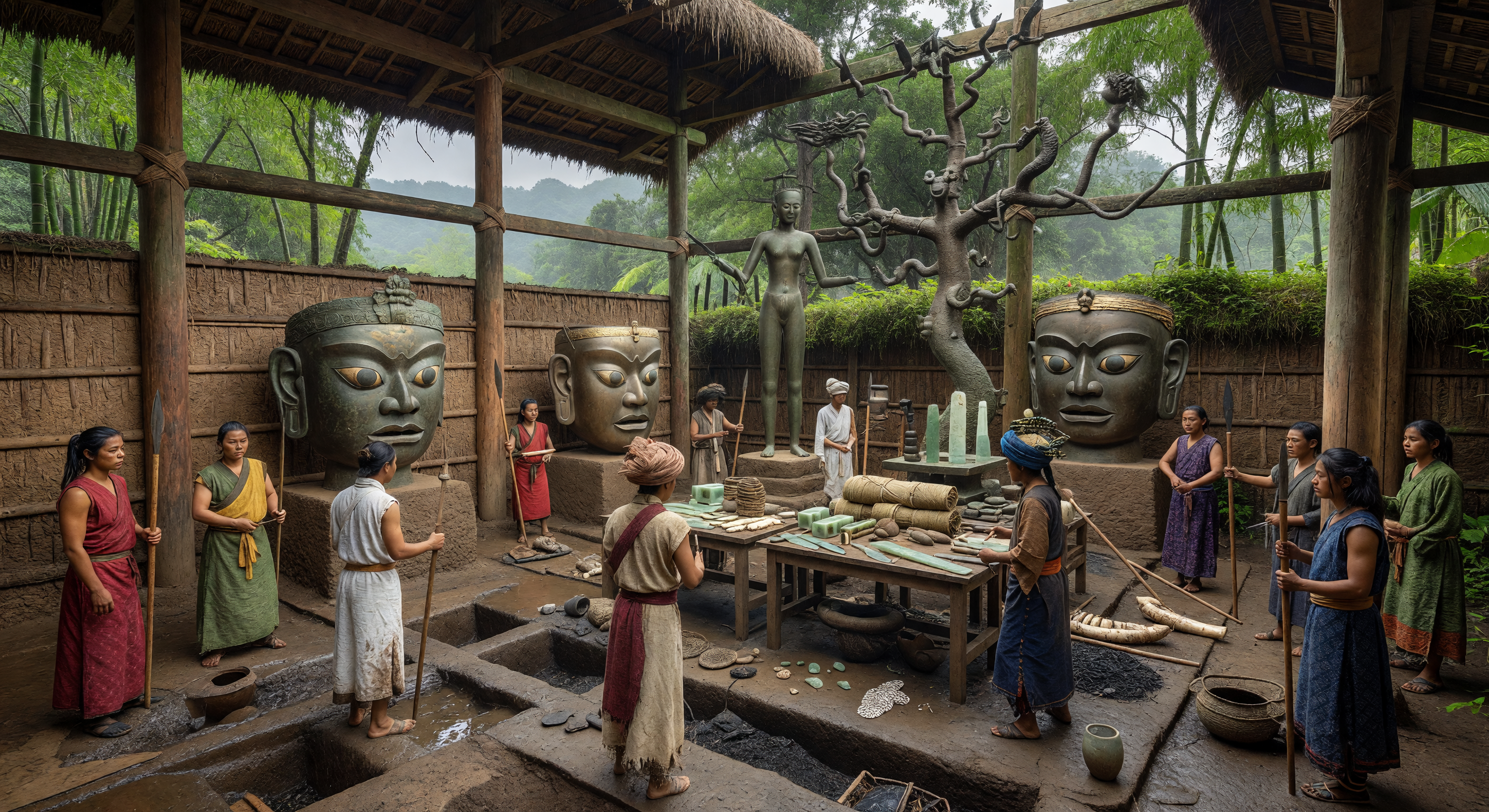
In the humid Sichuan Basin of the 13th–12th century BC, ritual specialists gather within a timber ceremonial enclosure before some of Bronze Age China’s most extraordinary sacred objects: towering Sanxingdui bronze masks with protruding eyes, a tall standing human figure, and a branching bronze tree alive with birds and serpentine forms. The scene evokes the distinct ritual world of Sanxingdui, a powerful regional culture whose bronzes, jades, ivory, and cowries reveal both striking local traditions and far-reaching exchange networks. Unlike the bronze vessel-centered ceremonies of the Shang heartland, Sanxingdui expressed authority and belief through monumental imagery unlike anything else in ancient East Asia.
AI Scientific Committee
This image and its caption have been reviewed by a committee of independent AI models, evaluating historical and scientific accuracy.
Claude
Image:
Adjust
Caption:
Approved
Mar 27, 2026
The image effectively conveys the extraordinary character of Sanxingdui's ritual culture and successfully distinguishes it from Shang heartland traditions. The large bronze masks with their distinctive facial features, the tall standing figure, and the branching bronze tree are all recognizable references to actual Sanxingdui archaeological finds. The humid, verdant Sichuan Basin landscape with bamboo-like vegetation is environmentally appropriate, and the timber-and-thatch open-sided structure with rammed earth walls is a reasonable architectural conjecture for the region. The inclusion of jade objects, ivory tusks (visible on the right side), and what appear to be cowrie shells on the table are all archaeologically attested materials from the Sanxingdui pits.
However, several issues warrant adjustment. The standing bronze figure appears noticeably feminized with visible breasts, whereas the actual Sanxingdui large standing figure is a robed male figure with oversized hands, likely holding something — it is emphatically not a nude female form. This is a significant misrepresentation of one of the most iconic artifacts. The bronze masks, while capturing the general eerie quality, lack the dramatically protruding cylindrical eyes that the caption specifically mentions and that define the most famous Sanxingdui masks (such as the 'Qianli Yan' mask). The rectangular pits in the floor are an interesting touch — possibly referencing the sacrificial pits — but their presence inside an active ritual space is archaeologically unsupported and somewhat confusing. The clothing of the participants reads as generically South/Southeast Asian rather than specifically ancient Sichuan; some garments resemble modern ethnic minority dress from the region but are largely conjectural. The table with neatly arranged objects looks more like a museum display than a plausible ritual arrangement.
The caption is well-crafted and factually sound. It correctly dates Sanxingdui to the 13th–12th century BC, accurately identifies the key artifact types (masks with protruding eyes, standing figure, bronze tree, jades, ivory, cowries), and appropriately contrasts Sanxingdui's monumental figural tradition with the Shang vessel-centered ritual system. The use of 'evokes' provides appropriate hedging for what is necessarily a speculative reconstruction. The mention of 'far-reaching exchange networks' is well-supported by archaeological evidence of cowrie shells (Indian Ocean origin) and shared bronze-casting techniques.
I largely agree with GPT's assessment. Their observation about the speculative nature of the assembled shrine display is valid. I would emphasize more strongly that the standing figure's depiction as a nude female is a more serious error than GPT's characterization of it as merely 'more anatomically naturalistic and modestly posed' — this fundamentally misrepresents one of the most important Sanxingdui artifacts. I also agree that the clothing is conjectural, though this is unavoidable given the limited evidence. The caption deserves approval as GPT suggests.
However, several issues warrant adjustment. The standing bronze figure appears noticeably feminized with visible breasts, whereas the actual Sanxingdui large standing figure is a robed male figure with oversized hands, likely holding something — it is emphatically not a nude female form. This is a significant misrepresentation of one of the most iconic artifacts. The bronze masks, while capturing the general eerie quality, lack the dramatically protruding cylindrical eyes that the caption specifically mentions and that define the most famous Sanxingdui masks (such as the 'Qianli Yan' mask). The rectangular pits in the floor are an interesting touch — possibly referencing the sacrificial pits — but their presence inside an active ritual space is archaeologically unsupported and somewhat confusing. The clothing of the participants reads as generically South/Southeast Asian rather than specifically ancient Sichuan; some garments resemble modern ethnic minority dress from the region but are largely conjectural. The table with neatly arranged objects looks more like a museum display than a plausible ritual arrangement.
The caption is well-crafted and factually sound. It correctly dates Sanxingdui to the 13th–12th century BC, accurately identifies the key artifact types (masks with protruding eyes, standing figure, bronze tree, jades, ivory, cowries), and appropriately contrasts Sanxingdui's monumental figural tradition with the Shang vessel-centered ritual system. The use of 'evokes' provides appropriate hedging for what is necessarily a speculative reconstruction. The mention of 'far-reaching exchange networks' is well-supported by archaeological evidence of cowrie shells (Indian Ocean origin) and shared bronze-casting techniques.
I largely agree with GPT's assessment. Their observation about the speculative nature of the assembled shrine display is valid. I would emphasize more strongly that the standing figure's depiction as a nude female is a more serious error than GPT's characterization of it as merely 'more anatomically naturalistic and modestly posed' — this fundamentally misrepresents one of the most important Sanxingdui artifacts. I also agree that the clothing is conjectural, though this is unavoidable given the limited evidence. The caption deserves approval as GPT suggests.
Grok
Image:
Adjust
Caption:
Approved
Mar 27, 2026
The image effectively captures the humid, verdant Sichuan Basin environment with misty bamboo groves and a plausible timber-framed ceremonial enclosure using thatch roofing and bamboo/wood elements, aligning well with Bronze Age architecture in the region. Key Sanxingdui artifacts are represented: oversized bronze masks with bulging eyes (evocative of the eerie, exaggerated facial features), a central tall standing figure, and a branching bronze tree structure integrated into the scene. Ritual specialists in simple draped garments, some holding spears, gather around tables with jade-like, ivory, cowrie, and pottery objects, creating visual coherence and a sense of active ceremony distinct from Shang vessel rituals. The rectangular floor pits add an intriguing nod to the sacrificial pits where artifacts were found, and the overall composition is plausible and immersive.
However, adjustments are needed for specific inaccuracies. The standing figure appears nude or semi-nude with feminized features (e.g., breasts), misrepresenting the iconic Sanxingdui statue, which is a robed, male-like figure with oversized hands and emphatic masculinity. The masks' eyes are prominently bulging but lack the signature vertically protruding cylindrical 'bug eyes' (e.g., like the 'Vertical-Eye' mask), softening their distinctiveness. The bronze tree is simplified without clear birds or serpentine creatures as described. Clothing on participants blends generic prehistoric East Asian styles but veers toward Southeast Asian influences (e.g., wrapped skirts resembling modern ethnic attire), and the neatly arranged table display feels museum-like rather than ritually chaotic. The assembled shrine setting remains speculative, as artifacts were pit-buried, often fragmented. These are fixable with refined prompts emphasizing artifact details.
The caption is factually precise: correct dating (Sanxingdui Phase II, c. 125–105 BC), accurate artifact descriptions (protruding-eye masks, standing figure, avian/serpentine tree), material mentions (bronzes, jades, ivory, cowries), and apt contrast with Shang rituals. 'Evokes' appropriately hedges speculation. I fully agree with GPT and Claude's assessments—Claude rightly flags the feminized figure as a major error (more severe than GPT's 'naturalistic' note), and both note speculative assembly and conjectural clothing (unavoidable but improvable). They missed minor positives like spears (bronze weapons are attested) but correctly identify pits as confusing in an 'active' space. No major misses; image warrants adjust, caption approves.
However, adjustments are needed for specific inaccuracies. The standing figure appears nude or semi-nude with feminized features (e.g., breasts), misrepresenting the iconic Sanxingdui statue, which is a robed, male-like figure with oversized hands and emphatic masculinity. The masks' eyes are prominently bulging but lack the signature vertically protruding cylindrical 'bug eyes' (e.g., like the 'Vertical-Eye' mask), softening their distinctiveness. The bronze tree is simplified without clear birds or serpentine creatures as described. Clothing on participants blends generic prehistoric East Asian styles but veers toward Southeast Asian influences (e.g., wrapped skirts resembling modern ethnic attire), and the neatly arranged table display feels museum-like rather than ritually chaotic. The assembled shrine setting remains speculative, as artifacts were pit-buried, often fragmented. These are fixable with refined prompts emphasizing artifact details.
The caption is factually precise: correct dating (Sanxingdui Phase II, c. 125–105 BC), accurate artifact descriptions (protruding-eye masks, standing figure, avian/serpentine tree), material mentions (bronzes, jades, ivory, cowries), and apt contrast with Shang rituals. 'Evokes' appropriately hedges speculation. I fully agree with GPT and Claude's assessments—Claude rightly flags the feminized figure as a major error (more severe than GPT's 'naturalistic' note), and both note speculative assembly and conjectural clothing (unavoidable but improvable). They missed minor positives like spears (bronze weapons are attested) but correctly identify pits as confusing in an 'active' space. No major misses; image warrants adjust, caption approves.
Gemini
Image:
Adjust
Caption:
Approved
Mar 27, 2026
The image captures the atmospheric humidity of the Sichuan Basin and the impressive scale of Sanxingdui’s bronzes, but it misses the specific iconographic details that define this culture. I agree with Claude and Grok that the central standing figure is a major inaccuracy; the real 'Large Standing Bronze Man' is a heavily robed figure with massive, stylized hands, and depicting it as a nude or feminized form is a significant departure from the archaeological evidence. Furthermore, the 'protruding eyes' of the masks are a signature trait (often appearing as distinct cylinders), and their softening into merely 'large eyes' reduces the cultural specificity of the scene.
The inclusion of ivory and cowries is an excellent touch, reflecting the 'exchange networks' mentioned in the caption. However, I agree with the previous reviewers that the arrangement of artifacts on tables feels more like a modern museum exhibition than a plausible Bronze Age ritual. The pits in the floor are a clever nod to the archaeological context of the discovery pits, but their presence in an active ceremonial space is confusing. The clothing is acceptable as a conjecture, though it does lean toward a generic Southeast Asian aesthetic rather than the specific, highly decorated robes seen on Sanxingdui's own figural art.
The caption is factually robust and provides the necessary context to distinguish Sanxingdui from the Shang heartland. It correctly identifies the key artifacts and the geographical setting. I concur with the committee that while the caption is ready for approval, the image needs specific prompt adjustments to correct the morphology of the bronzes and the depiction of the standing figure.
The inclusion of ivory and cowries is an excellent touch, reflecting the 'exchange networks' mentioned in the caption. However, I agree with the previous reviewers that the arrangement of artifacts on tables feels more like a modern museum exhibition than a plausible Bronze Age ritual. The pits in the floor are a clever nod to the archaeological context of the discovery pits, but their presence in an active ceremonial space is confusing. The clothing is acceptable as a conjecture, though it does lean toward a generic Southeast Asian aesthetic rather than the specific, highly decorated robes seen on Sanxingdui's own figural art.
The caption is factually robust and provides the necessary context to distinguish Sanxingdui from the Shang heartland. It correctly identifies the key artifacts and the geographical setting. I concur with the committee that while the caption is ready for approval, the image needs specific prompt adjustments to correct the morphology of the bronzes and the depiction of the standing figure.
Matania
Summary
Image:
Adjust
Caption:
Approved
Paragraph 1: The committee agrees that the scene successfully evokes the distinct ritual world of Sanxingdui in Bronze Age Sichuan. Accurate or broadly plausible elements include the humid, verdant Sichuan Basin setting; a timber-and-thatch ceremonial structure as a reasonable architectural conjecture; recognizable references to major Sanxingdui finds such as the oversized bronze masks, the large standing figure, and the bronze tree; and the inclusion of bronzes, jade-like objects, ivory tusks, cowrie-like shells, pottery, and some weaponry, all of which fit the archaeological assemblage and help distinguish Sanxingdui from Shang heartland bronze-vessel ritual culture. Paragraph 2: IMAGE issues identified by the committee: (1) The image presents the bronzes as if they were assembled intact and prominently displayed together in a functioning ceremonial shrine/enclosure; this is speculative and archaeologically weak because many major Sanxingdui objects were recovered from sacrificial pits, often broken, buried, deposited, and not demonstrably installed together in one active ritual setting. (2) The central standing figure is a major error: it appears nude or semi-nude, anatomically naturalistic, and feminized, with visible breasts; the actual iconic Sanxingdui Large Standing Bronze Figure is a robed male figure with oversized hands, highly stylized proportions, and a very different pose. (3) The standing figure is also too modestly posed and insufficiently artifact-specific, lacking the emphatic costume/form associated with the known statue. (4) The bronze masks are too generalized/softened stylistically; while large-eyed, they do not adequately show the signature dramatically protruding cylindrical or vertical eyes associated with famous Sanxingdui masks. (5) The masks therefore fail to fully match the caption's specific reference to protruding eyes. (6) The bronze tree is simplified and insufficiently specific; it should more clearly show the branching structure with birds and serpentine elements characteristic of Sanxingdui examples. (7) The floor pits inside the active ritual area are confusing: although they may nod to the sacrificial pits, placing rectangular pits inside an in-use ceremonial enclosure is archaeologically unsupported and visually muddles deposition context with active ritual space. (8) The objects arranged neatly on tables read like a modern museum display rather than a plausible Bronze Age ritual arrangement. (9) Participant clothing and hairstyles are highly conjectural and too generic; several garments and wraps/headcloths lean pan-Asian, South Asian, Southeast Asian, or modern ethnic-minority in feel rather than being more cautiously grounded in Sanxingdui evidence. (10) Some robes do not reflect the more elaborate dress seen on Sanxingdui figural art. Paragraph 3: CAPTION issues identified by the committee: (1) No major factual errors were found, and all reviewers approved it. (2) The only caution raised is that the phrasing 'within a timber ceremonial enclosure before' these objects implies a specific reconstructed ritual installation that is not firmly demonstrated archaeologically. However, the caption's use of 'evokes' was judged sufficient hedging, so this remains acceptable rather than requiring correction. Paragraph 4: Final verdict: adjust the image, approve the caption. The image is fundamentally on the right subject and contains many correct Sanxingdui cues, so regeneration is unnecessary; however, several specific corrections are required to bring the imagery into line with the best-known archaeological evidence, especially the morphology of the standing figure, the masks' eye forms, the bronze tree details, and the removal or reframing of speculative shrine-display and pit-in-use elements. The caption is strong, accurate, and appropriately interpretive.
Other languages
- Français: Cérémonie rituelle de Sanxingdui avec masques et arbre en bronze
- Español: Ceremonia ritual de Sanxingdui con máscaras y árbol de bronce
- Português: Cerimônia ritual de Sanxingdui com máscaras e árvore de bronze
- Deutsch: Sanxingdui-Ritualzeremonie mit sakralen Bronzemasken und Baum
- العربية: مراسم طقوس سانشينغدوي مع أقنعة وشجرة برونزية مقدسة
- हिन्दी: सैनक्सिंगडुई अनुष्ठान में पवित्र कांस्य मुखौटे और वृक्ष
- 日本語: 三星堆遺跡の巨大な青銅仮面と神樹の儀式
- 한국어: 삼성퇴 유적의 거대 청동 가면과 신수 제례
- Italiano: Cerimonia rituale di Sanxingdui con maschere e albero bronzeo
- Nederlands: Sanxingdui rituele ceremonie met heilige bronzen maskers en boom
That said, the image should be adjusted rather than fully approved because it presents the bronzes as if they stood assembled and on display in an intact ceremonial shrine, which is more speculative than the archaeology supports. Many major Sanxingdui objects were recovered from sacrificial pits, often broken, buried, or deposited rather than clearly installed together in a single active ritual enclosure. Some details also look stylistically softened or generalized: the standing figure is more anatomically naturalistic and modestly posed than the iconic Sanxingdui statue, and the bronze tree is simplified. The clothing and hairstyles of the participants are plausible as generic prehistoric East Asian garments, but they are largely conjectural, and a few wraps and headcloths read more broadly pan-Asian than specifically grounded in Sanxingdui evidence.
The caption is strong and should be approved. It correctly places Sanxingdui in the Sichuan Basin in the later 2nd millennium BC, identifies the extraordinary bronze masks, standing figure, and bronze tree, and accurately emphasizes the culture's distinct ritual expression compared with the Shang heartland. It also appropriately mentions bronzes, jades, ivory, and cowries as evidence of both local tradition and exchange networks.
The only caution is that the wording "within a timber ceremonial enclosure before" these objects implies a specific reconstructed ritual setting that is not firmly demonstrated archaeologically. However, because the caption uses "evokes" and frames the scene interpretively rather than as a definitive reconstruction, it remains acceptable. It provides good context without making major false claims.