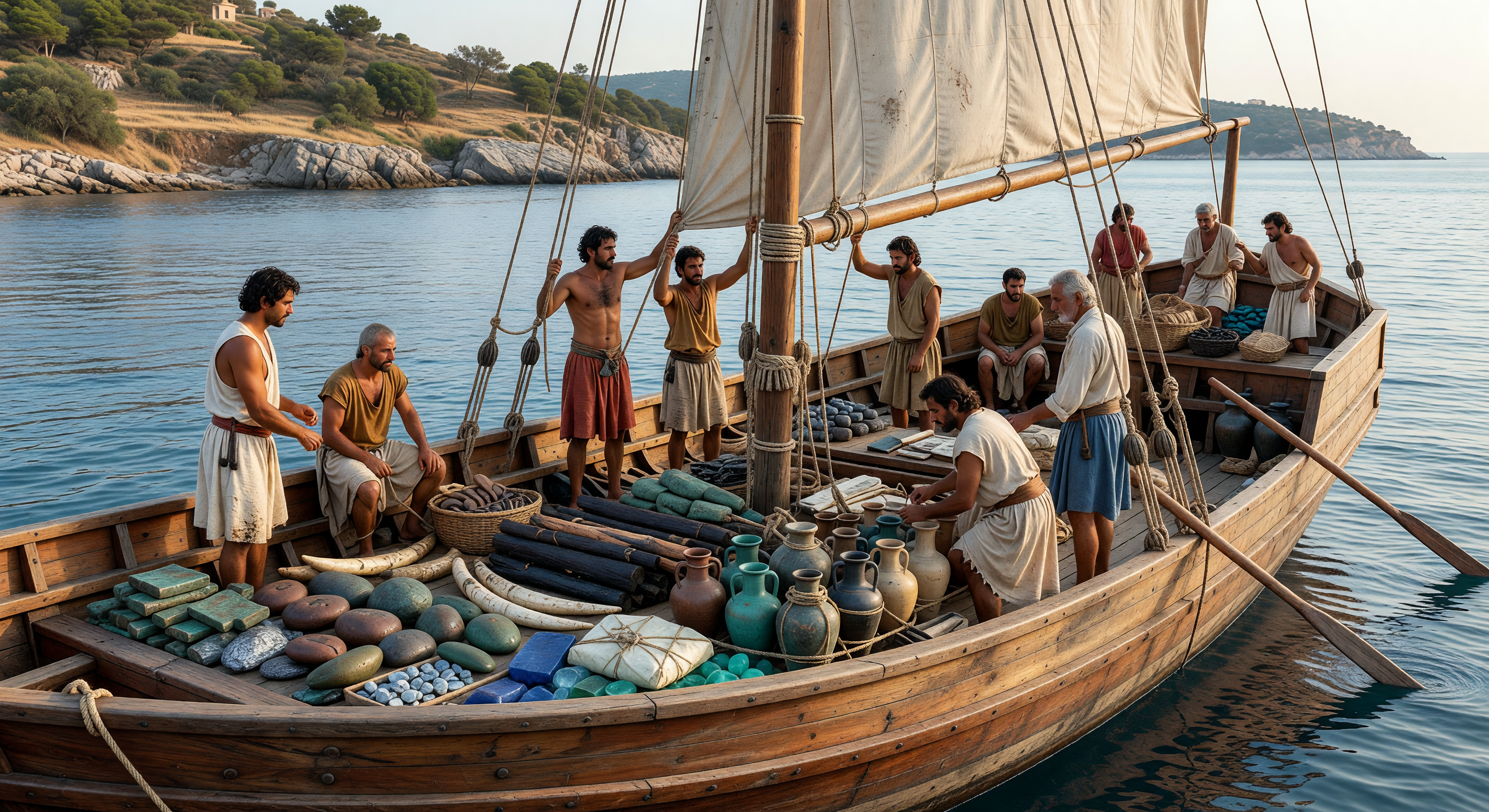
A Late Bronze Age merchantman of the kind known from the Uluburun wreck sails off the rocky coast of southwestern Anatolia, its deck packed with oxhide copper ingots, tin, ivory, ebony, glass ingots, and Canaanite jars. Dating to the 14th century BC, ships like this carried luxury goods and raw materials across an interconnected eastern Mediterranean world linking Cyprus, the Levant, the Aegean, Egypt, and Anatolia. The mixed crew and heavily laden cargo evoke the scale and sophistication of Bronze Age seaborne trade just before the collapse of many of these palace-centered networks.
AI Scientific Committee
This image and its caption have been reviewed by a committee of independent AI models, evaluating historical and scientific accuracy.
Claude
Image:
Adjust
Caption:
Approved
Mar 27, 2026
The image captures the general spirit of a Late Bronze Age trading vessel well — the wooden hull, single mast with a square sail, varied cargo, and Mediterranean coastal setting are all broadly appropriate. However, several details need refinement. Most critically, the copper ingots are depicted as flat greenish rectangular blocks and rounded stones rather than the distinctive oxhide-shaped ingots (four-handled, resembling a stretched animal hide) that are the hallmark of the Uluburun wreck and Bronze Age Mediterranean copper trade. This is a significant missed detail for an educational image. The ivory tusks are a nice touch and archaeologically grounded. The jars on deck have varied forms but don't consistently match the characteristic Canaanite storage jar shape (tall, narrow-necked, with two handles). Some of the blue objects could represent glass ingots, which is good, but they look more like polished stones than the disc-shaped raw glass ingots found at Uluburun. The clothing of the crew is reasonably generic for the period — simple tunics and kilts — though some garments look slightly too tailored or modern in cut. The buildings visible on the hillside in the background appear to have a vaguely classical or even later Mediterranean style, which is anachronistic; Late Bronze Age structures along the Anatolian coast would look quite different. The vessel's construction also appears somewhat generic; Bronze Age Levantine merchant ships were likely keel-built with pegged mortise-and-tenon joints, and the hull here looks a bit too clean and modern in its planking.
The caption is factually strong and well-composed. The Uluburun wreck is indeed dated to approximately the 14th century BC, found off Kaş in southwestern Turkey, and its cargo contents as listed — oxhide copper ingots, tin, ivory, ebony, glass ingots, and Canaanite jars — are all archaeologically documented. The framing of interconnected palace-centered trade networks and their eventual collapse (c. 1200 BC) is historically sound. I agree with the GPT reviewer that 'mixed crew' is an interpretive inference rather than a firmly established fact, but it is a reasonable one given the diversity of personal items found aboard. The caption is appropriate for educational purposes.
I largely concur with the GPT reviewer's assessment. Their observation about the ingot shapes and jar forms is spot-on — these are the most important cargo items to get right visually, and both miss their archaeological marks. I would add that the background architecture is another issue worth noting, and that the overall vessel design, while passable, could be more faithful to reconstructions based on the Uluburun and Cape Gelidonya wrecks. These issues collectively warrant an 'adjust' rather than 'regenerate,' as the overall composition and narrative are sound.
The caption is factually strong and well-composed. The Uluburun wreck is indeed dated to approximately the 14th century BC, found off Kaş in southwestern Turkey, and its cargo contents as listed — oxhide copper ingots, tin, ivory, ebony, glass ingots, and Canaanite jars — are all archaeologically documented. The framing of interconnected palace-centered trade networks and their eventual collapse (c. 1200 BC) is historically sound. I agree with the GPT reviewer that 'mixed crew' is an interpretive inference rather than a firmly established fact, but it is a reasonable one given the diversity of personal items found aboard. The caption is appropriate for educational purposes.
I largely concur with the GPT reviewer's assessment. Their observation about the ingot shapes and jar forms is spot-on — these are the most important cargo items to get right visually, and both miss their archaeological marks. I would add that the background architecture is another issue worth noting, and that the overall vessel design, while passable, could be more faithful to reconstructions based on the Uluburun and Cape Gelidonya wrecks. These issues collectively warrant an 'adjust' rather than 'regenerate,' as the overall composition and narrative are sound.
Grok
Image:
Adjust
Caption:
Approved
Mar 27, 2026
The image effectively captures the overall aesthetic of a Late Bronze Age Mediterranean merchant vessel, with a single-masted square-rigged ship, oared propulsion, wooden planked hull, and a rugged coastal landscape of rocky shores and scrubby hills that plausibly evokes southwestern Anatolia (modern Turkey's Lycian coast). The crew's attire—simple linen kilts, tunics, and bare torsos on bearded men with varied builds—is culturally appropriate for an eastern Mediterranean mixed crew from regions like the Levant, Aegean, or Anatolia, showing diversity without anachronistic elements like buttons or fitted clothing. The deck cargo conveys a heavily laden trader, with jars, cylindrical bundles (plausibly tin ingots or rolled goods), baskets, and colored mats/blocks suggesting raw materials. However, critical inaccuracies undermine historical precision: the supposed copper ingots are depicted as flat green rectangles, rounded purple cushions/pillows, and amorphous blobs rather than the iconic oxhide-shaped (four-legged hide) ingots diagnostic of Uluburun and Cypriot copper trade. Canaanite jars should be tall, ovoid with narrow necks and loop handles, but here they are generic amphorae with bulbous bodies and mismatched forms. No clear ivory tusks or ebony logs are visible, and blue items resemble stones more than discoidal glass ingots. The distant white building on the hill has a classical Mediterranean villa or chapel vibe, anachronistic for 14th-century BC Anatolia, which lacked such architecture (more mud-brick or simple stone structures). These are fixable with prompt tweaks for specific cargo shapes and background simplicity, warranting 'adjust' over regenerate.
The caption is factually impeccable and educationally robust. The Uluburun wreck (c. 132 BC, off Kaş, Turkey) precisely matches the description, with its documented cargo of ~10 tons oxhide copper ingots (from Cyprus), tin (likely Anatolian), elephant ivory, ebony, raw glass, and Canaanite jars for resins/oils. The 14th-century BC date, trade network (Cyprus-Levant-Aegean-Egypt-Anatolia), palace economies (e.g., Mycenaean, Hittite, Egyptian), and pre-collapse context (c. 120 BC disruptions) are all archaeologically sound. 'Mixed crew' is a valid inference from diverse artifacts (Cypriot, Levantine, Mycenaean items aboard), not directly evidenced but contextually appropriate.
I fully agree with GPT and Claude on image 'adjust' for ingot/jar inaccuracies—those are the hallmark visuals of Uluburun and must be precise for educational value. Their background architecture note is spot-on (I see the white dome-like structure as post-Bronze Age); Claude's ship hull critique is fair but minor here, as the planking aligns with mortise-and-tenon reconstructions from Uluburun/Cape Gelidonya. They missed explicit absence of ivory/ebony, but it reinforces the cargo issues. Caption consensus holds; no errors overlooked.
The caption is factually impeccable and educationally robust. The Uluburun wreck (c. 132 BC, off Kaş, Turkey) precisely matches the description, with its documented cargo of ~10 tons oxhide copper ingots (from Cyprus), tin (likely Anatolian), elephant ivory, ebony, raw glass, and Canaanite jars for resins/oils. The 14th-century BC date, trade network (Cyprus-Levant-Aegean-Egypt-Anatolia), palace economies (e.g., Mycenaean, Hittite, Egyptian), and pre-collapse context (c. 120 BC disruptions) are all archaeologically sound. 'Mixed crew' is a valid inference from diverse artifacts (Cypriot, Levantine, Mycenaean items aboard), not directly evidenced but contextually appropriate.
I fully agree with GPT and Claude on image 'adjust' for ingot/jar inaccuracies—those are the hallmark visuals of Uluburun and must be precise for educational value. Their background architecture note is spot-on (I see the white dome-like structure as post-Bronze Age); Claude's ship hull critique is fair but minor here, as the planking aligns with mortise-and-tenon reconstructions from Uluburun/Cape Gelidonya. They missed explicit absence of ivory/ebony, but it reinforces the cargo issues. Caption consensus holds; no errors overlooked.
Gemini
Image:
Adjust
Caption:
Approved
Mar 27, 2026
The caption is historically and archaeologically excellent, accurately reflecting the contents and significance of the Uluburun shipwreck. It correctly identifies the 14th-century BC timeframe and the complex 'International Age' of Mediterranean trade. However, the image requires adjustment to meet scientific standards. The most critical failure is the depiction of the cargo: 'oxhide' ingots have a very specific four-handled shape meant to resemble a stretched hide for easy transport; depicting them as rounded stones or flat blocks is a major archaeological inaccuracy. Similarly, Canaanite jars are distinctively tapered with narrow bases for stacking in a ship's hold, unlike the bulbous, generic amphorae typically produced by AI.
I agree with my colleagues regarding the anachronistic background architecture; the white-washed, villa-style buildings are more characteristic of the Classical or even modern era than the mud-brick and heavy stone masonry of Bronze Age Anatolia. I would also highlight a technical detail missed by most: the rigging. Late Bronze Age vessels utilized a boom-footed square sail (featuring both a top yard and a bottom boom). AI often defaults to a loose-footed sail which is more common in later periods. While the 'mixed crew' is a sound interpretive choice, the specific material culture of the cargo and the architectural backdrop must be corrected to provide true educational value.
I agree with my colleagues regarding the anachronistic background architecture; the white-washed, villa-style buildings are more characteristic of the Classical or even modern era than the mud-brick and heavy stone masonry of Bronze Age Anatolia. I would also highlight a technical detail missed by most: the rigging. Late Bronze Age vessels utilized a boom-footed square sail (featuring both a top yard and a bottom boom). AI often defaults to a loose-footed sail which is more common in later periods. While the 'mixed crew' is a sound interpretive choice, the specific material culture of the cargo and the architectural backdrop must be corrected to provide true educational value.
Matania
Summary
Image:
Adjust
Caption:
Approved
The committee agrees that the scene is broadly successful in overall concept: it clearly evokes a Late Bronze Age eastern Mediterranean merchant vessel off a plausible rocky southwestern Anatolian coast, with an appropriate single mast, square sail, wooden hull, varied cargo, and generally period-appropriate crew in simple tunics/kilts without glaring modern accessories. The caption is also unanimously judged strong, accurate, and educational: it correctly identifies a 14th-century BC Uluburun-type merchantman, accurately lists the major cargo categories attested from the wreck, and appropriately frames the ship within interconnected eastern Mediterranean trade networks before the wider Late Bronze Age collapse.
For the IMAGE, the committee identified the following specific issues: 1. The copper ingots are wrong in shape: they appear as rounded stones, pillow-like blobs, flat green rectangular blocks, and amorphous pieces rather than the distinctive four-handled oxhide ingots diagnostic of Uluburun and Cypriot copper trade. 2. The jar/amphora cargo is insufficiently specific: many vessels are generic, bulbous, or mixed-form amphorae rather than characteristic Canaanite transport jars with tall/ovoid bodies, narrow necks, and loop handles; one reviewer also noted their stacking-oriented tapered form is not represented. 3. The blue cargo pieces likely intended as glass ingots are inaccurate in form, reading more as polished stones or blocks rather than the more archaeologically grounded disc-shaped/raw glass ingots known from Uluburun. 4. Some expected cargo is missing or unclear: ivory tusks are present and praised by some reviewers, but another reviewer noted that ivory/ebony are not clearly or consistently legible; ebony logs/planks in particular are not securely identifiable. 5. Several cargo items seem stylized for visual variety rather than archaeologically grounded. 6. Background architecture is anachronistic: the white hillside buildings read as classical, villa-like, chapel-like, or even modern Mediterranean structures rather than Late Bronze Age Anatolian buildings, which should be simpler mud-brick or heavy stone forms if shown at all. 7. The ship's hull/construction looks somewhat generic and too clean/modern in its planking rather than more faithful to Late Bronze Age eastern Mediterranean construction associated with keel-built, pegged mortise-and-tenon traditions. 8. The rigging/sail treatment may be incorrect: a Late Bronze Age vessel should use a boom-footed square sail with both an upper yard and lower boom, whereas the image may default toward a looser later-style sail arrangement. 9. Some crew garments, while mostly acceptable, look slightly too tailored or modern in cut.
For the CAPTION, no factual errors requiring change were identified. The only committee caution was that the phrase 'mixed crew' is an interpretive inference rather than something directly and fully demonstrable from the wreck itself; however, all reviewers agreed it is reasonable in context and not misleading. No other inaccuracies, anachronisms, or inconsistencies were found.
Verdict: adjust the image, approve the caption. The image does not require full regeneration because the overall composition, setting, vessel type, and educational intent are strong, but several hallmark Uluburun details are currently too generic or incorrect for scientific/educational precision. Most importantly, the cargo must be corrected to show unmistakable oxhide copper ingots, more accurate Canaanite jars, and more archaeologically plausible glass ingots, while removing anachronistic background architecture and tightening vessel/rigging details.
For the IMAGE, the committee identified the following specific issues: 1. The copper ingots are wrong in shape: they appear as rounded stones, pillow-like blobs, flat green rectangular blocks, and amorphous pieces rather than the distinctive four-handled oxhide ingots diagnostic of Uluburun and Cypriot copper trade. 2. The jar/amphora cargo is insufficiently specific: many vessels are generic, bulbous, or mixed-form amphorae rather than characteristic Canaanite transport jars with tall/ovoid bodies, narrow necks, and loop handles; one reviewer also noted their stacking-oriented tapered form is not represented. 3. The blue cargo pieces likely intended as glass ingots are inaccurate in form, reading more as polished stones or blocks rather than the more archaeologically grounded disc-shaped/raw glass ingots known from Uluburun. 4. Some expected cargo is missing or unclear: ivory tusks are present and praised by some reviewers, but another reviewer noted that ivory/ebony are not clearly or consistently legible; ebony logs/planks in particular are not securely identifiable. 5. Several cargo items seem stylized for visual variety rather than archaeologically grounded. 6. Background architecture is anachronistic: the white hillside buildings read as classical, villa-like, chapel-like, or even modern Mediterranean structures rather than Late Bronze Age Anatolian buildings, which should be simpler mud-brick or heavy stone forms if shown at all. 7. The ship's hull/construction looks somewhat generic and too clean/modern in its planking rather than more faithful to Late Bronze Age eastern Mediterranean construction associated with keel-built, pegged mortise-and-tenon traditions. 8. The rigging/sail treatment may be incorrect: a Late Bronze Age vessel should use a boom-footed square sail with both an upper yard and lower boom, whereas the image may default toward a looser later-style sail arrangement. 9. Some crew garments, while mostly acceptable, look slightly too tailored or modern in cut.
For the CAPTION, no factual errors requiring change were identified. The only committee caution was that the phrase 'mixed crew' is an interpretive inference rather than something directly and fully demonstrable from the wreck itself; however, all reviewers agreed it is reasonable in context and not misleading. No other inaccuracies, anachronisms, or inconsistencies were found.
Verdict: adjust the image, approve the caption. The image does not require full regeneration because the overall composition, setting, vessel type, and educational intent are strong, but several hallmark Uluburun details are currently too generic or incorrect for scientific/educational precision. Most importantly, the cargo must be corrected to show unmistakable oxhide copper ingots, more accurate Canaanite jars, and more archaeologically plausible glass ingots, while removing anachronistic background architecture and tightening vessel/rigging details.
Other languages
- Français: Navire marchand d'Uluburun transportant des marchandises de luxe
- Español: Barco mercante de Uluburun con cargamento de lujo del Bronce
- Português: Navio mercante de Uluburun transportando carga de luxo
- Deutsch: Handelsschiff von Uluburun mit Luxusgütern der Spätbronzezeit
- العربية: سفينة أولوبورون التجارية تحمل بضائع فاخرة من العصر البرونزي
- हिन्दी: उलुबुरुन व्यापारी जहाज और कांस्य युग का विलासी माल
- 日本語: ウルブルン沈没船と同型の青銅器時代の豪華商船
- 한국어: 사치품을 운반하는 후기 청동기 울루부룬 상선
- Italiano: Nave mercantile di Uluburun con carico di lusso dell'Età del Bronzo
- Nederlands: Koopvaardijschip van Uluburun met luxe goederen uit de bronstijd
The caption is strong and largely accurate. Uluburun is indeed a 14th-century BC wreck off southwestern Anatolia, and its cargo included oxhide copper ingots, tin, ivory, ebony, glass ingots, and Canaanite jars. The statement about interconnected exchange linking Cyprus, the Levant, the Aegean, Egypt, and Anatolia is well supported, as is the broader framing of palace-centered trade networks before the Late Bronze Age collapse. The phrase "mixed crew" is a reasonable interpretive inference for eastern Mediterranean trade, though not something directly recoverable in full from the wreck itself; still, it is not misleading in context. Overall the caption matches the intended period and region well.